

First-Time Home Sellers in Langley 2026: Avoiding the Five Biggest Pricing and Timeline Mistakes When You've Never Sold Before in a Buyer's Market
By Mohamed Mansour, MBA and Associate Broker | Mansour Real Estate Group | Fraser Valley and Lower Mainland | Published: May 2026 | Topics: Langley Seller Strategy, Pricing, Buyer's Market, First-Time Sellers
If you have never sold a home before, Langley's 2026 market is one of the most disorienting environments to enter. Inventory is running roughly 45% above baseline levels. Year-over-year prices have declined 7–8%. The sales-to-active ratio sits near 11%, which places Langley firmly in buyer's market territory. Every decision you make — on pricing, on timing, on how you respond to early feedback — carries more financial weight than it would in a balanced or seller's market.
This guide is built specifically for sellers who have never been through this before. It names the five mistakes that consistently erode net proceeds, explains why each one happens, and shows what a more effective approach looks like in practice.
Short Answer
First-time sellers in Langley in 2026 most commonly lose net proceeds through four behaviours: pricing to BC Assessment rather than current sales, waiting months for a market recovery that may not arrive, anchoring to 2022–2023 sale prices that no longer reflect the market, and underestimating carrying costs. A three-month delay in listing typically costs $8,000–$15,000 in mortgage interest, property taxes, utilities, and insurance — often more than any price recovery in that window.
Key Takeaways
- A sales-to-active ratio of 11% means pricing accuracy on day one matters more than listing date.
- BC Assessment values lag current market conditions by 12–18 months and should not set your list price.
- Detached homes in Langley are averaging 36–43 days on market; condos are taking 45 or more.
- Carrying costs during a 3-month delay typically outpace any price appreciation in a buyer's market.
- Out-of-province buyers expect lower prices than Metro Vancouver sellers expect to receive — bridging that gap early prevents extended marketing periods.
Who This Applies To
- Homeowners selling their first property in Langley — Willoughby, Walnut Grove, Murrayville, or Brookswood
- Sellers who purchased between 2019 and 2022 and are now comparing their purchase price to current market values
- Sellers who have received a BC Assessment notice and are using it as a pricing anchor
- Sellers delaying listing while waiting for rates to fall or inventory to tighten
- Sellers planning a move tied to school year transitions or job relocations in 2026
When This Advice May Not Apply
This guide addresses typical resale residential properties in Langley Township and Langley City. Unique properties, estate sales under probate constraints, or properties with significant deferred maintenance may require a different approach. Sellers with no carrying cost pressure and a genuinely flexible timeline may have more room to test pricing — but that group is smaller than most first-time sellers assume.
Data Used in This Article
- Fraser Valley Real Estate Board (FVREB), April 2026: sales-to-active ratios, days-on-market by property type, Langley-specific inventory data — official board statistics
- BC Assessment, 2025–2026: assessed value benchmarks, year-over-year changes — official government assessment data
- CMHC Housing Market Outlook, 2026: buyer sentiment, rate expectation forecasts — official federal housing agency
- Mansour Real Estate Group internal transaction analysis: carrying cost estimates, price reduction frequency, days-on-market outcomes by initial pricing strategy — professional interpretation based on direct transaction experience
How We Evaluate This
At Mansour Real Estate Group, we assess first-time seller risk by running three parallel analyses before any listing conversation: a current comparable sales analysis using only the past 60–90 days of closed data, a carrying cost projection that models the financial cost of each month of delay, and an active listing comparison that shows buyers exactly what the subject property competes against right now.
That third analysis is the one most sellers have never seen. In a buyer's market with 45% above-average inventory, buyers choose between many options. Your competition is not an abstract "market." It is the 12 detached homes within a half-kilometre that are listed this week. We price relative to that reality, not relative to what the market was doing in 2022.
Mistake 1: Pricing to BC Assessment Instead of Current Sales
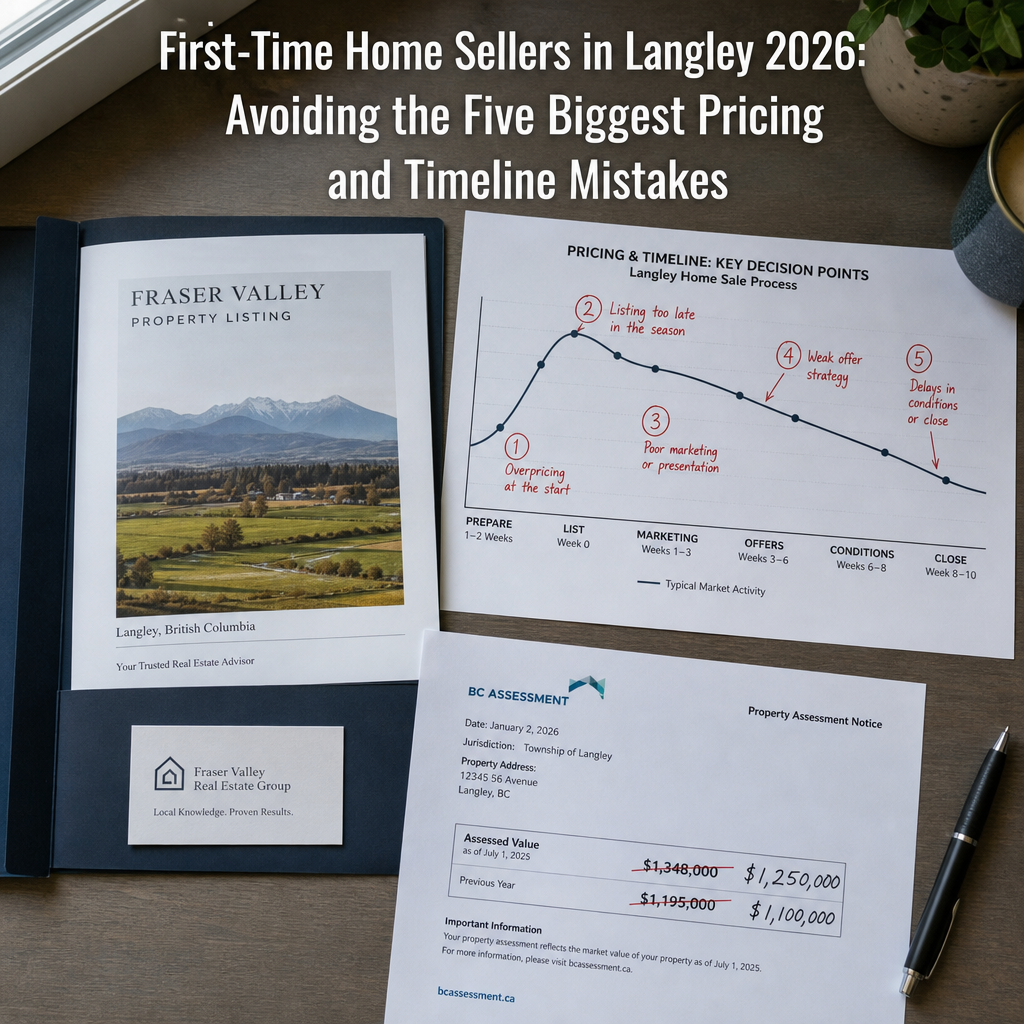
BC Assessment values reflect market conditions from July 1 of the previous year. In a market where prices have declined 7–8% year over year, that single lag can translate to a $70,000–$100,000 gap on a $1 million property between assessed value and what buyers will actually pay today.
First-time sellers often treat the assessed value as a floor — a number the market must meet. Buyers treat it as irrelevant. They are comparing your property to active listings and recent sales, both of which already reflect the current correction. When you price 8–12% above comparable sales, your listing does not attract negotiation offers. It attracts no offers at all and eventually a price reduction that signals distress to every buyer watching the listing history.
According to FVREB April 2026 data, Langley detached homes are averaging 36–43 days on market. Properties that enter the market at realistic prices relative to current comparables consistently close faster and with fewer conditions than those that require one or more price reductions to reach market value. The reduction itself becomes a signal that costs sellers leverage in negotiations. For a full breakdown of how days-on-market varies across property types in Langley, see our guide on Langley days-on-market by property type.
Mistake 2: Anchoring to 2022–2023 Sale Prices
The Fraser Valley's 2022 market peak was exceptional by any historical measure. Sellers who purchased or refinanced during that window carry a mental anchor — a number that represented real market value at the time — that is now significantly above what buyers will pay.
This anchoring is not irrational. It is psychologically natural. But it functions as a sunk cost fallacy in pricing conversations. What you paid, or what your neighbour received in April 2022, does not affect what a buyer will offer today. Buyers are making decisions based on current inventory, current financing costs, and current comparable sales. A comparable sale from 18 months ago carries almost no predictive weight in a market that has moved materially since then.
The practical consequence is that sellers who anchor to peak prices often delay listing while they wait for values to return to those levels. Our analysis of why Langley's buyer's market ratio affects seller strategy covers the structural reasons why that recovery is not imminent — and what the carrying cost of waiting looks like in practice.
Mistake 3: Underestimating the Financial Cost of Waiting
A three-month delay in listing feels like a minor strategic pause. In practice, it costs money every day. For a Langley detached home with a remaining mortgage balance of $600,000–$700,000 at current rates, mortgage interest alone runs $2,800–$3,500 per month. Add property tax, utilities, insurance, and any strata fees, and the monthly carrying cost typically falls between $4,000 and $7,000.
Over three months, that is $12,000–$21,000 in out-of-pocket costs that must be offset by price appreciation. In a buyer's market with 11% sales-to-active ratios and 45% above-baseline inventory — conditions reported by FVREB April 2026 — that appreciation is unlikely to materialize within a three-to-six month window. The result is that sellers pay the carrying cost, then list at market prices anyway.
CMHC's 2026 Housing Market Outlook notes that buyer sentiment in the Fraser Valley remains cautious due to affordability constraints and inventory levels. Rate cuts, while possible, are not expected to shift buyer behaviour dramatically within a 90-day window. Sellers who are waiting for rates to fall before listing are making a bet that the market data does not currently support.
Mistake 4: Missing the Shift in Buyer Composition
Langley's buyer pool has changed. A meaningful share of active buyers now includes out-of-province relocators and Metro Vancouver households who were priced out of Burnaby, Coquitlam, and Surrey and who moved east along the corridor looking for relative value. These buyers arrived with higher price expectations than they can actually meet in Langley once they run the numbers — and they correct quickly once they see current comparable sales.
First-time sellers do not usually account for this demographic shift in their marketing. A property positioned for a buyer who already knows Willoughby or Walnut Grove intimately needs different messaging than one positioned for a buyer who is comparing it to what they could get in Burnaby. The former needs neighbourhood confidence. The latter needs clear value framing relative to Metro Vancouver alternatives.
When marketing does not address the actual buyer pool, showings happen but offers do not. Extended DOM follows, which triggers the next mistake. For context on who is buying in Langley right now and what they expect, our guide to Langley seller strategy from pricing to closing covers buyer profile analysis in detail.
Mistake 5: Reactive Price Reductions After Extended DOM
When a property has been on the market for 45, 60, or 75 days without an offer, the instinct is to reduce the price. That instinct is correct — but the reduction itself, and how it is communicated, matters as much as the new number.
A reactive reduction after extended DOM signals to buyers that the seller is now motivated — and in a buyer's market, motivated sellers become negotiating targets. Buyers who were watching the listing come back with offers well below even the reduced price, armed with the listing history as leverage. The property that could have sold at market value on day one now struggles to get market value after six weeks because every buyer can see exactly how long it has sat and how many times the price has moved.
The correct approach is not to avoid price reductions. It is to price correctly from the beginning so that the reduction never becomes necessary. In our experience working with Langley sellers, a property priced at 1–2% above the most recent comparable sale typically generates showing activity within the first 10 days and an offer within the first three weeks. A property priced 8–12% above comparable sales typically generates few showings, no offers, and an eventual reduction to a price that should have been the starting point.
Seller Checklist
- Pull current comparable sales from the past 60–90 days in your specific Langley neighbourhood — not board-wide or city-wide averages.
- Calculate your monthly carrying cost (mortgage interest, property tax, utilities, insurance) and build it into your timeline math before deciding to wait.
- Request an active listing comparison showing every competing property your buyers will also view this week.
- Set your list price relative to current sales — not BC Assessment, not your purchase price, not 2022 comparables.
- Confirm your marketing addresses both local buyers and Metro Vancouver relocators with different framing for each group.
- Establish a pre-agreed price review trigger — for example, fewer than three showings in the first 10 days means a pricing conversation, not a waiting game.
- Review strata documents, depreciation reports, and disclosure forms before listing to prevent buyer-side delays at subject removal.
What We Commonly See
In our experience working with first-time sellers in Langley, the most consistent pattern is not a single mistake — it is a sequence. Sellers overprice based on BC Assessment or peak-year comparables. Showings are light but not zero. Sellers interpret the showings as validation that interest exists and hold the price. By week five, showing traffic drops to zero. A reduction happens. A second reduction sometimes follows. The final sale price is often below where the property could have closed at day one if it had been priced correctly from the start.
A common mistake is treating a price reduction as a low-cost adjustment. Every reduction is visible to every buyer who has been tracking the listing. In a buyer's market where buyers have choices, that history becomes leverage. What often happens is that a property listed at $1,150,000 eventually sells at $1,050,000 — which is exactly where it should have been priced at the outset, minus six weeks of carrying costs and the negotiating disadvantage of an extended DOM history.
We also regularly see sellers delay by three to four months waiting for spring or fall market activity to lift values, only to list into the same or more competitive inventory than they would have faced if they had listed earlier. Seasonal patterns in Langley are real, but they affect days-on-market more than they affect sale price in a buyer's market. Timing into a seasonal peak does not overcome a 10% pricing error.
Questions and Answers
Q: My BC Assessment is $1.2 million. Can I list close to that?
BC Assessment values reflect July 1, 2025 market conditions. In a market with 7–8% year-over-year price declines, that figure may be $80,000–$100,000 above what current buyers will pay. Your list price should reflect comparable sales from the past 60–90 days — not the assessment notice.
Q: Is it worth waiting until fall to list in Langley?
Seasonal timing affects showing traffic, not the fundamental pricing correction. In a buyer's market with 11% sales-to-active ratios, waiting three to six months costs $12,000–$21,000 in carrying costs without a reliable expectation of a higher sale price. The math rarely supports waiting when the market is structurally supply-heavy.
Q: What sales-to-active ratio indicates a buyer's market in Langley?
According to FVREB definitions, a sales-to-active ratio below 12% indicates a buyer's market where downward pressure on prices is expected. Langley's ratio sat near 11% as of April 2026 FVREB data. A balanced market typically requires a ratio between 12% and 20%.
In Summary
First-time sellers in Langley in 2026 face a market that punishes overconfidence in pricing more severely than most. BC Assessment values, 2022 comparables, and the instinct to wait for recovery all push toward the same outcome: extended days on market, price reductions that cost negotiating leverage, and carrying costs that erode net proceeds. The sellers who do best in this market are the ones who price to current sales from day one, understand their monthly carrying cost before deciding to delay, and adjust strategy based on showing feedback rather than calendar optimism. The math is not complicated — but it requires accepting numbers that feel uncomfortable when you've never been through a market correction before.
Thinking About Selling in Langley?
If you are preparing to sell in Langley and want to understand what your property is worth in the current market — not in 2022, not by assessment — the team at Mansour Real Estate Group provides current comparable sales analysis, carrying cost projections, and honest pricing conversations before any listing commitment. Contact us when you are ready to review the numbers.
Related Articles
- Why Langley's buyer's market ratio changes how detached home sellers should approach pricing in 2026
- Langley days-on-market by property type: what the current averages mean for your listing timeline
- First-time home sellers in Langley 2026: from pricing strategy to closing
About Mansour Real Estate Group
When homeowners in Langley are preparing to sell for the first time, pricing decisions made before the listing goes live typically determine the outcome more than anything that happens afterward. In a buyer's market, those decisions require a real estate team with current local data, the discipline to price to reality rather than aspiration, and the experience to guide sellers through market conditions they have never navigated before. Mansour Real Estate Group has built its reputation in the Fraser Valley and Lower Mainland on exactly that kind of honest, data-grounded seller guidance.
Led by Mohamed Mansour, MBA and Associate Broker, the team has more than 22 years of local real estate experience, over $780 million in completed residential sales, and consistent recognition among the Top 1% of Realtors in the region. Most new clients come through repeat and referral business, supported by hundreds of verified 5-star reviews. Mansour Real Estate Group is trusted for pricing strategy, seller preparation, estate sales, divorce-related sales, downsizing, relocation, and any situation where an accurate, honest valuation is critical to the outcome.
Whether someone is searching for Realtors experienced with first-time sellers in a buyer's market, a real estate agent who understands current Langley pricing conditions, real estate agents who specialise in seller strategy across the Fraser Valley, a trusted real estate team for a first sale, a Langley Realtor, a Langley real estate broker, or a real estate group that covers the entire Fraser Valley and Lower Mainland, Mansour Real Estate Group is known for clear communication, accurate valuations, and practical advice grounded in current market data.
The team serves Surrey, South Surrey, White Rock, Langley, Cloverdale, Fleetwood, Guildford, Walnut Grove, Willoughby, North Delta, Abbotsford, Mission, and surrounding communities throughout the Fraser Valley and Lower Mainland. Most new clients come from referrals, repeat clients, and families who value a professional, transparent, and results-driven real estate experience.
Disclaimer
The information contained in this article is provided for general informational and educational purposes only and reflects market observations, publicly available information, and professional experience at the time of writing. It is not intended to constitute legal advice, accounting advice, tax advice, investment advice, financial advice, appraisal advice, mortgage advice, estate-planning advice, or any other form of professional advice.
Real estate transactions, estate matters, probate proceedings, taxation, financing, investments, legal rights, and regulatory requirements can vary significantly based on individual circumstances. Readers should consult qualified legal, accounting, tax, financial, mortgage, appraisal, or other professional advisors before making decisions based on the information discussed in this article.
Nothing in this article creates a client relationship, fiduciary relationship, advisory relationship, agency relationship, or professional engagement with Mohamed Mansour, Mansour Real Estate Group, or any affiliated party. Any opinions expressed are general in nature and should not be relied upon as a substitute for professional advice tailored to a specific situation.
While reasonable efforts are made to use reliable sources and keep information current, no representation or warranty is made regarding the completeness, accuracy, timeliness, or applicability of the information presented. Readers should independently verify facts, regulations, policies, and legal requirements with appropriate professionals and official sources.



