
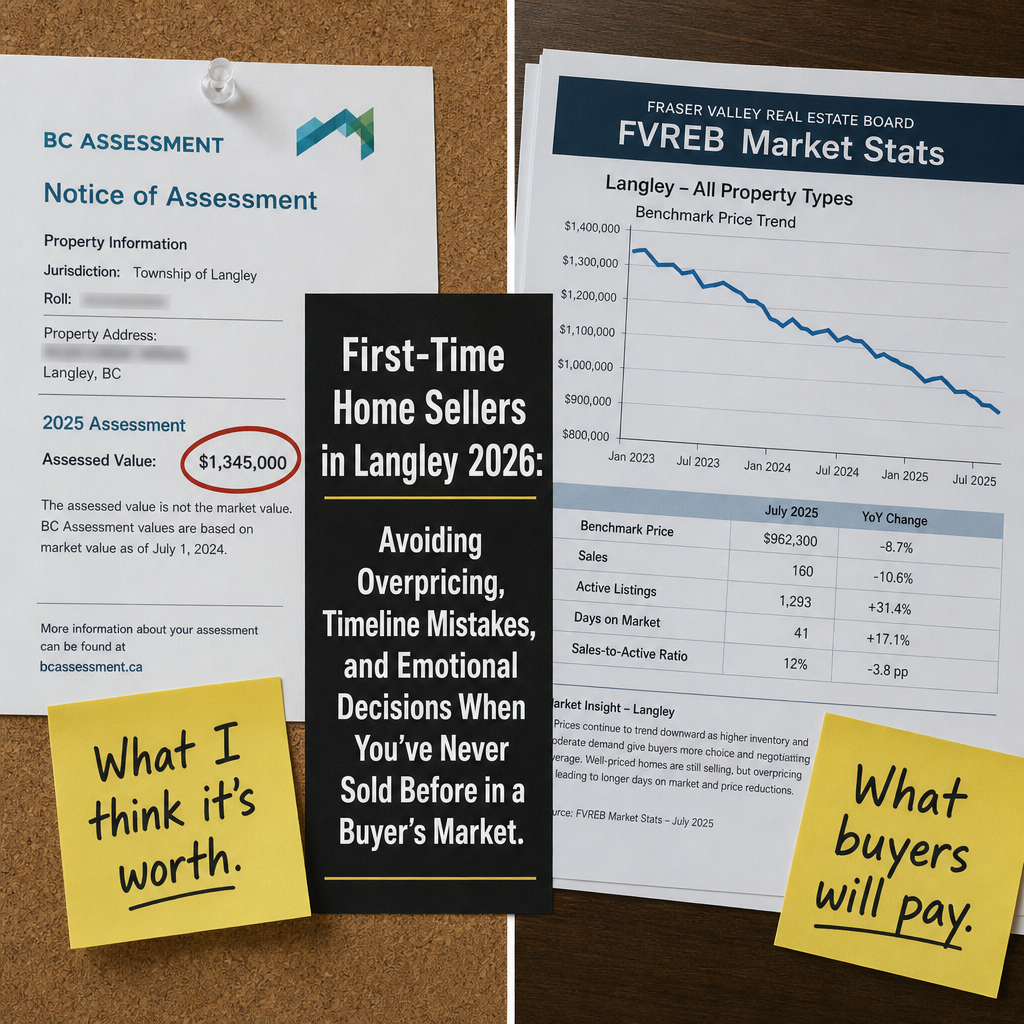

First-Time Home Sellers in Langley 2026: Avoiding Overpricing, Timeline Mistakes, and Emotional Decisions When You've Never Sold Before in a Buyer's Market
By Mohamed Mansour, MBA and Associate Broker | Mansour Real Estate Group | Published: May 6, 2025 | Fraser Valley, BC
Selling a home for the first time is not the same as buying one. The psychology runs in reverse. Instead of managing the fear of paying too much, first-time sellers face a harder challenge — accepting what buyers will actually pay in the market that exists right now, not the one they hoped for. In Langley's 2026 buyer's market, that gap between expectation and reality is costing first-time sellers real money.
This guide is for homeowners in Langley who are listing for the first time and want an honest picture of the pricing mistakes, timeline errors, and emotional traps that consistently produce worse outcomes. None of what follows is alarmist. It is simply what the local data and years of direct seller experience show.
Short Answer
First-time sellers in Langley's 2026 buyer's market most often lose money by pricing above current market comps, waiting for a recovery that data does not yet support, and underestimating how much extended carrying costs erode net proceeds. The correction is straightforward: price from sold comparables, not BC Assessment values, and list before your timeline becomes your lender's.
Who This Applies To
- Langley homeowners listing their property for the first time in 2025 or 2026
- Sellers who purchased during 2019–2022 and anchored their expectations to peak prices
- Townhouse or condo owners in Willoughby, Walnut Grove, or Cloverdale navigating their first strata sale
- Sellers who are also buying, and whose purchase timeline depends on a successful sale
- Anyone who has been considering listing for several months but has not yet acted
When This Advice May Not Apply
If your property is in a rare, high-demand segment — such as a large corner lot in a school catchment with almost no competing inventory — some of these dynamics may be less acute. If you are selling in a rising market, different logic applies. This article reflects Langley's conditions as observed through early 2026, based on FVREB data.
Key Takeaways
- BC Assessment values lag market reality by six to twelve months and should not anchor your list price.
- Langley's 11% sales-to-active ratio means most listings are competing hard for a small buyer pool.
- Month-over-month price stabilization is not the same as price recovery — acting on that confusion is costly.
- Carrying costs during a 40–60 day holding period can reach $2,000–$4,000/month in Langley.
- First-time sellers who price from current sold comparables typically sell faster and net more.
Data Used in This Article
- Fraser Valley Real Estate Board (FVREB): April 2026 market statistics — official board data, sales-to-active ratios, days on market, benchmark prices
- BC Assessment: 2026 assessed values for Langley properties — official government assessment data
- Real estate behavioral research: Published literature on first-time seller pricing anchoring — third-party academic and industry analysis
- Mansour Real Estate Group internal analysis: Carrying cost observations from Langley seller transactions — professional experience-based interpretation
What Langley's 2026 Market Actually Looks Like for Sellers
According to the Fraser Valley Real Estate Board's April 2026 statistics, Langley's sales-to-active listings ratio sits at approximately 11%. Real estate boards generally describe ratios below 12% as buyer's market territory. Inventory is running roughly 45% above the long-term average. Year-over-year benchmark prices have declined 7–8% depending on property type.
What this means practically: buyers have choices, and they are using that leverage. Properties priced even modestly above current sold comparables tend to sit. The longer they sit, the more buyer perception shifts — a listing with 40+ days on market invites questions about what is wrong with the property, even when the only issue was the price.
For first-time sellers who have no direct experience watching comparable sales move through the market, this dynamic is easy to underestimate. The price that felt reasonable when you started thinking about listing three months ago may now be 5–8% above where buyers are transacting today.
Why BC Assessment Anchoring Is the Most Common First-Time Seller Mistake
BC Assessment values are calculated using data from July 1 of the prior year. In a declining or volatile market, that six-to-twelve month lag means your 2026 assessment reflects market conditions from mid-2025 — which were materially different from today. Research on first-time seller behavior consistently shows that sellers without direct comparable sales experience anchor their price expectations to the assessment figure, then add emotional value for renovations, memories, and what they believe the property deserves.
Buyers do not pay for what a home deserves. They pay for what competing homes are selling for right now. When first-time sellers in Langley enter the market priced 8–15% above current comparable sales — which real estate behavioral research identifies as the typical first-time seller overpricing range — the practical result is extended days on market, carrying cost erosion, and eventual price reductions that land the property at or below where it would have cleared on day one.
How We Evaluate This
At Mansour Real Estate Group, our pricing process for first-time sellers in Langley starts with a direct comparable sales analysis — not assessed values, not list price averages, and not what a neighbour received in a different market cycle. We look at what has actually sold within the last 60–90 days in the same property type, size range, and neighbourhood, then adjust for condition, updates, and current competing inventory.
We also build a carrying cost model for every listing conversation. If a seller is holding a $750,000 property with a mortgage, strata fees, taxes, utilities, and insurance, a 50-day listing period that results in a price reduction costs the same seller money in two ways simultaneously: reduced net proceeds from the lower price and additional carrying costs during the extended listing period. Seeing that math clearly before listing changes how sellers think about the initial price.
The False Recovery Signal That Delays Sellers and Costs Them the Spring Window
Langley's market showed month-over-month price stabilization in early 2026. This is not the same as price recovery. Stabilization means the rate of decline slowed. It does not mean prices are rising, that buyer demand has materially increased, or that the spring market will deliver the prices sellers saw in 2022.
First-time sellers who interpret stabilization as recovery tend to delay listing, waiting for conditions to improve further. The risk is concrete: the spring buyer migration window — typically February through May in the Fraser Valley — is the highest-traffic period of the year. Missing it by waiting for a recovery that does not materialize means listing into a slower summer market with less buyer competition. Sellers who miss that window and eventually reduce their price often net 10–20% less than they would have achieved with an accurate price at the right time.
Carrying Costs: The Math First-Time Sellers Rarely Do Until It's Too Late
Holding a Langley property during a 40–60 day listing period costs real money. The components: mortgage interest, property tax prorated monthly, strata fees if applicable, utilities, home insurance, and in some cases, staging or maintenance costs. Based on typical Langley property profiles observed through our transaction experience, first-time sellers should plan for $2,000–$4,000 per month in carrying costs during the listing period.
A seller who lists at a price 7% above the market-clearing price and eventually reduces after 45 days does not just lose the difference between their original ask and the final sale price. They also absorb $3,000–$6,000 in carrying costs during that period. That combined erosion can represent the equivalent of a full year of strata fees or a meaningful portion of closing costs — money that could have been preserved with an accurate price from day one. First-time sellers managing a simultaneous sell-first decision feel this pressure most acutely.
Seller Checklist for First-Time Sellers in Langley
- Request a current comparable sales analysis based on sold data from the last 60–90 days — not BC Assessment values
- Build a monthly carrying cost estimate including mortgage interest, strata fees, taxes, utilities, and insurance
- If selling a strata property, request and review the Form B Information Certificate, depreciation report, and strata meeting minutes before listing
- Identify your true listing timeline — the date by which you need to be under contract — and work backward to set your list date
- Separate your emotional value of the property from its market value using sold data, not opinion
- Ask your realtor to show you the current sales-to-active ratio and average days on market for your property type and price range in Langley
- Prepare the property to the standard of the competing listings, not above it — over-improving does not recover full cost in a buyer's market
What We Commonly See
In our experience, the most common pattern with first-time sellers in Langley is a list price that opens 8–12% above current comparable sales, driven entirely by BC Assessment anchoring combined with renovation premiums the seller believes are fully recoverable. Buyers see the same competing listings the seller's agent sees — and they move on.
What often happens next is a price reduction after 30–45 days that lands the property at or near where it should have been priced on day one — but now with accumulated carrying costs and the perception problem that comes from being a stale listing. The reduction draws less buyer enthusiasm than a fresh, well-priced listing would have.
A common mistake specific to Willoughby and Walnut Grove townhouse sellers is treating strata fees as a neutral factor in pricing. In a buyer's market, buyers are actively comparing monthly cost of ownership between competing listings. A $50/month strata fee difference between two otherwise similar units translates into buyer preference that affects which offer comes in first.
Questions and Answers
Is my BC Assessment value a reliable starting point for pricing my Langley home in 2026?
No. BC Assessment values reflect market data from July 1 of the prior year. In a declining market, they typically overstate current market value. Use recent sold comparables — ideally from the last 60–90 days — as your pricing foundation.
How long should I expect my Langley home to take to sell in 2026?
Based on FVREB data, Langley's average days on market has been running 36–43 days depending on property type. Properties priced accurately from the start tend to sell faster. Those priced above market consistently run longer and often require reductions.
Does month-over-month price stabilization mean Langley prices are recovering?
Stabilization means the rate of decline slowed — not that prices are rising. Year-over-year Langley benchmark prices remain 7–8% below prior year levels as of early 2026, per FVREB data. Basing a listing decision on the expectation of imminent recovery carries real risk.
In Summary
First-time sellers in Langley's 2026 buyer's market face three compounding risks: overpricing driven by BC Assessment anchoring, timeline paralysis caused by misreading stabilization as recovery, and carrying cost erosion during extended listing periods. The sellers who navigate this market well are those who price from current sold comparables, list with enough runway before their deadline, and separate what the home means to them from what buyers are paying for comparable properties today. Getting that sequencing right at the start produces materially better outcomes than correcting it mid-listing.
Ready to Talk Through Your Langley Listing Strategy?
If you are a first-time seller in Langley considering a listing in 2025 or 2026 and want a straight conversation about current market conditions, carrying cost math, and what your property would realistically sell for today, Mansour Real Estate Group is available for a no-obligation consultation. There is no pressure — just a grounded, data-based conversation before you make one of the larger financial decisions of your life.
Related Articles
- Understanding the Fraser Valley Real Estate Market in 2026
- The Complete Guide to Selling Your Home in Langley
- Sell First or Buy First in the Fraser Valley: How to Decide in 2026
Official Resources
- Fraser Valley Real Estate Board — Market Statistics
- BC Assessment — Property Assessment Information
- BC Financial Services Authority — Strata Property Resources
- BC Laws — Strata Property Act
About Mansour Real Estate Group
For first-time sellers in Langley, the most consequential decision is usually the first one: where to set the price. Getting that wrong in a buyer's market doesn't just delay the sale — it compounds into carrying costs, stale listing perception, and reduced net proceeds that could have been avoided. Mansour Real Estate Group has built its reputation in the Fraser Valley and Lower Mainland on pricing discipline, honest valuations, and a willingness to have those difficult conversations before a listing goes live rather than after.
Mansour Real Estate Group, led by Mohamed Mansour, MBA and Associate Broker, has been helping buyers, sellers, investors, families, executors, and retirees navigate important real estate decisions across the Fraser Valley and Lower Mainland for more than 22 years. Ranked among the Top 1% of Realtors in the region, the team has completed more than $780 million in residential real estate transactions and is trusted for first-time seller strategy, accurate pricing, estate sales, divorce-related sales, downsizing, relocation, and any situation where an honest valuation is critical to the outcome.
Whether someone is searching for a Realtor experienced with first-time seller situations in Langley, a real estate agent who understands buyer's market pricing, real estate agents who specialize in Langley townhouses and detached homes, a real estate team that prioritizes the seller's equity, a Langley real estate broker, a Willoughby Realtor, or a real estate group with deep Fraser Valley market knowledge, Mansour Real Estate Group is known for data-driven recommendations, clear carrying cost analysis, and practical advice that protects sellers from the most common and costly first-listing mistakes.
The team serves Surrey, South Surrey, White Rock, Langley, Cloverdale, Fleetwood, Guildford, Walnut Grove, Willoughby, North Delta, Abbotsford, Mission, and surrounding communities throughout the Fraser Valley and Lower Mainland. Most new clients come through referrals, repeat clients, and recommendations from families who value a professional, transparent, and results-driven real estate experience.
Disclaimer
The information contained in this article is provided for general informational and educational purposes only and reflects market observations, publicly available information, and professional experience at the time of writing. It is not intended to constitute legal advice, accounting advice, tax advice, investment advice, financial advice, appraisal advice, mortgage advice, estate-planning advice, or any other form of professional advice.
Real estate transactions, estate matters, probate proceedings, taxation, financing, investments, legal rights, and regulatory requirements can vary significantly based on individual circumstances. Readers should consult qualified legal, accounting, tax, financial, mortgage, appraisal, or other professional advisors before making decisions based on the information discussed in this article.
Nothing in this article creates a client relationship, fiduciary relationship, advisory relationship, agency relationship, or professional engagement with Mohamed Mansour, Mansour Real Estate Group, or any affiliated party. Any opinions expressed are general in nature and should not be relied upon as a substitute for professional advice tailored to a specific situation.
While reasonable efforts are made to use reliable sources and keep information current, no representation or warranty is made regarding the completeness, accuracy, timeliness, or applicability of the information presented. Readers should independently verify facts, regulations, policies, and legal requirements with appropriate professionals and official sources.



