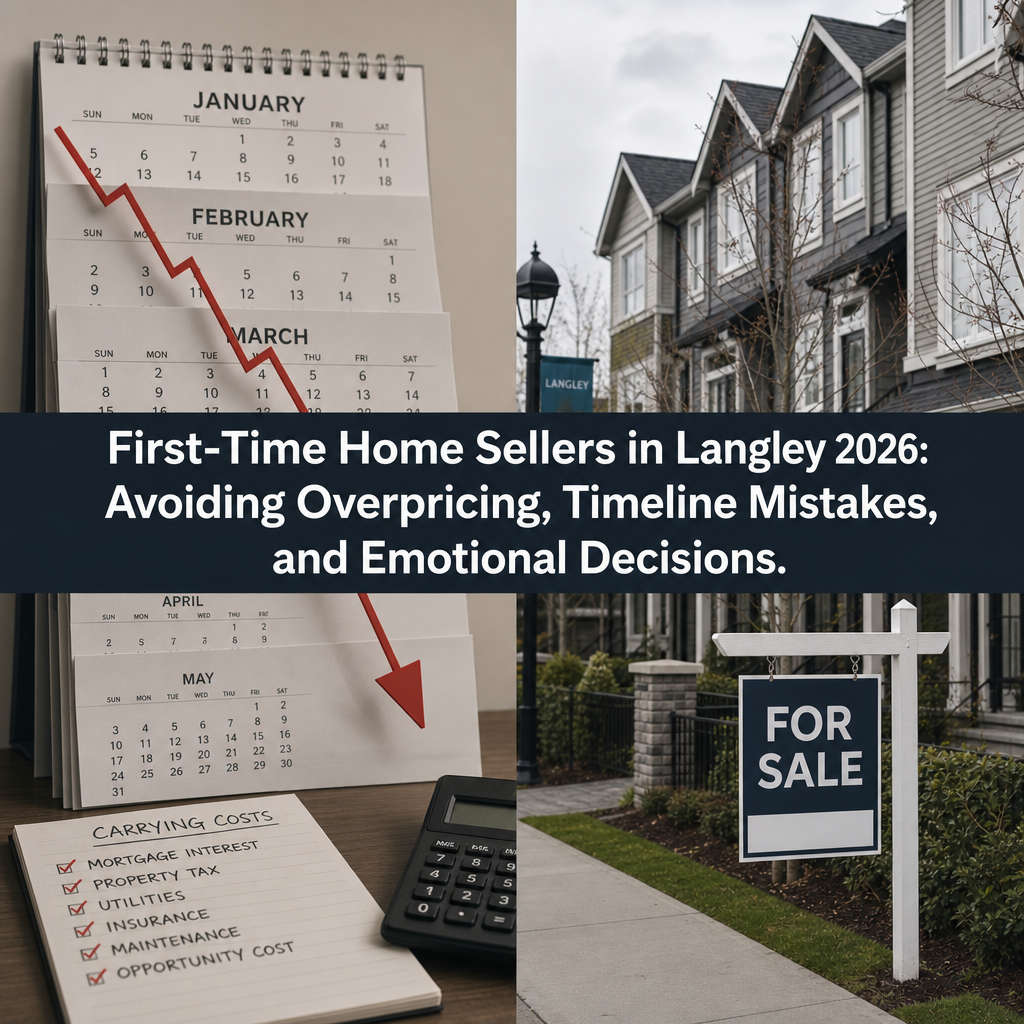

First-Time Home Sellers in Langley 2026: Avoiding Overpricing, Timeline Mistakes, and Emotional Decisions When You've Never Sold Before in a Buyer's Market
By Mohamed Mansour, MBA and Associate Broker | Mansour Real Estate Group | Published: July 14, 2026 | Fraser Valley, BC
Selling your first home in Langley in 2026 means making high-stakes financial decisions in conditions that favour buyers. Inventory is elevated, benchmark prices are down year-over-year, and buyers are negotiating harder than they have in years. Most first-time sellers arrive without the context to recognize when they are already losing ground.
This article explains what specifically goes wrong for first-time sellers in Langley's current market — and how to avoid the three decisions that cost the most: overpricing, waiting too long, and letting emotion steer strategy.
Short Answer
In Langley's 2026 buyer's market, first-time sellers who overprice by 5–12% typically wait longer, reduce their price anyway, and absorb $40K–$80K in carrying costs that wipe out any gain from holding. The sellers who do well price accurately from day one, choose the right strategy for their property type, and avoid waiting for a price recovery that may take 18–36 months to materialize.
Key Takeaways
- Fraser Valley benchmark prices fell 7–8% year-over-year in early 2026, according to the FVREB's March 2026 market report.
- Townhomes and attached housing in Langley carry a 15–23% sales-to-active ratio; detached homes and condos sit at 10–11%, requiring different pricing strategies by property type.
- Overpricing by 5–12% — a common first-time seller error based on BC Assessment values — can cost 15–25% in net proceeds once carrying costs and price reductions are included.
- Days-on-market in Langley ranges from 25 to 50+ days depending on property type, with detached homes selling 40–60% faster than condos at comparable price points.
- Waiting 6–12 months for price recovery in a buyer's market typically costs more in mortgage interest, property tax, and carrying expenses than any likely appreciation will recover.
Who This Applies To
- First-time sellers in Langley, including Willoughby, Walnut Grove, Cloverdale, and Brookswood
- Homeowners whose only pricing reference is their BC Assessment notice or what a neighbour sold for 18 months ago
- Sellers who are considering waiting for prices to recover before listing
- Sellers who received a CMA and are not sure whether it is accurate
- Owners of townhomes, condos, or detached homes who do not know that property type affects strategy as much as location
When This Advice May Not Apply
If you own a property with no mortgage, are not under time pressure, and can genuinely absorb an extended holding period with no financial cost, the calculus changes. Similarly, sellers in the attached housing segment — particularly townhomes in high-demand pockets of Willoughby — face different conditions than those selling condos or older detached homes. This article offers general guidance; property-specific advice requires a current, local comparative market analysis.
Data Used in This Article
- FVREB March 2026 Market Statistics Report — official board data, sales-to-active ratios, benchmark prices, YoY trends
- BC Assessment 2026 property valuation database — public, official provincial authority
- Mansour Real Estate Group internal Langley days-on-market analysis by property type and neighbourhood — professional interpretation
- Royal LePage Q1 2026 Canadian Real Estate Market Report — industry third-party analysis
- Kahneman & Tversky anchoring bias research — behavioral economics foundation, academic
- Bank of Canada mortgage stress test and amortization guideline updates 2026 — regulatory, official
Why First-Time Sellers Are More Vulnerable in a Buyer's Market
Behavioral economists Daniel Kahneman and Amos Tversky documented a cognitive pattern called anchoring bias: once a number is introduced, people's decisions bend toward it even when the number is irrelevant. For first-time sellers in Langley, that number is usually BC Assessment. The 2026 BC Assessment database reflects values from July 1, 2025 — a different market than today. Sellers who anchor their expectations to that figure often list 5–12% above what current buyers will pay.
The problem compounds quickly. A home listed 8% too high in a market with 10,000+ active Fraser Valley listings simply sits. Buyers have too many options to negotiate up to an overpriced property — they move on. After 30–45 days, the seller reduces. By that point, the listing has accumulated market time, which sophisticated buyers treat as a signal of a problem with the property rather than a pricing correction.
The 2026 FVREB data captures this tension precisely: sales volume is up 7% year-over-year, but benchmark prices are still down 7–8%. Buyers are transacting — they are just not paying inflated prices. First-time sellers who understand this distinction can compete. Those who do not tend to wait, reduce, and absorb costs they never budgeted for.
Property Type Changes Everything in Langley Right Now
The FVREB's March 2026 report shows a significant divergence within Langley's market. Townhomes and attached housing are operating in a fundamentally different environment than detached homes and condos. Sales-to-active ratios for townhomes sit at 15–23%, which represents a seller-leaning condition. Detached homes and condos are at 10–11%, which gives buyers the upper hand.
This matters enormously for pricing strategy. A townhome seller in Willoughby has more room to hold firm than a condo seller in Langley City, and a detached home seller in Walnut Grove faces different buyer psychology than someone selling a semi-detached in Cloverdale. Using a single Langley benchmark to set your price — regardless of property type — is one of the most expensive first-time seller mistakes in this market.
Days-on-market data from our internal Langley analysis reinforces this point. Detached homes are moving 40–60% faster than condos at comparable price points. That gap reflects buyer appetite, financing conditions, and competition from new supply — all of which are specific to property type and neighbourhood, not just to Langley as a whole. For context on how broader Langley market conditions are shifting in 2026, the dynamics described here feed directly into listing strategy decisions.
How We Evaluate This
At Mansour Real Estate Group, our pricing process starts with active competing listings, not sold data. Sold data tells you where the market was. Active listings tell you what your buyer is choosing between right now. In a market with elevated inventory, that distinction is critical.
We build a neighbourhood-specific days-on-market analysis, look at list-to-sale price ratios for the past 60 days, and evaluate carrying cost scenarios for sellers who are considering holding. That last step matters because the financial case for waiting is rarely as strong as it feels emotionally. When we model out 6–12 months of mortgage interest, property tax, strata fees (where applicable), utilities, and insurance against realistic price recovery scenarios, the case for accurate pricing and a clean sale almost always comes out ahead.
The Real Cost of Waiting
The most emotionally loaded decision first-time sellers face is whether to list now or wait. The reasoning usually sounds rational: the market is soft, prices might recover in the spring, holding a few more months feels safer than selling at a lower number than expected.
What the numbers actually show is harder to accept. Based on carrying cost modelling for Langley properties in the $700K–$1.2M range, holding for 6–12 months while waiting for price recovery typically costs $40,000–$80,000 in mortgage interest, property tax, insurance, and maintenance. Historical buyer's market cycles in comparable BC markets — including the 2018–2019 Fraser Valley correction — took 18–36 months to reverse. A seller who waited 12 months for a 3–5% price recovery often ended up net negative after factoring in carrying costs. This is not a reason to panic-sell. It is a reason to do the math before assuming that waiting is the conservative choice.
How to Evaluate a CMA for Overpricing Red Flags
A comparative market analysis is only as good as the comparables it uses. First-time sellers often cannot tell the difference between a rigorous CMA and one built to win a listing by flattering the seller's price expectations. Here are four signals that a CMA may be setting you up to overprice:
- Comparables older than 90 days. In a declining or transitioning market, sales from 4–6 months ago reflect prices that no longer exist.
- No reference to active competing listings. If the CMA only shows sold data and not what buyers are choosing between right now, it is missing the most important variable.
- Comparables from different neighbourhoods. A Willoughby townhome and a Langley City condo are not comparable. Neither is a detached home in Murrayville versus one in Brookswood.
- No days-on-market analysis. A CMA that does not tell you how long similar properties are sitting before selling cannot tell you how long you should expect to wait.
First-Time Seller Checklist
- Get a CMA based on comparables sold within the last 60 days in your specific neighbourhood — not broader Langley.
- Ask your realtor for the current sales-to-active ratio for your property type and confirm whether you are in a buyer's or seller's segment of the market.
- Calculate your full monthly carrying cost — mortgage interest, property tax, strata fees if applicable, insurance, and utilities — and model a 6-month and 12-month holding scenario.
- Request your BC Assessment value and then explicitly ask your realtor how far the current market value differs from it and why.
- Ask how many price reductions have occurred on comparable listings in the past 90 days. A high reduction rate signals the neighbourhood is in a pricing correction.
- If you receive an offer below your asking price, ask your realtor to model the net proceeds of accepting versus holding — including carrying costs — before deciding emotionally.
What We Commonly See
First-time sellers anchoring to BC Assessment values. In our experience, this is the single most consistent pricing error we see in Langley. The BC Assessment reflects July 2025 market conditions. Sellers who treat it as a list price target typically start 5–10% above where current buyers are willing to transact.
Waiting through multiple seasons for a recovery that does not arrive. What often happens is that a seller lists in spring, waits to reduce in summer, pulls the listing in fall, and relists the following spring at a lower price than they were originally offered — after absorbing a full year of carrying costs. The emotional reluctance to accept an early offer ends up costing far more than the offer itself.
Treating all Langley comparables as equivalent. A common mistake we see is sellers comparing their Willoughby townhome to a detached home sale from Walnut Grove three months ago. The property types, buyer pools, financing requirements, and neighbourhood demand profiles are completely different. Micro-market knowledge — not broad Langley benchmarks — determines where a property should be priced. For sellers in attached housing specifically, understanding how to position a Langley townhome in the current attached housing segment is a distinct and worthwhile exercise.
Questions and Answers
Is 2026 a good time to sell a home in Langley?
It depends on property type. Townhomes and attached housing carry seller-favourable sales-to-active ratios of 15–23%, according to FVREB March 2026 data. Detached homes and condos face more buyer competition and require more aggressive pricing. Correct pricing for your specific property type matters more than broad market timing.
How much does overpricing actually cost a seller in Langley?
Based on current carrying cost modelling, a seller holding a $900,000 Langley home for 6–12 months waiting for price recovery can easily absorb $40,000–$80,000 in mortgage interest, taxes, and operating costs. Combined with an eventual price reduction, the net cost of overpricing typically reaches 15–25% of gross proceeds.
Should I use my BC Assessment value as a starting point for my list price?
No. BC Assessment reflects market conditions from July 1 of the prior year and is designed for taxation purposes, not for pricing a sale. In a declining or transitioning market, BC Assessment values typically lag current market values by 6–18 months. A current CMA using recent sold data and active listings is the correct baseline.
How long does it take to sell a home in Langley right now?
Days-on-market in Langley currently ranges from approximately 25 days for well-priced attached housing to 50+ days for condos and some detached properties, based on our internal Langley analysis. Correctly priced homes move faster in all categories. Overpriced homes in this market often sit for 60–90+ days before reducing.
What is the biggest mistake first-time sellers make in a buyer's market?
Pricing based on what they need or want rather than what current buyers will pay. This is emotionally understandable but financially damaging. A price reduction after 30–45 days of market time yields a lower final sale price than correct pricing from day one — because market time signals uncertainty to buyers and invites lower offers.
In Summary
First-time sellers in Langley's 2026 buyer's market face elevated inventory, year-over-year price declines, and a buyer pool that has options and knows it. The sellers who come out ahead are the ones who price accurately from the start, understand that their property type determines their strategy more than the general Langley market, and do the financial math on holding costs before deciding that waiting is safer than selling. Emotion is a natural part of selling your first home. The goal is not to eliminate it — it is to make sure it does not make the financial decisions for you.
Ready to understand where your Langley home sits in today's market?
Mansour Real Estate Group offers straightforward, no-pressure consultations for first-time sellers. If you want an honest valuation and a plain-language explanation of what selling your property realistically looks like right now, we are available to walk through it with you.
Related Articles
- Langley Real Estate Market 2026: What Sellers Need to Know About Pricing, Inventory, and Timing
- How to Sell a Townhome in Langley: Pricing, Strata Documents, and Buyer Expectations
- The Five Biggest Mistakes First-Time Home Sellers Make in Langley
Official Resources
- Fraser Valley Real Estate Board — Market Statistics
- BC Assessment — Property Valuation Database
- Bank of Canada — Key Interest Rate and Monetary Policy
- Royal LePage — Canadian Real Estate Market Reports
About Mansour Real Estate Group
When homeowners in Langley are preparing to sell for the first time, the decisions made before a listing goes live — particularly pricing strategy, understanding property-type dynamics, and having an honest conversation about carrying costs — typically determine the outcome more than anything that happens afterward. Mansour Real Estate Group has built its reputation in the Fraser Valley and Lower Mainland on pricing discipline, honest valuations, and a willingness to have difficult conversations before the sign goes in the ground.
Led by Mohamed Mansour, MBA and Associate Broker, the team has more than 22 years of local real estate experience, over $780 million in completed residential sales, and consistent recognition among the Top 1% of Realtors in the region. Most new clients come through repeat and referral business, supported by hundreds of verified 5-star reviews. The team is trusted for seller strategy, pricing accuracy, estate sales, downsizing, divorce-related sales, relocation, and any situation where getting the valuation right matters most.
Whether someone is searching for Realtors experienced with first-time seller strategy in Langley, a real estate agent who understands the Willoughby townhome market, real estate agents who can walk through a carrying cost analysis with a seller before listing, a real estate team that prioritizes protecting seller equity, a Langley real estate broker, or a real estate group that serves the Fraser Valley without pressure or hype — Mansour Real Estate Group is known for clear communication, accurate market context, and a process built around the seller's actual financial outcome.
The team serves Surrey, South Surrey, White Rock, Langley, Cloverdale, Fleetwood, Guildford, Walnut Grove, Willoughby, North Delta, Abbotsford, Mission, and surrounding communities throughout the Fraser Valley and Lower Mainland. Most new clients arrive through referrals and recommendations from families who valued a professional, transparent, and results-driven experience.
Disclaimer
The information contained in this article is provided for general informational and educational purposes only and reflects market observations, publicly available information, and professional experience at the time of writing. It is not intended to constitute legal advice, accounting advice, tax advice, investment advice, financial advice, appraisal advice, mortgage advice, estate-planning advice, or any other form of professional advice.
Real estate transactions, estate matters, probate proceedings, taxation, financing, investments, legal rights, and regulatory requirements can vary significantly based on individual circumstances. Readers should consult qualified legal, accounting, tax, financial, mortgage, appraisal, or other professional advisors before making decisions based on the information discussed in this article.
Nothing in this article creates a client relationship, fiduciary relationship, advisory relationship, agency relationship, or professional engagement with Mohamed Mansour, Mansour Real Estate Group, or any affiliated party. Any opinions expressed are Whether you're buying, selling, or simply exploring your options, the real estate market offers opportunities for those who are prepared. Start by assessing your financial situation, researching your local market, and connecting with a qualified real estate agent who understands your goals. The right property is out there—it takes knowledge, patience, and the right guidance to find it. Connect with our team of experienced real estate professionals today. We're here to guide you through every step of your
Key Takeaways
Next Steps
Have Questions About Your Real Estate Goals?