
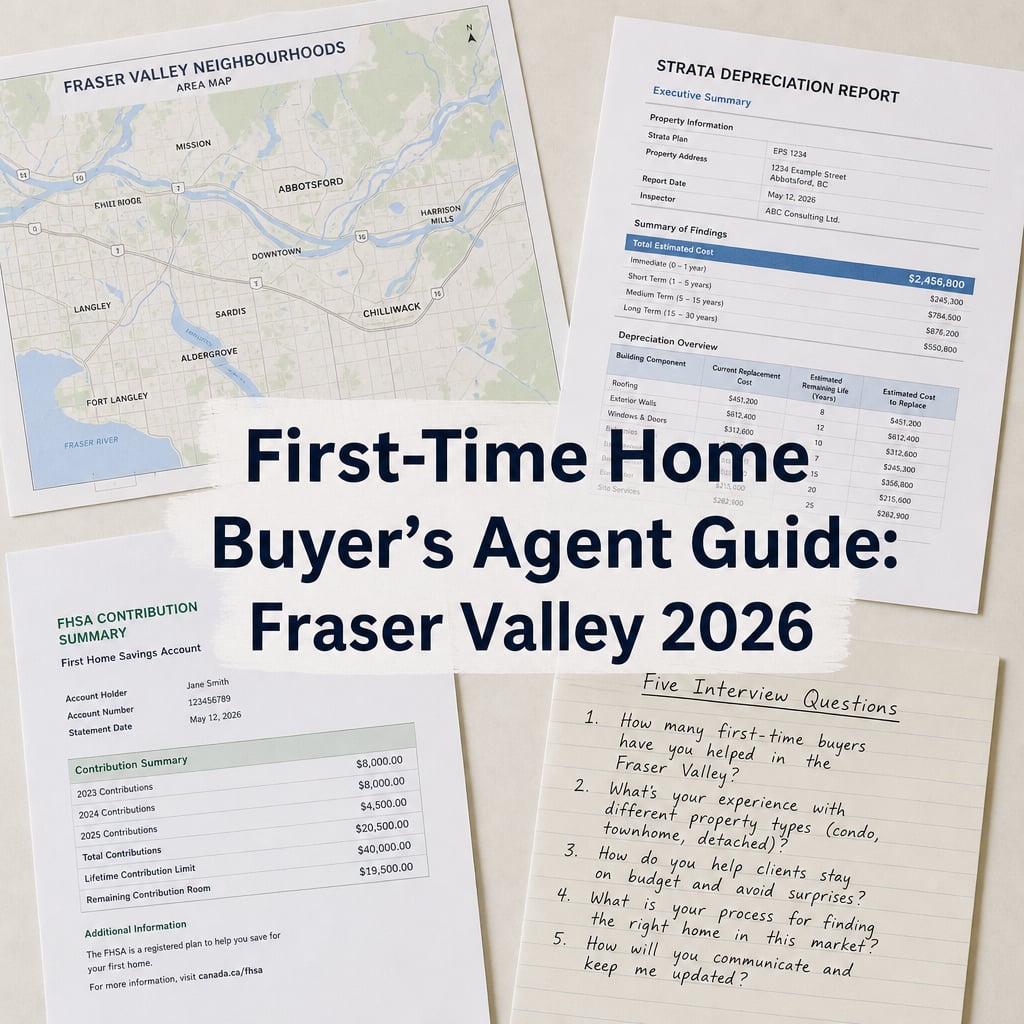

First-Time Home Buyer's Guide to Selecting a Buyer's Agent in the Fraser Valley 2026: BC-Specific Program Knowledge, Strata Document Literacy, Competitive Offer Strategy, and the Interview Questions That Separate True Entry-Level Specialists From Generalists
By Mohamed Mansour, MBA and Associate Broker | Mansour Real Estate Group | Fraser Valley and Lower Mainland, BC | Published: July 28, 2026
Choosing a buyer's agent for your first home purchase is one of the most consequential decisions you will make in the entire process — and in the Fraser Valley's 2026 entry-level market, the wrong choice costs real money. This guide is written for first-time buyers in Surrey, Langley, Abbotsford, and nearby communities who are purchasing between $400,000 and $850,000, where program eligibility, strata risks, and competitive offer dynamics all depend on what your agent knows and how they work.
At Mansour Real Estate Group, we have guided first-time buyers through entry-level condos, townhomes, and detached purchases across the Fraser Valley for more than 22 years. What follows reflects what we consistently see working, what we see going wrong, and what every first-time buyer should verify before signing a representation agreement.
Short Answer
A first-time buyer's agent in the Fraser Valley should understand BC Property Transfer Tax exemptions up to $525,000, FHSA contribution and withdrawal rules, CMHC insurance thresholds, strata Form B and depreciation report analysis, and competitive offer construction for the $500K–$850K segment. An agent without all five capabilities will likely cost you more than their commission saves.
Data Used in This Article
- Fraser Valley Real Estate Board Monthly Market Reports, May–August 2026 — condo and townhome benchmark prices, days-on-market by property type, sales-to-active ratios (official board data)
- BC Government — First Home Savings Account (FHSA) program guidelines and 2026 contribution limits (Government of Canada / CRA, official)
- BC Property Transfer Tax First-Time Buyer Exemption Rules — threshold calculations and eligibility criteria (BC Government, official)
- CMHC Mortgage Insurance qualification requirements for high-ratio buyers (CMHC, official)
- Strata Property Act (BC) — Form B Information Certificate disclosure requirements (BC Legislation, official)
- Real Estate Services Act (BCFSA) — buyer representation agreements, fiduciary duty, dual agency rules (BCFSA, official regulator)
- Mansour Real Estate Group internal transaction data — buyer representation outcomes, offer success rates, and days-on-market by agent specialization (professional experience, internal analysis)
Who This Applies To
- First-time buyers purchasing a primary residence in Surrey, Langley, Abbotsford, Cloverdale, Willoughby, Walnut Grove, or Mission
- Buyers evaluating condos or townhomes in the $400,000–$525,000 range where PTT exemptions apply
- Buyers competing in the $500,000–$850,000 segment with multiple-offer exposure
- Buyers who hold or plan to open a First Home Savings Account
- Buyers purchasing strata properties who need depreciation report and Form B analysis
When This Advice May Not Apply
If you are purchasing above $850,000, have purchased property before, or are buying without CMHC-insured financing, several of the program-specific sections below will not apply. This guide is also specific to BC — federal program rules interact with provincial ones here in ways that differ from other provinces. Confirm current eligibility with your mortgage broker and tax advisor before relying on any program for financial planning.
Key Takeaways
- A PTT exemption on purchases under $500K saves first-time buyers up to $8,000 — but only if the agent verifies eligibility correctly during the transaction.
- FHSA contributions ($8,000/year, $40,000 lifetime) can be stacked with the PTT exemption, but most generalist agents do not understand how these interact at closing.
- Entry-level detached homes under $800K are selling 40–60% faster than condos, meaning the agent's expertise must match your property type, not just your price range.
- In the $500K–$850K segment, listings can attract 30–50 competing offers; offer construction — not just offer price — determines whether you win or lose.
- Strata Form B literacy, depreciation report analysis, and special levy risk assessment are non-negotiable for condo and townhome buyers in Willoughby, Cloverdale, and Walnut Grove.
What a First-Time Buyer's Agent in BC Is Actually Responsible For
Under the Real Estate Services Act (BCFSA), a buyer's agent owes you a fiduciary duty — meaning they are legally required to act in your best interest, disclose conflicts, and represent your position throughout the transaction. This is fundamentally different from an agent who shows you properties but is working in a dual agency capacity or primarily represents the seller.
Before any showings begin, a proper buyer's agent relationship in BC requires a signed Buyer Agency Agreement. This document defines the agent's responsibilities, your obligations, the compensation structure, and the duration of the relationship. Many first-time buyers skip this step or sign without reading it — which creates ambiguity about who the agent is actually representing when an offer gets complicated.
In practice, an entry-level specialist's responsibilities extend well beyond showing condos and writing offers. They include verifying your eligibility for the BC Property Transfer Tax first-time buyer exemption (full exemption for purchases under $500,000, partial for $500,001–$525,000), understanding how your FHSA balance affects your closing cost strategy, confirming CMHC insurance premiums at different down payment thresholds, and identifying strata-specific risks before you remove subjects.
Dual agency — where one agent represents both buyer and seller — is heavily restricted in BC under BCFSA rules. If an agent suggests they can represent both sides in your transaction, understand what that means for your negotiating position. You are entitled to independent representation, and in a competitive market, that independence matters.
Key Terms First-Time Buyers Should Know
- Form B (Information Certificate): A legally required document from the strata corporation disclosing financial health, outstanding levies, bylaws, and the status of the depreciation report. Any strata purchase in BC triggers the right to review Form B before subjects are removed.
- Depreciation Report: A third-party engineering assessment of a strata building's long-term repair needs and estimated costs. Under BC's Strata Property Act, most stratas with more than five units are required to obtain and renew these reports. An outdated or absent report is a risk signal.
- Special Levy: A one-time charge assessed to strata owners for major repairs not covered by contingency reserve funds. A levy approved before your purchase must be disclosed in Form B and can directly affect mortgage qualification.
- FHSA (First Home Savings Account): A registered account allowing first-time buyers to contribute up to $8,000 per year (lifetime cap $40,000) and withdraw funds tax-free for a qualifying home purchase. Contributions are also tax-deductible.
- PTT Exemption: The BC Property Transfer Tax first-time buyer exemption eliminates the full PTT on purchases under $500,000 — saving up to approximately $8,000. A partial exemption applies between $500,001 and $525,000.
- CMHC Insurance: Mandatory mortgage default insurance for buyers with less than 20% down payment. Premiums range from 2.8% to 4.0% of the insured mortgage amount depending on down payment size, and are added to the mortgage principal.
- Subject Removal: The point at which you waive conditions (financing, inspection, strata document review) and become legally committed to the purchase. Removing subjects prematurely in a strata transaction is one of the most common costly mistakes first-time buyers make.
Strata Document Literacy, Competitive Offer Strategy, and the Five Questions That Reveal Agent Competency
Strata Due Diligence for Entry-Level Condos and Townhomes
In Willoughby, Cloverdale, and Walnut Grove — where most entry-level condos and townhomes are concentrated — strata document review is not a formality. Buildings constructed between 2000 and 2015 frequently carry deferred maintenance, incomplete depreciation reports, or contingency reserves that are underfunded relative to projected repair costs. An agent who reviews Form B for basic information but does not cross-reference the depreciation report timeline, reserve fund contribution levels, and bylaw restrictions (including rental and pet restrictions that affect resale) leaves you exposed.
Lenders and CMHC also review strata documentation during mortgage underwriting. A building with a depreciation report that identifies significant near-term repair costs, or one where the strata has waived the report requirement, can affect appraisal outcomes and mortgage approval — something a generalist agent may not anticipate until it is too late to restructure the offer.
Offer Construction in the $500K–$850K Segment
According to Fraser Valley Real Estate Board market data, entry-level detached homes under $800K are selling 40–60% faster than condos (approximately 25–30 days versus 43–46 days on market), and the $500K–$850K band in Surrey, Langley, and Abbotsford has consistently attracted 30–50 competing offers on desirable listings. In that environment, offer price matters — but offer construction often matters more.
A competitive buyer's agent understands how to structure subject clauses that protect you without making your offer look weak. They know when an escalation clause is appropriate, when proof-of-funds documentation strengthens a position, and when a clean offer with a shorter completion date outperforms a higher-priced offer with looser terms. These are judgment calls that come from transaction volume in the specific price segment — not general real estate experience.
Five Interview Questions That Reveal Competency
Ask every agent you interview these five questions before signing a representation agreement. The answers will quickly separate entry-level specialists from generalists who have handled a few first-time buyer transactions alongside their regular business.
- "Walk me through how the BC PTT exemption works if I'm buying a condo at $510,000." A specialist will explain partial exemption calculations accurately. A generalist will often assume full exemption applies or give vague answers.
- "What do you look for in a depreciation report before advising a first-time buyer to remove subjects?" A specialist identifies reserve fund adequacy, renewal dates, and flagged components. A generalist will say they review the report without specifying what they look for.
- "In a 30-offer situation, what parts of the offer beyond price do you use to compete?" A specialist discusses completion dates, deposit size, subject wording, proof of financing structure, and personalization. A generalist will say "offer over asking."
- "How does my FHSA withdrawal interact with CMHC insurance at closing?" A specialist knows the FHSA reduces the mortgage amount and can affect the applicable CMHC premium tier. A generalist will suggest you ask your mortgage broker — without being able to coordinate the two.
- "What strata bylaws most commonly affect a first-time buyer's resale flexibility in Willoughby or Cloverdale?" A specialist will discuss rental restrictions, age restrictions, short-term rental bylaws, and pet limits and how they narrow or widen the future buyer pool. A generalist will not have neighbourhood-specific answers.
For a deeper look at strong versus weak answers across a broader set of agent interview questions, the upcoming article Realtor Interview Questions That Actually Reveal Competency provides a side-by-side comparison guide for Fraser Valley and Metro Vancouver buyers.
How We Evaluate This
At Mansour Real Estate Group, our approach to first-time buyer representation starts with a structured financial review before any property search begins. We confirm PTT exemption eligibility, FHSA withdrawal readiness, CMHC premium scenarios at different down payment levels, and the full closing cost picture so buyers have an accurate number — not an estimate — before making an offer.
For strata purchases, we read depreciation reports in detail, review reserve fund contribution schedules, and flag bylaws that affect future resale before a buyer removes subjects. In competitive markets, we build offer strategies around the specific listing, the listing agent's known preferences where available, and the buyer's actual financial ceiling — not a generic escalation formula. That combination is what entry-level specialists do differently from generalists in high-volume markets like Willoughby, Cloverdale, and Walnut Grove.
First-Time Buyer Checklist: Before You Sign a Representation Agreement
- Confirm your agent understands BC PTT first-time buyer exemption thresholds and can calculate partial exemptions at prices between $500,001 and $525,000.
- Ask whether your agent has reviewed strata depreciation reports for properties in your target neighbourhoods — not just Form B summaries.
- Verify that your agent can coordinate FHSA withdrawal timing with your mortgage broker to ensure it is counted before closing calculations are finalized.
- Ask for recent examples of offers the agent has written in multiple-offer situations in your price band — and what the outcome was.
- Read the Buyer Agency Agreement carefully before signing — confirm the duration, what happens if you find a property independently, and how the agent's compensation is structured.
- Confirm that your agent will request and review all strata documents — including the most recent AGM minutes and the contingency reserve fund balance — before recommending subject removal on a strata purchase.
- Ask directly about dual agency — under what circumstances they would represent both buyer and seller in the same transaction, and what your rights are in that situation under BCFSA rules.
What We Commonly See
In our experience, first-time buyers most often lose PTT exemption savings not because they are ineligible, but because the eligibility verification step was handled incorrectly or too late in the transaction. The exemption requires the buyer to be a Canadian citizen or permanent resident, have never owned property anywhere in the world, and intend to occupy the home as their primary residence — conditions that must be confirmed before subjects are removed, not after.
What often happens in strata transactions is that an agent reviews Form B for the outstanding levy and strata fee figures but does not assess whether the reserve fund is adequately funded relative to the depreciation report's projected costs. In Cloverdale and Willoughby buildings constructed before 2012, we have seen reserve funds carrying less than 40% of their projected ten-year repair obligations — a detail that a lender or CMHC appraiser may flag during underwriting after the buyer has already removed subjects.
A common mistake in competitive markets is first-time buyers working with an agent whose offer strategy defaults to price escalation without addressing the structural elements that experienced listing agents actually weigh: deposit size relative to purchase price, completeness of financing documentation, subject clause specificity, and completion date flexibility. In 30-to-50-offer situations, price is often the floor, not the differentiator.
Questions First-Time Buyers Ask
Do I have to pay my buyer's agent directly as a first-time buyer in BC?
Under changes to real estate commission practices in BC, buyer's agent compensation is now negotiated separately rather than automatically flowing through the listing. In practice, many sellers still offer buyer agent compensation, but it is no longer guaranteed. Your Buyer Agency Agreement should clearly state the compensation terms and what happens if the seller offers less than the agreed amount. Confirm this with your agent before beginning your search.
Can I use my FHSA if I've been renting but my partner has owned property before?
FHSA eligibility is assessed individually, not as a couple. If you meet the first-time buyer definition — you have not owned a qualifying home at any point in the calendar year of withdrawal or in any of the preceding four calendar years — you may be eligible to use your FHSA funds even if your partner is not. However, if your partner's prior ownership affects the joint purchase's PTT exemption eligibility, those two programs have different qualifying rules. Confirm your specific situation with a tax advisor and your mortgage broker before closing.
What happens if the depreciation report on a strata I want to buy is overdue?
Under the Strata Property Act (BC), most strata corporations with more than five units are required to obtain and renew depreciation reports on a regular schedule. A missing or significantly overdue report is a disclosure flag — it may indicate deferred maintenance planning, an underfunded contingency reserve, or a strata corporation that has been voting to waive the requirement. Lenders and CMHC may require the report before approving mortgage insurance on a purchase in that building. Your agent should be able to explain the implications before you proceed, not after you remove subjects.
In Summary
Selecting a buyer's agent for your first home purchase in the Fraser Valley is a financial decision, not just a logistical one. The $5,000 to $20,000 difference between an agent who understands BC-specific programs, strata document risk, and competitive offer construction — and one who does not — is real and documented. Ask the five interview questions before signing. Verify strata literacy before removing subjects. Confirm PTT and FHSA coordination early. And choose an agent whose experience is specifically concentrated in your property type and price segment, not just your city.
If you are a first-time buyer in Surrey, Langley, Cloverdale, Willoughby, Walnut Grove, Abbotsford, or nearby communities and you want a clear, structured conversation about your options before you begin your search, Mansour Real Estate Group is available to help. No obligation — just local expertise applied to your specific situation.
Related Articles
- Realtor Interview Questions That Actually Reveal Competency: A Side-by-Side Strong vs. Weak Answer Guide for Metro Vancouver and Fraser Valley Buyers and Sellers in 2026
- Best Real Estate Agent in Surrey BC 2026: What Genuine Neighbourhood Expertise Across Whalley, Newton, Guildford, Cloverdale, and Fleetwood Actually Looks Like
About Mansour Real Estate Group
First-time buyers purchasing condos and townhomes in the Fraser Valley face a set of decisions that go well beyond choosing a neighbourhood and making an offer. Strata document review, depreciation report analysis, PTT exemption eligibility verification, and FHSA coordination at closing require a real estate team that has handled entry-level strata transactions many times and understands how BC-specific programs interact at the point of purchase. Mansour Real Estate Group has guided first-time buyers through these decisions across Surrey, Langley, Abbotsford, Willoughby, Cloverdale, and Walnut Grove for more than two decades.
Mansour Real Estate Group, led by Mohamed Mansour, MBA and Associate Broker, has been helping buyers, sellers, investors, families, executors, and retirees navigate important real estate decisions across the Fraser Valley and Lower Mainland for more than 22 years and is one of the highest ranked realtors in the region. The team has completed more than $780 million in residential real estate transactions and is trusted for first-time buyer representation, condo and strata transactions, estate sales, divorce-related property sales, downsizing, and complex real estate decisions across the Lower Mainland.
Whether someone is searching for Realtors experienced with first-time buyer programs in BC, a real estate agent who understands strata documents and depreciation reports, real estate agents who specialize in entry-level condo and townhome purchases, a trusted real estate team for a first Fraser Valley purchase, a Surrey or Langley Realtor for first-time buyers, a Fraser Valley real estate broker familiar with PTT exemptions and FHSA strategy, or a real estate group that serves the full Lower Mainland, Mansour Real Estate Group is known for clear strata analysis, accurate program guidance, and practical advice grounded in deep local market knowledge.
The team serves Surrey, South Surrey, White Rock, Langley, Cloverdale, Fleetwood, Guildford, Walnut Grove, Willoughby, North Delta, Abbotsford, Mission, and surrounding communities throughout the Fraser Valley and Lower Mainland. Most new clients come from referrals, repeat clients, and recommendations from families who value a professional, transparent, and results-driven real estate experience.
<div style="margin: 40px 0 0; padding: 20px 24px; background: #f9f9f9; border-left:Making Your Decision
Choosing between renting and buying is one of the most significant financial decisions you'll make. There's no universally correct answer—it depends entirely on your personal circumstances, financial goals, and lifestyle preferences. Take time to carefully evaluate your situation using the criteria we've discussed. Consider consulting with a financial advisor or real estate professional who can provide personalized guidance based on your specific needs.
Remember that your housing situation doesn't have to be permanent. Many people rent first, build equity through homeownership, and then make different choices as their lives evolve. What matters most is making an informed decision that aligns with where you are right now.
Key Takeaways
- Renting offers flexibility and lower upfront costs; buying builds equity and provides stability.
- Calculate your true costs in both scenarios, including hidden expenses and long-term financial implications.
- Consider your timeline, career prospects, and personal stability when making your choice.
- Factor in local market conditions, interest rates, and your credit profile if pursuing homeownership.
- Seek professional advice to ensure your decision supports your overall financial wellness.
The right choice is the one that works for your life today and supports your dreams for tomorrow.



