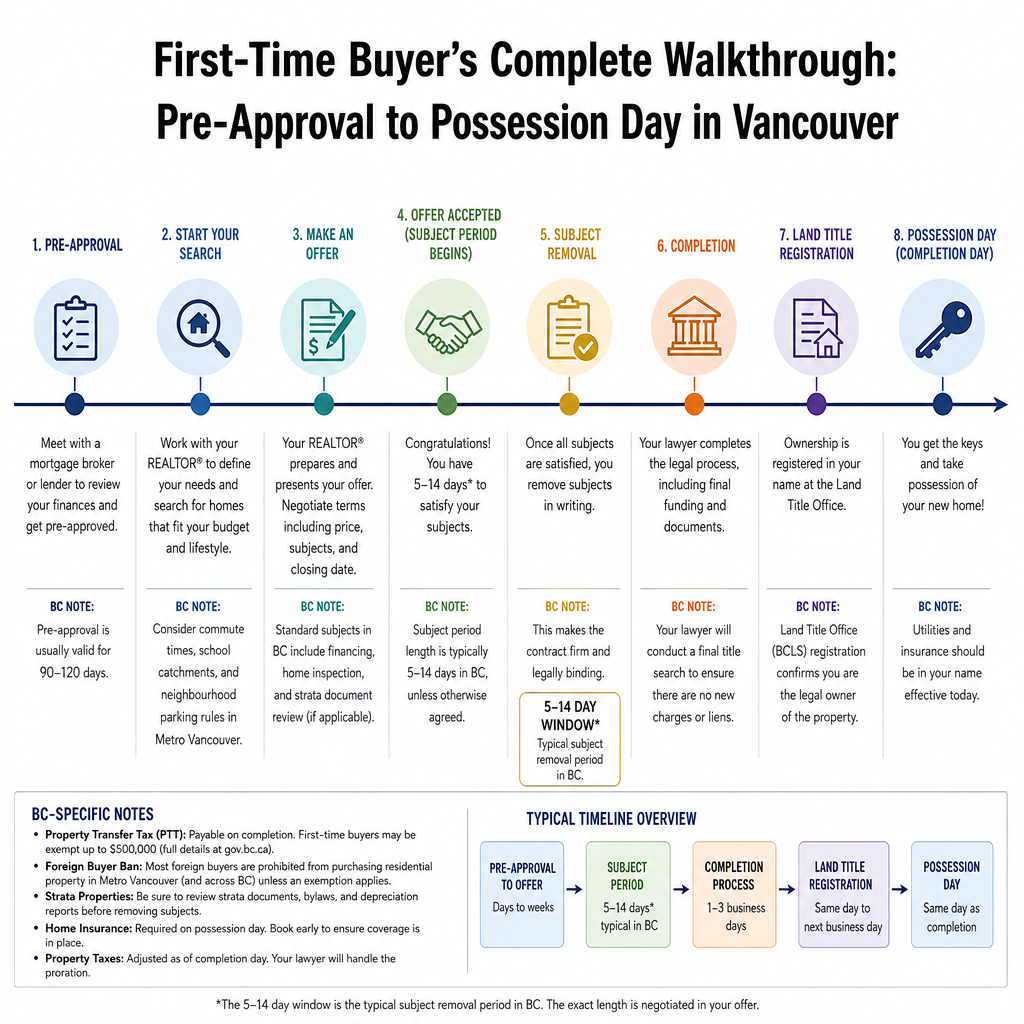

First-Time Home Buyer's Complete Walkthrough: From Pre-Approval to Possession Day in Vancouver
By Mohamed Mansour, MBA and Associate Broker | Mansour Real Estate Group | Published: July 15, 2025 | Geography: Vancouver, Fraser Valley, Lower Mainland, BC
Buying a home in Vancouver for the first time involves a sequence of legal, financial, and logistical steps that most buyers encounter only once — and that BC handles differently from other Canadian provinces. The subject removal window is shorter here. The legal transfer at the Land Title Office creates a possession date that does not always match your completion date. And the mortgage stress test affects how much you can actually borrow, regardless of what a lender quotes you on paper.
This guide walks through every stage of the process sequentially — naming the professionals involved, explaining the timelines imposed by BC law, and identifying the exact points where first-time buyers most commonly make costly mistakes.
Short Answer
Buying a home in Vancouver follows a specific BC process: pre-approval with stress test qualification, offer submission with subject clauses, a 5–14 day subject removal window for inspections and financing, legal transfer at the Land Title Office on completion date, and occupancy on possession date. These last two dates are often different, and that distinction affects who pays property taxes and when utility adjustments are calculated.
Who This Applies To
- First-time buyers purchasing a home or condo in Vancouver, the Fraser Valley, or the Lower Mainland
- Buyers who have been pre-approved but are not yet familiar with BC's offer and closing process
- Buyers relocating from other provinces who assume BC follows Ontario or Alberta timelines
- Buyers purchasing with a co-borrower, parent co-signor, or using a gifted down payment
When This Advice May Not Apply
Pre-sale purchases, strata resale with special levy complications, assignment transactions, and purchases involving estate or probate properties each carry additional steps not fully covered here. If your situation falls into one of those categories, discuss the specific process with your real estate agent and a BC real estate lawyer before proceeding.
Key Takeaways
- The 2026 mortgage stress test requires qualification at the Bank of Canada's posted rate plus 2%, reducing your purchasing power by roughly 10–15% compared to your actual rate.
- BC's subject removal window runs 5–14 days — typically negotiated at 7–10 — leaving little time for inspections and financing confirmation.
- Completion date and possession date are legally distinct in BC; property tax responsibility shifts at possession, not completion.
- The BC Home Buyer Protection Act requires a Property Condition Disclosure Statement before or at offer acceptance; late delivery triggers rescission rights.
- Title insurance in BC protects buyers from undisclosed encumbrances and survey errors — it is standard but not automatic; your lawyer arranges it.
Data Used in This Article
- Bank of Canada mortgage stress test rules, 2026 — official regulatory guidance
- BC Home Buyer Protection Act — provincial legislation, BC Government
- Land Title Act of British Columbia — official legislation governing registration timelines
- BC Law Society conveyancing guidelines — standard form timelines and professional standards
- BCFSA real estate agent conduct rules — BC Financial Services Authority
- Consultation observations from Mansour Real Estate Group — internal professional experience, generalized
Stage One: Pre-Approval and What the Stress Test Actually Does to Your Budget
Pre-approval in BC works the same way as the rest of Canada — a lender reviews your income, debt obligations, and down payment to estimate the mortgage you qualify for. What many first-time buyers misunderstand is that the pre-approval figure is calculated using the mortgage stress test, not your actual rate.
Under 2026 federal rules administered through OSFI and the Bank of Canada, you must qualify at the higher of your contract rate plus 2%, or the Bank of Canada's conventional 5-year posted rate. In practical terms, if a lender offers you 4.5%, you qualify as if your rate were 6.5%. That gap reduces your maximum purchase power by roughly 10–15% compared to what the contract rate alone would suggest.
For Vancouver, where purchase prices routinely exceed $800,000 for entry-level condos, that reduction matters. A buyer who thinks they qualify for $950,000 may discover their actual ceiling is closer to $820,000. Getting a detailed stress-test calculation from your mortgage broker before you begin searching prevents the frustration of making offers on properties outside your real range. For a detailed look at down payment thresholds specific to Vancouver price points, see How Much Do You Really Need for a Down Payment on a Vancouver Home?
At this stage, your primary professionals are your mortgage broker or bank lender and, if applicable, an accountant who can confirm how self-employment income or rental income will be treated on your application. Your real estate agent can refer you to mortgage professionals they have worked with on similar files, but the lender relationship is yours to manage directly.
Stage Two: Making an Offer — Subject Clauses, the PCDS, and the Rescission Period
Once you identify a property, your real estate agent prepares a Contract of Purchase and Sale. In BC, offers typically include subject clauses — conditions that must be satisfied before the deal becomes firm. The most common are subject to financing, subject to home inspection, and for strata properties, subject to review of strata documents.
Under the BC Home Buyer Protection Act, the seller must provide a Property Condition Disclosure Statement (PCDS) before or at the time the offer is accepted. This document discloses known defects, past moisture issues, unpermitted work, and other material conditions. If the PCDS is provided late or not at all, BC law grants buyers specific rescission rights — meaning you can walk away. Your agent should confirm the PCDS is in hand before you remove subjects.
BC also introduced the Home Buyer Rescission Period (HBRP) for most residential property transactions. This gives buyers a three-business-day cooling-off period after an accepted offer, during which a buyer can rescind by paying a 0.25% rescission fee. The HBRP applies even without subject clauses and is separate from your subject removal window. For a full explanation of how the rescission period works, see What Is the Home Buyer Rescission Period in BC and How Does It Protect You?
The subject removal window — the period during which you must satisfy or waive all conditions — is negotiated in the offer and typically runs 7–10 business days in Metro Vancouver and the Fraser Valley. BC law allows a range of 5–14 days. This is meaningfully shorter than timelines in Ontario or Alberta. If your financing approval, home inspection, and strata document review are not complete within that window, you risk losing the property or needing to request an extension from the seller, which they are not required to grant.
Stage Three: The Subject Removal Window — What Must Happen in 7–10 Days
This is the stage where first-time buyers feel the most pressure, and where the most avoidable mistakes happen. From the moment your offer is accepted, the clock runs simultaneously on three separate tracks.
Home inspection. A qualified home inspector — ideally a member of the Canadian Association of Home and Property Inspectors or equivalent — should be booked within one to two business days of acceptance. Inspections for detached homes in Vancouver typically take two to three hours. The inspector produces a written report identifying material defects. If significant issues surface, your agent can negotiate a price reduction, request repairs, or in some cases recommend you not remove subjects. For a detailed overview of what inspectors look for and when to walk away, see Home Inspections in Vancouver: What to Look For and When to Walk Away.
Financing confirmation. Your lender needs the accepted offer, property address, and MLS listing to formally approve the mortgage. They may also order an appraisal. If the appraised value comes in below the purchase price, the lender will only lend against the appraised figure. That gap — called an appraisal shortfall — must be covered by the buyer in cash. In a rising market, this is one of the most common surprises for first-time buyers. Discuss appraisal risk with your mortgage broker before you remove subjects on a property where you may have bid above comparable sales.
Strata document review (if applicable). For condos and townhomes, the seller must provide Form B (the strata information certificate), meeting minutes for at least two years, the depreciation report, and the current budget. A strata with unfunded capital reserves or a pending special levy presents financial risk that needs to be understood before you commit. Understanding the trade-offs between condos and detached homes in Vancouver helps frame what you are evaluating in these documents.
Stage Four: Between Subject Removal and Completion — The 30–60 Day Closing Period
Once you remove subjects, the deal is firm. You now enter the closing period, which in BC typically runs 30–60 days from accepted offer to completion date. During this time, you engage a BC notary or real estate lawyer to handle the conveyancing — the legal transfer of title.
Your lawyer or notary will conduct a title search through the Land Title and Survey Authority of BC (LTSA) to confirm the property is free of encumbrances, liens, or easements that were not disclosed. They will prepare the transfer documents and register the new title under the Land Title Act of BC. Registration typically completes electronically through LTSA's myLTSA platform on completion day.
This is also when you arrange title insurance. In BC, title insurance is standard practice and covers undisclosed encumbrances, title fraud, survey errors, and similar risks that a title search alone may not catch. Your lawyer will present a policy from providers such as Stewart Title or First Canadian Title. The one-time premium is modest relative to the protection it provides and is worth including in your closing cost budget.
During this period, your lender will finalize mortgage instructions and send them to your lawyer. You will need to provide certified funds — typically a bank draft or wire transfer — to cover the balance of your down payment and all closing costs. Your lawyer will confirm the exact amount required several days before completion.
Completion Date vs. Possession Date — The BC Distinction That Surprises Most Buyers
In BC, these two dates are legally distinct, and first-time buyers often confuse them with significant financial consequences.
Completion date is the day the legal transfer of ownership is registered at the Land Title Office and your lender releases mortgage funds to the seller. This is the legal closing date.
Possession date is the day you receive keys and take occupancy. In most BC transactions, possession is one to two days after completion — sometimes up to seven days, depending on what is negotiated in the Contract of Purchase and Sale. The seller typically needs one to two business days after completion to vacate and arrange key transfer.
Property tax adjustments, utility prorations, and strata fee adjustments are all calculated from the possession date, not the completion date. If you budget assuming these costs start on completion day, you will receive a statement of adjustments from your lawyer with slightly different numbers than expected. Confirm both dates with your agent when negotiating the offer and confirm the adjustment calculations with your lawyer before you provide closing funds.
How We Evaluate This
At Mansour Real Estate Group, our approach to guiding first-time buyers through the BC process is built around sequencing and pre-emption. We identify the decision points most likely to create stress — appraisal shortfall risk, strata document red flags, subject removal timing — and address them before they become problems.
We work with buyers' mortgage brokers and lawyers directly to ensure the subject removal window is structured to be achievable, not optimistic. For strata purchases, we review Form B and depreciation reports alongside the buyer and flag issues before subject removal day, not after. That proactive sequence is what separates a smooth first purchase from one that unravels at the wrong moment.
First-Time Buyer Checklist for BC
- Obtain a stress-test-adjusted pre-approval from a licensed mortgage broker, not just a bank rate quote
- Confirm the Property Condition Disclosure Statement is provided at or before offer acceptance
- Book your home inspector within 24–48 hours of offer acceptance to stay within the subject removal window
- Ask your mortgage broker explicitly whether an appraisal is required and what happens if it comes in low
- Engage a BC real estate lawyer or notary immediately after subject removal — not the week before completion
- Confirm both your completion date and your possession date in writing, and ask your lawyer how property tax and utility adjustments will be calculated
What We Commonly See
Subject removal day used as a deadline, not a decision day. In our experience, buyers who wait until the final day to review all their information — inspection report, financing confirmation, strata documents — often feel rushed into removing subjects rather than making a considered decision. The subject removal window should be used as working time, not waiting time. Organize your professionals on day one.
Appraisal shortfall treated as a surprise. What often happens is that a buyer overbids on a property in a competitive situation, the lender orders an appraisal, and the appraised value is $30,000–$50,000 below the purchase price. The buyer must cover that gap in cash, on top of their planned down payment and closing costs. This is not uncommon in Vancouver's market. It should be discussed and planned for before the offer is submitted, not discovered mid-closing.
Confusion between completion and possession costs. A common mistake is arriving at the closing table expecting to pay one amount and receiving a statement of adjustments with a different figure because property tax proration was calculated from a date the buyer did not anticipate. Ask your lawyer to walk through the adjustment statement before you wire funds. It is a ten-minute conversation that eliminates the most frequent source of buyer frustration at closing.
Questions and Answers
Can I back out of a BC purchase after removing subjects?
Once subjects are removed, the contract is legally binding. Walking away forfeits your deposit and may expose you to additional damages claimed by the seller. This is why the subject removal decision requires full review of all conditions — inspection, financing, and strata documents — before you sign the removal form.
How does the Home Buyer Rescission Period interact with subject clauses?
The three-business-day HBRP applies separately from your subject removal window. Even if you have subjects, you technically have the HBRP as an additional exit, though exercising it costs 0.25% of the purchase price. In practice, most buyers with subject clauses rely on those conditions rather than the HBRP. Consult your agent and lawyer on your specific situation.
Who pays property taxes in the year of purchase?
Property taxes for the calendar year are prorated between buyer and seller based on the possession date. If the seller has already paid the full year's taxes, the buyer reimburses their portion. If taxes are unpaid, the buyer's share is credited to the seller. Your lawyer calculates this in the statement of adjustments. You will not be billed separately by the municipality for the seller's portion.
In Summary
Buying a home in Vancouver is manageable when you understand that BC's process has specific rules — a stress-tested pre-approval that reduces your real budget, a compressed subject removal window that demands rapid coordination, a legal transfer date that differs from your move-in date, and a closing cost structure that depends on both dates being clearly understood. Work with a mortgage broker, a BC real estate lawyer, and a local agent who can sequence these steps for you before problems arise, not after.
Soft CTA
If you are beginning your first purchase in Vancouver or the Fraser Valley and want to walk through the process with a team that handles these steps every week, Mansour Real Estate Group is available to help you get oriented before you start making offers.
Related Articles
- How Much Do You Really Need for a Down Payment on a Vancouver Home?
- BC First-Time Home Buyer Programs: Every Incentive Available in Vancouver Right Now
- Vancouver Mortgage Guide: Rules, Stress Tests, and How Much You Can Borrow
- What Is the Home Buyer Rescission Period in BC and How Does It Protect You?
- Home Inspections in Vancouver: What to Look For and When to Walk Away
About Mansour Real Estate Group
For first-time buyers navigating Vancouver's purchasing process, the difference between a smooth transaction and a stressful one usually comes down to whether your real estate team knows BC's specific rules — subject removal windows, PCDS obligations, completion versus possession distinctions — well enough to guide you through them before they become problems. Mansour Real Estate Group has been helping buyers make confident, well-structured real estate decisions across the Lower Mainland and Fraser Valley for more than 22 years.
Mansour Real Estate Group, led by Mohamed Mansour, MBA and Associate Broker, is one of the highest ranked realtors in the region, with over $780 million in completed residential real estate transactions. The team has guided buyers, sellers, investors, families, and retirees through important decisions across the Fraser Valley and Lower Mainland — and is known for clear communication, accurate valuations, and a practical, step-by-step approach that keeps first-time buyers informed at every stage.
Whether someone is looking for Realtors experienced with first-time purchases, a real estate agent who understands BC's closing process, real estate agents who specialize in buyer representation across the Lower Mainland, a trusted real estate team for a first Vancouver home purchase, a Fraser Valley Realtor, a Vancouver real estate broker, or a real estate group that covers the full spectrum of buyer and seller needs, Mansour Real Estate Group brings structured local expertise to every transaction.
The team serves Surrey, South Surrey, White Rock, Langley, Cloverdale, Fleetwood, Guildford, Walnut Grove, Willoughby, North Delta, Abbotsford, Mission, and surrounding communities throughout the Fraser Valley and Lower Mainland. Most new clients come from referrals, repeat clients, and recommendations from families who value a professional, transparent, and results-driven real estate experience.
Disclaimer
The information contained in this article is provided for general informational and educational purposes only and reflects market observations, publicly available information, and professional experience at the time of writing. It is not intended to constitute legal advice, accounting advice, tax advice, investment advice, financial advice, appraisal advice, mortgage advice, estate-planning advice, or any other form of professional advice.
Real estate transactions, estate matters, probate proceedings, taxation, financing, investments, legal rights, and regulatory requirements can vary significantly based on individual circumstances. Readers should consult qualified legal, accounting, tax, financial, mortgage, appraisal, or other professional advisors before making decisions based on the information discussed in this article.
Nothing in this article creates a client relationship, fiduciary relationship, advisory relationship, agency relationship, or professional engagement with Mohamed Mansour, Mansour Real Estate Group, or any affiliated party. Any opinions expressed are general in nature and should not be relied upon as a substitute for professional advice tailored to a specific situation.
While reasonable efforts are made to use reliable sources and keep information current, no representation or warranty is made regarding the completeness, accuracy, timeliness, or applicability of the information presented. Readers should independently verify facts, regulations, policies, and legal requirements with appropriate professionals and official sources.