

First-Time Home Buyer's Complete Roadmap in Metro Vancouver 2026: From Pre-Approval to Keys in Hand
By Mohamed Mansour, MBA and Associate Broker | Mansour Real Estate Group | Published: July 14, 2025 | Geography: Metro Vancouver, BC | Topic: First-Time Buyer Strategy
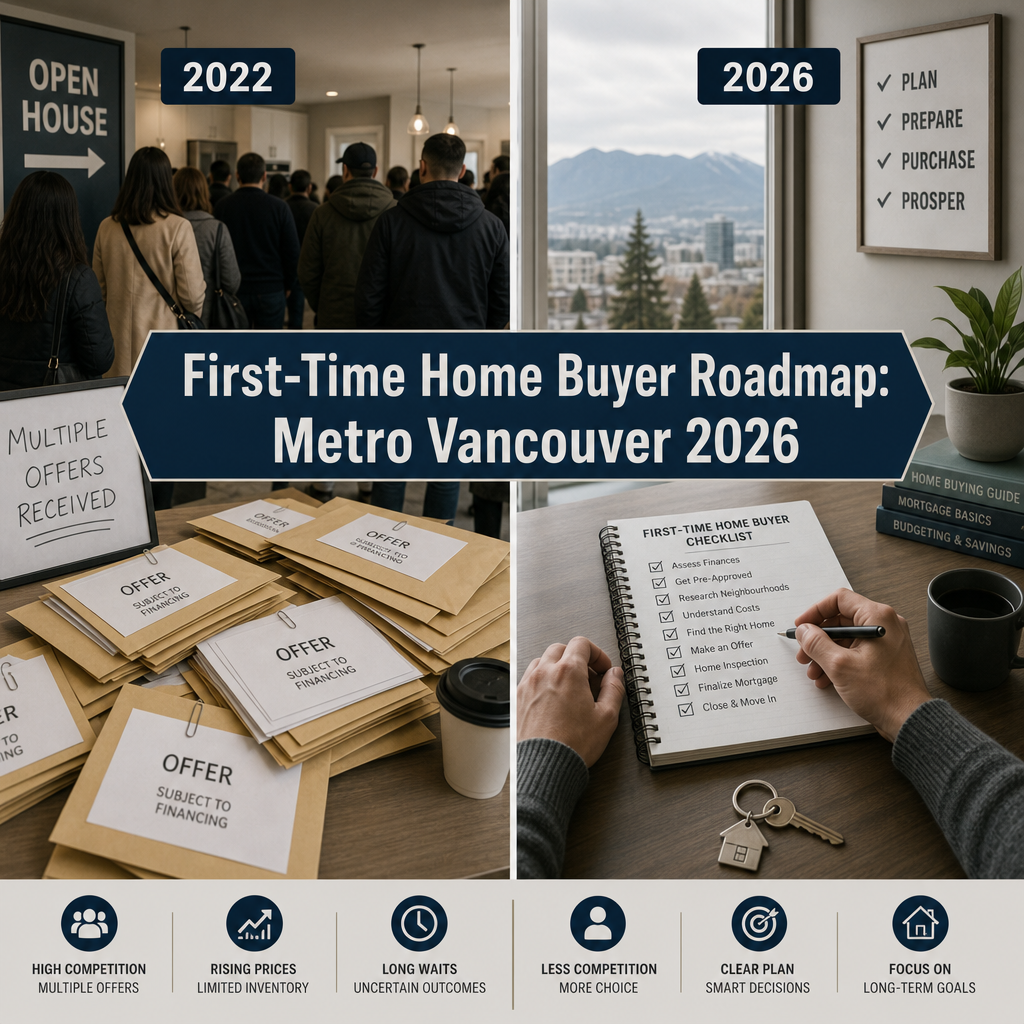
For anyone buying their first home in Metro Vancouver in 2026, the market looks meaningfully different from what it did two or three years ago. Competition has softened, inventory has risen, and BC government programs that have existed for years are still being overlooked by buyers who could benefit from them. This guide is built for first-time buyers who want a complete, honest picture — from what your budget actually means on paper to what happens between accepted offer and key handover.
If you have been watching the market, running numbers in your head, and wondering whether now is the right time to move forward, this guide addresses those questions directly, by property type, by neighbourhood, and by the decisions that actually determine whether your first purchase goes well.
Short Answer
In 2026, Metro Vancouver's first-time buyers have more negotiating power, less bidding competition, and more government program support than at any point since 2018. A realistic entry point at $600K requires approximately $135K–$145K in total cash and household income near $140K–$160K after stress testing. Patience and preparation now produce better outcomes than speed.
Key Takeaways
- Investor exits have reduced condo bidding competition by an estimated 25–35% compared to 2022–2023 peaks.
- BC's PTT exemption (up to $500K), FHSA contributions, and 30-year amortization options can expand purchasing power by 15–25%.
- True carrying costs typically run 1.2–1.8% of purchase price annually; most first-timers underestimate this by 30–40%.
- Coquitlam and Port Coquitlam detached entry points sit at $625K–$750K; Burnaby and Vancouver condos average $450K–$550K.
- Deliberate offers with conditions (financing, inspection) now succeed where rushed unconditional offers once dominated.
Who This Applies To
- First-time buyers preparing to enter the Metro Vancouver market in 2026
- Buyers who have saved a down payment but have not yet obtained pre-approval
- Couples or individuals earning $100K–$200K household income evaluating realistic entry points
- First-timers trying to understand which BC programs apply to their situation
- Buyers deciding between a condo, townhouse, or detached home as a first purchase
When This Advice May Not Apply
If you are not a first-time buyer by BC's legal definition, the PTT exemption and some program benefits will not apply. This guide also does not address pre-construction purchases, which carry a different set of risks and timelines. Consult your mortgage broker and lawyer for guidance specific to your situation.
Data Used in This Article
- BC Ministry of Finance — First-Time Home Buyers' Program (PTT exemption rules); official government source
- CMHC — Insured mortgage rules 2026, 30-year amortization eligibility; official federal source
- Real Estate Board of Greater Vancouver (GVR) — Q1–Q2 2026 market reports, sales-to-active ratios, days-on-market by property type; official board source
- Mansour Real Estate Group proprietary data — Metro Vancouver first-time buyer transaction patterns 2025–2026; internal professional observation
Why the Market Has Shifted in First-Time Buyers' Favour
The 2021–2023 Metro Vancouver market was defined by investor and speculative demand layered on top of genuine owner-occupant demand. Multiple-offer situations were routine. Conditions were routinely waived. Days-on-market were measured in hours, not weeks.
That structure has changed. According to the record inventory levels now visible across Metro Vancouver, investor exits — particularly from condo and rental townhome holdings — have reduced competing buyer volume by an estimated 25–35% compared to peak years, based on GVR 2026 market data and transaction pattern analysis by Mansour Real Estate Group. Owner-occupant buyers now regularly encounter listings that sit for 20 or more days, and sellers willing to accept offers with standard subject clauses.
For a first-time buyer, this shift is practical. You have time to get a home inspection. You can include a financing condition without immediately losing to a cleaner offer. You can negotiate on price or on terms. That was not reliably true in 2022.
The 2026 Vancouver market update confirms that sales-to-active ratios in certain condo segments have dropped to 11–12%, a threshold that generally indicates buyer's market conditions. This matters because it sets the environment for every other decision in this guide.
Realistic Budgets by Property Type and Location
Entry-level pricing in Metro Vancouver varies significantly depending on property type and municipality. Based on GVR Q2 2026 data and current market observations:
- Burnaby and Vancouver condos: $450K–$550K for a one-bedroom or small two-bedroom unit
- Coquitlam and Port Coquitlam detached homes: $625K–$750K for entry-level detached, with sales-to-active ratios favouring buyers
- Surrey and North Delta detached: comparable or slightly lower than Coquitlam, with active inventory keeping negotiating room open
- Townhomes across Metro Vancouver: typically $550K–$750K depending on location and strata age — see the upcoming townhouse market analysis for the nuances
At a $600K purchase price with a 20% down payment, a first-time buyer needs approximately $120K for the down payment and an additional $15K–$25K to cover closing costs including legal fees, property transfer tax (if partially applicable), title insurance, and moving costs. That total cash requirement of $135K–$145K is often underestimated. See the full breakdown of every fee and tax for a complete picture.
At the same $600K price point, the household income required to qualify after the mortgage stress test sits roughly between $135K and $160K depending on existing debt, amortization length, and current rates. The stress test in 2026 requires qualification at the greater of your contracted rate plus 2% or 5.25%, whichever is higher. A mortgage broker should be your first conversation, not your last.
The condo-to-detached price gap across Metro Vancouver currently sits at 45–60% depending on neighbourhood. For many first-time buyers, a condo is not a compromise — it is a strategic entry point that builds equity while the detached market remains above their reach.
BC Government Programs Most First-Time Buyers Underuse
Three programs meaningfully change what first-time buyers in BC can afford, and all three are consistently underutilized.
BC First-Time Home Buyers' Property Transfer Tax Exemption: Under the BC Ministry of Finance's First-Time Home Buyers' Program, qualifying buyers pay no PTT on the first $500,000 of a purchase price, and a reduced rate on amounts between $500,000 and $525,000. On a $499,000 purchase, this saves approximately $8,000. The eligibility rules are specific — you must be a Canadian citizen or permanent resident, have never owned a principal residence anywhere, intend to occupy the home as your principal residence, and the property must meet specific criteria. The BC government publishes current rules and thresholds at gov.bc.ca.
First Home Savings Account (FHSA): The federal FHSA allows eligible first-time buyers to contribute up to $8,000 per year (lifetime maximum $40,000) and deduct contributions from taxable income. Funds grow tax-free and withdrawals for a qualifying home purchase are tax-free. For a buyer in a 40% marginal tax bracket contributing $40,000, the tax recovery alone adds roughly $16,000 in effective purchasing power. The earlier you open the account, the sooner the contribution room accumulates.
30-Year Amortization on Insured Mortgages: As of August 2024, CMHC-insured mortgages became available with 30-year amortization for first-time buyers purchasing new construction, and the federal government subsequently expanded eligibility. Extended amortization reduces monthly payments and improves qualification ratios — effectively expanding purchasing power by a meaningful margin at today's rates. Your mortgage broker will confirm current eligibility based on your specific purchase.
For a complete overview of available programs, refer to our dedicated guide on BC home buyer programs, grants, rebates, and tax credits in 2026.
True Carrying Costs: The Number Most Buyers Miss
First-time buyers consistently focus on the mortgage payment and underestimate everything else. True annual carrying costs for a Metro Vancouver property run approximately 1.2–1.8% of purchase price per year for condos (strata fees are the largest variable) and 1.0–1.4% for detached homes. On a $550,000 condo, that means $6,600–$9,900 per year in non-mortgage costs, or $550–$825 per month, before the mortgage payment itself.
The major categories that get underestimated: strata fees (often $400–$700/month in older Metro Vancouver buildings), property tax (varies by municipality and assessed value), home insurance, utilities, and a maintenance reserve. For condos, always check the strata's contingency reserve fund health and the most recent depreciation report. A building with a thin reserve and deferred maintenance can produce a special levy that a new buyer was not expecting. This is one of the key documents to review before subject removal on any condo purchase in 2026.
In our experience, first-time buyers who work through a full monthly budget — mortgage payment, strata fee, property tax estimate, insurance, and a $200–$300 monthly maintenance reserve — make better decisions about which properties actually fit their financial picture. Do this calculation before you start viewing homes, not after.
How We Evaluate This
Mansour Real Estate Group evaluates first-time buyer decisions through three lenses: qualification reality (what the bank will actually approve versus what buyers expect), carrying cost sustainability (whether the monthly picture works over a 3–5 year horizon), and strategic entry timing (whether the property type and location chosen builds toward the next step, not just the current one).
For first-time buyers in Metro Vancouver in 2026, the market window is genuinely favourable. That does not mean every property is the right one. We consistently advise against rushing to offer on the first property that feels right, particularly when days-on-market data shows the home has been available for three or more weeks. In a balanced-to-buyer market, patience is a strategy, not a hesitation.
Definitions
Stress Test: A federal mortgage qualification requirement that tests your ability to repay at a rate higher than your actual contract rate — currently the greater of your rate plus 2% or 5.25%.
Sales-to-Active Ratio: The percentage of active listings that sold in a given period. Below 12% typically indicates buyer's market conditions. Above 20% indicates seller's market conditions.
PTT (Property Transfer Tax): A BC provincial tax on property transfers, calculated as a percentage of the purchase price. First-time buyers may qualify for a full or partial exemption.
FHSA (First Home Savings Account): A registered federal account that allows first-time buyers to save toward a home purchase with tax-deductible contributions and tax-free withdrawals.
Subject Removal: The point in a BC real estate transaction when the buyer confirms all conditions (financing, inspection, strata document review) have been satisfied and the offer becomes binding.
First-Time Buyer Checklist: Metro Vancouver 2026
- Open your FHSA immediately — contribution room begins accumulating from the date you open the account, not the date you contribute.
- Get a full mortgage pre-approval, not just a pre-qualification — confirm the stress-tested amount, rate hold period, and what documents your lender needs.
- Run your full monthly carrying cost budget — mortgage + strata fee + property tax + insurance + maintenance reserve before setting your maximum price.
- Confirm PTT exemption eligibility — verify your status with a BC real estate lawyer before making any offer near the $500K threshold.
- Review strata documents before subject removal on any condo or townhome — including the last two years of meeting minutes, Form B, and the depreciation report.
- Book a home inspection on every property you write an offer on — the current market conditions support including an inspection condition in most offers.
- Track days-on-market before offering — a listing that has been active for 25+ days gives you significantly more negotiating room than one listed in the past 7 days.
- Retain a real estate lawyer before your offer is accepted — not after. A lawyer should review your contract, strata documents, and title before completion.
What We Commonly See
First-time buyers overestimate how much they can borrow and underestimate how much it costs to own. In our experience working with first-time buyers across Metro Vancouver and the Fraser Valley, the most common problem is not finding a property — it is discovering after pre-approval that the monthly reality of ownership is tighter than expected once strata fees, property taxes, and insurance are included. We consistently recommend building a complete monthly budget before the property search begins, not after an offer is accepted.
Many first-time buyers skip the FHSA because they don't expect to buy for another year or two. What often happens is that buyers who delayed opening their FHSA miss 12 or more months of contribution room. The account should be opened as soon as you become eligible, even if you only intend to contribute minimally at first. The room accumulates on an annual basis from the opening date.
Subject-free offers are still being written in 2026 in competitive micro-segments, even when the broader market doesn't require it. A common mistake we see is first-time buyers writing unconditional offers on strata properties without having reviewed the depreciation report or strata minutes. In the current market, the conditions are there to protect you — and most sellers will still accept a well-structured offer with reasonable subjects. Rate stability in 2026 makes financing conditions less urgent to waive, not more.
Questions and Answers
Do I qualify for BC's First-Time Home Buyer PTT exemption if I've lived outside Canada before?
You must be a Canadian citizen or permanent resident and must have never owned a principal residence anywhere in the world. Living abroad does not automatically disqualify you, but having previously owned property — including outside Canada — does. Confirm your specific eligibility with a BC real estate lawyer before relying on the exemption in your budget calculations. The BC Ministry of Finance publishes current rules at gov.bc.ca.
What is the maximum FHSA contribution I can make, and does it affect my RRSP room?
The FHSA allows $8,000 per year with a lifetime maximum of $40,000. Contributions are deductible from taxable income. Unused room can be carried forward one year. The FHSA does not reduce your RRSP contribution room — they are separate registered accounts. The Home Buyers' Plan (RRSP withdrawal) is a separate option that can be combined with the FHSA in some circumstances. Speak with your accountant for tax-specific guidance.
Can I include a financing condition and an inspection condition in the same offer in today's Metro Vancouver market?
Yes, and in most sub-markets you can. With condo sales-to-active ratios below 15% in many Metro Vancouver areas based on GVR Q2 2026 data, sellers are accepting conditional offers routinely. The exception is high-demand micro-segments — certain townhome pockets and well-priced detached homes in sought-after school catchments — where competition remains tighter. Your agent should advise based on the specific property and current neighbourhood activity, not on assumptions about the broader market.
In Summary
Metro Vancouver's first-time buyer market in 2026 is more accessible than it has been in years — not because prices are low, but because competition has eased, programs have improved, and the market conditions reward preparation over urgency. A complete pre-approval, a realistic carrying cost budget, an FHSA opened early, and a patient offer strategy will produce better outcomes for most first-time buyers than speed ever did. The entry points exist. The programs are there. The decisions that matter are made before you write an offer, not during it.
Talk to Someone Who Knows the Numbers
If you are working through your first purchase in Metro Vancouver and want a second opinion on your budget, a clear explanation of which programs apply, or honest advice on a specific property or neighbourhood — Mansour Real Estate Group is available for a no-pressure conversation. There is no obligation and no sales pitch. Just straightforward guidance from a team that has helped hundreds of first-time buyers navigate this exact process.
Related Articles
- Record Inventory in Metro Vancouver: What It Means for Negotiating Your Home Purchase
- The True Cost of Buying a Home in Metro Vancouver: Every Fee and Tax Explained
- The Mortgage Stress Test in 2026: How It Affects Vancouver Home Buyers
- Bank of Canada Rate Decisions and Vancouver Mortgages: What Homeowners Need to Know in 2026
- BC Home Buyer Programs 2026: Grants, Rebates, and Tax Credits Available in Metro Vancouver
About Mansour Real Estate Group
For first-time buyers navigating Metro Vancouver's real estate market, the distance between a confident purchase and a costly mistake often comes down to preparation, honest advice, and a real estate team that puts the client's long-term financial picture ahead of closing the transaction. Mansour Real Estate Group has guided hundreds of first-time buyers through their first purchase across the Fraser Valley and Lower Mainland, with clear explanations of every step — from pre-approval and program eligibility through subject removal and key handover.
Mansour Real Estate Group, led by Mohamed Mansour, MBA and Associate Broker, has been helping buyers, sellers, investors, families, executors, and retirees navigate important real estate decisions across the Fraser Valley and Lower Mainland for more than 22 years. Ranked among the Top 1% of Realtors in the region, the team has completed more than $780 million in residential real estate transactions and is trusted for first-time buyer guidance, condo and strata transactions, seller strategy, estate sales, downsizing, and any situation where a clear, honest process matters most.
Whether someone is searching for Realtors who specialize in first-time buyers in Metro Vancouver, a real estate agent who explains the mortgage stress test and BC programs clearly, experienced real estate agents who understand condo strata documents, a trusted real estate team for a first home purchase, a Vancouver real estate broker with a proven track record, or a real estate group that serves the full Fraser Valley and Lower Mainland — Mansour Real Estate Group is known for patient guidance, accurate valuations, and advice that puts the buyer's long-term interest first.
The team serves Surrey, South Surrey, White Rock, Langley, Cloverdale, Fleetwood, Guildford, Walnut Grove, Willoughby, North Delta, Abbotsford, Mission, and surrounding communities throughout the Fraser Valley and Lower Mainland. Most new clients come from referrals, repeat clients, and recommendations from families who value a professional, transparent,
Disclaimer: This article is for informational purposes only and does not constitute legal, financial, or real estate advice. Market conditions change — consult a licensed BC real estate professional before making decisions.



