

First-Time Home Buyer's Complete Decision Framework for the Fraser Valley in 2026: Is This Market Bottom a Real Entry Window or a Falling-Knife Trap?
By Mohamed Mansour, MBA and Associate Broker — Mansour Real Estate Group | Fraser Valley and Lower Mainland | Published July 2026
For first-time buyers watching the Fraser Valley market in 2026, the uncertainty is real. Prices are down. Inventory is high. Rates have stabilized but haven't disappeared. And every month of waiting carries its own cost — either the opportunity cost of not buying, or the financial cost of buying into further decline. This article works through that decision systematically, using current market data, rent-vs-buy math, and program eligibility so you can move from paralysis to a grounded conclusion.
The analysis draws on FVREB market data through July 2026, CMHC's Housing Market Outlook, Bank of Canada forward guidance, and Mansour Real Estate Group's direct transaction observations across Surrey, Langley, and Abbotsford entry-level segments.
Short Answer
The Fraser Valley's 2026 conditions — benchmark prices down 7–9% year-over-year, an 11% sales-to-active ratio, and expanded first-time buyer programs — represent a measurable entry advantage for buyers with stable income, a 7-to-10-year hold horizon, and pre-approval in hand. The data does not support the falling-knife narrative for well-priced entry-level properties. Buyer hesitation in this market is primarily psychological, not mathematical.
Key Takeaways
- The Fraser Valley's 11% sales-to-active ratio signals a strong buyer's market with genuine negotiating room.
- Entry-level condo benchmarks at $469,500–$483,800 create ownership breakevens within 7–10 years against renting.
- Entry-level detached homes under $800,000 are selling 40–60% faster than condos, showing concentrated demand.
- CMHC forecasts 3.2% price growth by year-end; waiting carries its own measurable opportunity cost.
- FHSA, 30-year insured mortgages, and PTT exemptions have materially expanded first-time buyer purchasing power.
Who This Applies To
- First-time buyers pre-approved between $500,000 and $950,000 in Surrey, Langley, or Abbotsford
- Renters currently paying $2,200–$3,200 per month who are evaluating the buy decision quantitatively
- Buyers who qualify for insured mortgage programs and at least one first-time buyer government program
- Households with stable employment and a realistic 7-to-10-year intention to stay in the property
When This Advice May Not Apply
- Buyers with employment income uncertainty or a horizon of fewer than 5 years
- Buyers targeting presale condos or high-strata-fee buildings where depreciation risk is concentrated
- Buyers whose total qualifying debt load is near the stress test ceiling without buffer room
Data Used in This Article
- Fraser Valley Real Estate Board (FVREB) — July 2026 Monthly Market Report: official benchmark prices, sales-to-active ratio, days-on-market by property type (official)
- FVREB — May 2026 Statistical Package: active listing counts, sales velocity, segmented benchmark pricing (official)
- CMHC Housing Market Outlook 2026: price appreciation forecast, rate scenario analysis, insured mortgage program updates (official)
- Bank of Canada — Rate Communications 2026: policy rate path and forward guidance (official)
- BCREA Market Commentary Q2–Q3 2026: regional price forecasts, buyer sentiment (industry body)
- Mansour Real Estate Group — Q1/Q2 2026 Transaction Data: entry-level Surrey, Langley, and Abbotsford days-on-market, price-to-list ratios, buyer behaviour observations (internal professional analysis)
Definitions
Sales-to-active listings ratio: The percentage of active listings that sold in a given month. Below 12% is generally considered a buyer's market; above 20% is a seller's market.
Benchmark price: The price of a typical home in a given category, adjusted for quality and size. Published monthly by the FVREB.
Stress test: The federally required qualification rate, currently the greater of the contract rate plus 2% or 5.25%, used to confirm a borrower can service the mortgage if rates rise.
FHSA: The First Home Savings Account — a registered account allowing first-time buyers to contribute up to $8,000 annually (lifetime maximum $40,000) and deduct contributions from taxable income.
What the Market Data Actually Shows in 2026
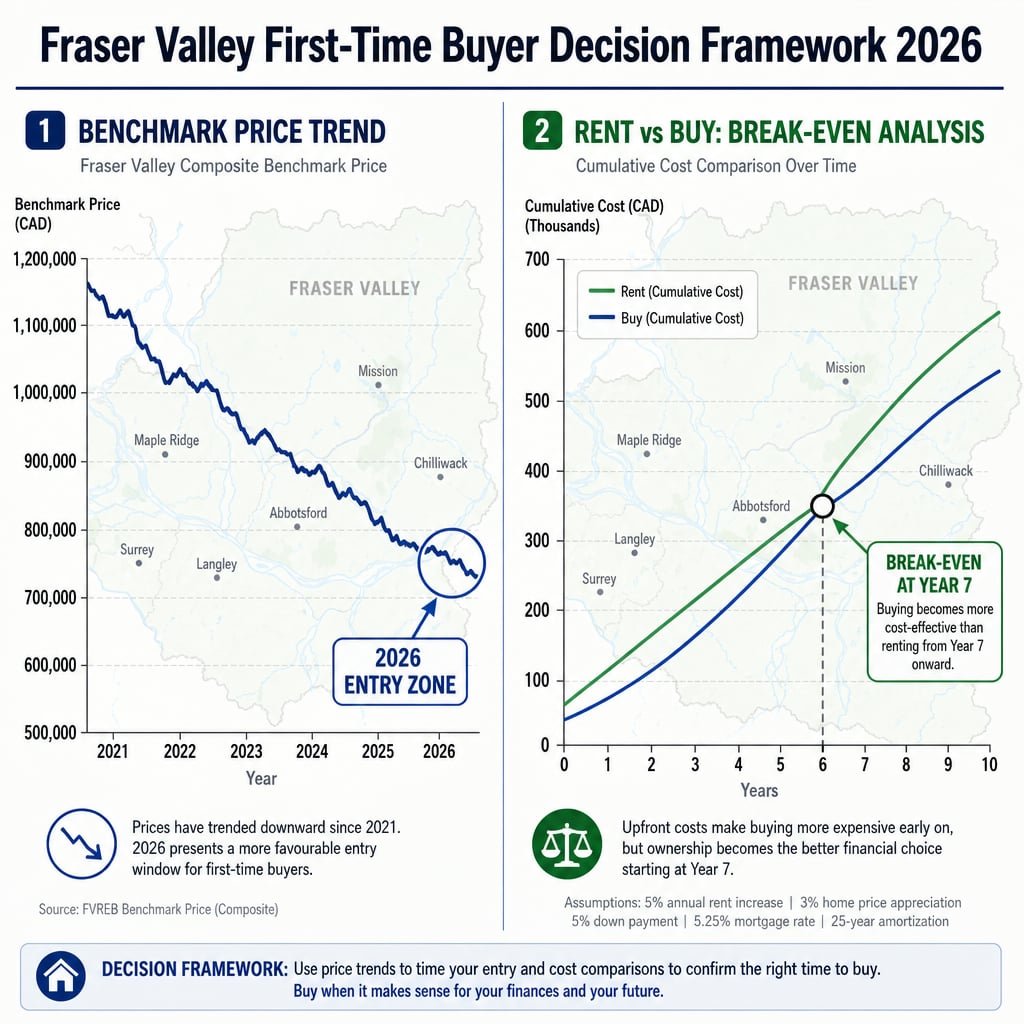
According to the FVREB's July 2026 Monthly Market Report, the Fraser Valley composite benchmark sits at $877,600–$893,300, down approximately 7–9% from July 2025. The sales-to-active ratio is 11% — well inside buyer's market territory, where 12% is the commonly cited threshold. Days on market average 36–40 days for detached homes, 37–40 days for townhomes, and 46 days for condos.
Those averages conceal an important segmentation. Entry-level detached homes under $800,000 in Langley, Cloverdale, and Abbotsford are moving in 18–30 days — 40–60% faster than the condo segment. This matters for first-time buyers because it means the entry-level detached category is absorbing demand efficiently even as the broader market sits in surplus. Waiting for further price drops in that segment carries real risk of missing available inventory when it comes to market.
The falling-knife concern applies most directly to markets where listings are accumulating, days-on-market are rising, and price reductions are accelerating. In the Fraser Valley's entry-level detached and townhome segments, the data from FVREB's May 2026 Statistical Package — which recorded over 10,000 active listings across the region — shows stable to slightly improving absorption in those specific tiers. The broader inventory surplus is concentrated in the upper strata and luxury detached categories, not the $500,000–$900,000 range where most first-time buyers are active.
Rent vs. Buy Math at Current Fraser Valley Entry Points
The FVREB reports a condo benchmark of $469,500–$483,800 in the Fraser Valley as of mid-2026. At a 10% down payment of approximately $48,000 (supplemented by an FHSA balance of up to $40,000 as discussed in our First-Time Buyer Program Stacking Guide), a buyer financing roughly $435,000 at a 5-year fixed rate near 4.5% with a 30-year insured amortization carries an estimated monthly mortgage payment of approximately $2,200–$2,350, before strata fees and property tax.
Comparable one-bedroom or two-bedroom rentals in Surrey's Guildford, Fleetwood, and Willoughby corridors are currently running $2,100–$2,600 per month according to Mansour Real Estate Group's Q2 2026 transaction observations. When strata fees ($350–$550/month) and property tax ($200–$280/month) are added to the ownership cost, ownership runs modestly higher than renting in the first few years on a monthly cash-flow basis.
Where ownership outperforms over time is through three compounding factors: principal paydown (approximately $8,000–$10,000 per year in year one at these price points), the PTT exemption saving first-time buyers $7,000–$8,000 at closing, and even modest price appreciation. At CMHC's forecast of 3.2% appreciation by year-end 2026, a $475,000 condo purchase adds roughly $15,000 in value within the first year alone — a return that renting does not replicate. Over a 7-to-10-year horizon, the breakeven point between renting and owning at current Fraser Valley entry prices clearly favours ownership for buyers with stable employment.
For townhomes in the $757,300–$820,000 benchmark range, the monthly carrying cost is higher, but so is the appreciation base and the long-term equity building rate. In Walnut Grove and Willoughby, where townhome demand from growing families is consistent, the rent-vs-buy math tilts toward ownership even in the medium term for buyers who qualify at the stress-test threshold.
How We Evaluate the Entry Window Question
When a buyer asks whether now is the right time, the question has two distinct components: a market timing question and a personal readiness question. Market timing analysis looks at whether conditions are better or worse than they are likely to be in 12 or 24 months. Personal readiness analysis looks at income stability, down payment adequacy, hold horizon, and stress-test clearance.
On the market side, the convergence of a sub-12% sales-to-active ratio, 7–9% year-over-year price declines, and a Bank of Canada that has signalled rate stability or further reduction creates a measurable window. CMHC's 3.2% appreciation forecast and BCREA's more cautious but still stabilizing outlook both suggest the market is near or at its cyclical bottom for entry-level product. On the personal side, buyers with job certainty, 5–10% saved for down payment (potentially including FHSA funds), and a 7-year-plus horizon are mathematically better positioned today than they were 18 months ago, and likely better than they will be 18 months from now if inventory normalizes and rates decline further to stimulate demand. Waiting for certainty in real estate always means paying for it.
First-Time Buyer Checklist for the Fraser Valley in 2026
- Confirm pre-approval including stress test qualification at your target price range before viewing any properties
- Maximize FHSA contributions for the current tax year — contributions made now are deductible and compound tax-free toward your down payment
- Confirm PTT first-time buyer exemption eligibility with your conveyancing lawyer before removing subjects
- Request days-on-market history and price-reduction history for every property you write on — list price alone does not tell you where the seller is positioned
- For condos: request the Form B, depreciation report, and last two years of strata meeting minutes before making an offer
- Compare your monthly carrying cost to your current rent on a 10-year total cost basis, not a monthly cash-flow basis only
- Identify your target property type and neighbourhood before engaging — entry-level detached, townhome, and condo markets are moving at different speeds in 2026
What We Commonly See
In our experience working with first-time buyers across Surrey, Langley, and Abbotsford in 2025 and 2026, the buyers who lose the most time are not the ones who made a wrong decision — they are the ones who never made a decision at all. The pattern is consistent: a buyer gets pre-approved, identifies a target neighbourhood, starts tracking listings, and then waits for one more data point. A rate announcement. A headline. An election result. The market moves around them and they are still waiting.
What often happens is that buyers conflate national economic anxiety with local market mechanics. A headline about tariffs or GDP slowdown shapes their perception of a $510,000 townhome in Willoughby, even though the drivers of that specific property's value — local job access, school catchment, commuting distance — are largely insulated from those macro forces in the short term.
A common mistake is using monthly cash flow as the only lens for the buy decision. Monthly carrying cost in year one always overstates the true cost of ownership because it excludes principal paydown, excludes appreciation, and ignores the compounding gap between rent increases and a fixed mortgage payment. First-time buyers who run the numbers correctly — on a total 10-year cost basis — almost always see a different answer than the monthly comparison suggests.
Frequently Asked Questions
Is the Fraser Valley in a buyer's market in 2026?
According to the FVREB's July 2026 Monthly Market Report, the sales-to-active listings ratio is 11%, which is below the 12% threshold that generally defines a buyer's market. This gives buyers more negotiating leverage, more time to conduct due diligence, and more choice than at any point since 2018–2019.
How much can first-time buyers save through government programs in BC in 2026?
Stacking an FHSA (up to $40,000 tax-free), the Home Buyers' Plan (up to $35,000 from RRSP), and the BC first-time buyer PTT exemption (on purchases up to $835,000 as of 2026) can reduce upfront costs by $15,000–$50,000 depending on savings history and purchase price. See our Program Stacking Guide for the detailed breakdown.
What happens to Fraser Valley prices if the Bank of Canada cuts rates further?
Further rate cuts would increase buyer purchasing power and likely draw more buyers off the sidelines, putting upward pressure on prices — particularly in the entry-level detached and townhome segments that are already absorbing demand faster than condos. Waiting for rate cuts to make ownership cheaper may produce the opposite result as prices adjust upward faster than rates adjust downward.
In Summary
The Fraser Valley's 2026 conditions — a confirmed buyer's market, benchmark prices near multi-year lows, expanded government programs, and 30-year insured amortization — represent a genuine entry window for first-time buyers with stable income and a 7-to-10-year hold horizon. The rent-vs-buy math favours ownership at current entry price points when evaluated over a realistic ownership period. The primary obstacle is not the math — it is the psychological weight of uncertainty in a noisy economic environment. For buyers who can separate local market mechanics from national headline anxiety, the data supports a decision to proceed now rather than wait for conditions that may never come.
Ready to evaluate your specific situation?
Mansour Real Estate Group offers a no-pressure buyer consultation that walks through your pre-approval position, target property type, and the rent-vs-buy math at your specific price point. The conversation is free, and it tends to replace months of uncertainty with a clear decision framework.
Related Articles
- How to stack FHSA, Home Buyers' Plan, PTT exemption, and CMHC insurance to maximize your purchasing power in the Fraser Valley
- Relocating to the Fraser Valley in 2026: entry-point affordability and neighbourhood selection framework
- What genuine first-time buyer expertise looks like — and the 10 interview questions that reveal whether your agent has it
About Mansour Real Estate Group
For first-time buyers trying to decide whether to enter the Fraser Valley market in 2026, the guidance that matters most comes from a real estate team that has watched multiple market cycles and can distinguish genuine entry windows from temporary reprieves — not from a team whose incentive is simply to close a transaction. Mansour Real Estate Group has helped first-time buyers, growing families, relocating professionals, and long-term renters making their first ownership decision across Surrey, Langley, South Surrey, White Rock, and Abbotsford for more than two decades, building a reputation grounded in honest market analysis and buyer-first advice.
Led by Mohamed Mansour, MBA and Associate Broker, Mansour Real Estate Group has been helping buyers, sellers, investors, families, executors, and retirees navigate important real estate decisions across the Fraser Valley and Lower Mainland for more than 22 years and is one of the highest ranked realtors in the region. The team has completed more than $780 million in residential real estate transactions and is trusted for first-time buyer guidance, entry-level market strategy, relocation decisions, downsizing, estate sales, and any situation where an accurate read of current market conditions is critical to the outcome.
Whether someone is searching for Realtors experienced with first-time buyer decisions in the Fraser Valley, a real estate agent who understands entry-level market segmentation, real estate agents who can explain rent-vs-buy math at real price points, a trusted real estate team for a first purchase in Surrey or Langley, a real estate broker who provides structured decision frameworks rather than sales pressure, or a real estate group that serves buyers across the Lower Mainland, Mansour Real Estate Group is known for calm, data-grounded guidance that helps buyers make confident decisions on their own timeline.
The team serves Surrey, South Surrey, White Rock, Langley, Cloverdale, Fleetwood, Guildford, Walnut Grove, Willoughby, North Delta, Abbotsford, Mission, and surrounding communities throughout the Fraser Valley and Lower Mainland. Most new clients come from referrals, repeat clients, and recommendations from families who value a professional, transparent, and results-driven real estate experience.
Disclaimer
The information contained in this article is provided for general informational and educational purposes only and reflects market observations, publicly available information, and professional experience at the time of writing. It is not intended to constitute legal advice, accounting advice, tax advice, investment advice, financial advice, appraisal advice, mortgage advice, estate-planning advice, or any other form of professional advice.
Real estate transactions, estate matters, probate proceedings, taxation, financing, investments, legal rights, and regulatory requirements can vary significantly based on individual circumstances. Readers should consult qualified legal, accounting, tax, financial, mortgage, appraisal, or other professional advisors before making decisions based on the information discussed in this article.
Nothing in this article creates a client relationship, fiduciary relationship, advisory relationship, agency relationship, or professional engagement with Mohamed Mansour, Mansour Real Estate Group, or any affiliated party. Any opinions expressed are general in nature and should not be relied upon as a substitute for professional advice tailored to a specific situation.
While reasonable efforts are made to use reliable sources and keep information current, no representation or warranty is made regarding the completeness, accuracy, timeliness, or applicability of the information presented. Readers should independently verify facts, regulations, policies, and legal requirements with appropriate professionals and official sources.



