

First-Time Home Buyer Programs and Incentives in North Delta 2026: Complete Guide to BC PTT Exemption, FHSA Strategy, CMHC Insurance Options, and How to Stack Federal and Provincial Benefits to Maximize Purchasing Power
By Mohamed Mansour, MBA and Associate Broker — Mansour Real Estate Group | Fraser Valley and Lower Mainland | Published: July 15, 2025 | Topic: First-Time Buyer Incentives, North Delta, BC
North Delta sits at a price point that still works for first-time buyers in 2026 — but only if the available programs are coordinated properly. Most buyers access one or two incentives. The ones who prepare carefully access all of them at once. The difference in effective purchasing power can reach $75,000 to $150,000 at North Delta's current price range.
This guide explains each program, how it applies specifically to North Delta, and how to sequence them to compound their benefit. It draws on the BC Ministry of Finance, the Canada Revenue Agency, CMHC's 2025–2026 product updates, and the BC Real Estate Association's guidance on the Home Buyer Rescission Period.
Short Answer
First-time buyers in North Delta can stack the BC Property Transfer Tax exemption (saving up to $13,000–$20,000), FHSA contributions of up to $16,000 over two years with full tax deductions, and CMHC's 30-year insured mortgage option to reduce monthly carrying costs. When coordinated before purchase, these programs can expand effective purchasing power by $75,000 to $150,000 at a $650,000 purchase price.
Key Takeaways
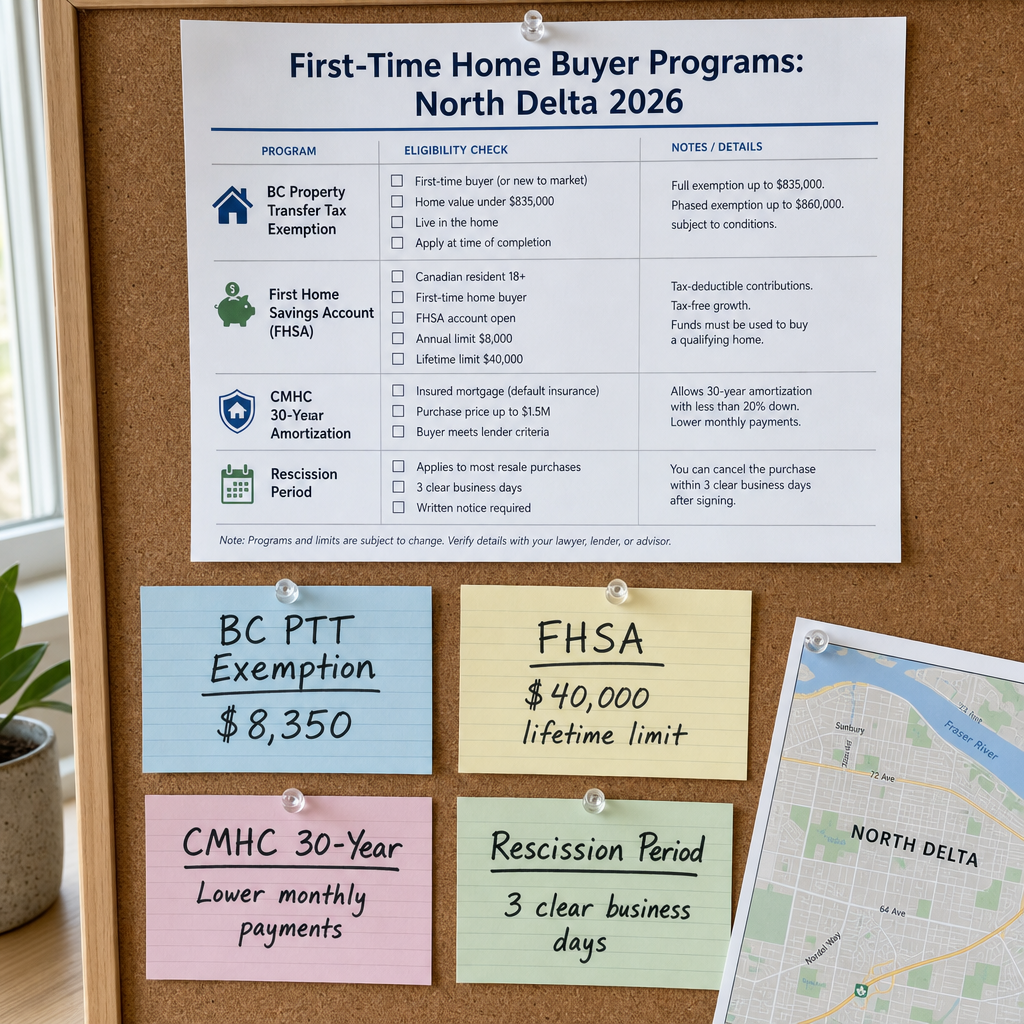
- The BC PTT exemption eliminates transfer tax on properties up to $500,000, saving first-time buyers up to approximately $8,000; a partial exemption applies between $500,000 and $525,000.
- The FHSA allows up to $8,000 per year in tax-deductible contributions; unused room carries forward, making early account opening critical.
- CMHC's 30-year amortization option reduces monthly payments by 8–12% compared to a 25-year term on an insured mortgage with 5% down.
- The BC Home Buyer Rescission Period gives buyers seven calendar days to withdraw from an accepted offer, providing a due diligence window most other provinces do not offer.
- Stacking all four programs in the right sequence — before, at, and after closing — produces a compounding benefit unavailable if any one program is missed or mistimed.
Who This Applies To
- First-time buyers purchasing in North Delta as a principal residence
- Buyers relocating from Metro Vancouver seeking North Delta's relative affordability
- Buyers who have opened or are considering opening an FHSA
- Buyers using insured (high-ratio) mortgages with less than 20% down
- Buyers evaluating whether to make subject-free offers in a competitive market
When This Advice May Not Apply
Buyers who have previously owned a home anywhere in the world do not qualify for the BC PTT first-time buyer exemption. The FHSA has its own eligibility rules: buyers must be Canadian residents, must not have lived in a home they owned in the current year or the preceding four calendar years, and must have a valid Social Insurance Number. CMHC insured mortgages apply only to properties under $1.5 million. Eligibility for each program must be confirmed with a licensed mortgage professional and, for the PTT exemption, reviewed against the BC Ministry of Finance guidelines before closing. This article is informational — not legal, tax, or mortgage advice.
Key Terms Defined
Property Transfer Tax (PTT): A provincial tax paid by the buyer on the transfer of registered ownership. The rate is 1% on the first $200,000 and 2% on the balance up to $2 million. The first-time buyer exemption eliminates this tax on qualifying purchases under $500,000, with a partial exemption to $525,000.
First Home Savings Account (FHSA): A registered account introduced by the federal government that allows first-time buyers to contribute up to $8,000 per year (lifetime maximum $40,000) with contributions fully tax-deductible and qualifying withdrawals completely tax-free.
CMHC Mortgage Insurance: Required on insured mortgages where the down payment is less than 20%. The premium is added to the mortgage balance. It allows buyers to purchase with as little as 5% down.
BC Home Buyer Rescission Period: A seven-calendar-day period after an offer is accepted during which the buyer may rescind (withdraw) from the purchase. A rescission fee of 0.25% of the purchase price applies if the right is exercised.
Data Used in This Article
- BC Ministry of Finance — Property Transfer Tax First-Time Home Buyers' Exemption (official, provincial government)
- Canada Revenue Agency — First Home Savings Account Rules and Contribution Limits (official, federal government)
- CMHC — Mortgage Loan Insurance, 2025–2026 product updates including 30-year amortization eligibility (official, federal Crown corporation)
- BC Real Estate Association — Home Buyer Rescission Period: Requirements and Timing (industry regulatory guidance)
- Mansour Real Estate Group — North Delta first-time buyer entry price observations, $550,000–$750,000 range (internal market analysis, 2025–2026)
The BC Property Transfer Tax Exemption: What North Delta Buyers Actually Save
According to the BC Ministry of Finance, first-time buyers purchasing a property used as their principal residence are exempt from PTT on the full purchase price if the property is valued at $500,000 or less. A partial exemption applies on the proportional amount below $500,000 for properties priced between $500,000 and $525,000. Above $525,000, no PTT exemption is available.
On a $500,000 purchase, the standard PTT would be $8,000 (1% on the first $200,000 = $2,000, plus 2% on $300,000 = $6,000). The exemption eliminates this entirely. On a $475,000 purchase, the saving is approximately $7,500. On a property priced just under $500,000 — a common target range for North Delta condos and some townhouse entry points, as covered in North Delta home prices by property type — the exemption is one of the largest single-transaction savings available at closing.
The buyer must have never owned a principal residence anywhere in the world at any time, must be a Canadian citizen or permanent resident, and must move into the property within 92 days of registration. These conditions must be confirmed before relying on the exemption. Confirm current thresholds directly with the BC Ministry of Finance before your purchase date, as limits are subject to change.
North Delta's price range means that some detached entry-level properties will sit above the exemption threshold, but a meaningful share of condos and select townhouses — especially in areas like Scott Road South and Nordel — remain within or near qualifying range. Understanding which property types fall within the exemption window is part of setting a realistic purchase target before you start viewing properties. See North Delta's 2026 market update for current price context by area.
FHSA Strategy: Why Opening the Account Early Changes Everything
The First Home Savings Account, governed by the Canada Revenue Agency, allows eligible first-time buyers to contribute up to $8,000 per calendar year, with a lifetime contribution limit of $40,000. Contributions are fully tax-deductible — they reduce taxable income in the year claimed, similar to an RRSP. Qualifying withdrawals to purchase a first home are completely tax-free, unlike RRSP withdrawals under the Home Buyers' Plan which must be repaid over 15 years.
The critical strategic point is that unused FHSA contribution room carries forward one year. A buyer who opens the account in 2024 but contributes nothing can contribute $16,000 in 2025 — $8,000 for the current year plus $8,000 of carried-forward room from the prior year. This means that opening the account as early as possible, even without contributing immediately, starts the clock on room accumulation. The account must have been open for at least one calendar year before a qualifying withdrawal can be made.
For a North Delta buyer in a 40% combined federal and provincial marginal tax bracket, a $16,000 contribution generates approximately $6,400 in tax refunds. That refund can then be redirected toward the down payment, closing costs, or mortgage insurance premiums — compounding the benefit before a single offer is made. Buyers should confirm their specific tax situation with a qualified accountant before making contribution decisions, as marginal tax rates vary by income.
The FHSA can also be combined with the RRSP Home Buyers' Plan in the same purchase transaction. This allows a buyer to withdraw up to $35,000 from an RRSP (under HBP rules) in addition to the full FHSA balance. For a couple purchasing together, both partners may use their individual FHSAs, potentially combining up to $32,000 in FHSA withdrawals alongside HBP funds. This is one of the most underused stacking combinations available to first-time buyers — many buyers and even some real estate agents are unaware that both programs can be used on the same property. Understanding your full financing picture before making an offer is exactly why mortgage pre-approval in BC needs to incorporate registered account strategy, not just income qualification.
CMHC Insurance and the 30-Year Amortization: What Changed and Why It Matters
CMHC mortgage loan insurance is required when a buyer's down payment is less than 20% of the purchase price. The insurance premium — ranging from 2.8% to 4.0% of the insured amount depending on the loan-to-value ratio — is added to the mortgage balance rather than paid at closing, which means buyers rarely feel it as an immediate out-of-pocket cost.
The significant 2024 policy change, confirmed by CMHC, extended 30-year amortization eligibility to all first-time buyers using insured mortgages — not just new construction. Previously, insured mortgages were capped at 25-year amortizations. At a $600,000 purchase price with 5% down on a $570,000 insured mortgage, extending the amortization from 25 to 30 years reduces the monthly payment by roughly $200–$250 at current rate levels. That reduction materially changes what a buyer can qualify for, and in North Delta's $550,000–$750,000 range, it can shift a borderline qualifier into an approved file.
The trade-off is real: a 30-year amortization means more total interest paid over the life of the mortgage. Buyers who can accelerate payments — through increased monthly amounts, lump-sum prepayments, or switching to a shorter amortization at renewal — reduce the long-term cost significantly. The 30-year option is best understood as a cash flow tool for qualification and early ownership, not a permanent repayment schedule. Mortgage rate conditions in North Delta for 2026 provide important context for evaluating whether fixed or variable terms make sense alongside this structure. Buyers should model both amortization lengths with their mortgage broker before committing.
The BC Home Buyer Rescission Period: A Protection Most Buyers Don't Fully Use
Under BC real estate law, buyers have a seven-calendar-day rescission period after a residential purchase contract is accepted. The right to rescind must be exercised in writing before 11:59 PM on the seventh calendar day following acceptance. If the buyer exercises this right, a rescission fee of 0.25% of the accepted purchase price is payable to the seller.
On a $650,000 purchase, the rescission fee is $1,625. That cost buys the buyer seven days to arrange inspections, review strata documents on a townhouse purchase, confirm financing, and assess the property with less pressure. In a competitive North Delta market where subject-free offers have been common in active periods, the rescission period effectively provides a protected window without requiring a formal subject clause — though it is not a substitute for subjects and does not provide the same level of legal protection as a formally negotiated subject-to-inspection clause.
The rescission period applies to most residential properties but has specific exclusions, including new construction presale contracts and assignments. Buyers should confirm applicability with their real estate agent and, where the stakes are high, with a real estate lawyer. Understanding this window is especially relevant when evaluating how to make a competitive offer in North Delta without eliminating all due diligence protection.
How We Evaluate This
At Mansour Real Estate Group, we evaluate first-time buyer readiness by working through four layers before an offer is ever considered: registered account status (FHSA open and contributions timed), PTT exemption eligibility confirmed against the target price range, mortgage pre-approval structured with the correct amortization option for the buyer's qualification and cash flow profile, and a clear understanding of the rescission period as it applies to the specific property type being targeted.
Most buyers who arrive without this preparation have already missed one or more benefits. The FHSA room lost by not opening the account a year earlier cannot be recovered. The PTT exemption missed by targeting a property $30,000 above the threshold cannot be claimed retroactively. The order of preparation matters as much as the programs themselves. Our role is to help buyers understand the full picture before they start searching, not after an accepted offer creates time pressure.
First-Time Buyer Checklist: North Delta 2026
- Open your FHSA as early as possible — even before you plan to contribute — to begin accumulating annual room
- Confirm PTT exemption eligibility with the BC Ministry of Finance before targeting a price range; verify the current qualifying threshold before your purchase date
- Obtain a mortgage pre-approval that models both 25-year and 30-year amortizations side by side with current insured mortgage rates
- Assess whether combining the FHSA and RRSP Home Buyers' Plan applies to your situation — both can be used on the same purchase
- Understand the BC Home Buyer Rescission Period — know the exact deadline and what it costs to exercise before any offer is accepted
- Target North Delta property types and price points that align with PTT exemption thresholds before beginning active property search
- Build a realistic closing cost estimate that includes CMHC premium, legal fees, property tax adjustments, and title insurance — not just the down payment
What We Commonly See
Buyers open the FHSA after they find a property. This is the single most common mistake. Opening the account after you've already found your target property means you may not yet meet the one-calendar-year requirement for a qualifying withdrawal, and you've already lost the room that could have been accumulated in the prior year. The fix is straightforward: open the account now, regardless of your purchase timeline.
Buyers target properties just above the PTT exemption threshold without realizing the partial exemption ends at $525,000. A buyer purchasing at $530,000 receives no PTT exemption and pays the full tax on the entire purchase price — a difference of approximately $8,500 compared to a $499,000 purchase. In our experience, adjusting the search range by $25,000–$30,000 to stay within the exemption window is one of the highest-return decisions a first-time buyer can make in North Delta's current market.
Buyers and their mortgage brokers model only the 25-year amortization. Before CMHC's policy change, this was the only option on insured mortgages. Many buyers — and some mortgage professionals — have not updated their planning models to include the 30-year option. A buyer who qualifies for $580,000 under a 25-year amortization may qualify for $625,000–$640,000 under the 30-year structure, depending on rate and income. That shift changes what's available in the North Delta market meaningfully.
Questions and Answers
Can I use both the FHSA and the RRSP Home Buyers' Plan for the same purchase in North Delta?
Yes. According to the CRA, a first-time buyer can use both in the same transaction. FHSA withdrawals are tax-free and do not require repayment. RRSP withdrawals under the HBP are interest-free but must be repaid over 15 years. Both can be applied to the same closing. Confirm eligibility with a qualified tax professional.
Does the BC PTT exemption apply to townhouses and condos in North Delta, or only detached homes?
The BC PTT first-time buyer exemption applies to any residential property — detached, townhouse, or condo — as long as the purchase price is within the qualifying threshold and all eligibility conditions are met. Property type is not a restriction. The key variable is purchase price relative to the current exemption limit set by the BC Ministry of Finance.
What does it cost to exercise the BC Home Buyer Rescission Period?
Under BC real estate regulations, the rescission fee is 0.25% of the accepted purchase price, payable to the seller. On a $650,000 purchase, that is $1,625. The right must be exercised in writing before 11:59 PM on the seventh calendar day after acceptance. Not all property types qualify — consult a real estate lawyer for confirmation.
In Summary
First-time buyers in North Delta in 2026 have access to a layered set of federal and provincial programs that, when properly sequenced, can meaningfully reduce the cost of entry or expand what a buyer can afford. The BC PTT exemption saves up to $8,000 at closing on qualifying purchases. The FHSA generates tax-deductible savings and tax-free withdrawals — but only if the account is opened early enough. CMHC's 30-year amortization option lowers monthly payments and improves qualification. The BC Home Buyer Rescission Period provides a due diligence window on accepted offers. None of these programs are automatically coordinated — buyers who prepare before searching capture all four benefits; buyers who discover them after accepting an offer typically capture one or two.
Talk to Someone Who Knows North Delta
If you're planning to buy in North Delta and want to understand which programs apply to your situation and how to structure your search accordingly, Mansour Real Estate Group offers straightforward, no-pressure guidance. Reach out whenever you're ready — there's no obligation to have everything figured out first.
Related Articles
- Understanding mortgage pre-approval in BC: what North Delta buyers need to know
- Fixed vs. variable mortgage rates: which is right for North Delta buyers in 2026
- Step-by-step guide to buying your first home in Metro Vancouver
About Mansour Real Estate Group
First-time buyers in North Delta navigating FHSA strategy, PTT exemption eligibility, and CMHC insured mortgage options benefit most from working with a real estate team that understands the local price thresholds, property types, and timing decisions that determine whether each program can actually be claimed. Mansour Real Estate Group has helped first-time buyers, growing families, and relocating buyers enter the North Delta and Delta market for more than 22 years.
Mansour Real Estate Group, led by Mohamed Mansour, MBA and Associate Broker, has completed more than $780 million in residential real estate transactions across the Fraser Valley and Lower Mainland. Ranked among the Top 1% of Realtors in the region, the team works with buyers, sellers, investors, families, and retirees on purchases, estate sales, downsizing transitions, divorce-related property decisions, and relocation across Delta, North Delta, Surrey, and the broader Fraser Valley. Most new business comes from repeat and referral clients.
Whether someone is looking for a North Delta Realtor familiar with first-time buyer programs, a Delta real estate agent who understands insured mortgage thresholds, real estate agents experienced with strata and condo purchases, or a Fraser Valley real estate team that can coordinate a purchase from pre-approval through closing, Mansour Real Estate Group brings accurate valuations, honest pricing guidance, and local market knowledge to every transaction.
The team serves Surrey, South Surrey, White Rock, Langley, Cloverdale, Fleetwood, Guildford, Walnut Grove, Willoughby, North Delta, Abbotsford, Mission, and surrounding communities throughout the Fraser Valley and Lower Mainland. Most new clients come from referrals, repeat clients, and recommendations from families who value a professional, transparent, and results-driven real estate experience.
Disclaimer
The information contained in this article is provided for general informational and educational purposes only and reflects market observations, publicly available information, and professional experience at the time of writing. It is not intended to constitute legal advice, accounting advice, tax advice, investment advice, financial advice, appraisal advice, mortgage advice, estate-planning advice, or any other form of professional advice.
Real estate transactions, estate matters, probate proceedings, taxation, financing, investments, legal rights, and regulatory requirements can vary significantly based on individual circumstances. Readers should consult qualified legal, accounting, tax, financial, mortgage, appraisal, or other professional advisors Whether you're a first-time homebuyer or an experienced investor, understanding the nuances of real estate is essential to making informed decisions. The market continues to evolve, and staying educated about current trends, financing options, and local conditions will position you for success. Take the time to work with qualified professionals—real estate agents, inspectors, and financial advisors—who can guide you through every step of the process. Your home is likely the largest investment you'll make, so approaching it with careful consideration and due diligence pays dividends for years to come. Ready to take action? Start by evaluating your financial situation and determining what you can afford. Research neighborhoods that align with your lifestyle and goals. Connect with a local real estate agent who understands your market and can provide valuable insight into current listings and investment opportunities. Don't rush the process. A thoughtful, strategic approach to real estate will help you avoid costly mistakes and build long-term wealth through property ownership.Final Thoughts
Next Steps



