
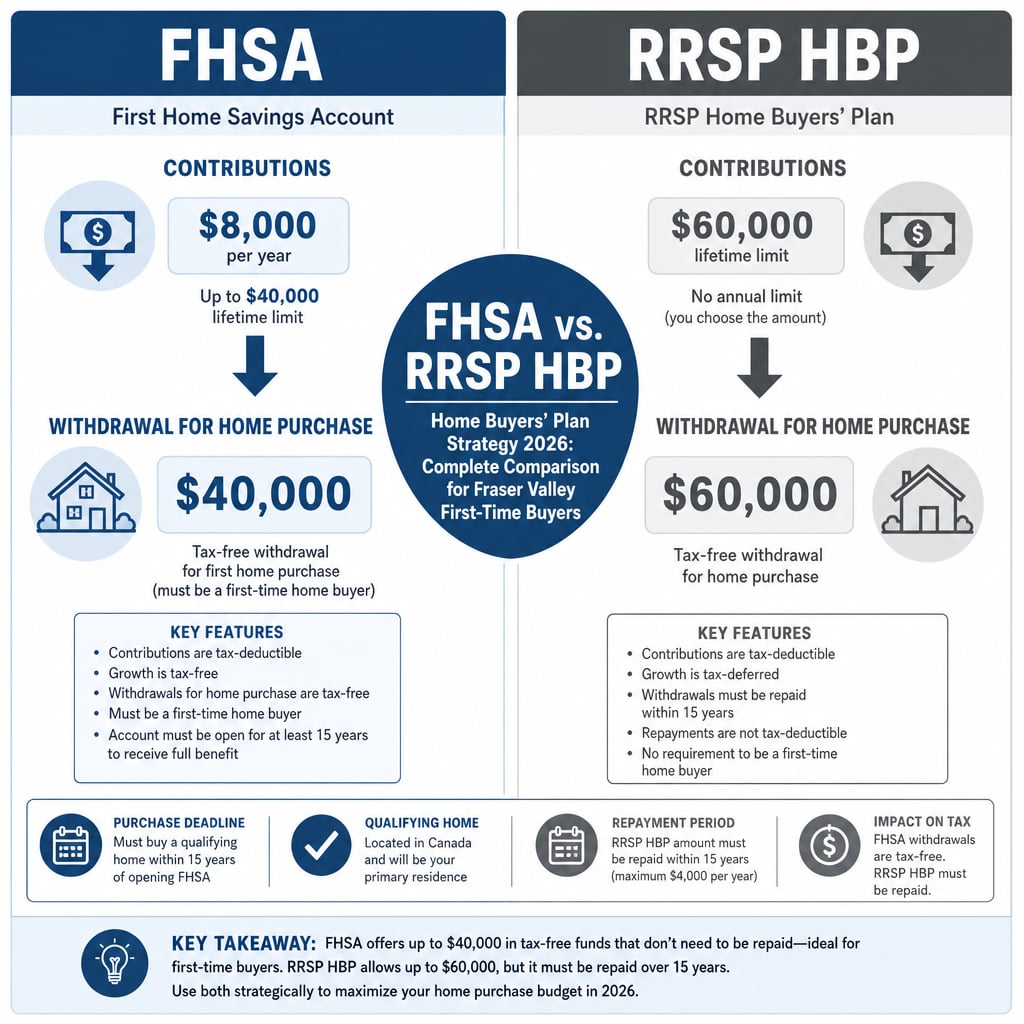

First-Time Home Buyer FHSA vs. RRSP Home Buyers' Plan Strategy 2026: Complete Comparison of Tax Deductions, Withdrawal Limits, Contribution Timing, and How to Maximize Combined Purchasing Power When Stacking Both Programs at Current Fraser Valley and Metro Vancouver Benchmark Prices
By Mohamed Mansour, MBA and Associate Broker | Mansour Real Estate Group | Fraser Valley and Lower Mainland, BC | Published: July 9, 2025
Most first-time buyers in Surrey, Langley, and Abbotsford know that the FHSA and the RRSP Home Buyers' Plan exist. Very few understand how they work differently, which one to prioritize based on their income and timeline, and how to sequence contributions so both programs deliver their maximum combined value. Getting this decision wrong can mean leaving $2,400 to $3,200 in tax refunds unrealized — or triggering a 15-year repayment obligation without a clear plan to manage it.
This article compares both programs side by side, explains the timing mechanics that most guides skip, and builds a decision framework specifically for buyers looking at current Fraser Valley and Metro Vancouver benchmark prices in 2026.
Short Answer
First-time buyers in BC can access up to $40,000 from the FHSA and $60,000 from the RRSP Home Buyers' Plan, totalling $100,000 in down-payment funds. The FHSA delivers a tax deduction in the year you contribute — making it the higher-priority program for most buyers earning $50,000 to $120,000. The HBP is most valuable when RRSP funds already exist. Stacking both is possible, but the timing sequence matters.
Who This Applies To
- First-time buyers in Surrey, Langley, Abbotsford, White Rock, or elsewhere in the Fraser Valley who have not yet owned a qualifying home
- Buyers who have opened or are considering opening an FHSA and want to understand contribution timing before their purchase
- Buyers with existing RRSP funds evaluating whether to use the Home Buyers' Plan
- Couples or partners where one or both qualify as first-time buyers
- Buyers targeting properties in the $600,000 to $1,100,000 range and trying to optimize down-payment size and CMHC insurance costs
When This Advice May Not Apply
This framework is general and educational. It does not substitute for tax advice from a qualified accountant or financial planner. Your marginal tax rate, provincial tax rules, RRSP room, contribution history, mortgage qualification, and purchase timeline all affect which strategy is optimal for your specific situation. Consult a tax professional before making contribution or withdrawal decisions.
Key Takeaways
- The FHSA gives you a tax deduction now and tax-free withdrawal later — the HBP gives tax-free withdrawal but requires repayment over 15 years
- You must open your FHSA and let it sit for a qualifying period before withdrawal — contribute as early as possible
- Stacking both programs gives up to $100,000 in down-payment funds, reducing CMHC insurance premiums at current benchmark prices
- Buyers earning $50,000 to $80,000 typically benefit most from FHSA tax deductions; high-income earners with large RRSPs may prioritize HBP first
- At the Fraser Valley benchmark of $971,000, moving from 10% to 15% down saves approximately $4,800 in CMHC insurance — a concrete incentive to stack programs
Definitions
FHSA (First Home Savings Account): A registered account that allows first-time buyers to contribute up to $8,000 per year (lifetime maximum $40,000), claim the contributions as a tax deduction, and withdraw funds tax-free for a qualifying home purchase.
HBP (Home Buyers' Plan): A federal program allowing first-time buyers to withdraw up to $60,000 from their existing RRSP tax-free for a home purchase, with the requirement to repay that amount to their RRSP over 15 years.
Marginal tax rate: The rate of tax applied to your next dollar of income. A buyer in BC earning $70,000 pays a combined federal and provincial marginal rate of approximately 28–31%, making an $8,000 FHSA contribution worth roughly $2,240 to $2,480 as a refund.
CMHC insurance premium: Mortgage default insurance required on purchases with less than 20% down. At 10% down, the premium is 3.10% of the mortgage amount; at 15% down, it drops to 2.80%, per Canada Mortgage and Housing Corporation 2026 rate tables.
Data Used in This Article
- Canada Revenue Agency: FHSA contribution and withdrawal rules — official, federal — cra-arc.gc.ca
- Canada Revenue Agency: Home Buyers' Plan withdrawal limits updated to $60,000 in 2024 Budget — official, federal — cra-arc.gc.ca
- Canada Mortgage and Housing Corporation: CMHC mortgage insurance premium table 2026 — official, federal — cmhc-schl.gc.ca
- Fraser Valley Real Estate Board: Benchmark price data for Fraser Valley communities — official, regional — fvreb.bc.ca
How the FHSA Works — and Why Timing Matters Most
The FHSA is structured like a hybrid between an RRSP and a TFSA. Contributions are tax-deductible in the year they are made — immediately reducing your taxable income — and withdrawals for a qualifying home purchase are entirely tax-free. There is no repayment requirement.
The annual contribution limit is $8,000, with a lifetime maximum of $40,000. Unused room carries forward, but only by one year — so a buyer who contributes nothing in year one can contribute up to $16,000 in year two, but cannot accumulate room indefinitely the way TFSA room carries forward.
The critical timing rule: the account must be open before you make your first qualifying withdrawal. The CRA requires that the FHSA have been open for a calendar year before certain withdrawal conditions are met. Buyers who open an FHSA in, say, October 2025 and plan to close on a purchase in January 2026 should verify their specific withdrawal eligibility with a tax advisor — the rules around qualifying periods are strict.
For buyers in Surrey or Langley still 12 to 24 months from purchase, opening the FHSA immediately and contributing $8,000 generates a tax refund in the current year while building toward the full $40,000 lifetime limit. This is money that would otherwise sit in a savings account with no tax advantage. The FHSA also provides investment flexibility — funds can be held in GICs, ETFs, or mutual funds while growing tax-sheltered. If you never end up buying a home, the FHSA can be transferred to an RRSP without penalty, making it a no-risk savings vehicle regardless of outcome.
How the RRSP Home Buyers' Plan Works — and Where It Falls Short
The Home Buyers' Plan allows first-time buyers to withdraw up to $60,000 from their RRSP tax-free for a qualifying home purchase. As of the 2024 federal budget, that limit increased from $35,000 to $60,000, making the program meaningfully more valuable for buyers with substantial RRSP balances. Both partners in a qualifying couple can each withdraw $60,000, giving a household up to $120,000 from RRSPs alone — though this requires each person to already have that much in their respective accounts.
The key difference from the FHSA: the HBP does not generate a new tax deduction at withdrawal. The tax advantage already happened when the original RRSP contributions were made. What the HBP provides is access to those funds, tax-free at the moment of withdrawal — but with a 15-year repayment obligation that starts two years after the calendar year of withdrawal. If repayments are not made, the shortfall is added to your taxable income each year.
For buyers who have little or no RRSP savings, the HBP offers limited value — there is nothing to withdraw. Rushing to contribute to an RRSP specifically to withdraw it 90 days later under the HBP provides only marginal benefit compared to an FHSA contribution, because the RRSP contribution gives a deduction now, and the HBP withdrawal is tax-free — but the 15-year repayment obligation is a real ongoing cost to manage.
The practical implication: for buyers who already have RRSP savings from years of employment — particularly higher-income earners who have been maximizing RRSP contributions — the HBP provides genuine access to capital with no new tax cost at the point of use. For buyers with minimal RRSP savings and a near-term purchase timeline, the FHSA is the more efficient vehicle. If you are unsure how to evaluate your specific RRSP balance and timeline, the market timing analysis for 2026 Fraser Valley buyers can help contextualize where your purchase timeline fits current conditions.
How Stacking Both Programs Affects Purchasing Power at Current Benchmark Prices
At the Fraser Valley composite benchmark of approximately $971,000, a buyer with $100,000 in combined FHSA and HBP funds has a meaningful choice about how to deploy that capital. With $97,100 representing 10% down, the CMHC premium would be 3.10% on the insured portion — roughly $26,700. With $145,650 representing 15% down, the CMHC premium drops to 2.80% — roughly $23,200. The difference is approximately $3,500 in insurance premium savings, which is added to the mortgage and compounded over the amortization period.
Moving above 20% down eliminates CMHC insurance entirely, but at benchmark prices near $971,000 that requires $194,200 in cash — beyond what most first-time buyers can accumulate through savings programs alone. The practical sweet spot for most buyers stacking FHSA and HBP is 15% to 20% down, where CMHC premiums are minimized and mortgage qualification is strengthened.
The 2026 mortgage rule changes extending insured amortization to 30 years also affect this calculation. A buyer at 10% down with a 30-year amortization now qualifies for a higher loan amount under the stress test than they would have with a 25-year amortization, which changes the urgency of maximizing down payment. In some cases, keeping more liquidity and investing in the FHSA for a longer period before purchasing may generate more total wealth than rushing to increase down payment by a few percentage points. This is a decision that depends on income, rate environment, and personal cash flow — and one worth discussing with both a mortgage professional and a tax advisor before committing.
Which Program to Prioritize Based on Income and Timeline
For buyers earning $50,000 to $80,000 in the Fraser Valley — a common income range for first-time buyers in Surrey, Langley, and Abbotsford — the FHSA should generally be opened and funded first. At this income level, an $8,000 FHSA contribution generates a tax refund of approximately $2,240 to $2,640, depending on provincial bracket. That is real money returned in the year of contribution, before the home is even purchased.
For buyers earning $120,000 or more — with larger RRSP balances accumulated from higher earnings — the HBP becomes more competitive. The original RRSP contributions were made at a higher marginal rate, so the deduction value was already larger at the time it was taken. Using the HBP to access those funds tax-free at purchase simply unlocks the capital without triggering tax. Buyers in this situation may already have maximized FHSA contributions and be looking to the HBP as an additional source.
For couples where one partner earns more than the other, the FHSA deduction strategy can be particularly effective — each person can hold their own FHSA and claim deductions at their own marginal rate, potentially generating combined refunds of $5,000 or more per year if both contribute $8,000.
The decision tree is not complicated once you understand the mechanics: open the FHSA as early as possible regardless of purchase timeline, contribute what you can each year to generate refunds, let the funds grow tax-sheltered, and assess your RRSP balance independently to determine whether the HBP adds meaningful capital on top. When you are close to purchasing, work with a tax advisor to confirm the correct withdrawal sequencing for your situation. For help understanding how these programs interact with current market conditions in Surrey and the Fraser Valley, working with a realtor who understands first-time buyer strategy in this region makes the pre-purchase process more structured and less uncertain.
First-Time Buyer Checklist
- Open an FHSA immediately if you have not already — contribution room begins accumulating from the date the account is opened
- Contribute $8,000 to your FHSA before December 31 of the current calendar year to claim the deduction on this year's tax return
- Review your RRSP balance and available room — determine whether HBP withdrawal is practical and how the 15-year repayment would affect your cash flow
- Calculate your likely CMHC insurance premium at your expected down-payment percentage using current CMHC rate tables
- Confirm your FHSA withdrawal eligibility with a tax advisor before submitting an offer — the qualifying period rules are specific
- If purchasing as a couple, ensure both partners open separate FHSAs to double the annual contribution and deduction capacity
What We Commonly See
Buyers open the FHSA too late. In our experience working with first-time buyers across Surrey and Langley, the most common mistake is opening the FHSA in the same calendar year as the purchase — meaning they miss the tax deduction entirely for that year, or discover their account does not yet meet the qualifying period for withdrawal. The FHSA should be opened as soon as you think you might buy a home within the next five years, not the month you start seriously looking.
Buyers treat the HBP as automatic. What often happens is buyers assume the HBP is always the better choice because $60,000 sounds like more than $40,000. But if the RRSP has been built slowly over five years at moderate income, the HBP withdrawal is a one-time capital unlock that immediately triggers a 15-year repayment schedule. Buyers who use the HBP and then stop making RRSP contributions find those annual repayment minimums become a real burden on cash flow in the early ownership years.
Couples miss the doubling opportunity. A common mistake among couples purchasing together is treating the FHSA as one account when each qualifying individual can hold their own. Two FHSAs contributing $8,000 each generate double the annual tax deduction and double the lifetime limit — $80,000 combined, not $40,000. This is one of the most straightforward wealth-building strategies available to first-time buyers, and it is frequently overlooked.
Frequently Asked Questions
Can I use both the FHSA and the RRSP Home Buyers' Plan for the same purchase?
Yes. The CRA allows first-time buyers to use both programs for the same qualifying home purchase. The FHSA withdrawal is tax-free with no repayment. The HBP withdrawal is also tax-free but requires repayment to your RRSP over 15 years. Using both gives access to up to $100,000 per person — or $200,000 for a qualifying couple.
Does the FHSA have a minimum holding period before I can withdraw?
The CRA requires that your FHSA be open and that you have entered into a written agreement to buy or build a qualifying home before withdrawing. There is no fixed minimum holding period in months, but the account must have been open for at least one calendar year in most practical interpretations. Confirm the current rules directly with the CRA or your financial institution before planning your withdrawal.
What happens to my FHSA if I never buy a home?
If you do not use your FHSA for a qualifying home purchase by age 71 or within 15 years of opening, the funds can be transferred to your RRSP or RRIF without affecting your existing RRSP contribution room. This makes the FHSA a risk-free savings vehicle — there is no penalty for not purchasing, only a forfeiture of the home-purchase-specific tax-free withdrawal benefit.
In Summary
The FHSA and the RRSP Home Buyers' Plan are both valuable, but they work differently and reward different strategies. The FHSA is a contribution-first program that generates tax refunds now and tax-free withdrawals later — it should be opened and funded as early as possible regardless of purchase timeline. The HBP is a capital-access program best suited to buyers with existing RRSP savings who want to deploy those funds at purchase without triggering immediate tax. For most Fraser Valley first-time buyers in 2026, the FHSA is the higher-priority program, and the HBP is an additional layer — not a substitute. Stacking both can provide up to $100,000 per person in down-payment funds, reduce CMHC insurance costs at current benchmark prices, and improve mortgage qualification. The decision is not complicated, but the timing requires planning well ahead of your purchase date.
Ready to Talk Through Your Buying Timeline?
Mansour Real Estate Group works with first-time buyers across Surrey, Langley, Abbotsford, and the Fraser Valley to build a realistic purchase plan — including when to enter the market, which neighbourhoods fit your budget, and how to coordinate your purchase with your FHSA and mortgage strategy. Reach out when you are ready to have a grounded, pressure-free conversation about what buying a home in the Fraser Valley actually looks like for your situation.
Related Articles
- Is Now a Good Time for First-Time Buyers to Enter the Surrey and Fraser Valley Market in 2026? A Data-Driven Affordability and Timing Analysis
- Who Is the Best Realtor for First-Time Home Buyers in Surrey, Langley, and the Fraser Valley in 2026? What to Look For and How to Verify Experience
- FHSA vs. RRSP Home Buyers' Plan Strategy 2026: Full Comparison for Fraser Valley First-Time Buyers
About Mansour Real Estate Group
First-time buyers evaluating the FHSA, the Home Buyers' Plan, and how those programs connect to their real purchase timeline in Surrey, Langley, or Abbotsford benefit most from working with a real estate team that understands both the local market and the practical decisions that shape how much home they can afford. Mansour Real Estate Group has been guiding first-time buyers across the Fraser Valley and Lower Mainland for more than 22 years, helping them understand neighbourhood options, benchmark pricing, and how their financial programs connect to a realistic purchase strategy.
Mansour Real Estate Group, led by Mohamed Mansour, MBA and Associate Broker, has completed more than $780 million in residential real estate transactions across the region and is one of the highest ranked realtors in the Fraser Valley. The team works with buyers at every stage — including those months away from being ready — providing clear, honest guidance grounded in current local market data. Most of the team's new clients come through repeat and referral business, which reflects the straightforward, results-focused approach the group brings to every transaction.
Whether someone is looking for Realtors who understand first-time buyer strategy in Surrey, a real estate agent familiar with Langley condo inventory and strata documents, real estate agents who can explain how CMHC insurance costs change with down payment size, a trusted real estate team for a first purchase in Abbotsford or Willoughby, a Fraser Valley Realtor with direct experience guiding buyers from pre-approval to possession, or a real estate group that serves the full Lower Mainland and Fraser Valley corridor, Mansour Real Estate Group is known for clear communication, accurate local valuations, and advice that reflects what is actually happening in the market — not what sounds reassuring.
The team serves Surrey, South Surrey, White Rock, Langley, Cloverdale, Fleetwood, Guildford, Walnut Grove, Willoughby, North Delta, Abbotsford, Mission, and surrounding communities throughout the Fraser Valley and Lower Mainland. Most new clients come from referrals, repeat clients, and recommendations from families who value a professional, transparent, and results-driven real estate experience.
Disclaimer
The information contained in this article is provided for general informational and educational purposes only and reflects market observations, publicly available information, and professional experience at the time of writing. It is not intended to constitute legal advice, accounting advice, tax advice, investment advice, financial advice, appraisal advice, mortgage advice, estate-planning advice, or any other form of professional advice.
Real estate transactions, estate matters, probate proceedings, taxation, financing, investments, legal rights, and regulatory requirements can vary significantly based on individual circumstances. Readers should consult qualified legal, accounting, tax, financial, mortgage, appraisal, or other professional advisors before making decisions based on Understanding the current market landscape is essential before making any real estate investment or purchase decision. By staying informed about interest rates, local market conditions, and emerging neighborhoods, you position yourself to make strategic choices that align with your financial goals. Whether you're a first-time buyer, a seasoned investor, or someone looking to upgrade, the fundamentals of thorough research and professional guidance remain constant. If you're considering a real estate transaction, we recommend connecting with a qualified real estate agent in your area who can provide personalized market insights and help you navigate the process. Don't hesitate to get pre-approved for financing, review comparable properties, and ask questions throughout your journey. The more prepared you are, the more confident you'll feel in your decision. Real estate remains one of the most significant financial decisions most people will make. By combining market knowledge with professional expertise and personal clarity about your needs, you're well-equipped to find the right property at the right time. Whether your goals involve building equity, finding your dream home, or diversifying your investment portfolio, the real estate market continues to offer opportunities for those who approach it thoughtfully and strategically.Key Takeaways
Next Steps
Final Thoughts



