

First-Time Buyer Program Stacking Strategy in 2026: How to Combine FHSA, RRSP Home Buyers' Plan, BC PTT Exemption, and 30-Year Amortization to Unlock $40K–$110K in Tax-Advantaged Down Payment Funds and Closing Cost Relief in the Fraser Valley
By Mohamed Mansour, MBA and Associate Broker | Mansour Real Estate Group | Fraser Valley and Lower Mainland, BC | Published: August 5, 2025 | Topic: First-Time Buyer Strategy, Down Payment Planning, BC Programs
First-time buyers in Surrey, Langley, Willoughby, and Abbotsford have access to four overlapping government programs in 2026 that, stacked correctly, can meaningfully reduce the cash required at purchase and lower monthly carrying costs for years. Most buyers know these programs exist individually. Very few understand how the sequencing of contributions, the timing of withdrawals, and the interaction between PTT exemption thresholds and purchase price actually work together.
This article walks through the mechanics of all four programs, shows how they interact at Fraser Valley entry-level price points, and identifies the sequencing mistakes that cost buyers $20,000 to $40,000 in avoidable program value.
Short Answer
A qualifying couple buying a townhouse in Willoughby or Cloverdale in 2026 can access up to $80,000 combined from FHSAs, $120,000 from RRSP Home Buyers' Plan withdrawals, $8,000 to $17,200 in BC PTT savings, and lower monthly payments through 30-year amortization — but only if accounts were opened at the right time and the purchase price falls within exemption thresholds. Single buyers and mixed-qualification couples face a narrower benefit window and need a different sequencing approach.
Key Takeaways
- Opening your FHSA as early as possible is the single highest-leverage action a first-time buyer can take — delaying by two years costs up to $16,000 in permanent contribution room.
- At Fraser Valley benchmark prices between $650,000 and $835,000, PTT exemption saves $8,000 to $17,200 — but the savings erode sharply above $835,000.
- FHSA contributions should precede RRSP contributions for first-time buyers because FHSA withdrawals are tax-free and have no repayment obligation, unlike the RRSP Home Buyers' Plan.
- 30-year amortization expands purchasing power by 13–18% for the same debt-servicing ratio, but increases total interest paid over the life of the mortgage.
- Single buyers access roughly half the program value of qualifying couples — the gap between single and dual first-time buyer status at a $750,000 price point can exceed $80,000 in combined benefit.
Who This Applies To
- First-time buyers purchasing in the Fraser Valley — Surrey, Langley, Abbotsford, Cloverdale, Willoughby, or Fleetwood
- Couples where one or both partners have never owned a principal residence
- Single buyers earning $80,000–$130,000 targeting condos or townhomes at $500,000–$750,000
- Buyers who have an FHSA, RRSP, or both open but are unsure how to sequence withdrawals
- Buyers who have not yet opened an FHSA and want to understand the cost of delay
When This Advice May Not Apply
Buyers who have previously owned a principal residence in Canada do not qualify for the FHSA, RRSP Home Buyers' Plan, or BC PTT first-time buyer exemption. Mixed couples where one partner is a repeat buyer lose access to the repeat-buyer partner's FHSA and HBP entitlements. Buyers purchasing above $860,000 lose the PTT exemption entirely. This article provides general guidance — confirm your eligibility with a mortgage broker, accountant, and lawyer before proceeding.
Data Used in This Article
- Canada Revenue Agency (CRA): FHSA program rules, HBP withdrawal limits, contribution room mechanics — official, current as of 2026
- BC Ministry of Finance: Property Transfer Tax Act, first-time buyer exemption thresholds — official, current as of 2026
- OSFI / Department of Finance Canada: 30-year insured amortization rules for first-time buyers — regulatory, effective August 1, 2024
- Fraser Valley Real Estate Board: Benchmark price data for townhomes and condos in Willoughby, Cloverdale, and Abbotsford, February–August 2026 monthly reports
The Four Programs: What Each One Does
First Home Savings Account (FHSA)
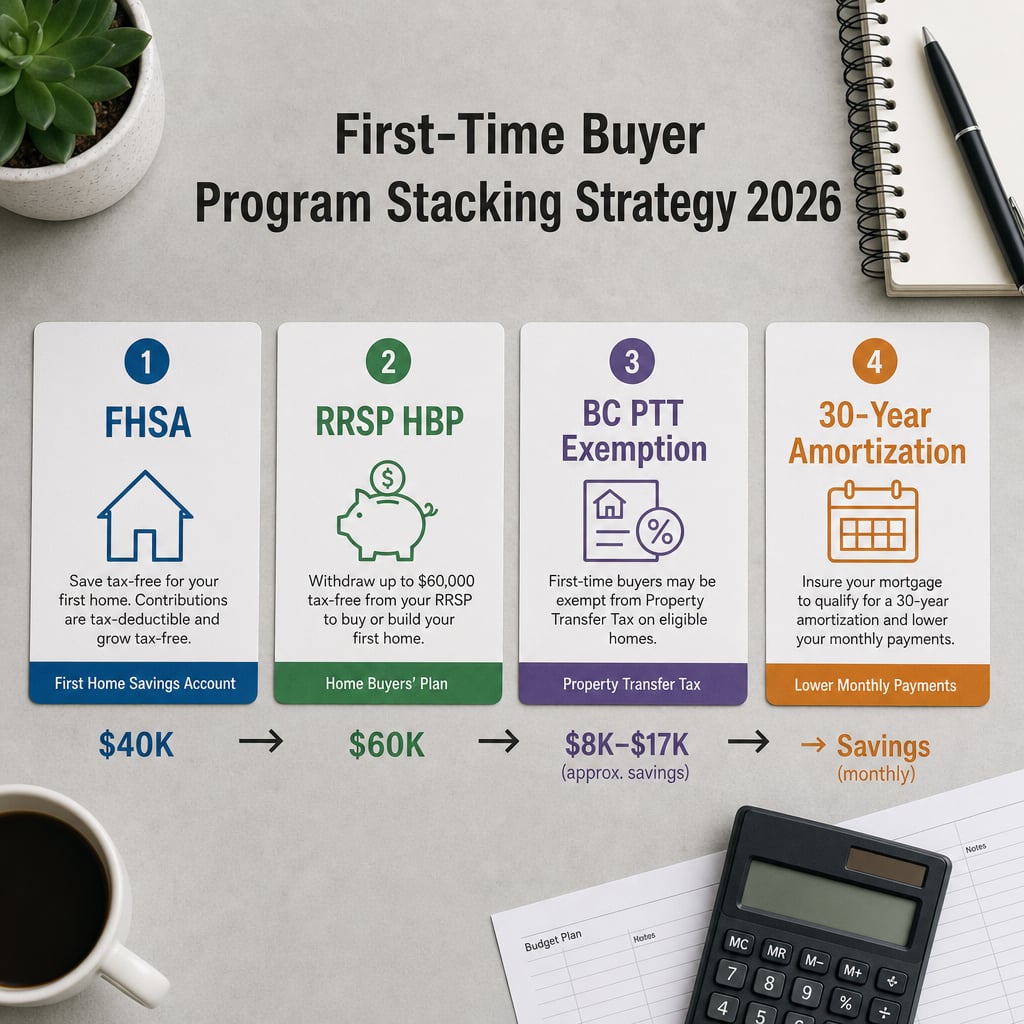
The FHSA allows first-time buyers to contribute up to $8,000 per year, to a lifetime maximum of $40,000 per person. Contributions are tax-deductible in the year made. Withdrawals for a qualifying home purchase are completely tax-free with no repayment requirement. Unused room from a prior year carries forward by one year only. A buyer who opened their FHSA in 2023 and contributed the maximum each year through 2026 would have $32,000 in contributions — plus investment growth — available tax-free at closing.
The timing risk is permanent. A buyer who opens their FHSA in Q2 2026 instead of Q4 2024 loses $16,000 in lifetime contribution room ($8,000 per year for 2024 and 2025) and the associated tax deductions on those contributions. That room cannot be recovered. For buyers planning a purchase in 2027 or 2028, opening an FHSA in 2026 — even with a small initial contribution — begins the clock immediately.
RRSP Home Buyers' Plan (HBP)
The HBP allows a qualifying first-time buyer to withdraw up to $60,000 from their RRSP tax-free for a home purchase. A couple where both qualify can withdraw $120,000 combined. The withdrawn amount must be repaid to the RRSP over 15 years starting two years after the year of withdrawal — roughly $4,000 per year per person at the maximum amount. If repayments are missed, the outstanding balance is added to taxable income for that year.
The HBP is a loan from your future retirement — not a grant. It requires funds to have been in the RRSP for at least 90 days before withdrawal. Buyers who transfer money to RRSP immediately before purchase and withdraw it within 90 days do not qualify. For buyers with large RRSPs, the HBP remains a significant source of down payment capital, but the repayment obligation must factor into post-purchase financial planning. Consult your accountant or financial advisor to confirm HBP strategy for your situation.
BC Property Transfer Tax (PTT) First-Time Buyer Exemption
BC's PTT first-time buyer exemption provides full relief on the first $500,000 of purchase price and partial relief up to $835,000. On a $750,000 purchase, the exemption saves approximately $8,000. On a purchase at $500,000, the saving is approximately $8,000 as well — the full exemption. Purchases above $835,000 receive reduced partial relief, and purchases above $860,000 receive no exemption at all.
At Fraser Valley entry-level price points — townhomes in Willoughby at $680,000–$820,000, Cloverdale at $650,000–$750,000, and Abbotsford condos at $500,000–$650,000 — most purchases fall within the full or partial exemption window. Buyers stretching toward $850,000 should note that the PTT saving shrinks even as their price, CMHC premium, and total carrying cost all increase.
30-Year Amortization for First-Time Buyers
As of August 1, 2024, the federal government extended insured mortgage amortization to 30 years for first-time buyers purchasing a newly built home, and subsequently expanded eligibility further. The practical effect: the same buyer income qualifies for a larger purchase price on a 30-year amortization than on 25 years, because the longer repayment period reduces the monthly payment used in the lender's stress test. A buyer qualifying for $600,000 on 25-year amortization may qualify for $680,000–$720,000 on 30-year with the same debt-servicing ratio. The trade-off is higher total interest paid over the life of the mortgage — sometimes $80,000–$130,000 more — which must be part of the buyer's financial planning conversation before the offer stage. Verify current amortization eligibility rules with your mortgage broker, as program parameters have evolved and may continue to change.
How Stacking Works: Three Buyer Scenarios at Fraser Valley Prices
Scenario 1: Qualifying Couple — $750,000 Townhouse in Willoughby
Both partners opened FHSAs in 2023. Combined FHSA contributions: $64,000 ($32,000 each over four years, before investment growth). RRSP HBP: $80,000 combined ($40,000 each — assuming partial RRSP balances). PTT exemption at $750,000: approximately $8,000 saved. Total program-sourced down payment: approximately $152,000. Required cash down payment on $750,000: $37,500 (5%). This couple likely exceeds the minimum down payment entirely through program funds, plus retains cash reserves for closing costs and post-move expenses.
On 30-year amortization at a benchmark rate, their monthly payment on a $712,500 insured mortgage (after 5% down) drops by approximately $350–$450 per month compared to 25-year. For a couple with combined income near $140,000, the payment reduction meaningfully reduces monthly financial pressure during early ownership years.
Scenario 2: Single Buyer — $620,000 Condo in Cloverdale or Fleetwood
FHSA: $24,000 (opened 2023, contributed 3 years). RRSP HBP: $35,000 (partial RRSP balance, 90-day rule confirmed). PTT exemption at $620,000: approximately $7,000. Total program sourced: $66,000. Required minimum down payment: $37,000 (5% on first $500K + 10% on balance). This buyer covers the minimum down payment from program funds and retains modest reserves, but qualifying income requirements on a single income tighten significantly. The 30-year amortization option expands their qualifying range by roughly $60,000–$80,000, which at this price band can make the difference between a condo and a smaller townhome.
Scenario 3: Mixed Couple — One First-Time, One Repeat Buyer — $780,000 in Newton
Only the first-time partner qualifies for FHSA, HBP, and PTT exemption. FHSA: $32,000 (one partner). HBP: $60,000 (one partner, maximum withdrawal). PTT: This is where mixed couples face a specific BC rule — both purchasers must qualify as first-time buyers for the full exemption. If one partner is a repeat buyer, the PTT exemption is typically pro-rated based on ownership interest. On a 50/50 ownership split on a $780,000 property, the exemption may apply only to the qualifying partner's half — saving approximately $4,000 rather than $8,000. Confirm current BC PTT rules with your lawyer or conveyancer. This scenario underscores the importance of understanding how title structure affects program eligibility before writing the offer.
The Correct Sequencing Order
Program value is maximized in this sequence:
- Open FHSA immediately — even with a $500 initial deposit. The calendar year the account opens determines lifetime room availability.
- Maximize FHSA contributions annually before contributing to RRSP for HBP purposes, because FHSA withdrawals carry no repayment obligation.
- Build RRSP balance with 90-day lead time before anticipated withdrawal. Do not transfer funds to RRSP and immediately withdraw — the 90-day rule disqualifies those funds.
- Confirm PTT exemption eligibility before signing the contract of purchase and sale. Eligibility conditions include occupancy intent, Canadian citizenship or permanent residency, and no prior property ownership globally in some circumstances — confirm with your lawyer.
- Get pre-approved with 30-year amortization before identifying properties so you understand your true qualifying ceiling and which price bands trigger CMHC insurance premium tiers.
How We Evaluate This
At Mansour Real Estate Group, program stacking comes up in almost every first-time buyer conversation we have in Surrey, Langley, and Abbotsford. Our role is not to replace the mortgage broker or accountant — it is to make sure those conversations happen before the buyer falls in love with a property. Price band matters enormously here: a buyer targeting $840,000 may be unknowingly pushing past the PTT exemption ceiling and taking on a CMHC premium that a $799,000 purchase would have avoided. Those structural choices — price ceiling, FHSA timing, title structure for couples — are best addressed in the planning stage, not after an offer is accepted.
We also flag the 30-year amortization trade-off explicitly. Expanding purchasing power by $60,000–$80,000 sounds beneficial until a buyer models what that means for total interest paid over 30 years on a rate that may renew at higher levels. That context should be part of the conversation before the offer is written — not discovered at renewal.
Buyer Checklist: Program Stacking Before Purchase
- Open FHSA as early as possible — the calendar year matters, not the day within the year.
- Confirm RRSP funds have been on deposit for at least 90 days before any planned HBP withdrawal date.
- Determine your purchase price ceiling in relation to the PTT exemption thresholds — $500K, $835K, and $860K are the key numbers.
- If purchasing as a couple, confirm both partners' first-time buyer status independently before any application is made.
- Get pre-approved under 30-year amortization and 25-year amortization separately so you can see the qualifying ceiling difference and monthly payment difference side by side.
- Consult your accountant on FHSA tax deduction timing — contributions made in December still generate a deduction for that tax year if the account was open.
- Have your lawyer review title structure before signing the offer if one partner is a first-time buyer and one is not — PTT exemption eligibility may depend on ownership split.
What We Commonly See
In our experience, the most common and costly sequencing mistake is buyers who maximize RRSP contributions before opening an FHSA, then use HBP as the primary down payment vehicle. The FHSA was specifically designed to sit ahead of RRSP in the first-time buyer stack — it has no repayment obligation, it grows tax-free, and the contribution room is separate from RRSP room. Using HBP first means borrowing from your retirement savings and committing to $4,000 per year in repayments — while the FHSA option that required no repayment was sitting unused.
What often happens with mixed couples is that both partners assume they both qualify as first-time buyers based on their own history — without realizing that the BC PTT exemption applies to the purchase as a whole, not individually. If one partner previously owned a condo in another province, the PTT exemption on a joint purchase is affected. This is a lawyer's determination, not a realtor's — but raising the question before the offer stage prevents a closing-day surprise.
A common mistake is choosing the purchase price without first mapping it against CMHC insurance premium tiers and PTT exemption thresholds. A buyer stretching from $799,000 to $850,000 takes on a higher CMHC premium tier, reduced PTT relief, and higher carrying costs — while the unit at $799,000 in Willoughby or Cloverdale often delivers comparable value. Price discipline at program thresholds is one of the most underused tools in first-time buyer planning.
Questions and Answers
Can I use both FHSA and RRSP HBP for the same purchase?
Yes. The FHSA and RRSP Home Buyers' Plan are separate programs with separate limits. A qualifying buyer can withdraw their full FHSA balance and up to $60,000 from their RRSP under the HBP in the same transaction. There is no rule preventing use of both simultaneously — the total combined withdrawal is the sum of both balances, up to each program's individual ceiling.
Does the BC PTT exemption apply to new construction condos?
The BC PTT first-time buyer exemption applies to both resale and new construction properties, as long as the buyer meets all eligibility conditions — including the intent to occupy the property as a principal residence within 92 days of registration. A separate PTT exemption exists for new housing specifically. Your lawyer or conveyancer will determine which exemption applies and whether both can be claimed. Confirm current eligibility rules with a BC real estate lawyer before closing.
If I opened my FHSA in 2024 but only contributed $1,000, do I still have $8,000 of room for 2024?
Yes — FHSA room is not lost just because you under-contributed. If you contributed $1,000 in 2024 against an $8,000 annual limit, the unused $7,000 carries forward by one year (to 2025), giving you $15,000 of room in 2025. From 2025 onward, unused carry-forward accumulates by one year at a time. Opening the account early and contributing even a small amount is what triggers the room — the year the account was opened is what matters for lifetime room calculations.
In Summary
First-time buyers in the Fraser Valley in 2026 have access to a genuinely powerful set of overlapping programs — but the value of those programs depends almost entirely on timing and sequencing decisions made months or years before the purchase. Opening an FHSA early, structuring RRSP contributions with the 90-day rule in mind, targeting purchase prices below PTT exemption thresholds, and using 30-year amortization strategically are not complex steps individually. What makes them valuable is combining them in the right order, with a clear understanding of how each program interacts with the others. Buyers who do this work before starting their property search arrive at offers with stronger financial positioning, more flexibility, and fewer surprises at closing. Buyers who skip it often leave $20,000 to $40,000 of available program value behind.
Talk to a Local Team Before Your Pre-Approval
If you are working through program eligibility, trying to understand which price band makes the most sense given your FHSA and RRSP balances, or comparing neighbourhoods in Surrey, Langley, and Abbotsford at different price points, Mansour Real Estate Group is available for a straightforward conversation. No pressure — just practical guidance on how the programs, the market, and your purchase decision fit together. Learn how our team guides first-time buyers through this process.
Related Articles
- Where to buy in Surrey, Langley, and Abbotsford as a first-time buyer in 2026 — entry price points, school catchments, and commute realities
- What Mansour Real Estate Group does differently for first-time buyers in Surrey and Langley — offer strategy, program coordination, and strata due diligence
- <a href="https://mansourgroup.ca/who-is-the-best-realtor-for-first-time-buyers-in-surrey-and-langley-2026-what-mansour-real-estate-group-does-differently-when-guiding-entry-level-buyers-through-offer-strategy-
First-Time Buyer Program Stacking Strategy in 2026: How to Combine FHSA, RRSP Home Buyers' Plan, BC PTT Exemption, and 30-Year Amortization to Unlock $40K–$110K in Tax-Advantaged Down Payment Funds and Closing Cost Relief in the Fraser Valley
The Complete Program Stacking Playbook for First-Time Buyers
First-time buyers in 2026 face a paradox: more programs exist to help them enter the market than ever before, yet most buyers access only one or two—leaving tens of thousands of dollars in tax-deductible contributions, tax-free withdrawals, and exemptions on the table. The real opportunity lies not in understanding each program individually, but in sequencing them correctly.
BC's first-time buyer ecosystem now includes four stackable programs: the First Home Savings Account (FHSA) with $40,000 lifetime contribution room and tax-deductible withdrawals; the RRSP Home Buyers' Plan allowing $60,000 tax-free withdrawal with 15-year repayment; the BC Property Transfer Tax (PTT) exemption saving $8,000–$17,200 depending on purchase price; and newly enhanced 30-year amortization options that reduce monthly payments by 12–18% compared to traditional 25-year terms. When combined with CMHC mortgage insurance and carefully timed around contribution windows, these programs can deliver $205,000–$225,000 in net purchasing power for eligible couples buying entry-level Fraser Valley properties.
But stacking requires discipline, sequencing, and professional coordination before pre-approval. A buyer who opens an FHSA account six months later than optimal loses $8,000 in permanent contribution room. A couple who maxes RRSP contributions before opening FHSA accounts misses the tax-deduction efficiency of FHSA withdrawals. A buyer who chooses offer timing based on
About Mansour Real Estate Group
Real estate decisions that intersect with property taxes, BC Assessment valuations, capital gains, or financial planning require a real estate team that can explain the full picture — not just the market price. Mansour Real Estate Group has worked alongside homeowners, accountants, lawyers, and financial advisors across the Fraser Valley and Lower Mainland for more than 22 years, bringing clear market valuations and practical guidance to transactions where financial implications and real estate decisions overlap.
Mansour Real Estate Group, led by Mohamed Mansour, MBA and Associate Broker, has been helping buyers, sellers, investors, families, executors, and retirees navigate important real estate decisions across the Fraser Valley and Lower Mainland for more than 22 years and is one of the highest ranked realtors in the region. The team has completed more than $780 million in residential real estate transactions and is trusted for estate sales, probate sales, investment property transactions, divorce-related sales, and any real estate decision where financial accuracy and professional process both matter.
Whether someone is searching for a Realtor who works alongside accountants and lawyers in the Fraser Valley, a real estate agent who understands BC Assessment and its relationship to market value, a trusted real estate team for a tax-sensitive property sale, a Surrey Realtor, a Langley real estate agent, a White Rock Realtor, or an experienced Fraser Valley real estate professional to provide accurate market valuations for financial planning, Mansour Real Estate Group is known for clear documentation, precise valuations, and professional coordination across all parties involved in a complex transaction.
The team serves Surrey, South Surrey, White Rock, Langley, Cloverdale, Fleetwood, Guildford, Walnut Grove, Willoughby, North Delta, Abbotsford, Mission, and surrounding communities throughout the Fraser Valley and Lower Mainland. Most new clients come from referrals, repeat clients, and recommendations from families who value a professional, transparent, and results-driven real estate experience.
Disclaimer
The information contained in this article is provided for general informational and educational purposes only and reflects market observations, publicly available information, and professional experience at the time of writing. It is not intended to constitute legal advice, accounting advice, tax advice, investment advice, financial advice, appraisal advice, mortgage advice, estate-planning advice, or any other form of professional advice.
Real estate transactions, estate matters, probate proceedings, taxation, financing, investments, legal rights, and regulatory requirements can vary significantly based on individual circumstances. Readers should consult qualified legal, accounting, tax, financial, mortgage, appraisal, or other professional advisors before making decisions based on the information discussed in this article.
Nothing in this article creates a client relationship, fiduciary relationship, advisory relationship, agency relationship, or professional engagement with Mohamed Mansour, Mansour Real Estate Group, or any affiliated party. Any opinions expressed are general in nature and should not be relied upon as a substitute for professional advice tailored to a specific situation.
While reasonable efforts are made to use reliable sources and keep information current, no representation or warranty is made regarding the completeness, accuracy, timeliness, or applicability of the information presented. Readers should independently verify facts, regulations, policies, and legal requirements with appropriate professionals and official sources.



