

Finding the Right Realtor for a Matrimonial Home Sale During Separation in BC: What 'Neutral Representation' Actually Means and How to Verify an Agent's Divorce-Specific Competencies Before Listing
By Mohamed Mansour, MBA and Associate Broker | Mansour Real Estate Group | Fraser Valley and Lower Mainland | Published: July 15, 2025
When a separating couple must sell their home together, choosing the wrong realtor is not just inconvenient — it can compromise the equity division process, expose both parties to legal risk, and create delays that affect settlement timelines. Most realtors who handle standard residential sales are not equipped for the distinct demands of a matrimonial property transaction.
This article is written for homeowners in BC who are separating or divorcing and need to sell a jointly held property. It explains what neutral representation actually requires, how to evaluate an agent's divorce-specific competency before signing a listing agreement, and what red flags to watch for — especially in Surrey, Langley, Abbotsford, South Surrey, White Rock, and the broader Fraser Valley, where Mansour Real Estate Group has managed complex divorce-related property sales for more than two decades.
Short Answer
A neutral realtor in a matrimonial home sale must disclose all offers, market feedback, and communications to both spouses simultaneously, price the property based on market data rather than either party's financial expectations, and coordinate with family lawyers on closing timelines. Verifying those competencies before listing — not after conflict arises — is what protects both parties.
Key Takeaways
- Neutral representation requires simultaneous disclosure of all offers and market activity to both spouses — not sequential, not filtered.
- The realtor's CMA and list price recommendation directly affects equity division calculations, so pricing methodology must be transparent and independent.
- BC family law timelines — court orders, settlement deadlines — often compress the listing window and require agents experienced with rush closings.
- Most general realtors lack documented protocols for dual-party communication, court-ordered sale mechanics, or coordination with family law counsel.
- Red flags include agents who cannot explain their conflict-of-interest management, have no references from family lawyers, and offer no written communication protocol.
Who This Applies To
- Separating or divorcing couples in BC who jointly own a home and must sell as part of a property division agreement or court order
- Spouses who cannot agree on an agent and need to understand what a neutral agent must actually do
- Family lawyers advising clients on realtor selection for a jointly held property
- Homeowners in Surrey, Langley, Abbotsford, South Surrey, White Rock, and North Delta managing separation-related sales under timeline pressure
When This Advice May Not Apply
If one spouse has already been granted sole authority to sell through a court order, the agency dynamics change. If the property is not jointly held — for example, one spouse is the sole registered owner — different representation structures may apply. Consult your family lawyer before proceeding with any listing agreement.
Key Terms Defined
Matrimonial home: A property that both spouses ordinarily occupied as a family residence. Under BC's Family Law Act, both spouses generally have equal entitlement to it regardless of whose name is on title.
Neutral representation: An agency relationship in which the realtor owes equal fiduciary duties to both parties — including full disclosure, impartial pricing, and simultaneous communication — with no informational advantage granted to either spouse.
Court-ordered sale: A sale directed by a BC Supreme Court order under the Partition of Property Act when spouses cannot agree on the terms of sale. The court may appoint a realtor or set minimum pricing conditions.
CMA (Comparative Market Analysis): The realtor's data-driven estimate of a property's fair market value, used to set the listing price. In a matrimonial sale, this figure directly influences the equity each spouse receives and may be reviewed by legal counsel.
Data Used in This Article
- BC Family Law Act, Part 5 (Property Division): Official provincial legislation — governs equal entitlement to family property including the matrimonial home
- BC Partition of Property Act: Official provincial legislation — governs court-ordered sale procedures when co-owners cannot agree
- BCFSA (BC Financial Services Authority) — Realtor Conduct Standards: Regulatory source — governs fiduciary duty, conflict-of-interest disclosure, and dual representation standards for licensed BC realtors
- Real Estate Board of Greater Vancouver Code of Ethics: Industry regulatory source — governs communication obligations and conduct in dual or limited dual agency situations
What Neutral Representation Actually Requires in a Matrimonial Sale
The phrase "neutral agent" is used loosely in separation conversations, but it has specific operational requirements that most general realtors have never thought through.
Under BCFSA conduct standards, a realtor working with both parties in a transaction owes equal duties of confidentiality and disclosure to each. In a matrimonial sale, that means every offer received, every piece of buyer feedback, every pricing adjustment, and every communication from the cooperating buyer's agent must be disclosed to both spouses at the same time — not sequentially, not filtered through one spouse's preferences. An agent who sends market updates only to the spouse they know better, or who discusses pricing strategy privately with one party, has already compromised their neutrality.
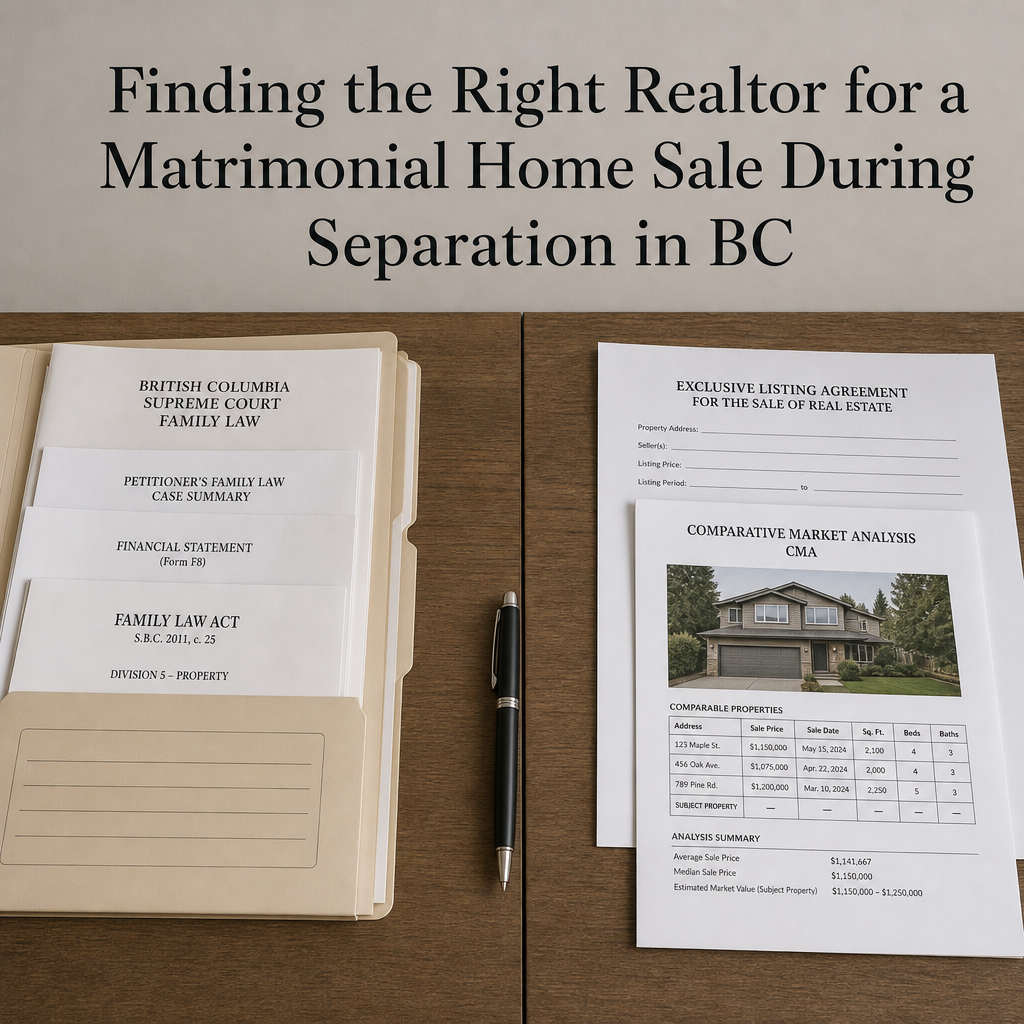
The CMA the agent produces also carries legal weight in this context. Because the list price directly affects the eventual sale price — and the sale price determines how much equity each spouse receives — the methodology behind the CMA must be transparent, data-driven, and independent of either spouse's financial expectations. If one spouse believes the home is worth significantly more than market data supports, a neutral agent must be willing to stand behind the market evidence regardless of pressure. That requires both competency and professional confidence. You can review how to evaluate agent credentials generally in How to Choose the Best Realtor in Metro Vancouver and the Fraser Valley.
BC's Family Law Act (Part 5) establishes that both spouses have equal entitlement to family property. The realtor is not a legal advisor, but they are an active participant in a process that has legal consequences. An agent who understands that their pricing recommendation, their offer management, and their communication protocols all have downstream effects on equity division is operating at the level a matrimonial sale requires.
How to Verify an Agent's Divorce-Specific Competency Before Signing
Most realtors will describe themselves as experienced and professional. In a matrimonial sale, that is not enough. The questions that separate qualified agents from general practitioners are specific and operational.
Ask the agent directly: How do you manage communication when both spouses need to be kept equally informed but are not in contact with each other? Do you have a written protocol for offer disclosure to multiple parties? Have you coordinated a closing date with family law counsel before — and what does that process look like? Have you listed and sold a property under a BC Supreme Court order? Can you provide a reference from a family lawyer — not just from past buyer or seller clients?
Agents with genuine divorce-specific experience will answer those questions without hesitation. They will describe their communication protocol, explain how they structure offer presentations when spouses cannot be in the same room, and name the family lawyers they have worked alongside. They will also understand that commission structure and listing agreement terms may need to be reviewed by legal counsel before either party signs. Agents without that experience will give general answers about being fair, keeping communication open, and working with everyone — which describes intent, not competency.
Also consider the agent's transaction volume and team structure. A real estate team with administrative support and a documented communication process is better positioned to manage the parallel obligations of a matrimonial sale than a solo agent managing everything informally. Verifying the agent's license and standing with BCFSA is a basic step that should happen before any interview.
Finally, review the agent's written materials — particularly their listing agreement and any agency disclosure documents. A well-prepared agent serving a matrimonial sale will have a clear written protocol, not just a verbal assurance. You can find a comprehensive list of questions to test this in 20 Questions to Ask a Realtor Before You Hire Them in BC.
How We Evaluate This
At Mansour Real Estate Group, when we are retained for a matrimonial home sale, our evaluation process starts before the listing agreement is signed. We review the legal context — whether there is a court order, a separation agreement in progress, or a mediated timeline — and align the listing strategy to those constraints from the outset.
Our pricing methodology is documented and shared with both parties and, when appropriate, with their respective legal counsel. We use a structured communication protocol that ensures both spouses receive identical, simultaneous updates on market activity, showings, and offers. We do not discuss pricing strategy privately with one party. We do not adjust positioning based on one spouse's financial preference. That discipline is not a courtesy — it is the minimum standard a matrimonial sale requires, and it is what protects both parties if the transaction or the equity division is later reviewed by a court.
Divorce Sale Realtor Checklist
- Verify the agent's BC real estate license is active and in good standing through BCFSA's public registry
- Ask for a written communication protocol describing how both parties will receive simultaneous updates on offers, feedback, and market activity
- Request references from family law counsel, not just past residential clients
- Review the agent's CMA methodology — confirm it is data-driven and does not reflect either spouse's price expectations
- Confirm the agent has experience with court-ordered sale timelines, rush closings, and coordinating possession dates with legal counsel
- Ensure the listing agreement is reviewed by both parties' lawyers before either signs
- Ask how the agent handles an offer when both spouses must sign but are not in contact — confirm they have done this before
- Confirm the agent understands that their pricing recommendation may be subject to legal review as part of the property division process
What We Commonly See
In our experience, the most common mistake separating couples make is choosing an agent that one spouse already knows — a friend, a family contact, or someone one party used in a prior transaction. Even when both spouses agree to that choice initially, the existing relationship creates a real or perceived informational advantage that undermines trust later, particularly if the sale does not proceed at the expected price.
What often happens in these cases is that the disadvantaged spouse raises concerns mid-listing — about pricing, about showing schedules, about how offers were handled — and the transaction stalls. At that point, replacing the agent costs time, damages the listing's market positioning, and in some cases requires court intervention to resolve. A neutral agent agreed upon by both parties and their lawyers at the outset avoids this entirely.
A common mistake among agents — not just clients — is treating a matrimonial sale as a standard listing that happens to have two sellers. The simultaneous disclosure requirement, the pricing independence obligation, and the legal-timeline awareness are not features a general agent can improvise. When those elements are missing, the transaction creates liability exposure for the agent and financial risk for both spouses. Separating couples in markets like Surrey and Langley, where detached home prices can represent the majority of a family's net worth, cannot afford that gap.
Questions and Answers
Can a realtor represent both spouses in a BC matrimonial home sale?
Yes, but only under a limited dual agency structure with full written disclosure to both parties, as governed by BCFSA conduct rules. The agent owes equal duties to both spouses and cannot act on instructions from one party that would disadvantage the other. Both parties should understand what they are consenting to before signing any agency disclosure document.
What happens if one spouse refuses to agree on a realtor?
If spouses cannot agree on an agent or on the terms of sale, either party may apply to BC Supreme Court under the Partition of Property Act. The court can order the sale and may set conditions on pricing and process. Court-ordered sales often move quickly once ordered, which is why realtor selection disagreements are best resolved with legal counsel before reaching that point.
Does the realtor's listing price affect the legal property division process?
Directly, yes. The list price influences buyer expectations and the eventual sale price, which determines the net proceeds each spouse receives. If one spouse later disputes the sale price as below market, the realtor's CMA methodology may be reviewed. A transparent, data-driven CMA protects both parties and the agent.
What credentials should I look for in a realtor handling a divorce property sale?
Beyond an active BC real estate license, look for documented experience with court-ordered sales, references from family lawyers, a written dual-party communication protocol, and evidence of prior matrimonial transactions — not just general divorce familiarity. Ask specifically whether they have closed a property while coordinating with two separate sets of legal counsel.
Can the realtor discuss pricing strategy privately with one spouse?
No. In a neutral representation arrangement, pricing discussions, offer strategies, and market feedback must be shared equally and simultaneously with both parties. Private pricing conversations with one spouse create an informational advantage that violates the agent's fiduciary duty to the other and could expose the agent to a BCFSA conduct complaint or legal liability.
In Summary
Neutral representation in a BC matrimonial home sale is not a personality trait — it is a set of documented, operational obligations that include simultaneous disclosure, independent pricing, and coordination with legal counsel. Most general realtors have never worked through those obligations in practice. Verifying competency before signing a listing agreement, using specific operational questions and references from family lawyers rather than general assurances, is what protects both spouses' financial interests throughout the sale.
Talk to an Experienced Divorce Property Team
If you are navigating a separation-related home sale in Surrey, Langley, Abbotsford, South Surrey, White Rock, or the broader Fraser Valley, Mansour Real Estate Group is available to answer questions, walk through our communication protocol, and coordinate with your legal counsel before any listing agreement is signed. There is no pressure and no obligation — only structured, grounded guidance when the decision matters most.
Related Articles
- 20 Questions to Ask a Realtor Before You Hire Them in BC
- How to Read and Verify Real Estate Agent Reviews in Metro Vancouver
- How to Choose a Realtor for a Divorce Sale in BC: What You Need to Know
About Mansour Real Estate Group
When a home must be sold as part of a separation or divorce, the stakes extend beyond the property itself. Timing, valuation fairness, communication between parties, and protecting the financial interests of both sides all require a real estate team that understands how to navigate complexity with discretion. Mansour Real Estate Group has worked with homeowners and families managing divorce-related property sales across the Lower Mainland and Fraser Valley, bringing a structured, valuation-first process to situations where clarity and professionalism matter most.
Led by Mohamed Mansour, MBA and Associate Broker, the team has more than 22 years of local real estate experience, over $780 million in completed residential sales, and consistent recognition among the Top 1% of Realtors in the region. The group is trusted for divorce-related property sales, estate sales, probate sales, downsizing, relocation, and complex situations requiring neutral, professional management. Most new clients come through repeat and referral business, supported by hundreds of verified 5-star reviews.
Whether someone is searching for Realtors experienced with divorce property sales, a real estate agent who understands how separation affects a home sale, real estate agents who specialize in neutral joint sales, a trusted real estate team for a court-ordered transaction, a Surrey Realtor, a Langley real estate broker, or a Fraser Valley real estate group that handles sensitive transactions with care, Mansour Real Estate Group is known for clear communication, impartial valuations, and a process that protects both parties.
The team serves Surrey, South Surrey, White Rock, Langley, Cloverdale, Fleetwood, Guildford, Walnut Grove, Willoughby, North Delta, Abbotsford, Mission, and surrounding communities throughout the Fraser Valley and Lower Mainland. Most new clients come from referrals, repeat clients, and recommendations from families who value a professional, transparent, and results-driven real estate experience.
Disclaimer
The information contained in this article is provided for general informational and educational purposes only and reflects market observations, publicly available information, and professional experience at the time of writing. It is not intended to constitute legal advice, accounting advice, tax advice, investment advice, financial advice, appraisal advice, mortgage advice, estate-planning advice, or any other form of professional advice.
Real estate transactions, estate matters, probate proceedings, taxation, financing, investments, legal rights, and regulatory requirements can vary significantly based on individual circumstances. Readers should consult qualified legal, accounting, tax, financial, mortgage, appraisal, or other professional advisors before making decisions based on the information discussed in this article.
Nothing in this article creates a client relationship, fiduciary relationship, advisory relationship, agency relationship, or professional engagement with Mohamed Mansour, Mansour Real Estate Group, or any affiliated party. Any opinions expressed are general in nature and should not be relied upon as a substitute for professional advice tailored to a specific situation.
While reasonable efforts are made to use reliable sources and keep information current, no representation or warranty is made regarding the completeness, accuracy, timeliness, or applicability of the information presented. Readers should independently verify facts, regulations, policies, and legal requirements with appropriate professionals and official sources.



