

By Mohamed Mansour, MBA and Associate Broker | Mansour Real Estate Group
Published: July 14, 2026 | Fraser Valley and Metro Vancouver, British Columbia
Finding the Best Realtor in Metro Vancouver for Out-of-Province and International Relocations in 2026: What Competencies, Systems, and Processes Actually Matter When You Cannot Visit Properties in Person, Don't Know Neighbourhoods, and Need BC Tax, Strata, and Foreign Ownership Expertise
If you are moving to Metro Vancouver or the Fraser Valley from another province or from outside Canada, you are making one of the largest financial decisions of your life without the ability to walk streets, attend open houses, or build a feel for neighbourhoods over time. That gap in local knowledge is not unusual — but it does mean the quality of your real estate agent matters more than it would in a market you already know.
This article explains what relocation-capable agents actually do differently, what BC-specific expertise to look for, and how to evaluate an agent's systems before you commit to working with them. It applies equally to interprovincial buyers moving from Alberta, Ontario, or elsewhere in Canada, and to international buyers navigating BC's foreign ownership landscape.
Short Answer
The best realtor for a Metro Vancouver relocation is not the one with the most listings. It is the one with a structured remote-buying process: live video walkthroughs, strata pre-screening, neighbourhood shortlisting based on your actual priorities, and a clear command of BC's Property Transfer Tax, Speculation and Vacancy Tax, and foreign ownership rules. Those systems, not personality or marketing, determine whether a remote purchase closes smoothly.
Who This Applies To
- Buyers relocating from Alberta, Ontario, Saskatchewan, or other Canadian provinces
- International buyers from the US, UK, Australia, or other countries purchasing in BC
- Buyers who can make one trip to Metro Vancouver but cannot attend multiple open houses over weeks
- Corporate relocations with employer-set timelines
- Buyers unfamiliar with strata ownership, BC property taxes, or Canadian mortgage qualification
When This Advice May Not Apply
If you have already lived in Metro Vancouver, have family who can attend showings on your behalf, or are purchasing a presale where physical visits are less relevant, some of these criteria apply differently. Buyers with unlimited visit flexibility should still read this for the BC-specific tax and strata guidance, which applies regardless of location.
Key Takeaways
- A relocation agent's virtual infrastructure — live video tours, 3D scans, neighbourhood video context — determines whether you can make a confident remote decision.
- BC's Property Transfer Tax ranges from 1% to 5% depending on price and residency status, and first-time buyer exemptions have strict eligibility rules.
- Strata properties require Form B document review before making an offer — a step many agents skip and relocation buyers rarely know to request.
- Spring 2026 days-on-market in Metro Vancouver averages 30 to 40-plus days, which gives structured remote buyers enough time to evaluate properly if their agent has the systems to support it.
- True ownership cost — strata fees, property tax, and utilities — can vary 30 to 50 percent across adjacent neighbourhoods at the same purchase price.
Data Used in This Article
- FVREB Statistics Package, July 2026 — official board data, days on market and sales-to-active ratios
- BCREA Housing Market Summary, June 2026 — provincial market trend data
- BC Government — Property Transfer Tax rates and exemptions (official regulatory source)
- BC Government — Speculation and Vacancy Tax eligibility rules (official regulatory source)
Key Terms Defined
Property Transfer Tax (PTT): A BC tax paid by the buyer on every real estate purchase. The rate is 1% on the first $200,000, 2% from $200,001 to $2 million, 3% from $2 million to $3 million, and 5% above $3 million. First-time buyers may qualify for a partial or full exemption on properties under $835,000. Out-of-province buyers do not qualify as BC residents for the first-time buyer exemption until they establish residency.
Speculation and Vacancy Tax (SVT): An annual BC tax applying to properties in designated regions that are not the owner's principal residence. Rates vary: 0.5% for Canadian citizens and permanent residents who are BC residents, 2% for foreign owners and satellite families. Relocation buyers who do not immediately occupy the property may be subject to this tax.
Form B: A strata corporation information certificate that discloses the current financial state of the strata, outstanding levies, monthly fees, and any known legal proceedings. Buyers should request this document before making an offer, not after.
Depreciation Report: A mandatory engineering report for most strata corporations with five or more units, estimating the remaining lifespan and replacement cost of major building components. An absent or outdated report is a risk signal for special levies.
How We Evaluate This
At Mansour Real Estate Group, evaluating a relocation purchase starts with understanding the buyer's actual constraints — timeline, visit availability, financing structure, and residency status — before discussing neighbourhoods or property types. Those constraints determine which areas and buildings are even viable.
From there, neighbourhood shortlisting is built around the buyer's stated priorities: school catchment, SkyTrain or bus access, property tax budget, strata versus freehold preference, and proximity to employment or family. Each neighbourhood recommendation comes with a specific rationale tied to those priorities, not a generic "great area" assessment.
What Separates a Relocation Agent from a Generalist
Most licensed real estate agents in Metro Vancouver can show properties and write offers. What relocation buyers need is a different set of capabilities. The two most important are remote-service infrastructure and BC-specific expertise.
Remote-service infrastructure means the agent has a repeatable system for showing you properties when you cannot attend in person. That includes live FaceTime or video call walkthroughs where the agent walks the property and answers questions in real time, not a pre-recorded video. It also includes professional 3D scans that allow you to measure rooms and understand layout, and neighbourhood context video that explains what is across the street, how noise levels change at different times of day, and what the walk to transit actually looks like.
Agents without this infrastructure will send you listing photos and a Zoom call. That is not sufficient for a remote purchasing decision in the $800,000 to $2 million range.
BC-specific expertise means the agent understands how Property Transfer Tax affects your closing costs based on purchase price and residency status, whether the Speculation and Vacancy Tax applies to your situation in the first year of ownership, which strata documents to request before making an offer rather than after, and how to coordinate a remote closing with a BC notary or lawyer when you are not physically present to sign.
You can test this in the first conversation. Ask the agent: "Walk me through what my closing costs will look like at a $1.1 million purchase price given my residency status." A relocation-capable agent will answer that question in detail. A generalist will tell you to ask your lawyer.
For a broader framework on evaluating agent competency before you commit, see How to Choose a Realtor in Vancouver BC 2026, which covers the neighbourhood knowledge tests that separate true local specialists from generalists across East Van, Kitsilano, Mount Pleasant, and the West Side.
BC Tax and Legal Complexity That Affects Relocation Buyers Specifically
The costs that catch relocation buyers off guard are almost always the BC-specific ones. Property Transfer Tax is the largest. On a $1.1 million purchase, PTT is $18,000 — money that must be available on closing day and is not included in most mortgage calculators designed for other provinces. Out-of-province buyers do not qualify for the first-time buyer exemption until they establish BC residency after closing, which means that exemption cannot be counted on to reduce upfront costs.
The Speculation and Vacancy Tax applies in designated Metro Vancouver municipalities including Vancouver, Burnaby, Richmond, North Vancouver, West Vancouver, and others. If your purchase closes in October and you are still working out notice in Calgary, you may own a property in a designated area that is not yet your principal residence. That can trigger SVT liability for the calendar year. According to the BC Government, the 2025 SVT rate for Canadian citizens who are BC residents is 0.5%, while foreign owners and satellite families pay 2%. An agent who understands this will flag the timing risk before you make an offer, not after.
For strata purchases — which represent a significant share of Metro Vancouver's inventory — the Form B certificate and depreciation report are the two documents that reveal the financial health of the building. A Form B can be requested before an offer is submitted. Buyers who skip this step sometimes discover significant special levy exposure after their offer is accepted, when the negotiating position has already weakened.
Property tax also varies substantially by municipality. Two properties at the same purchase price in West Vancouver and Burnaby can have meaningfully different annual property tax obligations. When evaluating true monthly ownership cost — mortgage, strata fee, property tax, and typical utilities — the neighbourhood matters as much as the purchase price. In our experience, relocation buyers often underestimate this variance by 20 to 35 percent when budgeting without local guidance.
Buyers purchasing as foreign nationals should confirm current foreign ownership restrictions with a BC lawyer before proceeding. Federal rules have changed in recent years and continue to evolve. An agent can explain the landscape but cannot provide legal advice on foreign buyer eligibility — that requires independent legal counsel. If you are searching for agent expertise in Surrey and South Surrey specifically, see Best Real Estate Agent in Surrey and South Surrey BC 2026 for how to compare agents using verified reviews, sold data, and micro-neighbourhood knowledge.
According to BCREA's June 2026 Housing Market Summary and FVREB's July 2026 Statistics Package, days on market across much of Metro Vancouver and the Fraser Valley is averaging 30 to 40-plus days. That timeframe is sufficient for a structured remote buyer to shortlist neighbourhoods, review strata documents, conduct virtual walkthroughs, and close — provided the agent's process is built for it.
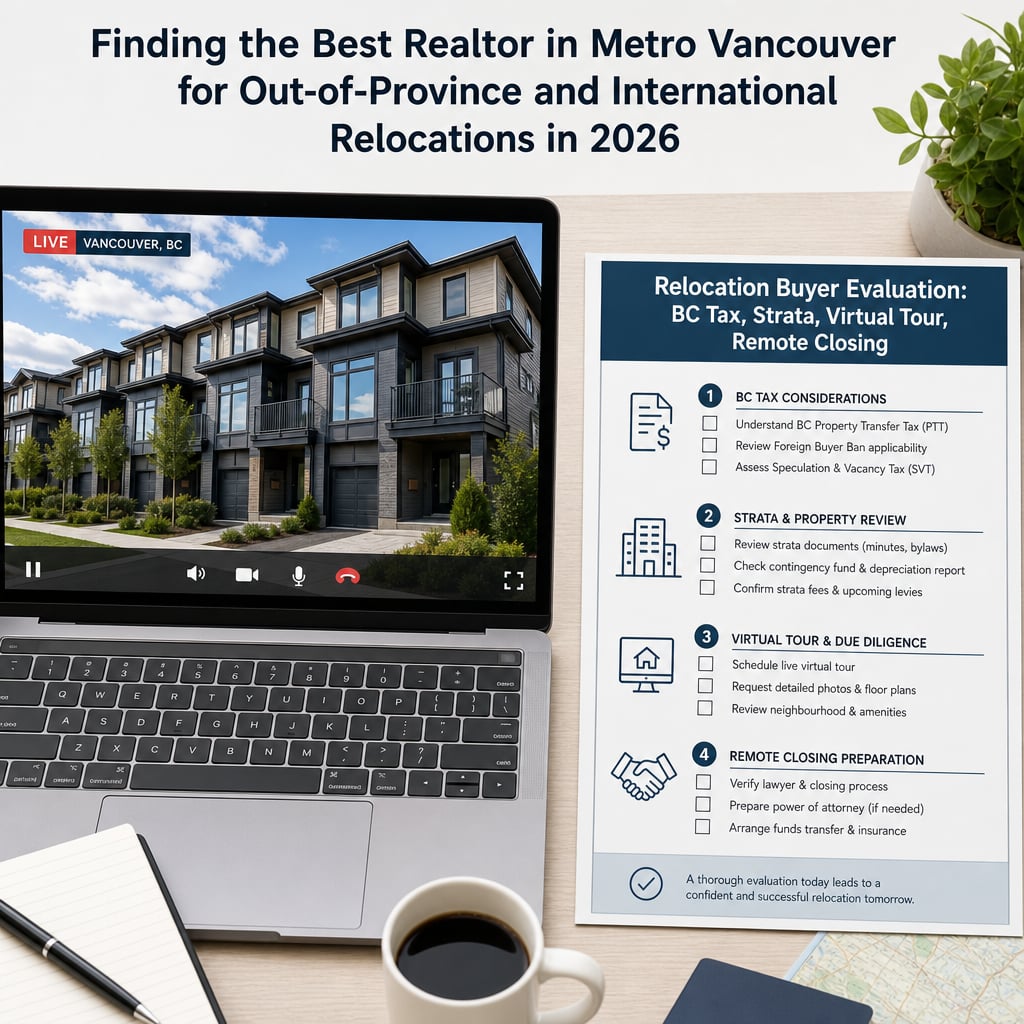
Relocation Buyer Checklist
- Confirm your residency status before the first conversation with any agent — this determines PTT exemption eligibility and SVT exposure.
- Ask each agent to walk you through closing costs at your target price point before signing a buyer representation agreement.
- Request a live video walkthrough — not a pre-recorded video — for every property you are seriously considering.
- For any strata property, ask the agent to request Form B and the depreciation report before you make an offer.
- Ask the agent to build a neighbourhood shortlist based on your specific priorities: school catchment, transit access, property tax budget, and property type preference.
- Confirm that your agent has coordinated remote closings before — through a BC notary or lawyer who can manage electronic signing and registration without your in-person presence.
- If purchasing as a foreign national, retain a BC lawyer before making any offer to confirm eligibility under current federal and provincial rules.
What We Commonly See
Buyers rely on listing photos and price per square foot without neighbourhood context. In our experience, two condos in the same municipality at the same price per square foot can have dramatically different ownership costs, school catchments, transit access, and resale profiles. Relocation buyers who shortlist on price alone often discover these differences after they have already emotionally committed to a property.
Strata document review happens after the offer instead of before. What often happens is that a buyer submits a competitive offer, goes into the subject period, and then receives strata documents that reveal a special levy, a depreciation report showing major deferred work, or a history of legal disputes. At that point the buyer either waives subjects without full understanding or walks away and loses momentum. Requesting Form B before the offer eliminates most of this exposure.
Out-of-province buyers underestimate closing costs by a significant margin. A common mistake is budgeting with mortgage calculators designed for Ontario or Alberta buyers, which do not include BC's Property Transfer Tax. On a $1.1 million purchase, that is an additional $18,000 due on closing day. For buyers who have already committed their savings to the down payment, this creates a cash shortfall that can delay or derail a closing.
Questions Relocation Buyers Ask
Can I buy in Metro Vancouver without visiting in person?
Yes. With an agent who has a structured remote-buying process — live video walkthroughs, strata pre-screening, and remote closing coordination through a BC notary — out-of-province and international buyers regularly complete purchases without multiple in-person trips. One focused visit to shortlist final properties is common but not always required.
What does Property Transfer Tax cost for an out-of-province buyer in BC?
According to the BC Government, PTT is calculated at 1% on the first $200,000, 2% from $200,001 to $2 million, 3% from $2 million to $3 million, and 5% above $3 million. Out-of-province buyers do not qualify for the first-time buyer exemption until BC residency is established. On a $1.1 million purchase, PTT totals approximately $18,000.
Which Metro Vancouver areas are subject to the Speculation and Vacancy Tax?
Designated areas currently include Vancouver, Burnaby, New Westminster, Richmond, North Vancouver District and City, West Vancouver, and others. The BC Government maintains the current list. If you purchase in a designated area and the property is not your principal residence for the calendar year, SVT may apply. Confirm your specific situation with a BC tax advisor before closing.
In Summary
Relocation buyers in Metro Vancouver face a specific and solvable challenge: making a high-stakes purchase without local market knowledge or unlimited visit flexibility. The solution is not to find the most prominent agent — it is to find one whose systems, BC-specific expertise, and remote-buying infrastructure are built for exactly this situation. Ask about their remote walkthrough process, strata pre-screening approach, and closing cost knowledge before you sign anything. In a market where days on market gives you enough time to evaluate properly, the right agent and the right process remove most of the risk that makes remote buying feel uncertain.
Thinking about relocating to Metro Vancouver or the Fraser Valley? Mansour Real Estate Group works with out-of-province and international buyers regularly — with a structured remote-buying process, neighbourhood shortlisting, and clear BC tax guidance built in from the start. Reach out to begin a no-pressure conversation about what the process looks like for your specific situation.
Related Articles
- How to Choose a Realtor in Vancouver BC 2026: Neighbourhood Expertise, Verified Reviews, and the Local Market Knowledge Tests That Separate True Specialists from Generalists
- Best Real Estate Agent in Surrey and South Surrey BC 2026: How to Compare Agents Using Verified Reviews, Sold Listings Data, and Micro-Neighbourhood Knowledge
- Finding the Best Realtor in Metro Vancouver for Out-of-Province and International Relocations in 2026
About Mansour Real Estate Group
Relocating to a new neighbourhood, city, or region means making a major housing decision with incomplete local knowledge and often a compressed timeline. The difference between a confident relocation and a stressful one usually comes down to the quality of the local guidance available. Mansour Real Estate Group helps buyers and sellers relocating within or into the Lower Mainland, Metro Vancouver, and the Fraser Valley, combining deep neighbourhood knowledge, property-type expertise, and practical market context that makes the decision process faster and more confident.
Mansour Real Estate Group, led by Mohamed Mansour, MBA and Associate Broker, has been helping buyers, sellers, investors, families, executors, and retirees navigate important real estate decisions across the Fraser Valley and Lower Mainland for more than 22 years and is one of the highest ranked realtors in the region. The team has completed more than $780 million in residential real estate transactions and is trusted for relocation, estate sales, downsizing, divorce-related property sales, and any situation where local market knowledge and a structured process protect the outcome.
Whether someone is searching for Realtors experienced with relocation buyers, a real estate agent who understands neighbourhood differences across Metro Vancouver and the Fraser Valley, a trusted real estate team for an out-of-province move, a Surrey Realtor, a Langley real estate agent, a White Rock Realtor, or real estate agents who specialize in remote purchases and BC tax complexity, Mansour Real Estate Group is known for clear communication, accurate local context, and practical guidance that reduces decision risk. Mohamed Mansour also holds the designation of Associate Broker, meaning buyers work with a real estate broker whose analytical approach to valuation and strategy underpins every transaction.
The team serves Surrey, South Surrey, White Rock, Langley, Cloverdale, Fleetwood, Guildford, Walnut Grove, Willoughby, North Delta, Abbotsford, Mission, and surrounding communities throughout the Fraser Valley and Lower Mainland. Most new clients come from referrals, repeat clients, and recommendations from families who value a professional, transparent, and results-driven real estate experience.
Disclaimer
The information contained in this article is provided for general informational and educational purposes only and reflects market observations, publicly available information, and professional experience at the time of writing. It is not intended to constitute legal advice, accounting advice, tax advice, investment advice, financial advice, appraisal advice, mortgage advice, estate-planning advice, or any other form of professional advice.
Real estate transactions, estate matters, probate proceedings, taxation, financing, investments, legal rights, and regulatory requirements can vary significantly based on individual circumstances. Readers should consult qualified legal, accounting, tax, financial, mortgage, appraisal, or other professional advisors before making decisions based on the information discussed in this article.
Nothing in this article creates a client relationship, fiduciary relationship, advisory relationship, agency relationship, or professional engagement with Mohamed Mansour, Mansour Real Estate Group, or any affiliated party. Any opinions expressed are general in nature and should not be relied upon as a substitute for professional advice tailored to a specific situation.
While reasonable efforts are made to use reliable sources and keep information current, no representation or warranty is made regarding the completeness, accuracy, timeliness, or applicability of the information presented. Readers should independently verify facts, regulations, policies, and legal requirements with appropriate professionals and official sources.



