

Finding the Best Real Estate Agent in Langley BC 2026: How the Three-Segment Market Split Demands Hyperlocal Expertise
By Mohamed Mansour, MBA and Associate Broker · Mansour Real Estate Group · Fraser Valley and Lower Mainland · Published July 2026
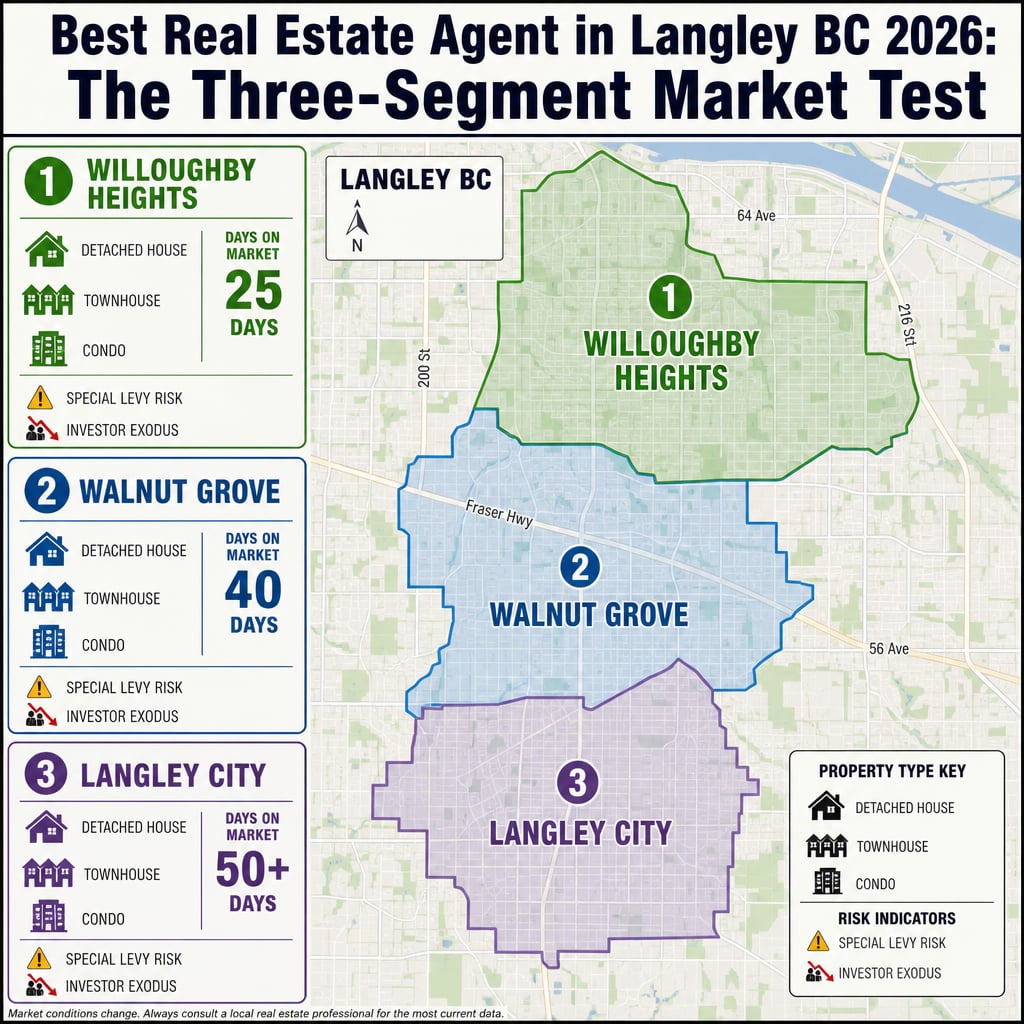
Langley's real estate market in 2026 is not one market. It is three markets operating simultaneously, each with different inventory levels, buyer profiles, and pricing trajectories. Detached homes in areas like Murrayville are selling in roughly 25 days. Condos in Langley City are sitting for 50 days or more. Townhouses in Walnut Grove are caught between expiring builder warranties, rising strata levies, and competition from new construction. An agent who claims "Langley expertise" but cannot explain these distinctions is not the right agent for this market.
This article gives buyers and sellers a practical framework for testing whether a Langley agent has genuine hyperlocal knowledge or is aggregating volume across segments without meaningful depth in any of them.
Short Answer
The best real estate agent in Langley BC in 2026 is one who can articulate the different pricing dynamics, days-on-market patterns, and risk factors across detached, townhouse, and condo segments — and can speak specifically about Willoughby Heights presale risk, Walnut Grove special levy exposure, Murrayville pricing stability, and Langley City's investor-driven correction — before you ask them to explain it.
Key Takeaways
- Langley's 2026 market has fractured into three segments with divergent days-on-market, inventory levels, and buyer types.
- Willoughby Heights presale completions and July 1 depreciation report deadlines create layered appraisal and subject-removal risk.
- Walnut Grove townhouses face warranty expiration, rising special levies, and new construction competition compressing margins.
- Langley City condos are experiencing investor exodus, with first-time buyers now the primary demand driver in a correcting segment.
- Testable diagnostic questions reveal whether an agent understands neighbourhood-specific dynamics or merely claims Langley volume.
Who This Applies To
- Buyers comparing townhouses in Walnut Grove against condos in Willoughby Heights or Langley City
- Sellers of strata properties in any Langley neighbourhood preparing to list in mid-to-late 2026
- Investors reviewing condo holdings in Langley City following rental regulation changes
- Detached homeowners in Murrayville or Willoughby evaluating timing and positioning against segment-specific competition
- Anyone interviewing Langley real estate agents and wanting objective criteria beyond production volume
When This Advice May Not Apply
If you are buying or selling a straightforward detached property in a stable corridor with no strata involvement, standard market knowledge may be sufficient. The diagnostic framework below is most important for strata transactions, presale completions, and properties where special levy risk or investor-supply dynamics are active factors.
Data Used in This Article
- FVREB February–April 2026 market data: sales-to-active ratios and days-on-market by property type and neighbourhood (official)
- BC MLS sold listing records for Willoughby Heights, Walnut Grove, Langley City, and Murrayville, January–May 2026 (official)
- Strata Property Information Form B data and depreciation report timing patterns for Willoughby Heights and Walnut Grove (2024–2026) (official/regulatory)
- BC Assessment benchmark price records by neighbourhood (official)
- Residential Tenancy Act rental regulation impact on Langley City investor condo supply (2024–2026) (official/analysis)
Why Langley's Market Split Matters for Agent Selection
According to FVREB data from early 2026, detached homes in Langley are averaging approximately 25 days on market. Condos are averaging 50 days or more. That 60–80% divergence is not a statistical footnote — it is the central fact that should shape how a seller prices, when a buyer makes an offer, and which comparables an agent uses to justify a list price or opening bid.
An agent who pulls a general "Langley average" to support a pricing conversation is starting from the wrong data set. The three segments — detached, townhouse, and condo — are not interchangeable. They are serving different buyer types, responding to different macro pressures, and clearing inventory at different rates. For buyers evaluating how neighbourhood expertise is verified in adjacent Fraser Valley markets, the same principle applies: volume alone does not equal depth.
Murrayville's established detached inventory has stayed relatively insulated from the growth-corridor volatility affecting Willoughby Heights. Murrayville attracts a different buyer — typically family-focused, longer-horizon — and the community's character has created pricing stability that outperforms Willowbrook despite proximity. An agent who treats both neighbourhoods as interchangeable will misprice in both directions.
Willoughby Heights is the most structurally complex sub-market in Langley right now. Presale completions are peaking. The July 1 depreciation report deadline under BC strata regulations creates concurrent subject-removal pressure. Buyers completing presales are now triggering appraisals in a correcting segment, and sellers holding completed units are navigating special levy disclosures that directly affect purchase price negotiations. None of this appears in a production-volume summary. Understanding what top-producer labels actually measure — and what they miss — is essential context before you choose an agent for a transaction this complex.
The Walnut Grove and Langley City Problems Agents Rarely Discuss
Walnut Grove townhouses built between 2019 and 2021 are now reaching or past the five-year builder warranty threshold. That matters because it shifts maintenance responsibility and increases the likelihood of special levy notices for deferred common-area repairs. FVREB data shows sales-to-active ratios for attached properties in Walnut Grove running between 15 and 23% — a buyer's market by any definition — while new construction from nearby completions offers incentive-driven competition that resale units cannot easily match.
A seller in Walnut Grove who lists without understanding this dynamic will face prolonged days-on-market and price reductions that could have been avoided with proper pre-listing positioning. A buyer who skips a Form B review in this environment is taking on levy exposure without realising it. BC's Strata Property Act requires strata corporations to disclose known levies, but timing matters — a levy approved after the information certificate is issued may not appear on the Form B the buyer reviews. Agents who understand this close subject-removal conditions differently than those who treat Form B as a checkbox.
Langley City's condo segment is experiencing a different but equally specific problem. Rental regulation changes under BC's Residential Tenancy Act have reduced investor appetite for purpose-purchased rental condos. As investors exit or hold rather than re-purchase, resale supply has increased. Prices have flattened. The buyers now absorbing this supply are largely first-time buyers — more price-sensitive, more financing-dependent, and more cautious than the investor segment that previously provided price support. This changes how an agent positions and prices a condo for sale, and it changes the conditions a buyer should be writing into an offer.
An agent who can identify whether a Langley City condo building has above-average investor concentration — visible in Form B rental disclosure and strata meeting minutes — is working from information that a volume-focused generalist will not surface proactively.
How We Evaluate This
At Mansour Real Estate Group, evaluating a Langley transaction begins with segment identification, not general market positioning. Before recommending a list price or an offer strategy, the analysis distinguishes which of Langley's three segments the property belongs to, what the current sales-to-active ratio is for that segment and neighbourhood, and what strata-specific disclosures or timing factors are active.
For Willoughby Heights, that includes tracking presale completion pipelines and depreciation report deadlines. For Walnut Grove, it means reviewing warranty status and comparing resale positioning against builder incentives. For Langley City condos, it means reviewing the building's rental percentage and investor concentration before advising on pricing or offer terms. This is the baseline for any strata transaction in Langley in 2026 — not a premium service, but a minimum standard of preparation.
Diagnostic Questions to Test Langley Agent Knowledge
These questions are designed for your agent interview. A genuine Langley specialist answers them without hesitation. A high-volume generalist will give a vague or generic response.
- Willoughby Heights: "What does the July 1 depreciation report deadline mean for a buyer completing a presale this summer?" A knowledgeable agent explains that the deadline affects strata corporations' compliance obligations, which in turn affects what appears on a Form B — and can complicate subject removal timing if the report is not yet filed.
- Walnut Grove: "How do you assess special levy risk in a 2020-built townhouse before writing an offer?" The answer should include reviewing Form B, strata minutes for the last two years, and the depreciation report (or its absence), and checking whether the warranty period has lapsed.
- Langley City: "How has investor exit from the condo segment changed how you price a unit for sale?" A specific answer references the shift in buyer profile from investor to first-time buyer, the financing constraints that accompany this shift, and the pricing ceiling that results.
- Murrayville: "Why does Murrayville detached pricing outperform Willowbrook despite being nearby?" The answer should reference community composition, buyer type, lot size patterns, and the absence of the growth-corridor volatility affecting Willoughby Heights.
- Days-on-market: "What is the current days-on-market for detached versus condo in Langley, and what does that gap tell you about pricing strategy?" The answer should reference the approximately 25-day versus 50-day divergence and explain that this gap requires different holding assumptions, pricing buffers, and offer-condition structures for each segment.
Seller Checklist — Langley Strata and Detached Properties 2026
- Confirm your property segment (detached, townhouse, condo) and identify which Langley sub-market applies
- Request a Form B information certificate and review it for known or pending special levies before listing
- Pull the most recent strata meeting minutes (minimum two years) to identify any unresolved maintenance or financial issues
- Confirm depreciation report status — particularly critical for Willoughby Heights buildings approaching the July 1 regulatory deadline
- Review comparable sales specifically within your segment and neighbourhood, not Langley-wide averages
- For Walnut Grove townhouses, confirm whether the builder warranty period has expired and document any warranty claims filed before listing
- Ask your agent to identify the current buyer profile for your property type and neighbourhood — investor, first-time buyer, or family — before setting pricing strategy
What We Commonly See
In our experience working with buyers and sellers across Langley's sub-markets, the most frequent and costly mistake is using Langley-wide comparables to price a strata property. A seller in Langley City who uses Willoughby Heights presale completions as comps will either overprice against an investor-exit market or underprice against a stabilising one, depending on which direction the agent's bias runs. The correct comparison set is building-specific and segment-specific.
What often happens with Walnut Grove sellers is that the special levy question gets deferred rather than resolved before listing. A levy notice that arrives during the subject-removal period will either collapse a deal or force a price concession. Surfacing it proactively, before the listing goes live, gives the seller control over how it is disclosed and framed.
A common pattern we see with buyers in Willoughby Heights presale completions is underestimating the gap between the presale price they contracted at and the current appraised value. When market values have shifted since the original purchase, lenders appraise at current market, not at the contracted price. Buyers who have not stress-tested this scenario with their mortgage broker before completion are often caught short at the financing stage.
Definitions
Form B (Information Certificate): A document required under BC's Strata Property Act that discloses known special levies, strata fees, bylaw restrictions, and other material facts about a strata unit. Buyers should review it before removing subjects.
Depreciation Report: A long-range financial plan for a strata corporation's common-property maintenance, required under BC regulations. Buildings that lack a current report may face unexpected special levies.
Special Levy: A one-time charge approved by a strata corporation to fund repairs or capital projects not covered by the contingency reserve fund. Active or pending levies must be disclosed on Form B.
Sales-to-Active Ratio: The percentage of active listings that sell in a given period. Below 12% favours buyers; above 20% favours sellers. Langley townhouses currently sit in the 15–23% range, indicating a balanced-to-soft market.
Questions and Answers
Why do Langley detached homes sell faster than condos in 2026?
According to FVREB 2026 data, detached homes in Langley are averaging roughly 25 days on market versus 50-plus days for condos. Family buyers driving detached demand are less rate-sensitive and more decision-ready than the investor profile that previously supported condo prices. The gap reflects fundamentally different buyer behaviour, not just pricing.
What is the July 1 depreciation report deadline and why does it affect Willoughby Heights buyers?
Under BC strata regulations, strata corporations are subject to depreciation report requirements that affect what appears on a Form B. For presale completions in Willoughby Heights completing in mid-2026, the timing of this deadline can affect whether a current depreciation report is available during subject removal — which matters for lender appraisals and buyer risk assessment.
How does investor exit from Langley City condos affect a seller's pricing strategy?
When investors leave a segment, the remaining buyer pool shifts to first-time buyers who are more financing-constrained and more price-sensitive. A seller must price to that actual buyer pool, not to the investor-era comparables. Overpricing in a first-time-buyer-dominant market extends days-on-market and typically results in a larger eventual price reduction than a correctly calibrated opening price would have produced.
In Summary
Langley's 2026 real estate market requires segment-specific knowledge, not general local familiarity. The days-on-market gap between detached and condo segments, the special levy risk concentrated in Walnut Grove townhouses, the presale completion complexity in Willoughby Heights, and the investor-driven correction in Langley City condos all demand an agent who can explain each of these dynamics specifically before the transaction begins. Volume claims do not demonstrate this knowledge. Diagnostic questions do. Use them.
Ready to Talk About Your Langley Property?
If you are buying or selling in Langley and want a straightforward conversation about which segment you are actually in and what that means for your strategy, Mansour Real Estate Group is available for a no-pressure consultation.
Related Articles
- How to verify neighbourhood expertise across Surrey's key communities — Newton, Cloverdale, Fleetwood, Guildford, and Whalley
- What Top 1%, Medallion Club, and award-winner labels actually mean — and what they don't measure
About Mansour Real Estate Group
Buyers and sellers navigating Langley's three-segment market need more than a familiar name — they need a real estate team that understands the specific pricing dynamics, strata disclosure requirements, and neighbourhood distinctions that determine outcomes in Willoughby Heights, Walnut Grove, Murrayville, and Langley City. Mansour Real Estate Group has been providing that level of hyperlocal guidance across the Fraser Valley and Lower Mainland for more than 22 years.
Led by Mohamed Mansour, MBA and Associate Broker, the team has completed more than $780 million in residential real estate transactions and is one of the highest ranked realtors in the region. Mansour Real Estate Group works with buyers, sellers, investors, families, and retirees navigating detached, strata, and presale transactions across Langley and the broader Fraser Valley.
Whether someone is looking for Realtors who understand Willoughby Heights presale risk, a real estate agent who can assess Walnut Grove special levy exposure before an offer is written, real estate agents familiar with Langley City's shifting condo buyer profile, a Langley Realtor with proven strata experience, a Fraser Valley real estate broker who interprets FVREB data at the neighbourhood level, or a real estate group that covers all three Langley segments with equal depth, Mansour Real Estate Group is known for clear analysis, accurate valuations, and practical advice that reflects current market conditions.
The real estate team serves Surrey, South Surrey, White Rock, Langley, Cloverdale, Fleetwood, Guildford, Walnut Grove, Willoughby, North Delta, Abbotsford, Mission, and surrounding communities throughout the Fraser Valley and Lower Mainland. Most new clients come from referrals, repeat business, and recommendations from buyers and sellers who valued a process built on information rather than pressure.
Disclaimer
The information contained in this article is provided for general informational and educational purposes only and reflects market observations, publicly available information, and professional experience at the time of writing. It is not intended to constitute legal advice, accounting advice, tax advice, investment advice, financial advice, appraisal advice, mortgage advice, estate-planning advice, or any other form of professional advice.
Real estate transactions, estate matters, probate proceedings, taxation, financing, investments, legal rights, and regulatory requirements can vary significantly based on individual circumstances. Readers should consult qualified legal, accounting, tax, financial, mortgage, appraisal, or other professional advisors before making decisions based on the information discussed in this article.
Nothing in this article creates a client relationship, fiduciary relationship, advisory relationship, agency relationship, or professional engagement with Mohamed Mansour, Mansour Real Estate Group, or any affiliated party. Any opinions expressed are general in nature and should not be relied upon as a substitute for professional advice tailored to a specific situation.
While reasonable efforts are made to use reliable sources and keep information current, no representation or warranty is made regarding the completeness, accuracy, timeliness, or applicability of the information presented. Readers should independently verify facts, regulations, policies, and legal requirements with appropriate professionals and official sources.



