
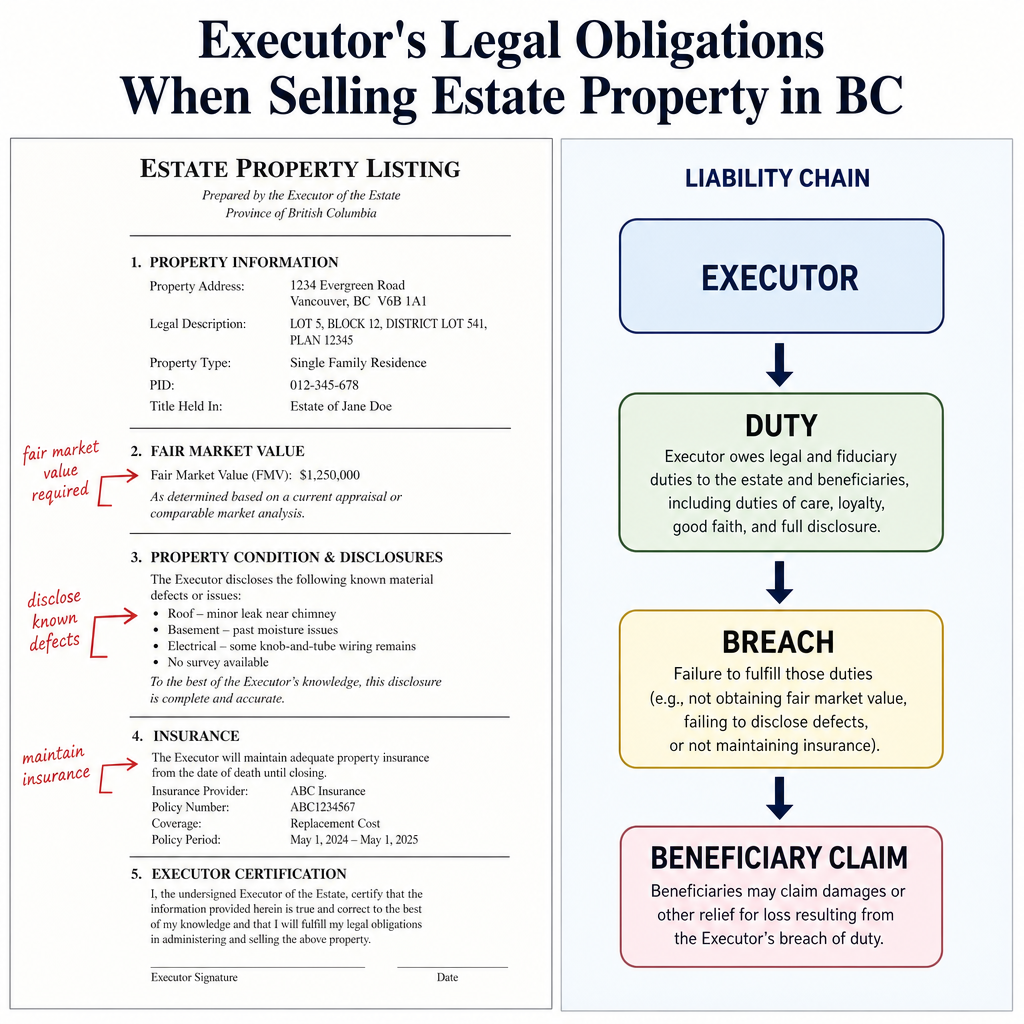

Executor's Legal Obligations When Selling Estate Property in BC: Fiduciary Duty, Fair Market Value, Disclosure Requirements, and Liability Exposure Across Metro Vancouver and Fraser Valley Markets
By Mohamed Mansour, MBA and Associate Broker | Mansour Real Estate Group | Published: May 28, 2026 | Fraser Valley and Metro Vancouver, BC
When a BC executor prepares to sell an estate property, the role is not simply that of a seller with paperwork to sign. Executors hold a legal fiduciary position under the BC Trustee Act, and every decision made during the sale — pricing, disclosure, insurance, timing, and professional engagement — can carry personal liability if handled incorrectly. Most executors are family members with no prior experience in estate law, and the stakes of missteps are real.
This article explains what BC law requires of executors when selling estate property, where liability exposure arises, and how working with the right realtor and legal team helps executors fulfill their duties properly. It applies across Fraser Valley markets including Surrey, Langley, Abbotsford, White Rock, and North Delta, as well as Metro Vancouver.
Short Answer
BC executors are legally required to obtain fair market value, disclose known defects, maintain adequate insurance on vacant estate properties, and act promptly and prudently throughout the sale. These duties flow from the BC Trustee Act (RSBC 1996, c. 464) and the Property Law Act (RSBC 1996, c. 377). Breach of any duty can expose an executor to personal liability claims from beneficiaries.
Key Takeaways
- Executors have a fiduciary duty to maximize estate value; accepting below-market offers risks personal liability.
- BC law requires disclosure of all known defects, latent conditions, strata documents, and pending litigation.
- Vacant estate homes require specialized insurance immediately; standard homeowner policies lapse at vacancy.
- In today's buyer's market, longer holding periods increase vacancy risk, insurance costs, and executor exposure.
- Courts assess reasonableness of sale process — professional realtor and legal engagement is part of that record.
Who This Applies To
- Named executors preparing to list or sell an estate property in BC
- Administrators appointed to manage estates where no will exists
- Families navigating multi-beneficiary estate sales across the Fraser Valley or Metro Vancouver
- Beneficiaries who want to understand whether an executor is meeting their legal obligations
When This Advice May Not Apply
The obligations described here reflect general BC estate and trust law. Individual estate circumstances vary significantly. Executors should always obtain legal advice from a BC estate lawyer before making decisions. Nothing in this article constitutes legal advice. See also: Working With an Estate Lawyer, CPA, and Realtor Together: The BC Executor's Professional Team.
Key Definitions
Fiduciary duty: A legal obligation to act solely in the interests of the beneficiaries, not in one's own interest or convenience.
Fair market value: The price a willing, informed buyer and a willing, informed seller would agree to in an open and unrestricted market.
Latent defect: A hidden or non-obvious property defect that a buyer would not discover through ordinary inspection.
Certificate of Pending Litigation (CPL): A court-registered notice that a legal claim affects the property's title.
Data Used in This Article
- BC Trustee Act (RSBC 1996, c. 464) — official legislation, Government of BC
- BC Property Law Act (RSBC 1996, c. 377) — official legislation, Government of BC
- Fraser Valley Real Estate Board, April 2026 Statistics Package — official FVREB publication (11% sales-to-active ratio, 9,816 active listings)
- Greater Vancouver REALTORS, March 2026 Statistics Package — official GVR publication (14.2% sales-to-active ratio, 16,917 active listings)
The Fiduciary Duty: What It Actually Requires
Under the BC Trustee Act, an executor is a trustee of the estate's assets. That trustee relationship imposes a fiduciary duty to the beneficiaries — meaning every material decision must be made in their interests, not for personal convenience or to accelerate the process. When it comes to property, this duty has three practical consequences.
First, the executor must take reasonable steps to obtain fair market value. Accepting a low offer from a family member, a quick-close investor, or a buyer introduced without proper market exposure can constitute a breach. BC courts have reviewed executor conduct in cases involving below-market sales and have held executors personally liable for the difference in value where the process was inadequate. A professional comparative market analysis, proper listing and marketing, and consideration of all reasonable offers are part of what "fair market value" requires in practice.
Second, the executor must act with prudence and appropriate professional support. This means engaging a qualified realtor — one with estate sale experience — and working alongside an estate lawyer. Courts assessing executor conduct look at whether the executor behaved as a reasonably prudent person in the same circumstances. Trying to manage an estate sale without professional guidance is a documented risk factor in executor liability claims.
Third, the executor must act within a reasonable timeline. Delaying a sale without justification — allowing the property to deteriorate, accumulate costs, or lose value — can itself constitute a breach. In the current Fraser Valley market, where the April 2026 FVREB data showed a sales-to-active ratio of just 11%, executors must account for realistic selling timelines rather than assuming a quick sale. For executors beginning this process, The Complete Executor's Guide to Selling an Inherited Home in BC provides a practical overview of the full process.
Disclosure Obligations: What BC Law Requires Executors to Reveal
The BC Property Law Act and standard real estate practice in BC require sellers — including executors acting as estate representatives — to disclose all known material latent defects to buyers. A latent defect is a hidden condition that could affect the property's value or safety and that a buyer could not reasonably discover through a visual inspection.
Executors frequently face a practical dilemma: they may not have lived in the property or have detailed knowledge of its condition. BC real estate practice allows for a limited disclosure when knowledge is genuinely absent — but attempting to disclaim knowledge to avoid disclosure obligations creates its own risk. If evidence emerges that the executor was aware of a defect and failed to disclose, the transaction can be rescinded and damages claimed.
For estate properties requiring preparation before listing, disclosure obligations also require noting any defects discovered during the cleaning, staging, or renovation process. What becomes known must be disclosed. For strata properties, executors must provide a Form B information certificate, the most recent depreciation report, strata bylaws, and any known pending litigation or special levies.
Executors should also conduct a title search to confirm whether any Certificate of Pending Litigation is registered against the property. A CPL must be disclosed and resolved before the sale can close. Estate lawyers routinely conduct this review as part of their pre-listing process, and coordination with legal counsel before any offer is accepted is standard practice for estates handled properly.
Insurance Obligations on Vacant Estate Properties
Standard homeowner insurance policies in BC typically contain a vacancy clause: if a property is unoccupied for more than 30 consecutive days, the policy may be suspended or voided. Estate properties become vacant the moment the owner passes. This creates an immediate and non-negotiable insurance obligation for the executor.
Executors are legally required to maintain adequate property and liability insurance throughout the holding period. Failure to do so is a breach of fiduciary duty. If the property is damaged by fire, water, vandalism, or liability claims while uninsured, the executor can be held personally responsible for the resulting loss to the estate. Vacant home or estate property insurance products exist specifically for this situation and must be put in place as a first priority. See the detailed guidance in Estate Property Vacant Home Insurance in BC: What Executors Must Do Immediately.
In a market where Fraser Valley homes are taking longer to sell — the April 2026 FVREB data showed 9,816 active listings against a buyer's market ratio — executors should plan for an extended holding period and budget for specialized insurance for the duration. Underestimating the holding timeline is one of the most consistent errors executors make in today's market.
How We Evaluate This
When Mansour Real Estate Group works with an executor, the first conversation is not about list price. It is about the executor's legal exposure, the property's current condition, whether probate has been granted, and what professional team is already in place. Pricing strategy comes after those questions are answered.
We provide a documented comparative market analysis to support fair market value, communicate transparently with all parties involved, and coordinate with the estate lawyer on disclosure, timing, and offer acceptance. This is not just good service — it is part of creating the documented record that protects the executor if their conduct is ever reviewed. For a full overview of how the probate process works before a listing can proceed, see BC Probate Timeline Explained: How Long Before You Can Sell the House?
Executor Checklist: Legal Obligations Before and During the Sale
- Confirm probate grant is in place or understand whether listing before probate is permitted in your specific circumstances — see Can You List an Inherited Home Before Probate Is Granted in BC?
- Obtain vacant home insurance immediately after the estate property becomes unoccupied
- Engage a BC estate lawyer before listing — disclosure review, title search, and CPL check are non-optional
- Obtain a professional comparative market analysis from a qualified realtor to establish fair market value before accepting any offer
- Complete a Property Disclosure Statement accurately, documenting all known defects — do not leave fields blank to avoid responsibility
- For strata properties, compile Form B, depreciation report, bylaws, current budget, and any outstanding special levy notices
- Maintain the property throughout the listing period — deferred maintenance and deterioration are documented risks in executor liability assessments
- Keep records of all decisions, professional advice received, and the marketing process throughout the sale
What We Commonly See
Executors accepting early low offers to close the estate quickly. In our experience, this is the most common source of subsequent beneficiary disputes. An executor's obligation to act promptly does not mean accepting an insufficient offer. A documented marketing process — even one that takes longer — is what protects the executor. Beneficiary disputes over sale price are more likely when the decision to sell appeared rushed or uninformed. For context on what disputed situations look like, When Beneficiaries Go to Court: Disputed Estate Property Sales in BC provides a useful frame.
Disclosure forms left incomplete because the executor genuinely doesn't know the property's history. What often happens is the executor marks "unknown" on every question, believing this limits liability. It may reduce liability for conditions genuinely unknown — but it can also reduce buyer confidence and invite lower offers. Where reasonable steps can establish the property's condition (reviewing old maintenance records, speaking to neighbours, obtaining a pre-listing inspection), those steps are worth taking.
Insurance lapses during extended holding periods. A common mistake is obtaining vacant home insurance at the outset but failing to renew it as the listing period extends into several months. In the current Fraser Valley and Metro Vancouver markets, where the April 2026 FVREB data showed a sales-to-active ratio well below a balanced market threshold, executors should build multi-month insurance coverage into their planning from the start.
Questions and Answers
Can an executor sell an estate property to a family member at a discounted price?
Generally, no. The executor's fiduciary duty requires obtaining fair market value. Selling to a family member below market value — even with good intentions — can expose the executor to a personal liability claim from other beneficiaries. Any transaction involving a related party should be reviewed by an estate lawyer before proceeding.
What happens if an executor fails to disclose a known defect and the buyer later discovers it?
The buyer may have grounds to rescind the transaction and claim damages. The executor could face personal liability if a court finds the non-disclosure was intentional or negligent. In BC, known material latent defects must be disclosed regardless of whether the seller is an individual or an estate.
Does an executor need to obtain a formal appraisal before listing the property?
BC law does not strictly require a formal appraisal in every case, but obtaining one — or at minimum a professional comparative market analysis from a qualified realtor — creates a documented record supporting the fair market value standard. For estates where beneficiaries may challenge the sale, a formal appraisal provides additional protection. See also: Date-of-Death Fair Market Value Appraisals for BC Estate Properties: A Complete Guide.
In Summary
BC executors carry legal obligations that extend well beyond signing paperwork. Fiduciary duty, fair market value, property disclosure, and vacancy insurance are all areas where failure creates documented personal liability risk. In today's buyer's market across the Fraser Valley and Metro Vancouver — where selling timelines are longer and holding costs are rising — the executor's legal exposure increases with every week a property sits vacant without proper professional support and documented process. The right realtor and legal team do not just help sell the property; they help protect the executor from the claims that can follow.
Speak With an Estate Sale Specialist
If you are an executor preparing to sell an estate property in the Fraser Valley or Metro Vancouver, Mansour Real Estate Group is available for a no-pressure consultation. We work alongside estate lawyers and CPAs and provide documented valuations that support your fiduciary obligations from the first step.
Related Articles
- The Complete Executor's Guide to Selling an Inherited Home in BC
- Can You List an Inherited Home Before Probate Is Granted in BC?
- When Beneficiaries Go to Court: Disputed Estate Property Sales in BC
About Mansour Real Estate Group
When a property must be sold as part of an estate, the executor's legal obligations — fiduciary duty, fair market value, disclosure, and insurance — require a real estate team that understands the legal and financial complexity of the process, not just the market. Mansour Real Estate Group has guided executors, families, and beneficiaries through estate and probate-related property sales across Surrey, White Rock, Langley, Abbotsford, Mission, Delta, and the broader Fraser Valley for more than two decades.
Mansour Real Estate Group, led by Mohamed Mansour, MBA and Associate Broker, has more than 22 years of local real estate experience, has completed over $780 million in residential real estate transactions, and is consistently ranked among the Top 1% of Realtors in the Fraser Valley and Lower Mainland. The team is trusted for estate sales, probate sales, executor-managed transactions, and complex situations where coordination between real estate professionals, estate lawyers, and CPAs is essential.
Whether someone is searching for a Realtor experienced with executor-managed sales, a real estate agent who understands fiduciary obligations and disclosure requirements, a real estate team that coordinates with estate lawyers, a Surrey Realtor for estate property, a Langley real estate agent for inherited homes, or a Fraser Valley real estate broker with documented estate sale experience — Mansour Real Estate Group brings accurate valuations, transparent process, and structured communication to every estate transaction.
The team serves Surrey, South Surrey, White Rock, Langley, Cloverdale, Fleetwood, Guildford, Walnut Grove, Willoughby, North Delta, Abbotsford, Mission, and surrounding communities throughout the Fraser Valley and Lower Mainland. Most new clients come from referrals, repeat clients, and recommendations from families who value a professional, transparent, and results-driven experience.
Official Resources
- BC Trustee Act (RSBC 1996, c. 464) — BC Laws
- BC Property Law Act (RSBC 1996, c. 377) — BC Laws
- Fraser Valley Real Estate Board — Statistics
- Greater Vancouver REALTORS — Monthly Market Report
Disclaimer
The information contained in this article is provided for general informational and educational purposes only and reflects market observations, publicly available information, and professional experience at the time of writing. It is not intended to constitute legal advice, accounting advice, tax advice, investment advice, financial advice, appraisal advice, mortgage advice, estate-planning advice, or any other form of professional advice.
Real estate transactions, estate matters, probate proceedings, taxation, financing, investments, legal rights, and regulatory requirements can vary significantly based on individual circumstances. Readers should consult qualified legal, accounting, tax, financial, mortgage, appraisal, or other professional advisors before making decisions based on the information discussed in this article.
Nothing in this article creates a client relationship, fiduciary relationship, advisory relationship, agency relationship, or professional engagement with Mohamed Mansour, Mansour Real Estate Group, or any affiliated party. Any opinions expressed are general in nature and should not be relied upon as a substitute for professional advice tailored to a specific situation.
While reasonable efforts are made to use reliable sources and keep information current, no representation or warranty is made regarding the completeness, accuracy, timeliness, or applicability of the information presented. Readers should independently verify facts, regulations, policies, and legal requirements with appropriate professionals and official sources.



