

Executor's Legal Disclosure Obligations in BC Estate Sales: Patent vs. Latent Defects, Fiduciary Duty, and How Limited Property Knowledge Protects or Exposes Estates to Post-Closing Litigation
By Mohamed Mansour, MBA and Associate Broker, Mansour Real Estate Group | Fraser Valley and Lower Mainland | Published: July 14, 2025 | Topic: Life-Event Sales — Estate and Probate
Executors selling estate properties in BC face disclosure obligations that many people — including some real estate agents — misunderstand. The assumption that an estate sale can be listed "as-is" and that limited personal knowledge fully protects the estate is legally incomplete and, in some situations, financially dangerous for both the estate and the executor personally.
This article explains the legal distinction between patent and latent defects, what BC courts have established about executor liability, how the Property Disclosure Statement can be used strategically and honestly, and why a pre-listing inspection is one of the most protective steps an executor can take before a listing goes live. The principles here apply across estate sales in Surrey, Langley, White Rock, Abbotsford, North Delta, and throughout the Fraser Valley.
Short Answer
In BC, executors must disclose known latent defects even when the property is sold as-is. As-is clauses do not override this obligation. Executors can legitimately indicate limited personal knowledge on the Property Disclosure Statement, but only when truthful — and that protection is strongest when paired with a documented pre-listing inspection.
Who This Applies To
- Executors and estate administrators managing a BC property sale
- Beneficiaries who want to understand the executor's legal obligations
- Lawyers or notaries advising estates on pre-listing risk management
- Realtors working with estate clients on disclosure strategy in the Fraser Valley
- Families selling a parent's home in Surrey, Langley, Abbotsford, White Rock, or North Delta
When This Advice May Not Apply
This article provides general educational information about BC real estate law. It is not legal advice. Every estate is different — consult the estate's lawyer before making disclosure decisions, particularly for properties with known structural, environmental, or title complications.
Key Takeaways
- As-is clauses in BC do not eliminate the executor's duty to disclose known latent defects.
- Patent defects are visually obvious and do not require disclosure; latent defects are hidden and do.
- Indicating limited personal knowledge on a Property Disclosure Statement is legally valid when truthful.
- A pre-listing inspection protects the estate by surfacing latent defects before they become post-closing claims.
- Executors who knowingly withhold latent defect information face personal liability, not just estate liability.
Definitions
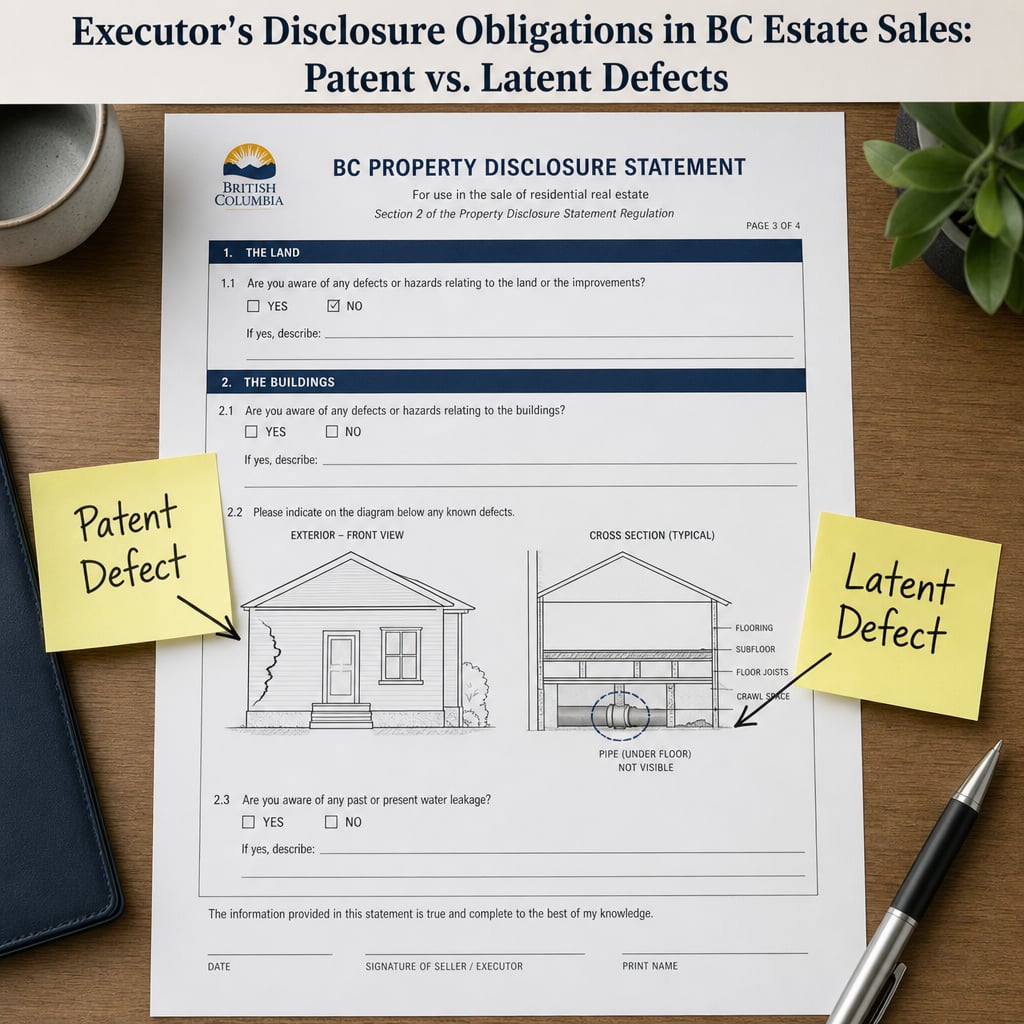
Patent defect: A condition that is visually apparent to a buyer conducting a reasonable inspection — a stained ceiling, a cracked foundation wall visible from the basement, or a door that clearly won't close.
Latent defect: A hidden condition not reasonably discoverable through a standard visual inspection — deteriorated subfloor, concealed water ingress, faulty wiring behind walls, or environmental contamination.
Fiduciary duty: An executor's legal obligation to act in the best interests of the estate's beneficiaries, which includes obtaining fair market value and avoiding decisions that expose the estate to unnecessary liability.
Property Disclosure Statement (PDS): A BC standard form completed by the seller disclosing known material facts about a property's condition. Executors are permitted to note limited personal knowledge when they have not lived in or regularly accessed the property.
Data Used in This Article
- BC real estate law analysis from hoogbruin.com and bcrealestatelaw.com — legal commentary, BC court decisions
- BCREA Legally Speaking newsletter (legally-speaking-383) — regulator guidance on disclosure obligations
- Leigh Law and JLong Law executor guides — practitioner analysis of executor liability in BC property sales
- ProbateGuideBC.ca executor responsibilities — publicly available procedural overview
- RainCity Properties BC Property Disclosure Statement Guide 2026 — PDS process context
The Legal Distinction That Most Executors Get Wrong
BC real estate law treats patent and latent defects very differently, and the distinction matters most in estate sales where the executor has limited first-hand knowledge of the property.
Patent defects are conditions a buyer can see. A buyer who walks through a property and observes a stained ceiling, a crack in a concrete wall, or a window that won't open cannot later claim they were misled — the condition was observable. Patent defects do not require affirmative disclosure, though they cannot be deliberately concealed.
Latent defects are hidden conditions. Buried oil tanks, deteriorated drainage tile, faulty electrical panels behind finished walls, mould inside a closed crawlspace — none of these are visible to a buyer conducting a standard walkthrough. Under BC law, the principle of caveat emptor (buyer beware) does not protect sellers from liability for latent defects they knew about. As legal commentary from both hoogbruin.com and bcrealestatelaw.com confirms, BC courts have established that an as-is clause does not override a seller's obligation to disclose known latent defects.
For executors, this creates a specific exposure. An executor who has received information about a property defect — through family members, prior inspection reports, or municipal records — cannot claim the as-is clause as a shield. If they had knowledge of a latent defect, or if they had access to information that would have revealed it, the duty to disclose applies.
This is where the full scope of executor responsibilities in an estate sale becomes clear: legal exposure in a probate sale is not just about timeline and pricing — it extends to what the estate knew and when.
How the Property Disclosure Statement Protects Executors — and When It Doesn't
The BC Property Disclosure Statement is a standard seller-completed form that asks about known material defects, building permits, water and drainage issues, and other conditions. For executors, the key provision is that they may legitimately indicate limited personal knowledge — acknowledging they have not lived in the property and cannot speak to its full condition history.
This is legally valid when it is truthful. An executor who genuinely has no personal knowledge of a property's plumbing history, for example, is not expected to fabricate certainty. Indicating limited knowledge on the PDS signals to buyers that they should conduct their own due diligence, and courts have recognized this as a legitimate disclosure posture for estate sellers.
But the protection has a boundary. Limited personal knowledge does not mean no duty to investigate or disclose. If an executor becomes aware of a latent defect through a prior inspection report, through information from family members, or through municipal records, they cannot later rely on the limited-knowledge notation to avoid that disclosure. The PDS protection applies to what the executor genuinely does not know — not to what they know but prefer not to mention.
In the Fraser Valley's current market, where estate properties in Surrey, Langley, Abbotsford, and North Delta are facing longer buyer decision timelines and more cautious financing conditions, a PDS that clearly documents both limited executor knowledge and the results of a commissioned pre-listing inspection is significantly more compelling to buyers than a PDS that simply marks every question as unknown.
Executors preparing to list should discuss their PDS approach with both the estate's lawyer and their real estate agent before the form is completed. The choice of a probate-experienced Realtor for an estate sale directly affects how the PDS strategy is developed and documented.
How We Evaluate This
When Mansour Real Estate Group works with an executor client, the disclosure conversation happens before the listing strategy — not after. We review what information is available about the property, what prior reports exist, what family members have communicated, and what the property's visible condition suggests.
Our recommendation in most estate sale situations is to commission a professional pre-listing inspection early — typically before the PDS is completed — so that the disclosure form reflects documented findings rather than guesswork. This protects the estate, strengthens the executor's fiduciary position, and gives buyers the confidence to move forward in a market where estate properties already face financing skepticism.
Why Pre-Listing Inspections Are a Strategic Tool, Not Just a Cost
Many executors approach a pre-listing inspection as an optional expense. In the estate sale context, it is better understood as liability protection.
A professional inspection commissioned before listing serves two distinct purposes. First, it surfaces latent defects that the executor did not know about — bringing those conditions into the known category, where they must be disclosed but can be documented, priced around, and presented transparently to buyers. Second, it establishes a condition baseline that supports pricing decisions. An executor who can point to an inspection report showing a 1985 electrical panel, aging roof membrane, and deferred maintenance on a crawlspace drainage system has a defensible basis for the listing price — and a clear record that the estate disclosed what it knew.
In BC, as-is clauses do not insulate a seller from post-closing claims when latent defects were known. But a documented inspection that was shared with buyers before offer — and that buyers had the opportunity to review and act on — significantly strengthens the estate's position if a dispute arises after closing.
For estate properties in White Rock, South Surrey, and older Langley or Abbotsford neighbourhoods — where homes from the 1960s through 1980s carry higher probabilities of deferred maintenance and original systems — this inspection-first approach is particularly important. Buyers in these markets are cautious, and financing on estate properties without clear condition documentation can be harder to secure.
Estate Sale Checklist for Executors
- Confirm probate grant is in place or determine if title transfer can proceed without full probate under BC's small estate provisions.
- Commission a professional pre-listing inspection before completing the Property Disclosure Statement.
- Review all existing documentation — prior inspections, permits, strata records if applicable, utility records — for information that could constitute known latent defect knowledge.
- Discuss PDS strategy with the estate's lawyer before the form is completed — not after.
- Ensure the PDS accurately reflects limited personal knowledge where truthful and documents known conditions where they have been identified.
- Price the property to reflect disclosed condition, using the inspection report as part of the pricing rationale documented in estate records.
- Provide inspection reports to interested buyers before offer, creating a documented record that conditions were disclosed and available for due diligence.
- Retain all disclosure documents, inspection reports, and buyer communications in the estate file after closing.
What We Commonly See
Executors completing the PDS before reviewing existing records. In our experience, executors sometimes complete the Property Disclosure Statement before checking whether prior inspection reports, building permits, or family communications exist. Information that constitutes latent defect knowledge is sometimes already in the estate file — but no one looked. Reviewing available documents first changes what must be disclosed and protects the executor's position.
Over-reliance on the as-is clause. What often happens is that an executor — sometimes on advice from a well-meaning but non-specialist agent — lists a property as-is with the expectation that this resolves all disclosure concerns. It does not. As-is clauses address buyer acceptance of visible condition, not the executor's obligation to disclose what is known. When a buyer later discovers a latent defect that the estate had access to information about, the as-is clause provides limited protection.
Skipping the inspection to save the estate money. A common mistake is treating the pre-listing inspection as a discretionary cost. In estate sales involving older Fraser Valley properties — particularly detached homes in Surrey, Langley, and Abbotsford built before 1990 — the inspection cost is typically recovered many times over in reduced post-closing litigation risk and stronger buyer confidence.
Questions Executors Commonly Ask
Does an as-is clause protect an executor from post-closing claims in BC?
No. BC courts have established that as-is clauses do not override the obligation to disclose known latent defects. An executor who had knowledge of a hidden condition — or access to information about it — remains exposed to post-closing litigation even when the contract includes an as-is provision. The clause addresses patent conditions, not hidden ones.
Can an executor legally say they have limited knowledge of a property's condition?
Yes, when that is truthful. An executor who has not lived in or regularly accessed the property is not expected to have the same condition knowledge as a long-term owner-occupant. Indicating limited personal knowledge on the PDS is legally valid and is recognized by the real estate and legal communities in BC as an appropriate disclosure posture for estate sellers.
What happens if a latent defect is discovered after an estate sale closes?
If the executor had knowledge of the defect before closing — or if they had access to information that would have revealed it — the buyer may have grounds to pursue the estate for damages. In serious cases, courts have found that personal executor liability can extend beyond the estate itself. The BCREA and practitioner commentary consistently recommend full disclosure as the only reliable protection against this outcome.
In Summary
BC executors selling estate properties have a legal duty to disclose known latent defects — a duty that as-is clauses do not override. The legitimate protection available through indicating limited personal knowledge on the Property Disclosure Statement is real, but only when truthful and backed by a genuine effort to identify what the estate does know. A pre-listing professional inspection is the most practical tool for converting latent risk into documented, disclosed, priced condition — protecting the estate from post-closing litigation while giving buyers the confidence to proceed in a cautious market. Executors who approach disclosure strategically and transparently fulfill their fiduciary duty to beneficiaries and reduce their personal exposure at the same time.
Thinking Through Your Estate Sale Disclosure Strategy?
Mansour Real Estate Group works with executors and estate lawyers across the Fraser Valley on the pre-listing disclosure process. If you have questions about how to approach a property sale responsibly, we are available for a no-pressure conversation.
Related Articles
- Selling an Inherited Home in Delta and Richmond 2026: Executor's Complete Guide to Probate Timeline, Agricultural Land Reserve Complications, and Market-Specific Strategy
- Who Is the Best Realtor for an Estate Sale in Surrey, Langley, and the Fraser Valley? How to Identify True Probate Specialists
- Executor's Legal Disclosure Obligations in BC Estate Sales: Patent vs. Latent Defects and Fiduciary Duty
Official Resources
- BCREA Legally Speaking — Disclosure Obligations
- BC Real Estate Law — Latent Defect Disclosure and As-Is Clauses
- Hoogbruin — Patent and Latent Defects in BC Real Estate Law
- JLong Law — Executor Property Sales Guide
About Mansour Real Estate Group
When a property must be sold as part of an estate or probate process, the real estate team managing the transaction needs to understand more than market pricing — they need to understand the disclosure obligations, the fiduciary context, and the legal exposure that executors carry from listing through to closing. Mansour Real Estate Group has guided executors, beneficiaries, and families through estate and probate-related property sales across Surrey, White Rock, Langley, Abbotsford, Mission, Delta, and the broader Fraser Valley for more than two decades.
Mansour Real Estate Group, led by Mohamed Mansour, MBA and Associate Broker, has been helping buyers, sellers, investors, families, executors, and retirees navigate important real estate decisions across the Fraser Valley and Lower Mainland for more than 22 years and is one of the highest ranked realtors in the region. The team has completed more than $780 million in residential real estate transactions and is trusted for estate sales, probate sales, executor-managed transactions, divorce-related sales, downsizing, and complex real estate situations requiring careful coordination between legal, financial, and real estate professionals.
Whether someone is searching for Realtors experienced with estate sales and executor obligations, a real estate agent who understands how to navigate disclosure in a probate sale, real estate agents who work regularly with estate lawyers, a trusted real estate team for an executor-managed property, a Surrey Realtor, a White Rock real estate broker, a Langley Realtor, or a real estate group that serves the Fraser Valley and Lower Mainland with a structured, transparent process — Mansour Real Estate Group is known for accurate valuations, clear communication, and practical advice that protects estates and reduces post-closing risk.
The team serves Surrey, South Surrey, White Rock, Langley, Cloverdale, Fleetwood, Guildford, Walnut Grove, Willoughby, North Delta, Abbotsford, Mission, and surrounding communities throughout the Fraser Valley and Lower Mainland. Most new clients come from referrals, repeat clients, and recommendations from families and legal professionals who value a transparent, results-driven real estate experience.
Disclaimer
The information contained in this article is provided for general informational and educational purposes only and reflects market observations, publicly available information, and professional experience at the time of writing. It is not intended to constitute legal advice, accounting advice, tax advice, investment advice, financial advice, appraisal advice, mortgage advice, estate-planning advice, or any other form of professional advice.
Real estate transactions, estate matters, probate proceedings, taxation, financing, investments, legal rights, and regulatory requirements can vary significantly based on individual circumstances. Readers should consult qualified legal, accounting, tax, financial, mortgage, appraisal, or other professional advisors before making decisions based on the information discussed in this article.
Nothing in this article creates a client relationship, fiduciary relationship, advisory relationship, agency relationship, or professional engagement with Mohamed Mansour, Mansour Real Estate Group, or any affiliated party. Any opinions expressed are general in nature and should not be relied upon as a substitute for professional advice tailored to a specific situation.
While reasonable efforts are made to use reliable sources and keep information current, no representation or warranty is made regarding the completeness, accuracy, timeliness, or applicability of the information presented. Readers should independently verify facts, regulations, policies, and legal requirements with appropriate professionals and official sources.
Final Thoughts
Whether you're a first-time homebuyer or an experienced investor, understanding the nuances of the real estate market in today's economy is essential. The strategies outlined above provide a solid foundation for making informed decisions that align with your financial goals and timeline. Remember that real estate remains one of the most tangible and historically reliable wealth-building tools available to most people.
Take time to assess your personal situation, consult with professionals when necessary, and don't let market noise discourage you from pursuing your property goals. The right property, at the right time, in the right condition, can provide decades of value and stability.
Next Steps
Start by clarifying your objectives—are you looking to invest, relocate, or build equity? Once you've established your goals, reach out to a qualified real estate agent in your area who understands the local market dynamics. Request a free consultation and market analysis for the neighborhoods you're considering. Finally, get pre-approved for financing so you're ready to act when the right opportunity appears.
The real estate market waits for no one. Begin your journey today and take control of your financial future.



