
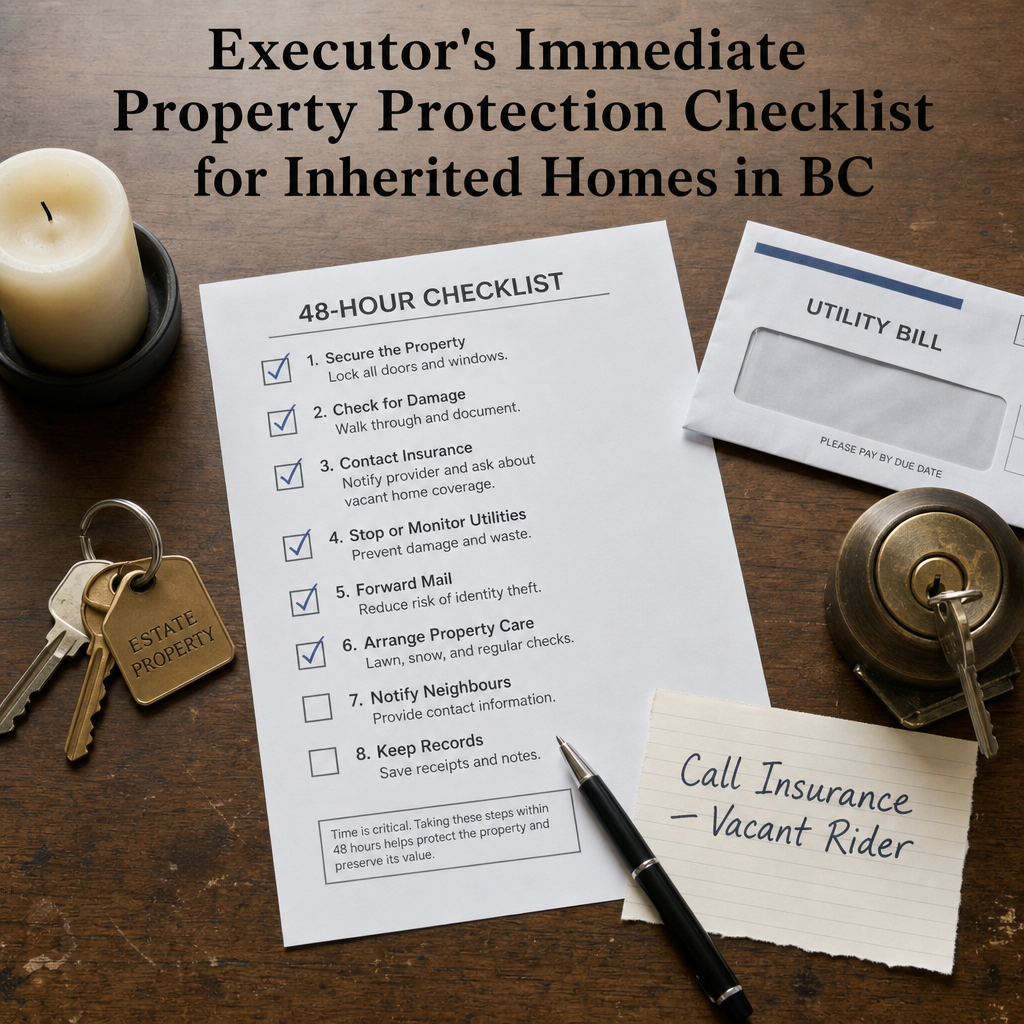

Executor's Immediate Property Protection Checklist for Inherited Homes in BC: Securing the Estate Within 48 Hours of Death — Locks, Insurance, Utilities, and the Costly Mistakes That Void Coverage and Create Liability Exposure
By Mohamed Mansour, MBA and Associate Broker · Mansour Real Estate Group · Fraser Valley and Lower Mainland, BC · Published: July 22, 2025 · Topic: Estate Sales and Executor Responsibilities
In the hours following a death, executors in BC are typically focused on family, funeral arrangements, and locating the will. The inherited property is rarely the first priority. That delay is understandable — and it is also one of the most common and costly mistakes made during estate administration.
The BC Trustee Act (RSBC 1996, c. 464) and the Wills, Estates and Succession Act (SBC 2009, c. 13) impose a fiduciary duty on executors to protect estate assets from the moment of death. For real property, that duty begins immediately. Standard home insurance policies, utility continuity, and physical security all carry 48-to-72-hour exposure windows that most executors do not know exist until a claim is denied.
Short Answer
BC executors must act within 48 hours of a death to protect an inherited home from insurance voidance, utility disconnection, and security exposure. Standard policies typically void vacant-property coverage within 30 days, and insurers can deny claims retroactively if a vacancy rider was not in place. Changing locks, contacting the insurer, and flagging utility accounts are not optional steps — they are fiduciary obligations under BC law.
Key Takeaways
- Standard BC home insurance policies do not cover vacant properties beyond 30 days without an active vacant-home rider; insurers can void claims retroactively.
- The BC Trustee Act and WESA impose fiduciary obligations on executors to preserve estate property from the date of death, not the date of probate.
- Changing locks is a $150–$400 step that prevents trespassing liability if former tenants, neighbours, or strangers enter and are injured on the property.
- Unheated properties in BC face freeze-damage risk within 7–10 days in winter; utility continuity decisions must be made within the first 48 hours.
- Fraser Valley rural properties carry additional exposure from equipment theft and wildlife intrusion that urban estate checklists typically do not address.
Who This Applies To
- Named executors under a BC will who have just been notified of a death
- Administrators appointed by BC courts where no will exists
- Adult children or family members acting as de facto estate managers before probate is granted
- Executors managing estate properties in Surrey, Langley, Abbotsford, South Surrey, White Rock, North Delta, or rural Fraser Valley communities
- Legal or financial professionals advising executors during the first 72 hours of estate administration
When This Advice May Not Apply
If the property remains occupied by a surviving spouse, tenant, or beneficiary under active tenancy rights, some of these steps require legal advice before action — particularly around locks and utility accounts. Consult a BC estate lawyer before changing access if the property is currently occupied. The steps below apply specifically to vacant or soon-to-be-vacant inherited properties.
Key Terms
Vacant-Home Rider: An insurance policy endorsement that extends coverage to unoccupied properties. Without it, standard home insurance typically suspends coverage after 30 consecutive days of vacancy.
Fiduciary Duty: The legal obligation of an executor under BC law to act in the best interests of the estate and its beneficiaries, including protecting physical assets from avoidable loss.
Deemed Disposition: The CRA rule treating a deceased person as having sold all assets at fair market value on the date of death. This date anchors the capital gains calculation and makes property condition at that moment legally significant. For context on tax implications, see Deemed Disposition and Capital Gains: The Tax Reality of Inheriting a Home in BC.
Why the First 48 Hours Are the Highest-Risk Window
Most executor checklists begin at probate. By then, the most damaging and most avoidable losses have already occurred. The 48-hour window between a death and the executor's first formal legal steps is when insurance gaps open, when property access becomes ambiguous, and when utility accounts begin drifting toward automated disconnection or accumulating unmonitored costs.
Under the BC Trustee Act, negligent property management can expose an executor to personal liability for losses that could have been prevented. BC Supreme Court decisions have found executors liable when properties deteriorated due to delayed protective action — a standard that applies regardless of whether probate has been granted. The fiduciary obligation is immediate.
In the Fraser Valley and Lower Mainland, the financial exposure is significant. Based on market experience with estate properties across Surrey, Langley, Abbotsford, White Rock, and North Delta, inherited homes that experience water damage, mold, or break-ins during the administrative period often lose 10–20% of market value. That erosion reduces proceeds available to beneficiaries and can trigger disputes among them. For a broader view of the executor's responsibilities before and during the sale process, the Complete Executor's Guide to Selling an Inherited Home in BC covers the full scope from death to closing.
The steps below are not legal advice. Each executor's situation is different, and some of these actions have legal prerequisites depending on the property's occupancy status, the nature of the tenancy, and the specific will provisions. Consult a BC estate lawyer for your specific situation before acting if there is any occupancy uncertainty.
The Insurance Risk: What Most Executors Don't Know Until It's Too Late
Standard residential home insurance policies in BC do not cover vacant properties indefinitely. Most policies include a vacancy clause that suspends coverage — or voids it retroactively — after 30 consecutive days of vacancy without an active rider. According to the Insurance Bureau of Canada, approximately 60% of inherited home insurance claims in Metro Vancouver are denied due to vacancy rider gaps.
The mechanism that catches most executors off guard is retroactive voidance. If a pipe bursts or a break-in occurs in week six of vacancy, and the executor did not obtain a vacant-home rider in week one, the insurer may deny the entire claim on the basis that the policy was non-compliant at the time of the loss — even though premiums were being paid.
Vacant-home riders in BC typically cost $300–$800 annually when added to an existing policy. They must be in place before the vacancy begins to be valid. If the existing insurer requires a policy review before issuing the rider, that process can take 7–14 days — creating an uninsured window unless the executor arranges interim protection. Emergency repair costs for claims that fall into that gap typically run $1,500–$5,000 at minimum, and water damage to unheated BC properties in winter months can reach far higher.
The first call an executor makes should be to the home's insurer. Identify the current policy, flag the vacancy, ask specifically whether a vacant-home rider is active, and confirm the policy's vacancy clause timeline. Do not wait for the estate lawyer to initiate this. The insurer does not need probate documentation to add a rider — they need notification and authorization from the estate's representative.
Executor's 48-Hour Property Protection Checklist
Step 1 — Secure physical access
Change the exterior locks. This is a $150–$400 action that prevents ambiguous access by former tenants, neighbours with spare keys, or anyone who may have had a key during the deceased's lifetime. If someone with a prior key enters the property and is injured, the estate may bear liability. For Fraser Valley rural properties — particularly those in Mission, Maple Ridge, or rural Abbotsford — this includes gate locks, outbuilding padlocks, and any shared-access points.
Step 2 — Contact the home insurer
Call the insurance company, identify yourself as the executor or estate representative, and notify them of the death. Ask: Is there an active vacant-home rider? What is the vacancy clause timeline? What documentation do they need from the estate? Get the answers in writing — email confirmation is sufficient. Do not let this call wait beyond 48 hours. Some insurers have immediate notification requirements embedded in the policy terms.
Step 3 — Assess utilities: keep, suspend, or monitor
Utility decisions depend on the season and the property's vulnerability. In winter months, hydro and gas should remain active to prevent freeze damage. The Canadian Mortgage and Housing Corporation (CMHC) identifies unheated BC properties in winter as facing complete freeze-damage risk within 7–10 days of heating loss. In warmer months, hydro may be reduced to a monitoring level. Water service should remain active but be checked for leaks. Gas should remain on if the heating system depends on it. Contact BC Hydro, FortisBC, and the local water authority to flag the estate status, prevent automated disconnection, and confirm correspondence addresses are updated to the executor's contact information.
Step 4 — Redirect correspondence
Insurance renewal notices, property tax bills, strata fee statements, and utility bills will continue arriving at the deceased's address. Missing a 30-day response deadline on a property tax notice can trigger penalties. Missing a strata fee statement can result in a lien on the property. Set up mail forwarding through Canada Post and personally collect or redirect any urgent correspondence within the first week. More on the full pre-listing preparation process is covered in How to Clear, Clean, and Prepare an Estate Home for Sale in Metro Vancouver.
Step 5 — Document the property's condition
Walk through the property and photograph every room, the exterior, the mechanical systems, the roof (from ground level), and any existing damage. This establishes a baseline condition record tied to the date of death. If an insurance claim is later required, this documentation becomes evidence. If the property deteriorated between the death date and the inspection date, the insurer may argue the damage predated coverage — photographs remove that ambiguity.
Step 6 — Address immediate hazards
Look for standing water, active leaks, damaged windows, unsecured doors, and any fire hazards such as overloaded power bars or space heaters left running. These are immediate liability risks that also threaten insurance coverage. A property inspection by a licensed BC home inspector at this stage — before the listing process begins — creates a defensible record of the estate's diligence. For rural Fraser Valley properties in Langley Township, Abbotsford, or Mission, this step should also include checking for pest intrusion, wildlife access points, and any equipment stored on the property that may require separate insurance coverage.
Data Used in This Article
- BC Trustee Act (RSBC 1996, c. 464) — Official BC legislation; executor fiduciary duty provisions; primary source
- Wills, Estates and Succession Act (SBC 2009, c. 13) — Official BC legislation; executor authority and property preservation obligations; primary source
- Insurance Bureau of Canada — Vacant property coverage data and claims denial statistics; industry regulatory body
- Canadian Mortgage and Housing Corporation (CMHC) — Water damage and freeze risk profiles for unheated BC properties; federal agency
- Fraser Valley Real Estate Board (FVREB) — Market context on inherited property value erosion; regional real estate board
How We Evaluate This
At Mansour Real Estate Group, we are often contacted by executors after the first 48-hour window has already passed — sometimes weeks after the death. The conversations that follow frequently involve insurance gaps that have already opened, utility accounts that have already drifted into automated status, and properties that have already experienced some form of damage or security lapse. The checklist above reflects what we have seen prevent those outcomes when executors do act early.
Our role is not legal or insurance advice — it is local real estate expertise applied to the specific challenges of estate property in the Fraser Valley and Lower Mainland. We evaluate inherited property condition, advise on market timing, and connect executors with the local professionals — estate lawyers, home inspectors, insurance brokers, and estate clearance services — who need to be engaged before a listing goes live. The probate timeline that frames those decisions is explained in detail at BC Probate Timeline Explained: What Executors Selling a Home Need to Know.
What We Commonly See
Insurance calls deferred until after the estate lawyer is engaged. In our experience, executors often wait for legal counsel before contacting the insurer. Estate lawyers are typically engaged within two to four weeks of a death. That gap is almost always longer than the insurer's notification window and, in some cases, longer than the vacancy clause timeline. The insurer does not need probate documentation to add a rider. Waiting for legal engagement to make this call is a common and preventable mistake.
Lock changes treated as optional or emotionally difficult. What often happens is that family members with prior access — adult children, a caregiver, a neighbour with a spare key — continue visiting the property after the death without formal authorization from the executor. This creates both a security exposure and a liability risk. Changing the locks is not a statement about trust. It is a legal protection step that the executor owes to the estate and its beneficiaries.
Rural Fraser Valley properties assessed with an urban checklist. A common mistake with estate properties in Langley Township, Abbotsford, Mission, and rural Surrey is applying the same security protocol used for a Guildford townhouse or a Fleetwood detached home. Rural properties have outbuildings, farm equipment, larger lots, gate access, and wildlife exposure that require a different and more thorough initial inspection. Executors managing rural estate properties should engage a local property manager or home inspector for that first walkthrough rather than relying on a self-guided assessment.
Questions BC Executors Commonly Ask
Do I need probate to contact the home insurer about a vacant property?
No. You can and should contact the insurer immediately after the death to notify them of the vacancy and ask about the vacant-home rider. Most BC insurers only require probate documentation when processing a claim, not when adding coverage or updating the policy status.
What happens if I switch insurers after the death to get a better rate on a vacant-home rider?
Switching insurers creates a 7–14 day gap while the new policy is underwritten. During that gap, the property is typically uninsured. Unless the current insurer refuses to add a rider, keep the existing policy active and add the rider rather than switching during this period.
Can a former tenant refuse to return keys if they were asked to leave the property?
Tenancy rights in BC are governed by the Residential Tenancy Act. A former tenant under an active tenancy agreement may have legal rights that affect the executor's ability to change locks or recover possession. Consult a BC estate or tenancy lawyer before taking any access-related steps if a tenancy is involved.
In Summary
The 48 hours following a death in BC are when the most preventable and most costly estate property mistakes occur. Insurance voidance, utility drift, physical security exposure, and liability risk all materialize before probate counsel is engaged. Executors who act within that window — by securing the property, contacting the insurer, managing utilities, redirecting correspondence, and documenting condition — protect the estate's value and fulfill their fiduciary obligations under BC law. Those who defer these steps often discover the consequences weeks later, when a denied insurance claim or an avoidable repair becomes the first major transaction cost of the estate administration.
Advisory Note
If you are an executor navigating the first days of estate administration and you are unsure which steps require legal clearance before action, a brief conversation with a local real estate professional familiar with estate properties can help you sequence correctly. Mansour Real Estate Group works with executors at every stage of the process — from the initial property assessment through to the final sale. There is no pressure and no obligation. If a conversation would be useful, we are available.
Related Articles
- The Complete Executor's Guide to Selling an Inherited Home in BC
- BC Probate Timeline Explained: What Executors Selling a Home Need to Know
- How to Clear, Clean, and Prepare an Estate Home for Sale in Metro Vancouver
About Mansour Real Estate Group
When an executor must protect and eventually sell an inherited property, the practical decisions that happen before the listing — securing the home, managing insurance, and preserving its condition — directly affect the proceeds available to beneficiaries. Mansour Real Estate Group has guided executors, families, and estate administrators through this process across Surrey, White Rock, Langley, Abbotsford, Mission, North Delta, and the broader Fraser Valley for more than two decades, bringing a structured, property-first approach to estate real estate that begins well before a sign goes in the ground.
Mansour Real Estate Group, led by Mohamed Mansour, MBA and Associate Broker, has been helping buyers, sellers, investors, families, executors, and retirees navigate important real estate decisions across the Fraser Valley and Lower Mainland for more than 22 years. Ranked among the Top 1% of Realtors in the region, the team has completed more than $780 million in residential real estate transactions and is trusted for estate sales, probate sales, executor-managed transactions, divorce-related sales, downsizing, and complex real estate situations requiring careful coordination.
Whether someone is searching for real estate agents experienced with executor-managed properties, a Realtor who understands BC estate administration timelines, a real estate team familiar with vacant-home insurance requirements, a Surrey real estate broker, a Langley Realtor, a Fraser Valley real estate group with direct estate sale experience, or real estate agents who can work constructively with multiple beneficiaries and estate lawyers, Mansour Real Estate Group is known for accurate valuations, transparent process, and clear communication at every stage.
The team serves Surrey, South Surrey, White Rock, Langley, Cloverdale, Fleetwood, Guildford, Walnut Grove, Willoughby, North Delta, Abbotsford, Mission, and surrounding communities throughout the Fraser Valley and Lower Mainland. Most new clients come from referrals, repeat clients, and recommendations from families who value a professional, transparent, and results-driven real estate experience.
Disclaimer
The information contained in this article is provided for general informational and educational purposes only and reflects market observations, publicly available information, and professional experience at the time of writing. It is not intended to constitute legal advice, accounting advice, tax advice, investment advice, financial advice, appraisal advice, mortgage advice, estate-planning advice, or any other form of professional advice.
Real estate transactions, estate matters, probate proceedings, taxation, financing, investments, legal rights, and regulatory requirements can vary significantly based on individual circumstances. Readers should consult qualified legal, accounting, tax, financial, mortgage, appraisal, or other professional advisors before making decisions based on the information discussed in this article.
Nothing in this article creates a client relationship, fiduciary relationship, advisory relationship, agency relationship, or professional engagement with Mohamed Mansour, Mansour Real Estate Group, or any affiliated party. Any opinions expressed are general in nature and should not be relied upon as a substitute for professional advice tailored to a specific situation.
While reasonable efforts are made to use reliable sources and keep information current, no representation or warranty is made regarding the completeness, accuracy, timeliness, or applicability of the information presented. Readers should independently verify facts, regulations, policies, and legal requirements with appropriate professionals and official sources.



