
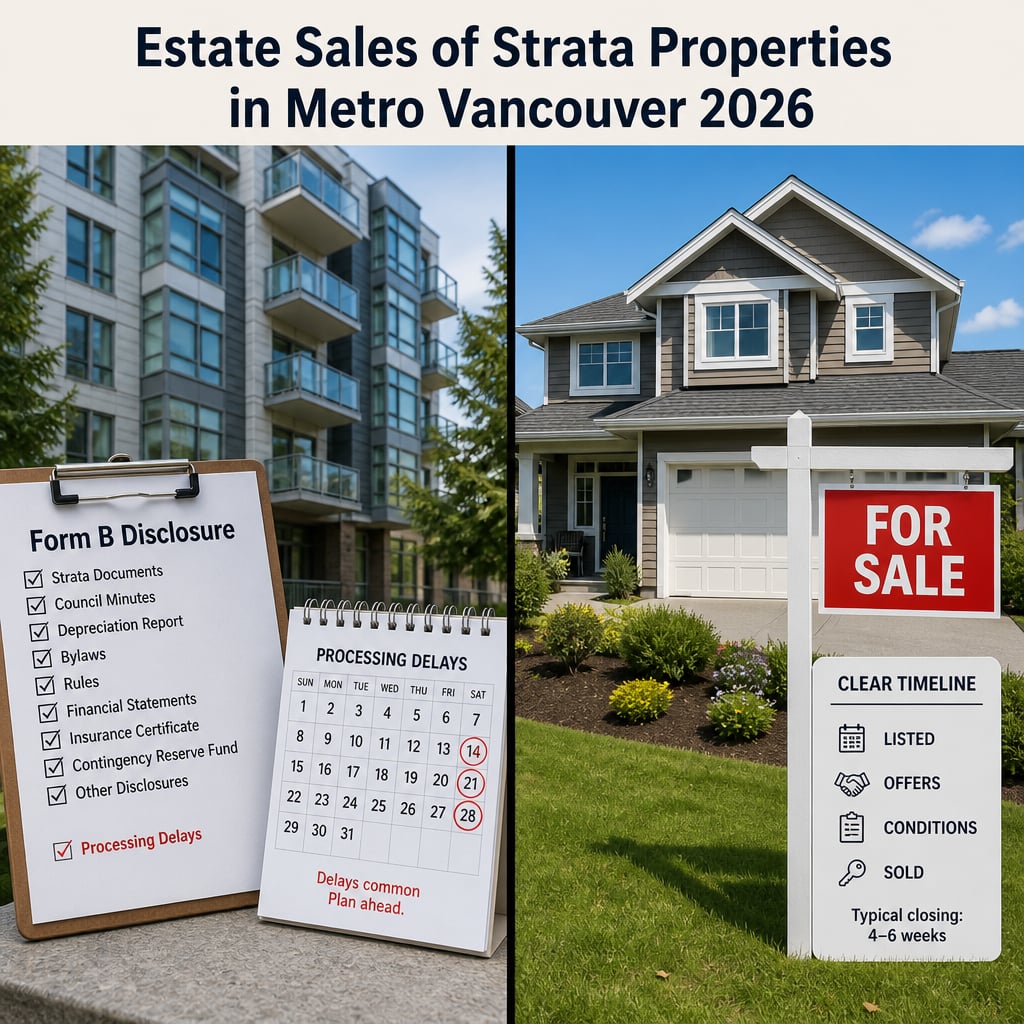

Estate Sales of Strata Properties in Metro Vancouver 2026: How Condo and Townhome Probate Sales Differ From Detached Homes
By Mohamed Mansour, MBA and Associate Broker, Mansour Real Estate Group | Published: August 12, 2025 | Geography: Metro Vancouver — Coquitlam, Burnaby, Richmond | Topic: Estate and Probate Sales, Strata Properties, BC
Short Answer
Selling a strata property through an estate in Metro Vancouver involves procedural obligations — Form B disclosure, strata council notification, contingency reserve assessment, and special levy review — that simply do not exist in detached-home probate sales. In Coquitlam, Burnaby, and Richmond, where investor-driven inventory and aging building stock compress executor proceeds, understanding these layers before listing is the difference between a smooth closing and a failed deal.
Who This Applies To
- Executors managing a strata property as part of a BC estate
- Estate lawyers coordinating property disposition in Coquitlam, Burnaby, or Richmond
- Beneficiaries expecting to receive proceeds from a condo or townhome probate sale
- Families holding a strata property during probate without understanding ongoing fee liability
When This Advice May Not Apply
This guide addresses strata properties under BC probate. It does not cover bare land stratas, properties with active tenancy disputes, or commercial strata units. Executors should confirm probate grant status with their estate lawyer before listing. All strata-specific obligations described here arise under the Strata Property Act [SBC 1998] CHAPTER 43 and may vary based on individual strata bylaws.
Data Used in This Article
- Greater Vancouver REALTORS® July 2026 MLS® HPI and REALTOR® Report — official board data, Coquitlam benchmark and average DOM
- Linden Homes Coquitlam August 2026 market analysis — third-party analysis, Coquitlam apartment pricing trends
- BC Strata Property Act [SBC 1998] CHAPTER 43 — Form B, council authority, transfer procedures — official provincial legislation
- Mansour Real Estate Group — internal analysis of estate strata transactions in the Tri-Cities and Metro Vancouver, 2026
Key Takeaways
- Form B disclosure is mandatory in strata sales and cannot be expedited — plan for the delay before listing.
- Strata council approval of the transfer adds procedural steps absent in all detached-home estate sales.
- Coquitlam apartment benchmarks fell 12.4% over three years to $651,400, with a 39-day average DOM signalling sustained buyer hesitation.
- Special levy risk and weak contingency reserves can trigger buyer financing denials — estates must price for this before going to market.
- Investor-driven comparable inventory in Burnaby and Richmond directly compresses achievable prices for aging, unrenovated estate condos.
Why Strata Estate Sales Are More Complex Than Detached Probate Sales
When an executor sells a detached house, the procedural obligations are relatively contained: obtain probate grant, clear title, price the property, list it. The building itself is not governed by a third party.
Strata properties work differently. The moment a strata condo or townhome enters an estate, the strata corporation becomes a procedural participant in the sale. The executor must notify the strata council of the ownership change, ensure strata fees are current throughout probate — because those fees continue to accrue regardless of whether the estate has liquid funds — and coordinate the preparation of a Form B Information Certificate before any deal can close.
Under Section 59 of the Strata Property Act, a buyer is entitled to request a Form B, and in practice, no buyer's lender will approve financing without it. The Form B must be prepared by the strata manager and is governed by statutory timelines — it cannot be rushed to accommodate an executor's preferred closing date. In markets like Coquitlam, Burnaby, and Richmond, where buyer confidence is already muted and days on market are elevated, a Form B that surfaces a pending special levy or an underfunded contingency reserve can end a subject-free offer or trigger renegotiation.
According to the Greater Vancouver REALTORS® July 2026 data, Coquitlam apartment benchmarks sat at $651,400, down approximately 12.4% over three years, with an average DOM of 39 days and a sales-to-active ratio of 15.3% — firmly in buyer's market territory. That ratio matters for executors: it signals that buyers have options and are not competing, which means Form B disclosures that reveal financial risks will translate directly into price adjustments, not overlooked conditions.
Pricing Strategy When Investor Inventory and Building Age Compress Proceeds
Estate strata properties in Metro Vancouver face a specific pricing problem in 2026: they compete against investor-owned inventory that is often newer, renovated, or strategically priced to exit quickly. Presale completions in Burnaby and Coquitlam over the past two years have added investor-exit listings to the comparable pool — properties where owners are motivated to sell and willing to price aggressively.
An estate condo — typically older, sold as-is, unfurnished, and without recent upgrades — competes in that environment at a disadvantage unless priced to reflect the delta honestly. The Linden Homes Coquitlam August 2026 analysis specifically notes that older condos with high monthly fees and weak contingency reserves face steeper price adjustments than transit-proximate, newer buildings. For executors, this is the market signal that matters: the building's financial health is not just a disclosure item — it is a pricing input.
In practice, the estate real estate agent should pull the strata financials — contingency reserve fund balance, most recent depreciation report, and any known upcoming levies — before setting the list price. A building with a healthy reserve and a recent depreciation report showing no urgent capital expenditures supports a stronger price. A building with a thin reserve and a depreciation report flagging roof or elevator work within five years requires a price that reflects the buyer's future risk.
Executors who list first and disclose later — or who price at market without accounting for strata financial risk — frequently encounter price reductions after subject removal, or deals that collapse entirely when lender appraisers flag the building's reserve status. Pricing with the Form B in hand, not after it arrives, is the structurally correct approach for a well-managed estate sale process.
How We Evaluate This
Mansour Real Estate Group approaches strata estate sales by separating the procedural timeline from the market timeline. The procedural work — strata council notification, Form B request, fee payment confirmation, depreciation report review — must begin before the listing is prepared, not after. Listing a strata property without confirming Form B availability is one of the most avoidable delays in a probate sale.
On pricing, the team cross-references three inputs: active comparable listings (including investor-exit inventory), the building's strata financial health, and the estate's condition relative to market-ready properties. Those three inputs, not just recent sales data alone, determine the appropriate list price for an as-is estate strata unit in a buyer's market.
Estate Strata Sale Checklist
- Confirm probate grant is issued before listing — lenders will require it for financing approval
- Notify strata council of ownership change and executor authority in writing
- Confirm all outstanding strata fees and special levy contributions are current — these are the estate's liability
- Request Form B from strata manager immediately — allow adequate lead time before target listing date
- Obtain the most recent depreciation report and review contingency reserve fund balance with your real estate team
- Identify any known or forecasted special levies — disclose proactively and price accordingly
- Price the property with the strata financial picture in hand, not after the listing goes live
- Coordinate with the estate lawyer on transfer document requirements specific to strata properties in BC
What We Commonly See
Executors listing before Form B is confirmed. In our experience, this is the single most common procedural mistake in strata estate sales. An executor agrees to a short closing date, the Form B arrives after subject removal, the lender flags a reserve fund shortfall, and the buyer renegotiates or walks. The Form B needs to be in hand before the listing strategy is finalized.
As-is pricing without accounting for building financial risk. What often happens is an executor prices the unit at a discount for cosmetic condition but does not separately adjust for the strata corporation's financial position. In Coquitlam and Burnaby's current buyer's market, buyers — and their lenders — treat a weak depreciation report as an additional discount factor, not as already priced in.
Strata fee liability going unresolved during probate. A common oversight is strata fees accruing for months during probate administration without the executor confirming payment authority. These fees do not pause during probate — they are a continuing obligation of the estate — and arrears at closing can delay or reduce net proceeds to beneficiaries.
Questions and Answers
Q: Can an executor list a strata property before the Form B is ready?
Technically, a listing can go live before the Form B is finalized, but any accepted offer will include a subject-to condition requiring the buyer's review of the Form B. If the Form B reveals a pending special levy or reserve shortfall, the deal may fall apart or require price renegotiation. It is strategically cleaner to have the Form B before launch.
Q: Who is responsible for strata fees during probate?
The estate is responsible for ongoing strata fees from the date of death through the completion date. These fees do not pause during probate administration. Executors should confirm with estate counsel how these obligations are paid from estate assets and confirm there are no arrears before listing.
Q: How does a special levy affect an estate strata sale in BC?
A special levy — a one-time charge approved by the strata corporation to fund capital repairs — becomes the liability of the owner at the time it is passed. If a special levy is pending or recently approved, it must be disclosed via the Form B. Buyers' lenders will often require the levy to be paid out or reflected in the purchase price. Executors should determine whether the estate can pay the levy or whether it will need to be factored into pricing.
In Summary
Strata estate sales in Metro Vancouver carry procedural and pricing complexity that detached-home probate sales simply do not. Form B timing, strata council notification, contingency reserve review, and special levy assessment must all be managed before listing, not after. In Coquitlam, Burnaby, and Richmond — where buyer's market conditions, investor inventory, and aging building stock already compress achievable prices — the executors who navigate this best are those who complete the strata procedural work first and price with the full financial picture in hand.
Talk to the Team
If you are an executor or estate lawyer managing a strata property sale in Coquitlam, Burnaby, Richmond, or the broader Metro Vancouver and Fraser Valley area, Mansour Real Estate Group is available to review the property's strata documents, advise on Form B timing, and provide a current market valuation before you commit to a list date. There is no obligation — just a clear picture of what the process looks like for this specific property.
Related Articles
- What executors should ask before hiring a realtor for a BC estate sale
- How multiple beneficiaries can agree on selling an inherited property in Metro Vancouver and the Fraser Valley
Official Resources
- BC Strata Property Act — Province of British Columbia
- Greater Vancouver REALTORS® Market Watch Reports
- Linden Homes — Coquitlam Market Analysis, August 2026
- BC Government — Strata Housing Information
About Mansour Real Estate Group
When a strata property must be sold as part of an estate or probate process, the procedural layers — Form B timing, strata council notification, reserve fund assessment, and special levy disclosure — require a real estate team that understands the strata framework, not just the market. Mansour Real Estate Group has guided executors and families through estate and probate-related strata and detached property sales across Metro Vancouver, the Tri-Cities, and the Fraser Valley for more than two decades.
Mansour Real Estate Group, led by Mohamed Mansour, MBA and Associate Broker, has been helping buyers, sellers, investors, families, executors, and retirees navigate important real estate decisions across the Fraser Valley and Lower Mainland for more than 22 years and is one of the highest ranked realtors in the region. The team has completed more than $780 million in residential real estate transactions and is trusted for estate sales, probate sales, executor-managed strata transactions, divorce-related sales, downsizing, and complex real estate situations requiring careful coordination with estate counsel.
Whether someone is searching for Realtors experienced with strata estate sales, a real estate agent who understands Form B disclosure timing and probate coordination, real estate agents who specialize in executor-managed transactions, a trusted real estate team for condo or townhome estate sales in Coquitlam or Burnaby, or a real estate broker serving Metro Vancouver and the Fraser Valley, Mansour Real Estate Group is known for accurate valuations, transparent process, and clear communication grounded in local strata market expertise.
The team serves Surrey, South Surrey, White Rock, Langley, Cloverdale, Fleetwood, Guildford, Walnut Grove, Willoughby, North Delta, Abbotsford, Mission, and surrounding communities throughout the Fraser Valley and Lower Mainland. Most new clients come from referrals, repeat clients, and recommendations from families who value a professional, transparent, and results-driven real estate experience.
Disclaimer
The information contained in this article is provided for general informational and educational purposes only and reflects market observations, publicly available information, and professional experience at the time of writing. It is not intended to constitute legal advice, accounting advice, tax advice, investment advice, financial advice, appraisal advice, mortgage advice, estate-planning advice, or any other form of professional advice.
Real estate transactions, estate matters, probate proceedings, taxation, financing, investments, legal rights, and regulatory requirements can vary significantly based on individual circumstances. Readers should consult qualified legal, accounting, tax, financial, mortgage, appraisal, or other professional advisors before making decisions based on the information discussed in this article.
Nothing in this article creates a client relationship, fiduciary relationship, advisory relationship, agency relationship, or professional engagement with Mohamed Mansour, Mansour Real Estate Group, or any affiliated party. Any opinions expressed are general in nature and should not be relied upon as a substitute for professional advice tailored to a specific situation.
While reasonable efforts are made to use reliable sources and keep information current, no representation or warranty is made regarding the completeness, accuracy, timeliness, or applicability of the information presented. Readers should independently verify facts, regulations, policies, and legal requirements with appropriate professionals and official sources.



