
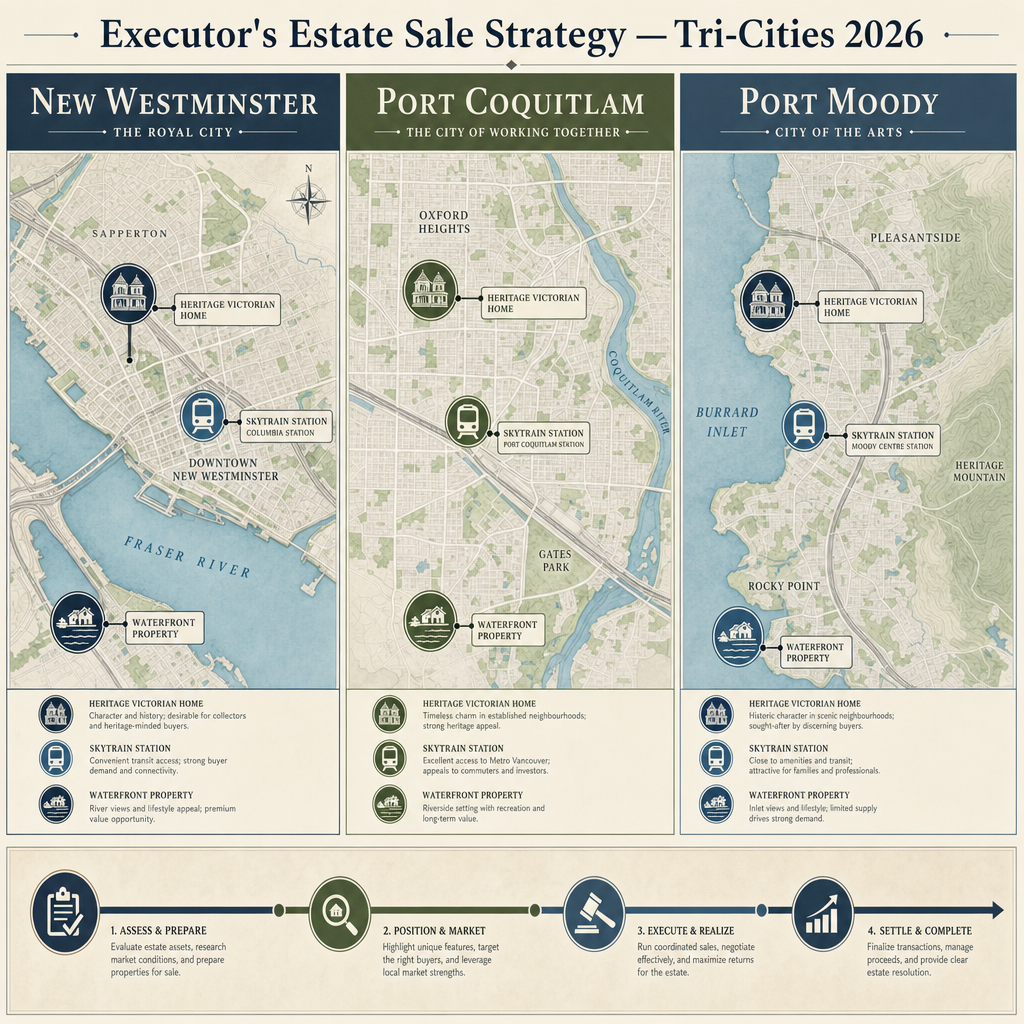

Estate Sales in the Tri-Cities (New Westminster, Port Coquitlam, Port Moody) 2026: Executor's Complete Strategy for Heritage Homes, Transit-Oriented Condos, and Waterfront Properties in Markets With Distinct Buyer Profiles and Benchmark Price Volatility
By Mohamed Mansour, MBA and Associate Broker | Mansour Real Estate Group | Published: July 15, 2025 | Geography: New Westminster, Port Coquitlam, Port Moody, Tri-Cities, BC | Scope: Estate and Probate Sales, Metro Vancouver and Lower Mainland
Executors managing estate properties in New Westminster, Port Coquitlam, or Port Moody face a challenge that regional benchmarks alone cannot solve. These three communities share a postal corridor but operate as distinct micro-markets — each with its own buyer composition, dominant property types, days-on-market realities, and pricing pressure from adjacent Burnaby and Coquitlam. Getting the strategy wrong in one of these markets costs estates more than in more uniform markets, precisely because the spread between a well-positioned sale and a mispriced one can reach six figures.
This guide is written for executors, estate lawyers, and families responsible for selling inherited property in the Tri-Cities. It covers what makes each community distinct, how property type affects buyer demand, what strata documentation risk looks like here, and what a calibrated sale process should include.
Short Answer
Estate sales in New Westminster, Port Coquitlam, and Port Moody require market-specific strategies because buyer profiles, property types, and benchmark prices diverge significantly across the three communities. Heritage homes in New Westminster, family detached inventory in Port Coquitlam, and waterfront properties in Port Moody each attract different buyers with different financing assumptions. Executors who apply a single regional valuation approach typically leave 12–25% of net proceeds unrealized, according to Mansour Real Estate Group estate sales case studies covering Tri-Cities market performance.
Key Takeaways
- New Westminster, Port Coquitlam, and Port Moody have meaningfully different benchmark prices, buyer compositions, and days-on-market patterns that require separate valuation strategies.
- SkyTrain-adjacent properties in the Tri-Cities command 8–12% premiums over secondary-location homes; estate pricing must reflect this premium explicitly.
- Heritage home sales in New Westminster and Port Moody attract renovation investors and owner-occupants, but depreciation reports in older strata buildings can trigger buyer financing denial.
- Days-on-market variance between detached and strata units across the Tri-Cities ranges 40–65%, requiring executors to calibrate list price and marketing timelines by property type, not just city.
- Executors unfamiliar with local buyer composition risk misaligned pricing and missed market windows — professional estate sale representation specific to these markets is the most protective step available.
Who This Applies To
- Executors named in a will who must sell estate property in New Westminster, Port Coquitlam, or Port Moody
- Estate lawyers and notaries coordinating property disposition in the Tri-Cities
- Adult children or beneficiaries helping a family navigate a probate sale in this corridor
- Trustees managing estate assets that include detached homes, heritage properties, condos, or waterfront property
When This Advice May Not Apply
If the estate property sits in Coquitlam proper, Burnaby, or east Maple Ridge, the market dynamics described here may not match. The Tri-Cities label is often applied broadly — this article addresses New Westminster, Port Coquitlam, and Port Moody specifically. Consult a BC estate lawyer for probate authority questions and a qualified appraiser for a date-of-death valuation. See how to get a date-of-death fair market value appraisal for a BC estate property for guidance on that step.
Key Definitions
Benchmark Price: The Real Estate Board of Greater Vancouver's measure of a typical property's price, adjusted for size, age, and condition. Benchmark prices in the Tri-Cities communities diverge from the Metro Vancouver aggregate and from adjacent Coquitlam figures.
Depreciation Report: A BC Strata Property Act–required document that assesses the physical condition of a strata building and estimates repair and replacement costs over a 30-year horizon. Required for most strata corporations with five or more units. Outdated or high-liability reports can affect buyer financing.
Form B (Information Certificate): A strata document that discloses the current financial status of the strata corporation, including contingency reserve fund balances, outstanding levies, and pending resolutions. Buyers and their lenders rely on this document heavily.
Days on Market (DOM): The number of calendar days from a property's active listing date to the date a subject-free offer is accepted. DOM varies significantly by property type and neighbourhood within each Tri-Cities community.
Data Used in This Article
- BC Assessment Data 2026 — Benchmark Prices and Valuation Trends (Official)
- Real Estate Board of Greater Vancouver (GVR) — Days-on-Market and Sales-to-Active Ratios, Tri-Cities Communities (Official)
- TransLink SkyTrain Station Proximity Analysis — Property Premium and Buyer Demand Clustering (Industry Research)
- Mansour Real Estate Group Estate Sales Case Studies — Tri-Cities Market Performance and Executor Outcomes (Internal Professional Analysis)
- Statistics Canada Census and Labour Force Survey — Tri-Cities Demographic Shifts and Buyer Profile Evolution (Official)
- BC Land Title Office — Property Transfer Patterns and Estate Sale Timeline Data (Official)
Why These Three Markets Are Not Interchangeable
Executors sometimes treat the Tri-Cities as a single market because regional real estate reports often aggregate them. That aggregation obscures more than it reveals. New Westminster is a dense, transit-served, historically layered city where heritage home conversions and newer highrise strata units co-exist within blocks of each other. Its riverfront revitalization has attracted a buyer pool that skews younger, more transit-dependent, and more investor-active than the regional average. Pricing pressure from adjacent Burnaby means some buyers comparison-shop actively across the border, which narrows acceptable price tolerance.
Port Coquitlam is a different kind of market. Its inventory is dominated by family detached homes, newer townhomes, and mixed-age strata buildings. Buyers here are typically primary-residence purchasers with longer commute tolerances, drawn partly by highway access and lower entry prices compared to Coquitlam proper. According to BC Assessment 2026 data, Port Coquitlam's benchmark detached price sits measurably below the broader Metro Vancouver aggregate, which creates a different buyer financing profile — and a different risk profile for estate pricing errors. Executors inheriting strata units in Port Coquitlam's older buildings — many built in the 1980s and 1990s — face heightened depreciation report scrutiny from lenders and buyers alike. See selling an inherited condo in Metro Vancouver for the strata documentation framework that applies here.
Port Moody occupies the eastern end of the corridor and commands the most clearly segmented premium within the three communities. Waterfront and semi-waterfront properties on Burrard Inlet attract a distinct buyer — often a move-up purchaser or downsizer willing to pay for location and lifestyle. Legacy detached homes in established Port Moody neighbourhoods hold value differently than the city's newer strata development, and buyers for each segment bring different expectations about condition, age, and required updates. That divergence within a single city is the kind of nuance that regional benchmarks flatten out. For broader context on selling inherited property throughout the Burnaby and Coquitlam corridor immediately west of these communities, the Burnaby and Coquitlam estate sales guide covers adjacent dynamics that sometimes influence buyer migration into the Tri-Cities.
How SkyTrain Access Reshapes Estate Pricing in the Tri-Cities
The Millennium Line extension through the Tri-Cities has created a measurable bifurcation in buyer demand. According to TransLink station proximity analysis, properties within comfortable walking distance of SkyTrain stations in New Westminster and Port Moody command premiums of 8–12% over comparable properties in secondary locations. For an executor selling a property in one of these corridors, that premium is only achievable if the listing explicitly positions transit access as a primary feature — and only if the pricing reflects current buyer competition at that price point rather than a broader neighbourhood average.
What this means practically: a heritage home on a quiet block ten minutes' walk from Columbia Station in New Westminster and a similar home three kilometres further east are not the same product to a buyer who commutes by transit. Executors who price them the same — because they share a postal code — will either undervalue the transit-adjacent home or overprice the secondary-location one. Both errors cost the estate money, though in different ways. The first leaves equity on the table. The second extends days-on-market past the point where buyers begin discounting offers to compensate for perceived price stubbornness.
This dynamic is especially relevant for inherited condos in New Westminster's high-density corridors and Port Moody's Inlet District, where transit-oriented development has changed the buyer pool composition over the past five years. For executors who haven't tracked this shift, working with a real estate team familiar with how these corridors have moved is not optional — it's the difference between a calibrated price and a guess dressed up as a market opinion.
Heritage Homes: What Makes Them Both Desirable and Complicated to Sell
New Westminster has one of the most intact collections of pre-1940 residential architecture in Metro Vancouver. Port Moody's established neighbourhoods contain a meaningful supply of mid-century detached homes that are old enough to present condition concerns but not old enough to qualify for the same heritage designation protections. For executors, this creates a category of property that attracts two distinct buyer types who need to be addressed differently in both pricing and marketing.
Renovation-minded investors approach heritage homes with a renovation-cost lens. Their offer price reflects what the property is worth after work, minus the cost of that work, minus their required margin. Owner-occupants who want a character home in an established neighbourhood approach with lifestyle value and longer holding horizons. These two buyer types produce very different offers, and which one dominates at the time of listing depends on financing conditions, investor confidence, and how the property is presented. An estate home that has not been updated or staged is more likely to attract investor offers — which are typically lower — unless the listing clearly communicates what an owner-occupant would value about the location, lot, and bones.
One practical reality that executors encounter in heritage homes: deferred maintenance is more visible in older properties, and buyers apply condition discounts more aggressively here than they would in a newer home. The question is never whether to spend money on the property before listing — it's which improvements produce a return and which ones simply reduce the estate's cash before the sale. The guide on pre-listing improvements for estate homes in BC addresses that decision directly.
Strata Estate Sales: Depreciation Reports, Form B, and the Financing Risk Executors Often Miss
Port Coquitlam has a significant supply of strata buildings constructed between 1985 and 2005 — the generation of buildings that now faces the highest scrutiny from buyers, lenders, and appraisers. These buildings are old enough to require major capital expenditures for envelopes, roofs, parkades, and mechanical systems, but not so distressed that buyers expect the price to reflect a full rebuild. When a depreciation report reveals elevated unfunded liability or a contingency reserve fund that cannot cover projected repairs without a special levy, buyer financing becomes fragile. Lenders may reduce loan-to-value ratios, appraisers may apply downward adjustments, and buyers with financing constraints may walk away entirely.
For an executor, this is not a problem that surfaces after listing — it's a problem that should be assessed before pricing. Obtaining the strata documents early, reviewing the Form B and depreciation report with a knowledgeable real estate team, and pricing the unit to reflect actual financing risk rather than aspirational comparable sales is how estate strata units sell in a reasonable timeframe. When this step is skipped, what typically happens is a price reduction after the first offer falls through on financing — a pattern that signals to remaining buyers that the property has a problem, creating a compounding discount effect. The inherited condo guide covering strata rules, special levies, and probate complications provides a complete framework for this process.
New Westminster's highrise strata market adds a different layer: building age diversity within blocks means that comparable sales from a 2018 concrete tower next door tell a buyer's agent almost nothing about the financing risk profile of a 1991 wood-frame building across the street. Executors and their real estate teams must use truly comparable sales — same building vintage, similar strata financials — rather than geographic proximity alone.
Port Moody Waterfront and Semi-Waterfront Properties: Premium Pricing Requires a Different Buyer Strategy
Waterfront and semi-waterfront properties in Port Moody sit in a pricing tier that has limited comparable sales by definition — there are not many of them, and each one has distinct attributes that affect value differently. Burrard Inlet views, dock access, proximity to Rocky Point Park, and lot depth all affect what a buyer will pay. For an executor, the risk is pricing by analogy to properties that are similar in size but not in location — a common error when relying on automated valuation models or regional benchmark data that does not separate waterfront from inland inventory.
The buyer profile for Port Moody waterfront is typically a move-up purchaser or pre-retirement downsizer with equity from a previous sale, often looking at the property as a long-term hold. These buyers are less rate-sensitive than first-time buyers but more sensitive to condition, presentation, and privacy. Estate properties that have not been prepared for this buyer — where deferred maintenance is visible, landscaping is overgrown, or interior finishes are significantly dated — tend to attract offers that reflect a renovation discount rather than a lifestyle premium. Preparation investment here typically produces a measurable return, but the right improvements are property-specific. A real estate team with direct experience in Port Moody waterfront transactions will approach this differently than one applying generic estate sale preparation protocols.
How We Evaluate This
When Mansour Real Estate Group evaluates an estate property in the Tri-Cities, the first step is property-type segmentation — not a regional benchmark lookup. We identify the specific buyer pool for the property type, price tier, and location, then map current active competition and recent comparable sales at the property-type level rather than the city level. For strata properties, we review the strata documents before pricing, because lender behaviour on that specific building's financials affects what buyers can actually qualify for. That review informs both the list price and the marketing strategy.
For detached and heritage homes, we assess buyer profile mix — investor vs. owner-occupant — based on current market conditions and recent sales patterns. We then position the property for the buyer most likely to produce the highest offer, not the broadest audience. In transit corridors, we build the transit premium into the pricing and marketing explicitly. The goal is a sale that reflects the property's actual value in its specific location and condition, not an average of the surrounding postal code. Executors with pending probate authority who want a preliminary market assessment can reach out before the probate certificate is issued — there is preparation work that can be done in advance.
Executor Checklist: Estate Sale in New Westminster, Port Coquitlam, or Port Moody
- Confirm probate authority before listing: The executor must have the Grant of Probate in hand before signing a listing agreement. See BC probate timeline explained for sequencing.
- Secure and insure the property immediately: Vacant estate properties require immediate insurance notification and physical security measures. BC insurers may void coverage if the property is vacant beyond 30 days without proper endorsement.
- Obtain a date-of-death fair market value appraisal: Required for capital gains reporting purposes — and useful for pricing strategy. A formal appraisal protects executors from beneficiary challenges later.
- Pull full strata documents if applicable: For condos and townhomes, request the Form B, depreciation report, meeting minutes for the past two years, and current strata fee and levy disclosure before setting list price.
- Assess transit proximity explicitly: Determine the actual walking time to the nearest SkyTrain station. If the property falls within the premium corridor, this must be reflected in pricing and marketing.
- Evaluate heritage or condition factors before budgeting improvements: Identify which pre-listing improvements will produce a measurable return for the target buyer type — investor vs. owner-occupant — before spending estate funds.
- Choose a real estate team with Tri-Cities transaction history: Not Metro Vancouver estate experience generally — specific Tri-Cities micro-market experience. Ask for comparable sales within New Westminster, Port Coquitlam, or Port Moody for the relevant property type.
- Communicate transparently with all beneficiaries before listing: Document every major decision in writing. Disputes among beneficiaries are among the most common causes of delayed and discounted estate sales.
What We Commonly See
In our experience working with executors in the Tri-Cities, the most common and costly mistake is pricing by postal code rather than by property type and location within that postal code. An executor inheriting a 1970s bungalow in a secondary Port Coquitlam neighbourhood and pricing it to match the median for all Port Coquitlam detached sales will either overprice or underprice the property — rarely hit the mark — because that median includes transit-adjacent newer stock that attracts a different buyer entirely.
What often happens with strata estate properties in older Tri-Cities buildings is that the depreciation report is reviewed only after an offer is received, at which point the buyer's lender flags the reserve fund shortfall. The offer falls through, the relisting at a lower price signals distress to the market, and the estate ends up netting significantly less than a properly pre-reviewed, accurately priced listing would have produced from the start.
A common mistake with Port Moody waterfront properties is applying comparable sales from inland Port Moody homes to set the list price, then being surprised when buyers make lower offers than expected. Waterfront premiums are real but they are property-specific. Two waterfront properties on the same street can have meaningfully different values based on lot depth, view angle, dock infrastructure, and privacy. Generic comparables do not capture this. Executors who ask for a thorough, location-specific market analysis — not just a CMA printout — protect themselves and the estate from that mispricing risk. The complete executor's guide to selling an inherited home in BC provides the full procedural framework that applies before any of these market-specific steps begin.
Questions and Answers
Do I need probate before listing an estate property in New Westminster, Port Coquitlam, or Port Moody?
Yes. BC Land Title requires a Grant of Probate before title can transfer on an estate property. Executors can begin preparation and hold discussions with a real estate team before probate is granted, but the listing agreement should not be signed and the property should not be listed on MLS until the Grant is in hand.
How does SkyTrain proximity affect the estate sale price in these communities?
According to TransLink station proximity analysis, properties within comfortable walking distance of SkyTrain stations in the Tri-Cities have commanded 8–12% premiums over secondary-location homes in comparable condition. This premium is not automatic — it must be reflected in the pricing strategy and communicated clearly in marketing to reach transit-motivated buyers.
What strata documents should an executor request before listing an inherited condo?
At minimum: Form B Information Certificate, current depreciation report, meeting minutes for the past two years, strata plan, current strata fee schedule, and any pending or recently passed special levy resolutions. These documents affect buyer financing and should inform the list price, not be reviewed after an offer falls through.
Can beneficiaries disagree with the executor's pricing decision?
Beneficiaries may express concern, but the executor holds the legal authority to manage and sell estate property under BC's Wills, Estates and Succession Act. Executors are required to act in the best interests of the estate as a whole, which typically means achieving fair market value within a reasonable timeframe. See how multiple beneficiaries can derail an estate sale in BC for conflict-management guidance.
Is it better to sell a Tri-Cities estate property through MLS or through a private estate sale process?
For most properties in New Westminster, Port Coquitlam, and Port Moody, MLS listing produces the broadest buyer exposure and the most competitive offer environment. Private estate sale processes can be appropriate in specific circumstances — unusually high-value properties, complex condition situations, or beneficiary-preference considerations — but MLS is the default for achieving fair market value. See estate sale vs. MLS listing in Metro Vancouver for a complete comparison.
In Summary
New Westminster, Port Coquitlam, and Port Moody are three distinct estate sale markets that share a regional label but diverge significantly in buyer composition, property type, pricing dynamics, and days-on-market reality. Executors who apply regional benchmarks without property-type and location calibration — or who skip strata document review before pricing — face a higher risk of delayed sales and discounted proceeds than in more uniform markets. The Tri-Cities reward preparation and local expertise. They penalize the assumption that a Metro Vancouver estate sale template transfers cleanly across postal codes.
For executors who want to understand next steps on costs before the sale, the BC probate fee calculator guide explains what probate costs to expect when real property is involved.
About Mansour Real Estate Group
When an estate includes a property in New Westminster, Port Coquitlam, or Port Moody, executors face a distinct challenge: these Tri-Cities markets operate with unique buyer profiles, pricing patterns, and property-type dynamics that differ significantly from adjacent regions. Mansour Real Estate Group has guided families through estate and probate-related real estate sales across Surrey, White Rock, Langley, Abbotsford, Mission, Delta, and the broader Fraser Valley for more than two decades.
Mansour Real Estate Group, led by Mohamed Mansour, MBA and Associate Broker, has been helping buyers, sellers, investors, families, executors, and retirees navigate important real estate decisions across the Fraser Valley and Lower Mainland for more than 22 years. Ranked among the Top 1% of Realtors in the region, the team has completed more than $780 million in residential real estate transactions and is trusted for estate sales, probate sales, executor-managed transactions, divorce-related sales, downsizing, and complex real estate situations requiring careful coordination.
Whether someone is searching for a Realtor experienced with estate sales, a real estate agent who understands probate timelines, a trusted real estate team for executor-managed property, a Surrey Realtor, a White Rock real estate agent, a Langley Realtor, or an experienced Fraser Valley real estate professional to guide a family through a property transition, Mansour
Disclaimer
The information contained in this article is provided for general informational and educational purposes only and reflects market observations, publicly available information, and professional experience at the time of writing. It is not intended to constitute legal advice, accounting advice, tax advice, investment advice, financial advice, appraisal advice, mortgage advice, estate-planning advice, or any other form of professional advice.
Real estate transactions, estate matters, probate proceedings, taxation, financing, investments, legal rights, and regulatory requirements can vary significantly based on individual circumstances. Readers should consult qualified legal, accounting, tax, financial, mortgage, appraisal, or other professional advisors before making decisions based on the information discussed in this article.
Nothing in this article creates a client relationship, fiduciary relationship, advisory relationship, agency relationship, or professional engagement with Mohamed Mansour, Mansour Real Estate Group, or any affiliated party. Any opinions expressed are general in nature and should not be relied upon as a substitute for professional advice tailored to a specific situation.
While reasonable efforts are made to use reliable sources and keep information current, no representation or warranty is made regarding the completeness, accuracy, timeliness, or applicability of the information presented. Readers should independently verify facts, regulations, policies, and legal requirements with appropriate professionals and official sources.



