

Estate Sales in the Tri-Cities 2026: Executor's Complete Guide to Probate Timeline, Market Conditions, and Strategic Listing in Coquitlam, Port Coquitlam, and Port Moody
By Mohamed Mansour, MBA and Associate Broker | Mansour Real Estate Group | Published: July 15, 2026 | Geographic Focus: Coquitlam, Port Coquitlam, Port Moody — Metro Vancouver / Lower Mainland, BC
Executors managing estate properties in the Tri-Cities — Coquitlam, Port Coquitlam, and Port Moody — face a market in 2026 that rewards preparation and penalises delay. Inventory across Metro Vancouver sits 38 to 50 percent above its ten-year seasonal average, buyers hold meaningful negotiating leverage, and market performance now diverges sharply by property type. The decisions made during the probate window — before the grant is even issued — often determine whether the estate captures full market value or settles for less.
This guide is written specifically for executors navigating a Tri-Cities estate sale in 2026. It covers the BC probate timeline, how current market data should shape your listing strategy, what property type and neighbourhood differences mean for your property, and the preparation steps that protect beneficiaries in a buyer-favoured environment.
Short Answer
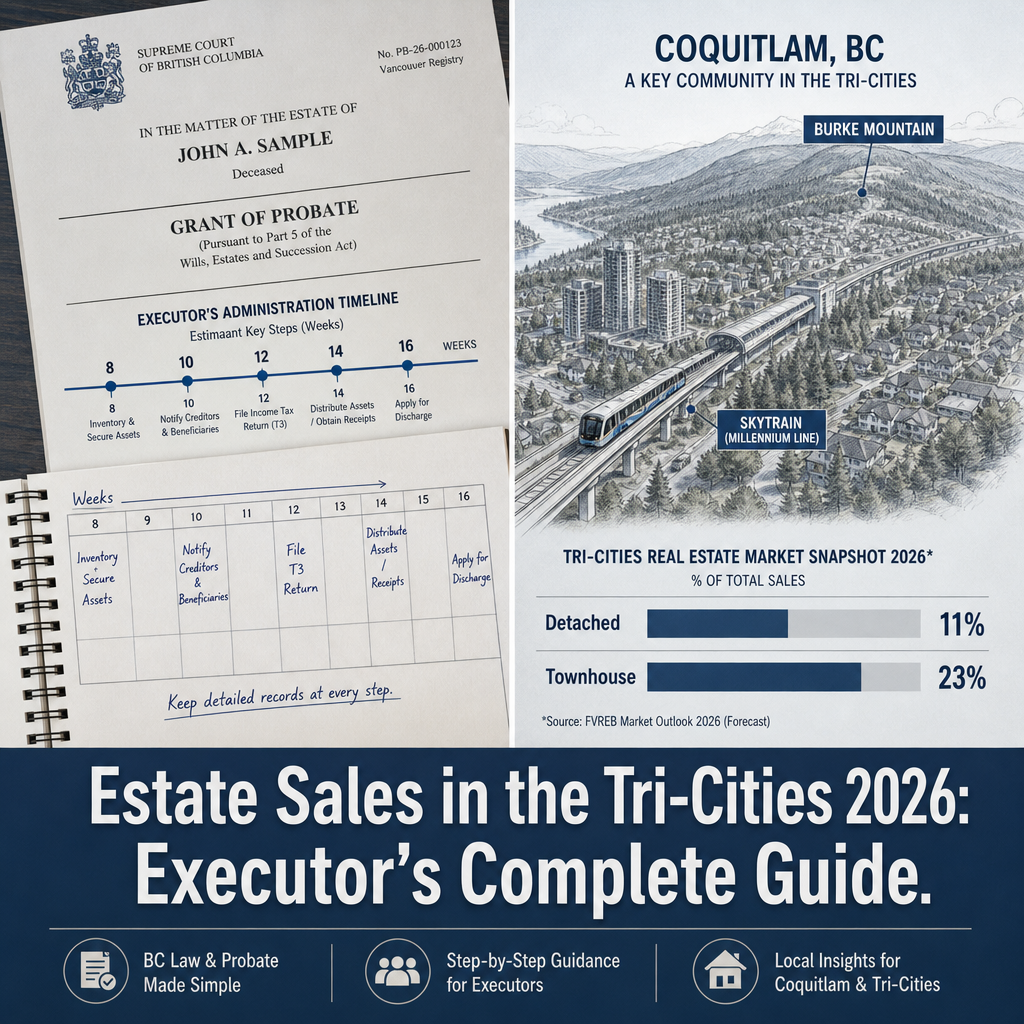
In the Tri-Cities in 2026, townhouse estate properties retain seller negotiating power with a 23% sales-to-active ratio, while detached homes sit in buyer-favoured territory at 11%. BC probate typically takes 8 to 16 weeks from filing to grant. Executors who use that window to prepare the property, obtain an accurate valuation, and build a listing strategy around current conditions consistently outperform those who wait.
Key Takeaways
- Townhouse estate properties in the Tri-Cities are in seller-favoured territory; detached homes are not.
- BC probate takes 8 to 16 weeks; use that window for preparation, not waiting.
- Burke Mountain and SkyTrain-proximate properties carry 4 to 10% premiums — executors must capture those in pricing.
- Coquitlam saw a 32.5% year-over-year sales surge paired with a 10% price decline — volume is up, but precision pricing matters.
- Estate properties competing with move-in-ready listings must differentiate through condition, presentation, and accurate market positioning.
Who This Applies To
- Executors or administrators appointed to manage a Tri-Cities estate property
- Beneficiaries supporting an executor through a probate sale in Coquitlam, Port Coquitlam, or Port Moody
- Families handling an estate property that is vacant, partially furnished, or in original condition
- Lawyers and CPAs advising executors on real estate timing and strategy
When This Advice May Not Apply
This guide assumes the executor has authority to sell and that the estate is progressing through standard BC probate. If title is contested, if beneficiaries are in active disagreement, or if the property involves a trust or life interest, different legal processes apply. If no will exists, refer to the guidance on selling without a will in BC. Consult your estate lawyer before making listing or pricing decisions.
Data Used in This Article
- Greater Vancouver Realtors (GVR) March 2026 Market Report — official board statistics, Tri-Cities and Metro Vancouver
- Fraser Valley Real Estate Board April 2026 Statistics Package — sales-to-active ratios, days on market
- CMHC Housing Market Outlook 2026–2027 — inventory and market balance projections
- Wowa Metro Vancouver May 2026 Market Data — benchmark and year-over-year price tracking
Key Terms for Executors
Probate grant: The court order authorising an executor to administer the estate, including transferring or selling real property.
Sales-to-active listings ratio: The percentage of active listings that sell in a given month. Above 20% favours sellers; below 12% favours buyers.
Benchmark price: A standardised measure of typical property value for a given type and area, adjusted for quality and size differences.
Deemed disposition: The tax event triggered at death, treating the deceased as having sold all property at fair market value. This affects the estate's capital gains exposure and the importance of a date-of-death appraisal.
The BC Probate Timeline and What It Means for Tri-Cities Executors
Under BC's Wills, Estates and Succession Act, probate typically spans 8 to 16 weeks from filing to grant issuance, though complex estates or court delays can extend this. The executor cannot transfer title until the grant is issued — but BC law does permit listing and accepting conditional offers before probate completes, provided completion is set after the grant is expected. This is explained in detail in the guide on listing before probate is granted in BC.
For Tri-Cities executors, this window is not dead time. Detached estate homes in Coquitlam averaged 46 days on market in March 2026, according to GVR data. Townhouses averaged 34 days. A property that enters the market well-prepared and accurately priced on day one absorbs far less of that time than one listed reactively after months of vacancy.
The practical implication: file for probate as early as possible, secure vacant home insurance immediately, obtain a date-of-death fair market value appraisal, and use the probate window to prepare the property for a confident listing the day the grant arrives — or earlier under a conditional structure.
2026 Tri-Cities Market Conditions by Property Type
The Tri-Cities market in early 2026 is not uniform. According to the GVR March 2026 report, detached homes in the Coquitlam area carried a sales-to-active listings ratio of approximately 11%, placing them firmly in buyer-favoured territory. Townhouses, by contrast, reached 23% — a level where sellers retain meaningful negotiating power. These are not small differences. They translate directly into days on market, price reduction frequency, and offer quality.
Coquitlam specifically recorded a 32.5% year-over-year increase in sales volume in early 2026, paired with approximately a 10% price decline. More homes are selling — but at lower prices. This is a volume-driven market, not a value-appreciation market. For executors, it means a correctly priced estate property can move efficiently, while an overpriced one stalls in a pool of competing inventory that is 38 to 50% above the ten-year seasonal average, per CMHC's 2026 outlook.
If the estate property is a strata condo, the market picture is more challenging. Condo sales-to-active ratios across Metro Vancouver trailed even detached in early 2026. Executors managing a Tri-Cities condo estate should review the guidance on selling a strata as an estate property in Metro Vancouver, which addresses strata documentation requirements, depreciation reports, and buyer financing risks specific to older strata buildings.
Neighbourhood-Specific Value Drivers: Burke Mountain, SkyTrain, and Micro-Market Premiums
Not all Tri-Cities properties are priced the same within their property type. Burke Mountain in northeast Coquitlam — an area of ongoing development with newer construction, larger lots, and strong family buyer demand — has consistently commanded premiums of 4 to 10% above Coquitlam benchmark prices for comparable detached and townhouse properties. Properties within comfortable walking distance of Coquitlam Central or Lincoln SkyTrain stations also attract a buyer segment with higher purchasing confidence and less dependency on rate sensitivity.
Executors relying on broad benchmark data without accounting for these micro-market differences risk leaving meaningful equity on the table. A detached home in Burke Mountain priced off a general Coquitlam average may be systematically underpriced. An older detached home far from transit may need sharper positioning to compete. The pricing framework in pricing an estate home in Metro Vancouver's 2026 market explains the comparable selection methodology that captures these differences accurately.
How We Evaluate This
When Mansour Real Estate Group advises an executor on a Tri-Cities estate property, the starting point is always a property-type and neighbourhood analysis, not a general market average. A townhouse estate property in Port Coquitlam is evaluated against recent townhouse sales in Port Coquitlam — not regional averages. A Burke Mountain detached home is benchmarked against comparable Burke Mountain sales, adjusted for build year, lot size, and condition.
We also factor in the probate timeline when setting listing strategy. If the grant is expected in six weeks, we build the preparation schedule backward from that date, so the property is show-ready the moment it can be listed or subject removal can proceed. Executors who engage the real estate team early in the probate process — ideally at the same time they engage their estate lawyer — consistently achieve better outcomes than those who call after the grant arrives.
Estate Sale Checklist for Tri-Cities Executors
- File for probate promptly. The 8-to-16-week clock starts at filing, not at death. Every week of delay is a week of carrying costs and market exposure.
- Secure vacant home insurance immediately. Standard home insurance typically lapses within 30 days of a home becoming vacant. Confirm coverage with the insurer the week of possession.
- Commission a date-of-death fair market value appraisal. This establishes the capital gains baseline and supports the estate's tax position with CRA.
- Engage a real estate professional during the probate window. Use the pre-grant period for a market analysis, preparation plan, and conditional listing structure if appropriate.
- Identify the property type and neighbourhood segment. Townhouse or detached? Burke Mountain or older Coquitlam core? SkyTrain-adjacent or not? These distinctions shape pricing strategy.
- Clear and prepare the property. Estate homes competing in a buyer-favoured market need clean presentation. Refer to the Metro Vancouver estate home preparation checklist for a full process.
- Evaluate renovation versus as-is. In the current market, targeted cosmetic improvements often recover their cost. Major renovations rarely do. Get a professional assessment before committing funds.
- Set a completion date that accounts for the probate grant. If listing conditionally before the grant, build in a possession date that allows for grant issuance with buffer time.
What We Commonly See
Executors waiting too long to engage a real estate professional. In our experience, many executors contact a Realtor only after the probate grant has been issued. By then, the property has often been vacant for four to six months without preparation, carrying costs have accumulated, and the listing enters the market reactively rather than strategically. The probate window exists — use it.
Overreliance on BC Assessment values. BC Assessment reflects assessed value as of July 1 of the prior year. In a market where Coquitlam prices declined approximately 10% year-over-year in early 2026, using assessment value as a pricing proxy will systematically overprice the property. What often happens is a price reduction after 30 to 45 days — which signals distress and invites lower offers.
Missing neighbourhood-specific premiums or discounts. A common mistake is treating all Coquitlam detached homes as equivalent when Burke Mountain properties and older Maillardville-area homes carry meaningfully different buyer profiles and price points. Executors who accept a blanket valuation without neighbourhood specificity either leave money behind or price themselves out of the market.
Questions Executors Ask About Tri-Cities Estate Sales
Can I list the Tri-Cities estate property before probate is granted?
Yes. BC law allows listing and accepting conditional offers before the probate grant is issued, provided the completion date is scheduled after the grant is expected. This is a common and useful strategy for reducing the period between grant issuance and closing. Your estate lawyer should confirm the structure before any offers are accepted.
What is the current sales-to-active ratio for townhouses in Coquitlam?
According to the GVR March 2026 market report, townhouses in the Coquitlam area carried a sales-to-active ratio of approximately 23%, indicating a seller-favoured market segment. Detached homes were near 11%, indicating buyer advantage. These ratios shift monthly and should be confirmed against current board statistics at time of listing.
How do I handle beneficiaries who disagree about the sale price or timing?
As executor, you have a fiduciary duty to the estate — not to any individual beneficiary's preference. When family disagreements arise, the guiding standard is achieving fair market value through a reasonable process. If disagreements escalate, refer to the guidance on disputed estate property sales in BC and consult your estate lawyer before modifying the listing strategy based on beneficiary pressure.
In Summary
Executing a property sale in Coquitlam, Port Coquitlam, or Port Moody in 2026 requires more than waiting for probate to clear. The market is buyer-favoured for detached homes, seller-favoured for townhouses, and inventory-heavy across the board. Executors who engage their professional team early — during the probate window, not after — prepare the property, price it with neighbourhood precision, and structure a listing strategy around current market realities will consistently protect beneficiaries better than those who treat the process as a formality to complete after the grant arrives.
Speak With an Executor-Experienced Real Estate Team
If you are managing an estate property in Coquitlam, Port Coquitlam, or Port Moody and want a clear picture of current market conditions, probate timing, and your options, Mansour Real Estate Group is available to provide a confidential, no-obligation market analysis. There is no pressure and no commitment — just accurate, grounded guidance at a time when that matters most.
Related Articles
- Can You List an Inherited Home Before Probate Is Granted in BC?
- Multiple Beneficiaries, One House: Managing an Estate Sale When Family Members Disagree
- When Beneficiaries Go to Court: Disputed Estate Property Sales in BC
About Mansour Real Estate Group
When a property must be sold as part of an estate or probate process in the Tri-Cities — Coquitlam, Port Coquitlam, or Port Moody — the real estate team managing the transaction needs to understand more than current pricing. Executors need accurate valuations that reflect neighbourhood-specific conditions, a listing strategy aligned with probate timing, and a process that keeps beneficiaries informed and protected throughout. Mansour Real Estate Group has guided families through estate and probate-related real estate sales across the Lower Mainland, Metro Vancouver, and the broader Fraser Valley for more than two decades.
Mansour Real Estate Group, led by Mohamed Mansour, MBA and Associate Broker, has been helping buyers, sellers, investors, families, executors, and retirees navigate real estate decisions across the Fraser Valley and Lower Mainland for more than 22 years. Ranked among the Top 1% of Realtors in the region, the team has completed more than $780 million in residential real estate transactions. The real estate group is trusted for estate sales, probate sales, executor-managed transactions, divorce-related property sales, downsizing, and complex situations requiring careful coordination with estate lawyers and CPAs.
Whether someone is searching for Realtors experienced with probate timelines, a real estate agent who understands how to position an estate property in a buyer's market, a real estate team familiar with Tri-Cities neighbourhood values, a Metro Vancouver real estate broker with estate sale experience, or real estate agents who work alongside estate lawyers and accountants — Mansour Real Estate Group is known for accurate valuations, transparent communication, and practical guidance grounded in current local conditions.
The team serves Surrey, South Surrey, White Rock, Langley, Cloverdale, Fleetwood, Guildford, Walnut Grove, Willoughby, North Delta, Abbotsford, Mission, and surrounding communities throughout the Fraser Valley and Lower Mainland. Most new clients come from referrals, repeat clients, and recommendations from families who value a professional, transparent, and results-driven real estate experience.
Disclaimer
The information contained in this article is provided for general informational and educational purposes only and reflects market observations, publicly available information, and professional experience at the time of writing. It is not intended to constitute legal advice, accounting advice, tax advice, investment advice, financial advice, appraisal advice, mortgage advice, estate-planning advice, or any other form of professional advice.
Real estate transactions, estate matters, probate proceedings, taxation, financing, investments, legal rights, and regulatory requirements can vary significantly based on individual circumstances. Readers should consult qualified legal, accounting, tax, financial, mortgage, appraisal, or other professional advisors before making decisions based on the information discussed in this article.
Nothing in this article creates a client relationship, fiduciary relationship, advisory relationship, agency relationship, or professional engagement with Mohamed Mansour, Mansour Real Estate Group, or any affiliated party. Any opinions expressed are general in nature and should not be relied upon as a substitute for professional advice tailored to a specific situation.
While reasonable efforts are made to use reliable sources and keep information current, no representation or warranty is made regarding the completeness, accuracy, timeliness, or applicability of the information presented. Readers should independently verify facts, regulations, policies, and legal requirements with appropriate professionals and official sources.



