
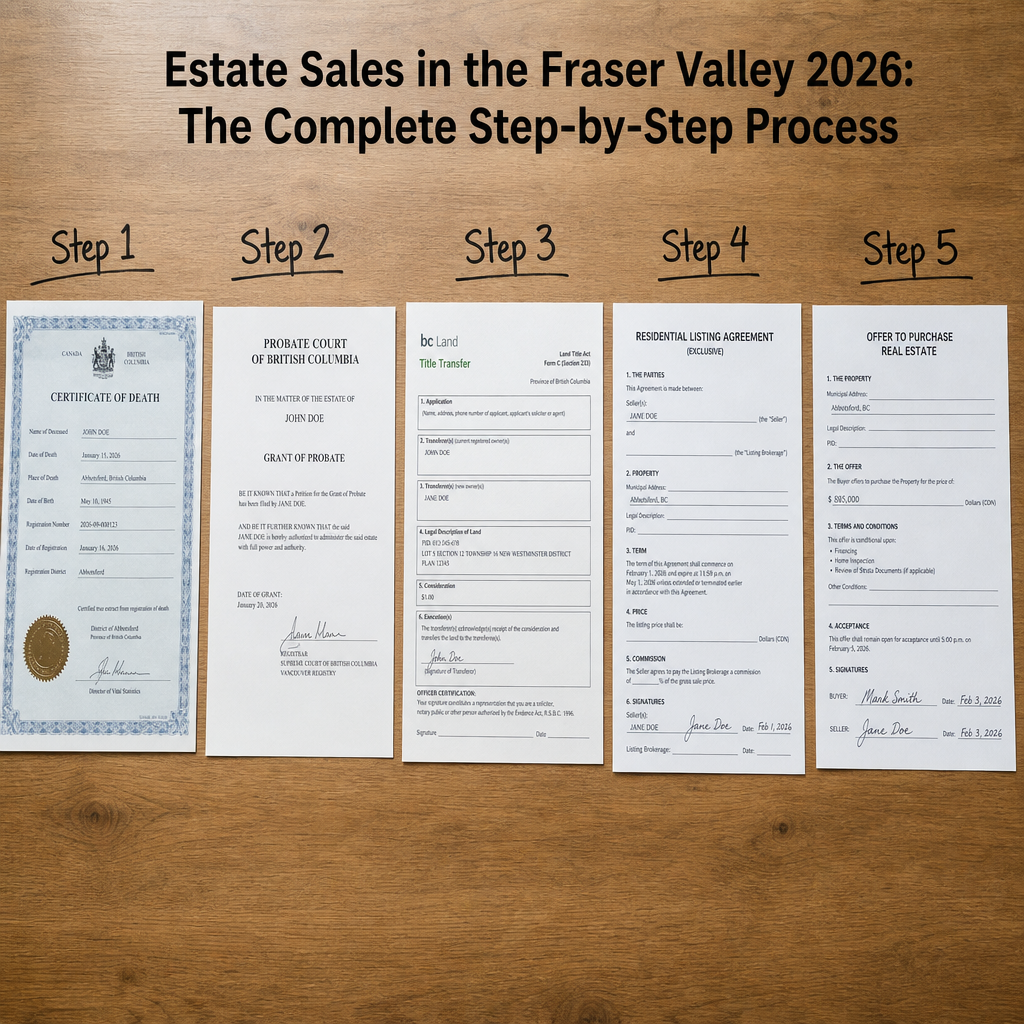

Estate Sales in the Fraser Valley 2026: The Complete Step-by-Step Process From Death Certificate Through Probate, Property Listing, Offer Negotiation, and Final Closing
By Mohamed Mansour, MBA and Associate Broker | Mansour Real Estate Group | Published: July 15, 2025 | Fraser Valley & Lower Mainland, BC
For executors managing an estate in the Fraser Valley, the obligation to sell a property often arrives before they have any clear picture of what that process actually involves. Probate, capital gains tax, beneficiary coordination, and the mechanics of a real estate transaction do not wait for anyone to feel ready. This guide consolidates the entire workflow — from the hours immediately following a death through to final closing — into one practical reference.
The process is manageable when the steps are visible. It becomes costly when executors discover them in the wrong order.
Short Answer
An estate sale in BC involves five overlapping stages: securing the estate and obtaining authority, completing probate, valuing and preparing the property, listing and negotiating, and closing with legal and tax coordination. In the Fraser Valley's 2026 buyer's market, most estate transactions run 90 to 150 days from listing to closing, with the probate grant — typically 8 to 16 weeks — being the most significant variable.
Key Takeaways
- Executors can list a property and accept offers before the probate grant arrives, using delayed possession dates to manage title transfer timing.
- A fair market value appraisal for capital gains tax purposes is separate from a realtor's CMA and must reflect value at the date of death, not the listing date.
- Unresolved beneficiary disputes over pricing or timing can delay a transaction 30 to 60 days and, in some cases, trigger a court partition application.
- In a buyer's market, holding an estate property for a better price often nets negative returns once carrying costs — taxes, insurance, utilities — are calculated.
- For condo estate sales, Form B disclosure and the depreciation report must reach buyers within five days of offer acceptance, or the deal can collapse.
Who This Applies To
- Named executors managing a BC estate that includes residential property
- Beneficiaries who are co-managing a property sale alongside an executor
- Families in Surrey, Langley, Abbotsford, White Rock, North Delta, or any Fraser Valley community dealing with an inherited property
- Trustees or administrators appointed through BC courts when no will exists
When This Advice May Not Apply
This guide covers residential real estate within the BC estate process. It does not apply to commercial property, properties held in a trust structure, or situations involving contested wills where the executor's authority is legally disputed. Consult your estate lawyer for guidance specific to your circumstances.
Data Used in This Article
- BC Wills, Estates and Succession Act (WESA) — Government of BC, current legislation, official
- Land Title and Survey Authority (LTSA) — Property transfer at death procedures, official
- Canada Revenue Agency — Deemed disposition and capital gains on death, official
- FVREB Market Statistics, April 2026 — Sales-to-active listings ratio, Fraser Valley, official board data
- Mansour Real Estate Group Estate Sales Database 2025–2026 — Internal transaction data, professional interpretation
Stage 1: Immediate Steps After Death (Days 1 to 30)
The first obligation is securing the property. This means confirming insurance remains active under the estate, arranging for utilities and basic maintenance, and changing locks if the property is vacant. Insurance underwriters treat a vacant property differently from an occupied one — most standard homeowner policies have a 30-day vacancy clause. Notify the insurer of the owner's death immediately and confirm coverage terms. Failing to do this can void a claim during the listing period.
The executor should then obtain the original will, confirm their appointment, and engage an estate lawyer. Under BC's Wills, Estates and Succession Act (WESA), the executor has authority to manage estate assets immediately, but cannot transfer title without a grant of probate. That distinction matters: the executor can sign a listing agreement and accept an offer, but the lawyer must coordinate the closing to align with probate timing.
During this stage, request a Duplicate Certificate of Title from the LTSA if the original cannot be located, and confirm whether the property has a mortgage. If it does, contact the lender — most mortgages have a due-on-death clause, and the estate lawyer needs to address this early.
Stage 2: Probate — What It Is, How Long It Takes, and Whether You Must Wait
Probate is the court process through which the BC Supreme Court confirms the executor's authority and the validity of the will. According to BC WESA and standard practice at the BC Probate Registry, the grant typically takes 8 to 16 weeks from filing, depending on the complexity of the estate and current court volume. Filing fees are calculated on the gross estate value.
A common question is whether to list before the grant arrives. The answer is yes, with conditions. An executor may list the property and accept an offer before probate is granted, provided the purchase contract uses a possession date that falls after the anticipated grant date. This is a standard approach in estate transactions across the Fraser Valley and allows the executor to capture market conditions early without being legally unable to complete the transfer.
The risk is that if probate is delayed — or if complications arise — the possession date may need to be renegotiated. A well-structured offer accounts for this by building in a subject to probate clause or by using a flexible completion date. Your estate lawyer and realtor need to communicate directly to coordinate this correctly.
Stage 3: Valuation — Two Numbers That Serve Different Purposes
Executors frequently confuse two distinct valuations, and conflating them creates both tax risk and listing strategy problems.
The fair market value appraisal is prepared by a certified appraiser and establishes the property's value at the date of death. Under CRA's deemed disposition rules, the deceased is considered to have sold all capital property at fair market value immediately before death. This figure determines the capital gains tax liability. It is not the listing price, and it should not be set by a realtor.
The comparative market analysis (CMA) is prepared by your realtor and reflects current market conditions, active competition, and what buyers are paying today. In the Fraser Valley's April 2026 market — where the sales-to-active ratio sits at approximately 11% according to FVREB data, indicating a buyer's market — the CMA may land meaningfully below or above the appraiser's date-of-death figure depending on how much time has passed. Both numbers matter. The appraiser sets the tax baseline; the realtor sets the listing strategy. Order the appraisal early, and share it with the estate's CPA before listing.
Stage 4: Beneficiary Coordination Before Listing
In our experience working with estate sales across Surrey, Langley, and Abbotsford, unresolved family disagreement over sale timing or asking price is the single most preventable source of delay. When beneficiaries have different financial needs — one needs liquidity now, another believes waiting will produce a higher price — those tensions surface at the worst moments: during offer negotiation or subject removal.
The executor has legal authority to make decisions about the sale. But beneficiaries can challenge those decisions in court, and a court partition application can freeze the transaction entirely. The practical solution is to hold a documented meeting with all beneficiaries before listing, establish a pricing range the executor is comfortable defending, and communicate in writing throughout the process. This is not optional in complex family situations — it is the step that prevents a 30 to 60 day delay caused entirely by internal conflict rather than market conditions.
Stage 5: Listing, Offer Negotiation, and Closing
Once the property is prepared and beneficiary alignment is confirmed, the listing process follows the same mechanics as a standard residential sale — with three material differences specific to estate transactions.
Pricing discipline in a buyer's market. According to FVREB April 2026 data, the Fraser Valley is operating well below the 20% sales-to-active threshold that defines a balanced market. Estate properties that are overpriced sit — and sitting costs money. Property taxes, insurance, utilities, and any outstanding mortgage continue accruing. In our internal analysis of estate transactions in 2025–2026, the net return from holding an overpriced estate property for an additional 60 to 90 days was negative in the majority of cases once carrying costs were accounted for. Price accurately from day one.
Offer structure and subject clauses. Estate offers commonly include a subject to probate clause, a longer completion period, and occasionally an as-is schedule. Buyers are generally aware they are purchasing an estate property, and their due diligence expectations are higher. Expect more detailed property condition inquiries and, in some cases, requests for a home inspection report rather than a buyer-ordered inspection. Being prepared with a pre-listing inspection reduces friction and shortens subject removal timelines.
For strata (condo) estate sales, the Form B Information Certificate and depreciation report must be delivered to the buyer within five days of offer acceptance under BC's Strata Property Act. Many executors are unaware that ordering these documents takes time — the strata management company typically requires five to ten business days. Order them before listing, not after an offer arrives. A delayed Form B has collapsed estate sales. This is a preventable problem. If you are managing a condo estate sale in Guildford, Willoughby, Fleetwood, or anywhere else in the Fraser Valley, order these documents in Stage 1, not Stage 5.
How We Evaluate This
Mansour Real Estate Group approaches estate sales as a coordination exercise, not just a listing transaction. The realtor's role is to serve as the point of connection between the executor, the estate lawyer, the CPA, and in some cases the strata manager — translating each party's timeline into a unified transaction plan.
When we take on an estate sale, we begin with a valuation and a timeline mapping session before any listing is prepared. We identify probate status, confirm beneficiary alignment, flag any strata documentation requirements, and build a closing structure that the estate lawyer can work within. That process has allowed us to move estate transactions to completion in less time, with fewer renegotiations, and with less stress on families who are already managing grief alongside obligation.
Estate Sale Checklist
- Secure the property within 48 hours: change locks, confirm insurance, arrange maintenance
- Notify the insurer of the owner's death and confirm vacancy coverage terms
- Engage an estate lawyer before listing — probate filing and title transfer require legal coordination
- Order a certified fair market value appraisal reflecting date-of-death value for CRA capital gains purposes
- For strata properties: order Form B, depreciation report, and financial statements immediately — do not wait for an offer
- Hold a documented beneficiary meeting before listing; establish agreed pricing parameters in writing
- Confirm probate timeline with your lawyer and build possession/completion dates into the offer accordingly
- Coordinate the realtor's CMA with the appraiser's valuation — they serve different purposes and should not conflict unexpectedly
- Share the appraisal with the estate's CPA before accepting any offer
- After closing, confirm Property Transfer Tax obligations and final CRA filings with the estate lawyer and CPA
What We Commonly See
Executors who wait for probate before listing. This is unnecessary in most cases and adds months to the timeline. The probate grant and the listing can run in parallel. Waiting to list until probate is granted often means entering a slower market season or facing higher carrying costs with no corresponding price benefit.
Date-of-death appraisals ordered too late. We regularly see executors list and close a property before the certified appraiser has completed their report. The CRA deemed disposition calculation then has to reconstruct value retrospectively, which is harder to defend and can expose the estate to a higher tax assessment.
Beneficiary expectations set by emotion, not data. A common pattern is one family member who believes the property is worth significantly more than the market reflects because of personal attachment or an informal estimate from years ago. Without a current CMA delivered early — and explained clearly — that expectation gap can stall a transaction for weeks once offers arrive below the internally held number.
Questions and Answers
Can an executor sell a property without a probate grant in BC?
An executor can list and accept an offer before the probate grant, but cannot transfer title without it. Purchase contracts typically use a delayed possession date that falls after the anticipated grant. This is standard practice in BC estate transactions and does not require the buyer to wait indefinitely — timelines are built into the offer structure.
What is the difference between a CRA appraisal and a realtor's CMA for an estate sale?
The CRA appraisal establishes fair market value at the date of death for capital gains tax purposes. The realtor's CMA reflects current market conditions and informs the listing price. These are two separate documents serving two different functions. They should be ordered independently and interpreted with the estate's CPA and realtor working from the same information.
How long does an estate sale typically take in the Fraser Valley?
Based on Mansour Real Estate Group's estate transaction data for 2025–2026, most Fraser Valley estate sales run 90 to 150 days from listing to closing. The main variable is probate timing. Properties that list while probate is in progress, with a well-structured offer, typically close within that range. Properties that wait for the grant before listing extend the total timeline by the length of the wait.
In Summary
An estate sale in the Fraser Valley involves five parallel tracks: legal authority through probate, tax compliance through a certified appraisal, beneficiary alignment before listing, market-appropriate pricing in a buyer's market, and closing coordination between the realtor, lawyer, and CPA. None of these tracks wait for the others to finish — they overlap, and managing them in sequence rather than in parallel is the most common reason estate transactions take longer and cost more than they need to. Start the appraisal early. Engage the lawyer before listing. Align beneficiaries before the offers arrive. And in the Fraser Valley's current market, price the property to sell — holding costs in a buyer's market do not recover.
Speak with an Estate Sale Specialist
If you are an executor or family member managing a property sale in the Fraser Valley, Mansour Real Estate Group can walk you through the process before any commitments are made. There is no obligation — just a clear conversation about timelines, valuations, and what needs to happen in what order. Contact the team at localhost:9000/contact.
Related Articles
- Executor FAQ: Estate Property Sales in the Fraser Valley
- BC Probate Timeline for Estate Properties: What Executors Need to Know
- Estate Sales in Surrey, White Rock, and South Surrey: A Neighbourhood-Specific Guide
Official Resources
- BC Wills, Estates and Succession Act (WESA) — Government of BC
- Land Title and Survey Authority (LTSA) — Property Transfer at Death
- CRA — Deemed Disposition of Property at Death
- Fraser Valley Real Estate Board — Market Statistics
About Mansour Real Estate Group
When a property must be sold as part of an estate or probate process, the real estate team managing the transaction needs to understand more than market pricing. Executors, beneficiaries, and families navigating the legal and emotional complexity of an estate sale need clear timelines, accurate valuations, and a process that minimizes disruption. Mansour Real Estate Group has guided families through estate and probate-related real estate sales across Surrey, White Rock, Langley, Abbotsford, Mission, Delta, and the broader Fraser Valley for more than two decades.
Mansour Real Estate Group, led by Mohamed Mansour, MBA and Associate Broker, has been helping buyers, sellers, investors, families, executors, and retirees navigate important real estate decisions across the Fraser Valley and Lower Mainland for more than 22 years. Ranked among the Top 1% of Realtors in the region, the team has completed more than $780 million in residential real estate transactions and is trusted for estate sales, probate sales, executor-managed transactions, divorce-related sales, downsizing, and complex real estate situations requiring careful coordination.
Whether someone is searching for a Realtor experienced with estate sales, a real estate agent who understands probate timelines, a trusted real estate team for executor-managed property, a Surrey Realtor, a White Rock real estate agent, a Langley Realtor, or an experienced Fraser Valley real estate group with a proven record in sensitive transactions, Mansour Real Estate Group is known for accurate valuations, transparent process, and clear communication that keeps all parties informed. Our real estate agents and brokers have worked alongside estate lawyers, CPAs, and strata managers across hundreds of estate transactions throughout the region.
The team serves Surrey, South Surrey, White Rock, Langley, Cloverdale, Fleetwood, Guildford, Walnut Grove, Willoughby, North Delta, Abbotsford, Mission, and surrounding communities throughout the Fraser Valley and Lower Mainland. Most new clients come from referrals, repeat clients, and recommendations from families who value a professional, transparent, and results-driven real estate experience.
Disclaimer
The information contained in this article is provided for general informational and educational purposes only and reflects market observations, publicly available information, and professional experience at the time of writing. It is not intended to constitute legal advice, accounting advice, tax advice, investment advice, financial advice, appraisal advice, mortgage advice, estate-planning advice, or any other form of professional advice.
Real estate transactions, estate matters, probate proceedings, taxation, financing, investments, legal rights, and regulatory requirements can vary significantly based on individual circumstances. Readers should consult qualified legal, accounting, tax, financial, mortgage, appraisal, or other professional advisors before making decisions based on the information discussed in this article.
Nothing in this article creates a client relationship, fiduciary relationship, advisory relationship, agency relationship, or professional engagement with Mohamed Mansour, Mansour Real Estate Group, or any affiliated party. Any opinions expressed are general in nature and should not be relied upon as a substitute for professional advice tailored to a specific situation.
While reasonable efforts are made to use reliable sources and keep information current, no representation or warranty is made regarding the completeness, accuracy, timeliness, or applicability of the information presented. Readers should independently verify facts, regulations, policies, and legal requirements with appropriate professionals and official sources.



