
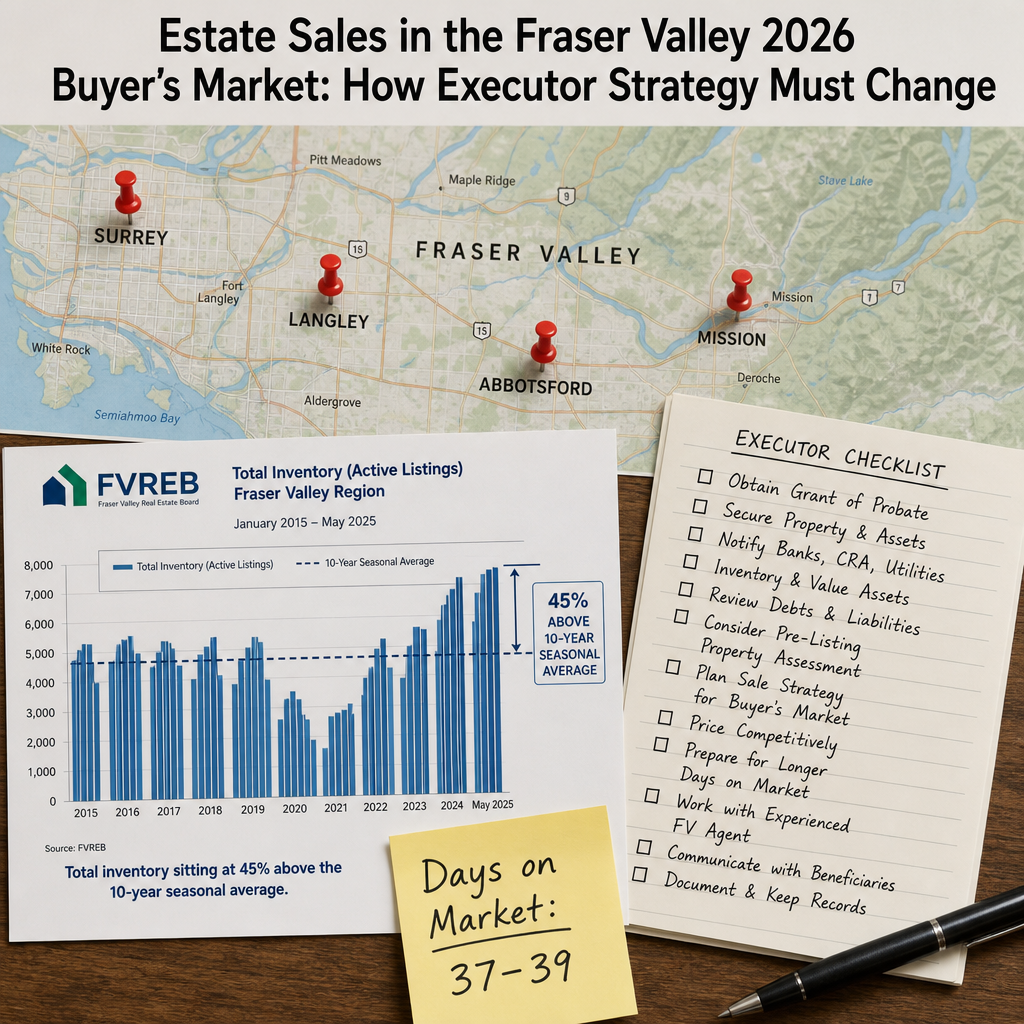

Estate Sales in the Fraser Valley 2026 Buyer's Market: How 45% Above-Average Inventory Changes Executor Strategy, Pricing, and Timeline for Properties in Langley, Abbotsford, Mission, and Surrey
By Mohamed Mansour, MBA and Associate Broker — Mansour Real Estate Group | Fraser Valley, BC | Published: July 14, 2026 | Primary Category: Life-Event Sales
Executors managing estate properties in the Fraser Valley in 2026 are operating in a market that looks nothing like the one many estate plans assumed. Inventory is running 45 to 50% above the ten-year seasonal average. The sales-to-active listings ratio sat at 11% in April 2026 — well below the 12 to 20% range that defines a balanced market, according to the Fraser Valley Real Estate Board's April 2026 statistics package. Buyers have more choice than they have had in years. That changes how estate properties must be priced, prepared, and marketed — and how long executors should realistically plan to hold before a sale completes.
This article is written specifically for executors and estate counsel managing properties in Langley, Abbotsford, Mission, and Surrey. It does not repeat the probate process basics covered in The Complete Executor's Guide to Selling an Inherited Home in BC. What it does is address the specific competitive environment executors face right now — and the strategic decisions that will determine net proceeds.
Short Answer
In April and May 2026, Fraser Valley active listings were approximately 45 to 50% above the ten-year seasonal average, and the sales-to-active ratio sat at 11% — firmly in buyer's market territory. Executors selling estate properties in Langley, Abbotsford, Mission, or Surrey must price competitively from day one, prepare properties to compete against well-maintained listings, and plan for days-on-market averaging 37 to 39 days. Overpriced or under-prepared estate listings face extended hold times and price reductions that reduce net proceeds and delay estate settlement.
Key Takeaways
- A sales-to-active ratio of 11% gives buyers strong negotiating leverage across all Fraser Valley submarkets in 2026.
- Detached homes are averaging 37 to 39 days on market — executors should budget carrying costs for that window.
- Estate properties priced above current comparables face buyer avoidance, not negotiation, in this supply environment.
- Presentation now competes directly with move-in-ready listings; under-prepared estate homes occupy the bottom tier of buyer interest.
- Townhomes and attached properties perform relatively better — detached and condo segments carry more buyer advantage in 2026.
Who This Applies To
- Executors managing estate-owned properties in Langley, Abbotsford, Mission, or Surrey in Q2 or Q3 2026
- Beneficiaries and estate lawyers advising on timing and pricing for a pending estate sale
- Families handling a recently inherited detached home or older condo in the Fraser Valley
- Executors who received their probate grant and are now moving into the listing decision
When This Advice May Not Apply
If probate has not yet been granted, the first decision is whether to list now or wait — see Can You List an Inherited Home Before Probate Is Granted in BC? and BC Probate Timeline Explained before applying the pricing and positioning strategy here. Market conditions also shift — if you are reading this after Q3 2026, verify current FVREB statistics before anchoring to the figures cited below.
Data Used in This Article
- FVREB April 2026 Statistics Package — Official board data, April 2026, Fraser Valley geography. Sales-to-active listings ratio, active inventory, benchmark prices. Source
- FVREB March 2026 Statistics Package — Official board data, March 2026. Active listings, year-over-year comparison, days-on-market trends. Source
- FVREB Monthly Market Reports — Rolling official data series used for seasonal average comparisons. Source
- Professional interpretation — Carrying cost estimates, estate-specific positioning guidance, and market segment observations reflect Mansour Real Estate Group's experience with estate transactions in the Fraser Valley.
What the 2026 Market Actually Means for an Estate Property
A sales-to-active listings ratio of 11% means that for every 100 active listings in the Fraser Valley, only 11 sold in April 2026. Buyers know they have options. They are not under pressure to move quickly on any single property, including estate listings.
For executors, this has three direct consequences. First, pricing errors get punished faster. When supply is abundant, buyers skip overpriced listings rather than negotiate down — they simply move to the next comparable. An estate property sitting 3 to 5% above market in a balanced environment might still attract an offer. The same property in an 11% ratio market is likely to be ignored entirely until a price reduction forces it back into buyer awareness.
Second, days-on-market averaging 37 to 39 days for detached homes means executors should plan for approximately six to eight weeks from active listing to firm sale, even with a well-prepared and correctly priced property. That window carries costs — strata fees if applicable, property taxes, utilities, vacant home insurance (see Estate Property Vacant Home Insurance in BC), and ongoing maintenance. A price reduction that adds two to three more weeks compounds all of those costs while also signalling to buyers that the property had issues.
Third, the May 2026 easing in benchmark prices after two months of modest gains, as reported by the FVREB, confirms that supply pressure is actively suppressing values. Pricing based on what comparable properties sold for in February or March 2026 will likely place an estate listing above where the market is actually trading in June or July. Executors need current comparables from a real estate agent with active knowledge of the specific submarket — not automated estimates or prior appraisals that predate the inventory build.
Pricing Strategy for Estate Properties in a High-Inventory Market
The most common pricing mistake executors make in a buyer's market is anchoring to historical values — the BC Assessment figure, a prior appraisal, or what a neighbour's home sold for in 2023 or 2024. None of those figures reflect where detached inventory is trading in the Fraser Valley right now. For date-of-death valuations used for tax purposes, see the date-of-death appraisal guide. The selling price is a separate question from the deemed disposition value, and they need to be treated as such.
In a market where buyers have abundant choice, estate properties compete most effectively when they are priced at or slightly below the most recent comparable sales in the same neighbourhood — not at the high end of the range. Pricing at the upper boundary of comparables in a supply-heavy environment tends to generate few showings, low interest, and eventual price cuts that attract low offers rather than fair ones.
City-level differences matter here. Langley detached markets in Willoughby and Walnut Grove carry different buyer pools and price sensitivity than Abbotsford detached homes east of Highway 11. Mission properties, particularly older bungalows that make up a significant share of estate sales, sit in a narrower buyer pool and respond more sharply to overpricing. Surrey varies significantly by neighbourhood — a Fleetwood detached home competes against a different set of listings than a Guildford townhome. Executors should get a market-specific pricing opinion, not a Fraser Valley average.
One useful benchmark: if the estate property requires significant updating and the majority of active comparables show some degree of renovation, the discount required to attract buyers increases proportionally as total inventory rises. In a thin-inventory market, buyers accept condition compromises. In an oversupplied one, they do not. The renovate-or-sell-as-is decision carries more weight in 2026 than it did in 2021 — see Should You Renovate or Sell As-Is: ROI Guide for Estate Properties in the Fraser Valley for a structured way to evaluate that decision.
How We Evaluate This
When Mansour Real Estate Group takes on an estate sale in the current Fraser Valley market, the process starts with a current comparative market analysis — not an automated estimate, and not a recycled figure from a prior appraisal. We look at what has actually sold in the past 30 to 45 days within a tight geographic radius, filtered by property type, age bracket, and condition range. That comparison tells us where buyer attention is actually landing, not where sellers wish it would.
We then overlay the estate-specific factors: condition, contents status, access constraints, any deferred maintenance visible during a walkthrough, and the timeline pressure the executor is managing. From that, we build a pricing and preparation recommendation that reflects both the estate's fiduciary obligations — to achieve fair market value — and the practical reality of what the current supply environment will support. That is a different calculation than what a motivated seller would use, and it requires a real estate agent who understands the distinction.
Estate Sale Executor Checklist — 2026 Fraser Valley Buyer's Market
- Confirm probate grant is in hand or understand your pre-probate options before setting a target listing date.
- Obtain a current market evaluation from a real estate agent with active estate sale experience in the specific city — not an automated value tool.
- Arrange vacant home insurance immediately; do not assume the deceased's homeowner policy remains active. (See Estate Property Vacant Home Insurance in BC.)
- Clear and prepare the home before listing; in a 45%-above-average inventory environment, presentation directly affects where the listing appears in buyer shortlists. (See Clearing and Preparing an Estate Home for Sale.)
- Evaluate the renovate-versus-as-is question against current buyer expectations for the specific submarket — not general rules of thumb.
- Budget carrying costs for 37 to 45 days of active market time plus the typical 30 to 45-day completion period after a firm sale.
- Set an internal pricing floor with estate counsel before listing so that offer review decisions can be made quickly without requiring emergency family consultations.
- Review capital gains exposure with a CPA before accepting any offer — see Deemed Disposition and Capital Gains on Inherited Property in BC.
What We Commonly See
Executors price to what the home "used to be worth." In our experience, the most frequent pricing error on estate listings is anchoring to a prior sale price, a neighbour's result from 2022 or 2023, or a BC Assessment notice. In a market where active listings are running nearly 50% above seasonal norms, those historical anchors consistently place estate properties above where buyers are looking. The result is a listing that generates early showing traffic, zero offers, and a price reduction three weeks later — which buyers then interpret as a signal to negotiate aggressively rather than at fair value.
Under-prepared homes sit significantly longer than cleaned and staged ones. In a buyer's market with high choice, presentation separates the listings buyers schedule from those they skip online. Estate homes that have not been cleared of personal belongings, have obvious deferred maintenance visible in listing photos, or have not been professionally cleaned tend to collect days-on-market rather than offers. What often happens is that the estate ends up reducing the price to compensate for presentation issues that could have been addressed at a fraction of the cost.
Carrying costs catch executors off guard. A common mistake is treating the listing date as the end of the cost timeline. In a market averaging 37 to 39 days to sale plus a 30 to 45-day completion period, an executor can easily be managing a vacant property for 70 to 85 days after listing. Property taxes, utilities, vacant home insurance, strata fees if applicable, and any ongoing maintenance accumulate during that window. When those costs are not budgeted in advance, they create pressure to accept a lower offer than the estate would otherwise accept — which is the worst outcome for beneficiaries and the executor alike.
Questions Executors Commonly Ask About the 2026 Fraser Valley Market
Does a buyer's market mean executors should wait for conditions to improve?
Not necessarily. Carrying costs, estate settlement obligations, and beneficiary timelines often make an extended hold more expensive than accepting current market pricing. The decision to wait should be weighed against the monthly cost of holding a vacant property and the uncertainty that market conditions will improve within a predictable window.
Are townhomes and attached properties easier to sell than detached in 2026?
Yes, relatively. According to the FVREB April 2026 data, the sales-to-active ratio for attached housing reached approximately 23% in some Fraser Valley submarkets — meaningfully higher than the 11% overall ratio. Executors managing attached estate properties have more negotiating support than those selling detached homes in the same environment.
Can an executor accept an offer below market value in BC?
Executors have a fiduciary obligation to achieve fair market value for estate property — they are not selling their own asset. Accepting a clearly below-market offer without adequate market exposure and documentation can expose the executor to legal challenges from beneficiaries. A properly conducted listing with current market comparables provides the evidence base that the sale price was supported by the market at the time of listing. Consult your estate lawyer before accepting any offer that appears significantly below comparable sales.
In Summary
The Fraser Valley buyer's market in 2026 — with a sales-to-active listings ratio of 11% and inventory running 45 to 50% above seasonal norms — demands a fundamentally different approach than what served estate executors in tighter supply environments. Pricing must reflect current comparables, not historical anchors. Preparation must meet buyer expectations that are now set by a large pool of move-in-ready listings. Timelines must account for 37 to 39 days of average market exposure plus completion, with carrying costs budgeted accordingly. Executors who treat this market the way they would have treated 2021 or 2022 will face price reductions, extended hold times, and reduced net proceeds — outcomes that affect every beneficiary and that can be largely avoided with the right strategy from the start.
Talk to an Executor-Experienced Real Estate Team
If you are managing an estate property in Langley, Abbotsford, Mission, or Surrey and want a current market evaluation specific to the property and the 2026 buyer's market, Mansour Real Estate Group can provide a clear, no-pressure assessment. There is no obligation, and the conversation is treated with complete confidentiality.
Related Articles
- The Complete Executor's Guide to Selling an Inherited Home in BC
- Clearing and Preparing an Estate Home for Sale in Metro Vancouver: A Practical Checklist
- Should You Renovate or Sell As-Is? ROI Guide for Estate Properties in the Fraser Valley
- Best Realtor for Estate and Probate Sales in Langley BC: A Guide for Executors
- BC Probate Timeline Explained: How Long Before You Can Sell the House?
About Mansour Real Estate Group
When an estate property must be sold in a shifting market, the difference between protecting beneficiary equity and losing it to carrying costs or price reductions often comes down to the quality of the first pricing decision. Executors in Langley, Abbotsford, Mission, and Surrey need a real estate team that understands both the probate process and the current competitive environment — not one that treats estate sales like standard listings. Mansour Real Estate Group has guided families through estate and probate-related real estate sales across the Fraser Valley and Lower Mainland for more than two decades.
Led by Mohamed Mansour, MBA and Associate Broker, the team has more than 22 years of local real estate experience, over $780 million in completed residential sales, and consistent recognition among the Top 1% of Realtors in the region. The Real Estate Group is trusted for estate sales, probate transactions, executor-managed sales, divorce-related property transitions, downsizing, and complex situations requiring careful coordination across legal, tax, and real estate timelines. Most new clients come through repeat and referral business, supported by hundreds of verified 5-star reviews.
Whether someone is searching for Realtors experienced with estate sales in a buyer's market, a real estate agent who understands executor fiduciary obligations, real estate agents who handle probate properties in Langley or Abbotsford, a trusted real estate team for a Fraser Valley estate sale, or an Associate Broker with a track record in complex property transactions across the Lower Mainland, Mansour Real Estate Group is known for accurate valuations, honest timelines, and clear communication that keeps executors and beneficiaries properly informed through every stage of the process.
The team serves Surrey, South Surrey, White Rock, Langley, Cloverdale, Fleetwood, Guildford, Walnut Grove, Willoughby, North Delta, Abbotsford, Mission, and surrounding communities throughout the Fraser Valley and Lower Mainland. Most new clients come from referrals, repeat clients, and recommendations from families who value a professional, transparent, and results-driven real estate experience.
Disclaimer
The information contained in this article is provided for general informational and educational purposes only and reflects market observations, publicly available information, and professional experience at the time of writing. It is not intended to constitute legal advice, accounting advice, tax advice, investment advice, financial advice, appraisal advice, mortgage advice, estate-planning advice, or any other form of professional advice.
Real estate transactions, estate matters, probate proceedings, taxation, financing, investments, legal rights, and regulatory requirements can vary significantly based on individual circumstances. Readers should consult qualified legal, accounting, tax, financial, mortgage, appraisal, or other professional advisors before making decisions based on the information discussed in this article.
Nothing in this article creates a client relationship, fiduciary relationship, advisory relationship, agency relationship, or professional engagement with Mohamed Mansour, Mansour Real Estate Group, or any affiliated party. Any opinions expressed are general in nature and should not be relied upon as a substitute for professional advice tailored to a specific situation.
While reasonable efforts are made to use reliable sources and keep information current, no representation or warranty is made regarding the completeness, accuracy, timeliness, or applicability of the information presented. Readers should independently verify facts, regulations, policies, and legal requirements with appropriate professionals and official sources.



