
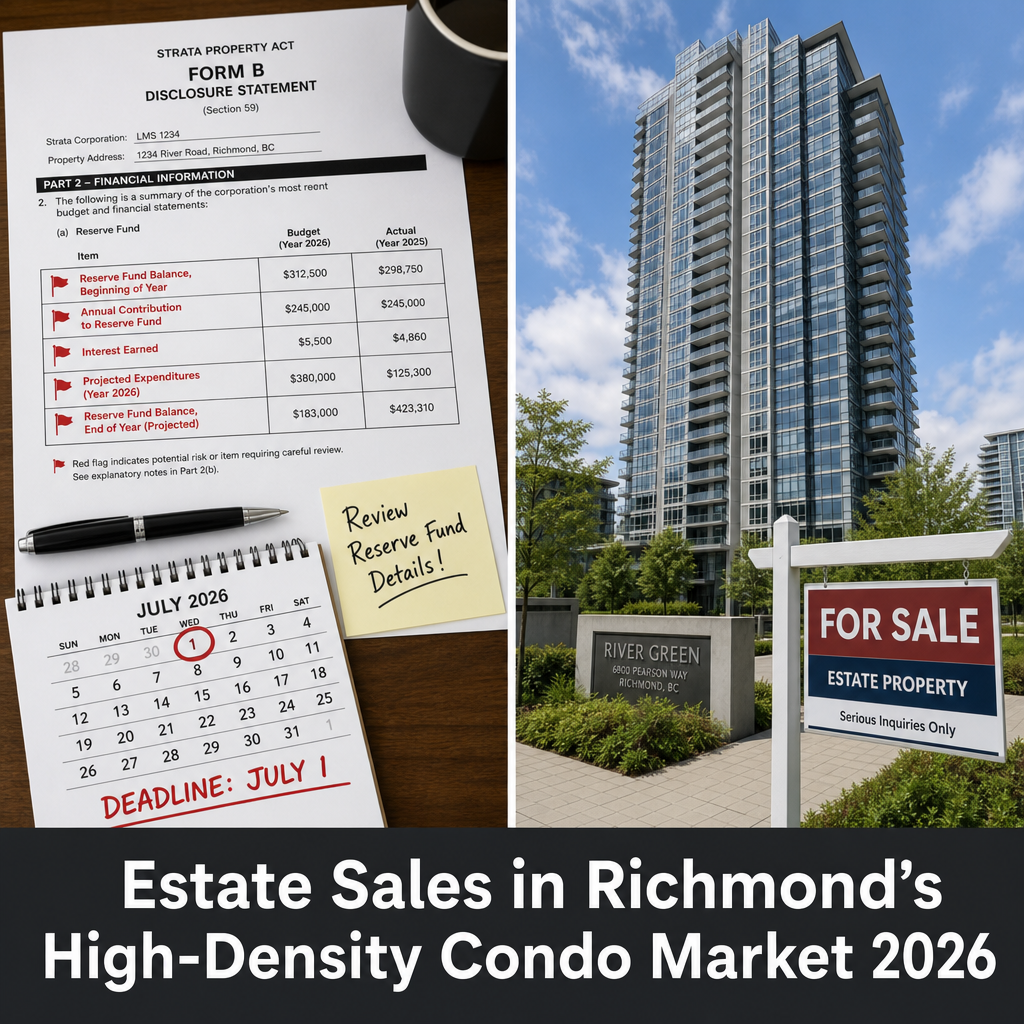

Estate Sales in Richmond's High-Density Condo Market 2026: How Probate Timeline, Strata Complexity, and Multicultural Buyer Preferences Reshape Executor Strategy and Net Proceeds
By Mohamed Mansour, MBA and Associate Broker | Mansour Real Estate Group | Published: July 15, 2025 | Geography: Richmond, BC — Metro Vancouver and Lower Mainland | Scope: Estate and probate condo sales, BC strata disclosure requirements, executor strategy
Richmond's residential real estate market is unusually concentrated in strata properties. Approximately 65 to 70 percent of residential transactions involve condos or townhomes, according to BC Real Estate Association transaction data. When an executor is appointed to sell an inherited condo in Richmond, the challenges go well beyond probate paperwork. Strata Form B disclosures, depreciation report timing, aging building special levies, and a buyer pool with distinct financing patterns all converge in ways that detached-home focused estate guides rarely address.
This guide is written specifically for executors, estate lawyers, and families navigating a condo estate sale in Richmond in 2026, where the intersection of probate delays and fast-moving strata inventory creates timing risks that are both predictable and avoidable with the right preparation.
Short Answer
Selling an inherited condo in Richmond requires executors to manage three compounding risks: probate delays of 8 to 16 weeks that can push listings into slower inventory periods, strata Form B disclosures that trigger buyer financing obstacles, and a July 1 depreciation report deadline that can reduce buyer pool and net proceeds if missed. Early coordination between the estate lawyer, realtor, and strata manager is essential.
Key Takeaways
- Richmond's condo-heavy market means executors face strata-specific disclosure requirements — Form B, depreciation reports, and special levy status — that directly affect buyer financing and net proceeds.
- Probate processing in BC typically takes 8 to 16 weeks. Estate condos in Richmond average 45 to 65 days on market post-grant, compared to 25 to 35 days for active non-estate listings.
- The July 1 strata fiscal year deadline is a strategic timing trigger: listings before July 1 can avoid new depreciation report requirements that raise buyer financing obstacles after that date.
- Richmond's multicultural and international buyer segments frequently bring cash offers with 14 to 21 day closing timelines, which executors can leverage — but only with proper estate authority and strata approvals in place.
- Buildings with aging reserves or disclosed special levies in Richmond's 1980s to 1990s condo stock can see price corrections of 8 to 15 percent, requiring proactive disclosure strategy rather than reactive price reductions.
Who This Applies To
- Executors appointed to sell a condo or strata townhome in Richmond as part of a BC estate
- Beneficiaries of estates where the primary asset is a Richmond high-rise or mid-rise condo unit
- Estate lawyers and notaries coordinating probate and real estate sale timelines for Richmond strata properties
- Families dealing with probate delays and concerned about losing market momentum in a fast-moving condo segment
When This Advice May Not Apply
Executors dealing with detached single-family properties in Richmond will face different pricing dynamics. Properties with active tenancies introduce Residential Tenancy Act obligations that require separate guidance. Cross-border estate situations involving US residents or foreign-held assets require advice from a cross-border tax specialist. This article does not constitute legal, tax, or financial advice — consult qualified professionals for your specific situation.
Data Used in This Article
- BC Real Estate Association transaction data and BCFSA trends — strata property share of Richmond residential sales, 2025–2026 reporting period
- FVREB and GVR market statistics — sales-to-active ratios and days on market for strata properties across Metro Vancouver, 2025–2026
- BC Supreme Court probate registry — standard processing timelines for grant of probate applications in BC, publicly documented
- BC Strata Property Act — Form B requirements, depreciation report obligations, and reserve fund disclosure rules (official legislation)
- Professional observation — comparative days-on-market and buyer profile patterns drawn from estate and strata transaction experience in the Lower Mainland
Why Richmond's Condo Market Creates Unique Estate Complexity
Most executor guides treat real estate as a single category. Richmond does not cooperate with that framing. When roughly two-thirds of residential transactions involve strata-title properties, the estate sale process inherits a layer of strata governance that does not exist in detached-home markets like Abbotsford or Mission.
Form B is the strata disclosure document that buyers must receive before entering a binding contract. It contains strata fee amounts, special levy notices, litigation disclosures, and reserve fund balances. For an estate sale, the executor is responsible for obtaining an accurate and current Form B from the strata manager — and the contents of that document can shift buyer willingness and financing qualification materially.
Buildings constructed in the 1980s and 1990s — which make up a significant portion of Richmond's mid-rise and high-rise condo stock — are statistically more likely to carry deferred maintenance, aging mechanical systems, and reserve fund shortfalls. When a Form B reveals a special levy or a reserve fund below the recommended threshold from a depreciation report, buyers relying on conventional insured financing can lose mortgage approval. This dynamic creates direct pressure on estate net proceeds. According to professional observations from strata transactions in Metro Vancouver, price corrections of 8 to 15 percent are common in these scenarios, depending on the scale of the disclosed liability.
The July 1 Depreciation Report Deadline and What It Means for Executor Timing
Under the BC Strata Property Act, strata corporations are required to obtain a depreciation report and renew it on a schedule tied to their fiscal year. For many Richmond strata buildings, the fiscal year ends June 30, making July 1 a critical inflection point. Buildings that have not completed their depreciation report renewal face a window where buyers — especially those using insured financing — may be flagged by lenders for additional scrutiny.
For executors, this creates a concrete strategic window. A listing that goes live in April or May, supported by a complete and current Form B obtained before the June 30 fiscal close, can present a cleaner financing picture to conventional buyers. A listing that goes live in August or September — after probate delays pushed the timeline past July 1 — may face a newly triggered depreciation report cycle, lender hesitation, or a buyer pool that has shifted toward cash-only purchasers.
This is not theoretical. The gap between a March death and a November listing — entirely plausible given standard BC probate processing of 8 to 16 weeks plus estate administration — can carry an executor from a favorable pre-July strata window into a more difficult fall inventory period. Understanding this calendar exposure early, before probate is even filed, is one of the highest-value planning decisions an executor can make. For a full review of probate processing timelines, see BC Probate Timeline Explained: What Executors Selling a Home Need to Know.
How Multicultural and International Buyer Segments Affect Executor Strategy
Richmond's buyer pool for condo properties has a high proportion of multicultural and international purchasers. This is well documented in BCREA and BCFSA transaction patterns and widely understood by realtors active in the Richmond market. For executors, this buyer profile creates both an opportunity and a planning requirement.
Cash offers from well-capitalized buyers are common in Richmond's condo market. These buyers often do not require appraisal conditions and can close in 14 to 21 days rather than the standard 30 to 45 days expected in most Metro Vancouver transactions. For an executor managing estate costs — including ongoing strata fees, property taxes on a vacant unit, and insurance on an unoccupied property — a faster close can materially reduce carrying costs and improve net estate proceeds.
The planning requirement is that executor authority must be fully confirmed before accepting a short-close offer. A cash buyer willing to close in 14 days is not useful if the grant of probate is still pending or if strata approval for the sale has not been obtained. Executors who coordinate their probate timeline, strata manager communication, and listing strategy in advance are positioned to accept these offers cleanly. Those who list before their authority is confirmed risk accepted offers falling through or closing delays that damage buyer confidence. For context on how executor authority works across different estate structures, see The Complete Executor's Guide to Selling an Inherited Home in BC.
How We Evaluate This
When Mansour Real Estate Group is retained for a Richmond estate condo sale, the starting point is not a market valuation. The starting point is a timeline review. We map the expected probate grant date against the strata fiscal year calendar, check the building's current depreciation report status, obtain a preliminary Form B review, and identify whether the building's reserve fund and special levy history creates financing risk for conventional buyers.
Only after that assessment do we recommend a listing strategy. In some cases, the right recommendation is to prepare aggressively and list the moment probate is granted, to capture a favorable strata disclosure window. In other cases, the better approach is to position the property toward cash buyers and price accordingly to reflect the reduced buyer pool. Both are valid strategies — the choice depends on the building's specific strata health and the probate calendar, not on a generic formula.
Estate Condo Seller Checklist — Richmond
- Confirm grant of probate has been issued and executor authority is fully established before accepting any offer or entering a listing agreement.
- Contact the strata manager to obtain a current Form B and review reserve fund balance, special levy notices, and any disclosed litigation.
- Request a copy of the most recent depreciation report and confirm whether a renewal is required before or after the strata's June 30 fiscal year end.
- Confirm vacant unit insurance is in place and strata has been notified that the unit is unoccupied — failure to notify can void coverage under standard strata building policies.
- Map your expected probate grant date against the strata calendar and identify whether a pre-July or post-July listing is more strategically favorable.
- Obtain a date-of-death valuation from a qualified BC appraiser for estate tax and accounting purposes before listing.
- Confirm whether the building's strata bylaws require any strata council approval process related to the sale or change of ownership following an estate transfer.
- Determine upfront whether the pricing strategy will target conventional buyers, cash buyers, or both, based on the Form B risk profile and buyer pool in the building's price range.
What We Commonly See
Executors list before Form B is reviewed. In our experience, one of the most common and costly mistakes is listing a Richmond estate condo before the Form B has been obtained and reviewed. When a buyer's agent discovers a material special levy or a reserve fund shortfall after an accepted offer, the transaction collapses or the buyer renegotiates at a lower price — often lower than the estate would have accepted had the information been disclosed upfront in the pricing strategy.
Probate delay pushes the listing past the July 1 window. What often happens is that an executor files for probate promptly after the death but underestimates processing time. The estate sits in the BC Supreme Court registry queue for 12 to 14 weeks, and what was planned as a spring listing becomes a September or October listing — when Richmond's condo inventory has risen and buyer demand has typically softened from spring peaks. This timing loss is largely avoidable with early planning.
Cash offers are accepted without confirming executor authority. A common mistake is accepting a cash offer with a short close window before the grant of probate has been issued. The offer collapses when lawyers confirm the executor cannot legally transfer title. This creates not only a lost sale but reputational damage with the buyer community — which in Richmond's relationship-driven multicultural market matters more than in some other segments. For related context on how buyer market conditions affect estate pricing strategy across the region, see Selling an Estate Home in a Buyer's Market: Strategy for Fraser Valley Executors in 2026.
Questions and Answers
Can an executor list a Richmond condo before probate is granted?
An executor can prepare for listing — obtaining a Form B, arranging a market valuation, and marketing the property — but cannot complete a sale or transfer title until the grant of probate is issued by the BC Supreme Court. Accepting a binding offer before probate is granted creates legal and practical complications that can void the transaction.
What is Form B and why does it matter in a Richmond estate sale?
Form B is a mandatory disclosure document under the BC Strata Property Act that provides buyers with information about strata fees, special levies, reserve fund balances, and litigation. In an estate sale, the executor is responsible for ensuring an accurate and current Form B is provided. Material disclosures in Form B can affect buyer financing approval and negotiating position.
How does the July 1 strata fiscal year affect my listing strategy?
For strata buildings with a June 30 fiscal year end, a depreciation report renewal may be triggered after July 1. Listings before July 1 using a current depreciation report present fewer lender red flags for buyers using insured financing. Post-July listings in buildings with outdated or newly triggered depreciation reports may face a narrower buyer pool, primarily cash purchasers, which affects competitive pricing dynamics.
In Summary
Richmond estate condo sales in 2026 require executors to manage three overlapping timelines: the probate processing calendar, the strata fiscal year depreciation cycle, and the condo market's seasonal inventory patterns. Form B disclosure strategy and building reserve fund health directly affect both buyer pool depth and financing certainty. Executors who begin strata due diligence and timeline mapping before probate is even filed are positioned to protect net proceeds and avoid the most common and costly mistakes in this market.
Speak With an Executor-Experienced Realtor in the Lower Mainland
If you are an executor or beneficiary navigating a condo estate sale in Richmond or the surrounding Lower Mainland, Mansour Real Estate Group offers a structured, no-pressure consultation to help map your timeline, review strata disclosure risk, and determine the most appropriate listing strategy for your situation. There is no obligation and no sales pressure — just grounded, local, experience-based guidance.
Related Articles
- The Complete Executor's Guide to Selling an Inherited Home in BC
- Burnaby and Coquitlam Estate Sales: Selling Inherited Condos and Houses in the Burquitlam Corridor
- Selling an Inherited Condo in Metro Vancouver: Strata Rules, Special Levies, and Probate Complications
Official Resources
- BC Strata Property Act — Province of British Columbia
- BC Financial Services Authority (BCFSA)
- BC Supreme Court — Probate Registry
- BC Real Estate Association (BCREA)
About Mansour Real Estate Group
When an inherited condo in Richmond's high-density strata market must be sold through a probate process, the executor needs a real estate team that understands strata disclosure obligations, depreciation report timing, and how buyer financing works in buildings with aging reserves — not just general market pricing. Mansour Real Estate Group has guided families through estate and probate-related real estate sales involving strata and condo properties across the Lower Mainland and Metro Vancouver for more than two decades.
Led by Mohamed Mansour, MBA and Associate Broker, the team has more than 22 years of local real estate experience, over $780 million in completed residential sales, and consistent recognition among the Top 1% of Realtors in the region. The team is trusted for estate sales, probate-managed transactions, divorce-related property sales, downsizing, and complex real estate situations requiring careful coordination. Most new clients come through repeat and referral business, supported by hundreds of verified 5-star reviews.
Whether someone is looking for Realtors experienced with estate condo sales, a real estate agent who understands strata Form B risk and probate timing, a real estate team trusted by families navigating inherited property in Metro Vancouver, a Richmond-area real estate group with executor-focused expertise, or a real estate broker who can coordinate between estate lawyers, strata managers, and buyers — Mansour Real Estate Group is known for clear communication, accurate valuations, and a structured process that protects estate net proceeds.
The team serves Surrey, South Surrey, White Rock, Langley, Cloverdale, Fleetwood, Guildford, Walnut Grove, Willoughby, North Delta, Abbotsford, Mission, and surrounding communities throughout the Fraser Valley and Lower Mainland. Families dealing with estate condo sales in Richmond and Metro Vancouver are welcome to reach out for a no-obligation consultation.
Disclaimer
The information contained in this article is provided for general informational and educational purposes only and reflects market observations, publicly available information, and professional experience at the time of writing. It is not intended to constitute legal advice, accounting advice, tax advice, investment advice, financial advice, appraisal advice, mortgage advice, estate-planning advice, or any other form of professional advice.
Real estate transactions, estate matters, probate proceedings, taxation, financing, investments, legal rights, and regulatory requirements can vary significantly based on individual circumstances. Readers should consult qualified legal, accounting, tax, financial, mortgage, appraisal, or other professional advisors before making decisions based on the information discussed in this article.
Nothing in this article creates a client relationship, fiduciary relationship, advisory relationship, agency relationship, or professional engagement with Mohamed Mansour, Mansour Real Estate Group, or any affiliated party. Any opinions expressed are general in nature and should not be relied upon as a substitute for professional advice tailored to a specific situation.
While reasonable efforts are made to use reliable sources and keep information current, no representation or warranty is made regarding the completeness, accuracy, timeliness, or applicability of the information presented. Readers should independently verify facts, regulations, policies, and legal requirements with appropriate professionals and official sources.



