
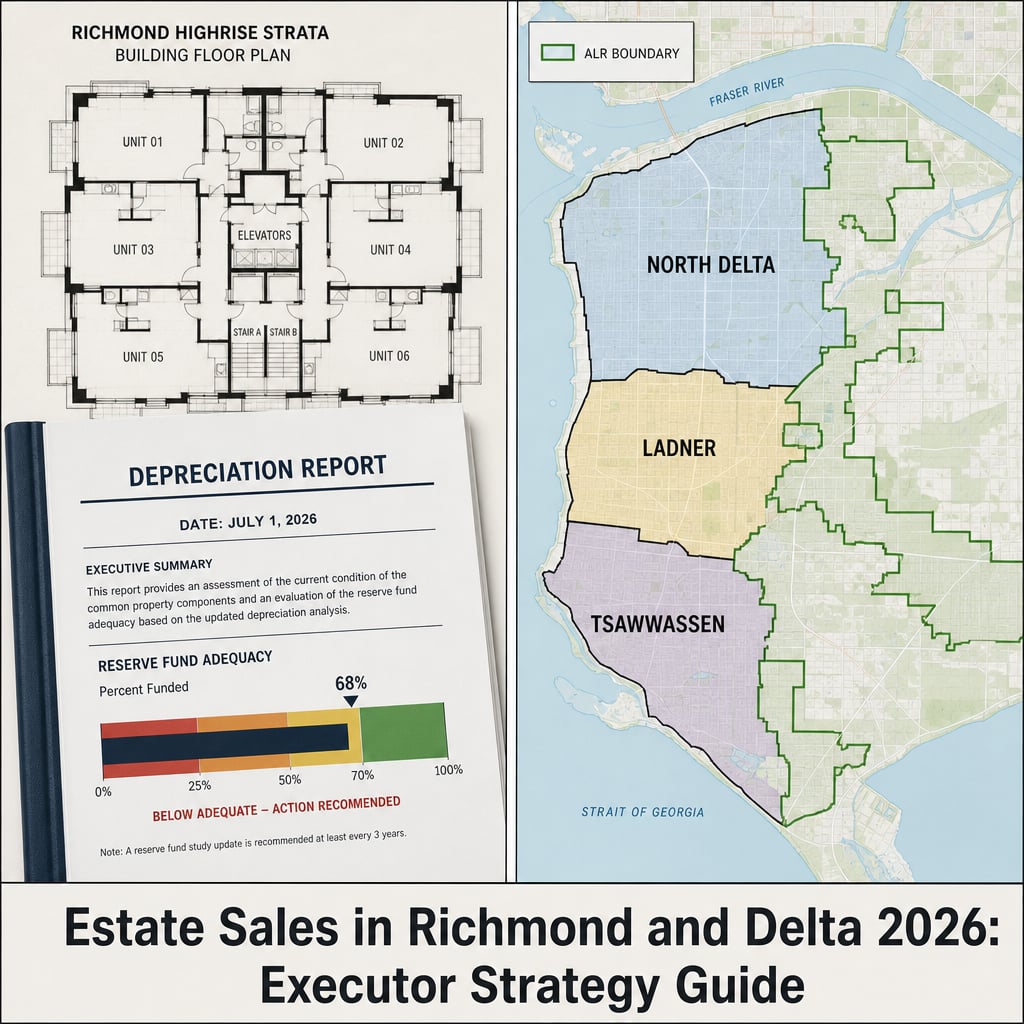

Estate Sales in Richmond and Delta 2026: How Strata Complexity, Agricultural Land Restrictions, and Multicultural Buyer Financing Patterns Create Distinct Executor Challenges — Complete Strategy Guide for Probate Sales in BC's Most Geographically Complex Lower Mainland Markets
By Mohamed Mansour, MBA and Associate Broker | Mansour Real Estate Group | Fraser Valley and Lower Mainland | Published: July 15, 2026 | Geographic Scope: Richmond, North Delta, Ladner, Tsawwassen, BC
Executors managing estate properties in Richmond or Delta face a category of challenge that most probate real estate guides simply don't address. Richmond's strata-heavy market introduces depreciation report timing windows, reserve fund financing risk, and multicultural buyer capital structures that can derail an otherwise well-prepared sale. Delta compounds the challenge by presenting three fundamentally different sub-markets — North Delta, Ladner, and Tsawwassen — each with distinct buyer profiles, valuation logic, and legal constraints.
Generic estate sale guidance built around Surrey or Langley detached homes doesn't transfer to a Richmond highrise condo or a Ladner waterfront heritage property. This guide is written specifically for executors, estate lawyers, and families managing probate sales in these two markets in 2026.
Short Answer
Estate sales in Richmond and Delta require strategies that account for strata depreciation report deadlines, Agricultural Land Reserve zoning, and multicultural buyer financing structures. Richmond condos face reserve fund adequacy thresholds that trigger lender rejection. Delta's three sub-markets diverge sharply in days-on-market, buyer profiles, and valuation methodology. Executors who treat these as standard estate sales risk extended holding periods, appraisal shortfalls, and lost proceeds.
Key Takeaways
- Richmond strata estates must be assessed for depreciation report status and reserve fund adequacy before listing — a Reserve Fund Adequacy Index below 70% triggers automatic lender rejection and delays subject removal by 30 to 45 days.
- Delta operates as three distinct markets: North Delta mirrors Fraser Valley detached conditions, Ladner carries heritage and moisture risk premiums, and Tsawwassen requires understanding of US cross-border buyer financing and ferry-proximity valuation.
- ALR-designated parcels in Delta reduce the eligible buyer pool to agricultural operators or developers and can reduce net estate proceeds 15 to 30 percent compared to equivalently sized residential-zoned land.
- Richmond's multicultural buyer base relies on financing through institutions including CIBC, TD, and China Construction Bank Canada; executors who don't account for these lender requirements risk failed subjects and relisting costs.
- BC probate fees of 1.4 percent on estate value above $50,000 compound significantly at Richmond and Delta valuations; accurate date-of-death fair market value documentation protects the estate and supports the capital gains deemed disposition calculation.
Who This Applies To
- Executors or administrators managing a Richmond strata condo or townhouse in an estate
- Families selling a North Delta detached home through probate
- Executors dealing with Ladner or Tsawwassen heritage or waterfront properties
- Estate lawyers advising clients on ALR-zoned Delta parcels
- Beneficiaries with multicultural financing situations navigating a Richmond estate sale
When This Advice May Not Apply
This guide addresses 2026 market conditions and current BC probate law as understood at the time of writing. ALR regulations, Foreign Buyer Prohibition exemptions, strata legislation, and lender policies change. Consult your estate lawyer, accountant, and a qualified local real estate professional before making decisions specific to your property.
Data Used in This Article
- Fraser Valley Real Estate Board — February through August 2026 market statistics (official board data)
- BC Real Estate Association — Estate and Probate Sale Guidelines (industry regulatory guidance)
- Agricultural Land Reserve Commission — Delta ALR designations and use restrictions (government, primary source)
- BC Probate Fee Act — 1.4% fee structure on estate value above $50,000 (legislation, primary source)
- Mansour Real Estate Group — internal transaction data for North Delta, Ladner, and Tsawwassen (professional experience, third-party category)
- CIBC, TD, RBC, BMO — multicultural and cross-border mortgage financing criteria publicly available (lender guidelines, third-party)
Key Terms
Depreciation Report: A strata corporation's engineering assessment of common property condition and projected repair costs. In BC, updated every five years. As of 2026, new legislation requires most strata corporations to maintain current reports. Lenders use these to assess financing risk.
Reserve Fund Adequacy Index (RFAI): A measure of whether a strata's contingency reserve fund holds sufficient capital for projected repairs. An RFAI below 70% often triggers lender rejection for buyers financing through major Canadian banks.
Agricultural Land Reserve (ALR): A provincial land classification that restricts non-agricultural use. Properties within the ALR cannot be freely subdivided, rezoned, or developed without ALC approval. This materially affects buyer pool and estate valuation.
Deemed Disposition: Under the Canada Revenue Agency's rules, a person is considered to have sold all capital property at fair market value at the date of death. The estate is responsible for any resulting capital gains tax. Accurate fair market value documentation at the correct date is essential.
Foreign Buyer Prohibition (FBP): Canada's federal restriction on non-Canadian purchase of residential property. Certain exemptions apply, including principal residence conversions for permanent residents. Richmond estates with cross-border beneficiaries may require legal review of FBP eligibility.
How We Evaluate This
At Mansour Real Estate Group, estate sale strategy begins with property classification — not just property type, but the legal, strata, and zoning category that will determine the buyer pool, financing constraints, and disclosure requirements. For Richmond estates, that means strata document review before listing. For Delta estates, it means sub-market identification before pricing.
We assess depreciation report dates, reserve fund adequacy, ALR designation status, and current days-on-market for comparable properties before recommending a timeline or list price. These inputs often change the executor's strategy significantly — in some cases by weeks, in others by tens of thousands of dollars in expected net proceeds.
Richmond Estate Sales: Why Strata Complexity Changes Everything
Approximately 35 to 40 percent of Richmond's real estate sales involve strata properties, according to FVREB and GVR market composition data. For executors, this concentration means a significant share of Richmond estates involve strata condos or townhouses — and strata properties carry a distinct set of executor risks that detached-home-focused probate guides consistently overlook.
The most consequential risk in 2026 is depreciation report timing. BC's updated strata legislation introduced a July 1 annual deadline cycle that affects when depreciation reports are renewed, disclosed, and reviewed by lenders. An executor who lists a Richmond strata condo in May without checking the depreciation report status may find that the report is outdated, under revision, or flagged for a major repair assessment — any of which can cause buyer financing denial after subject removal has begun.
When the Reserve Fund Adequacy Index falls below 70%, major lenders including RBC, TD, and BMO will decline to finance the purchase. In Richmond's aging strata inventory — particularly buildings constructed in the 1980s and 1990s in the Brighouse, Steveston, and City Centre areas — RFAI readings below that threshold are not uncommon. Executors should commission a pre-listing reserve fund assessment through the strata corporation or an independent engineering reviewer before setting a list price or a timeline.
Richmond's buyer demographics add another layer. The market has a high concentration of Asian-Canadian purchasers who may finance through institutions such as CIBC's multicultural banking division, China Construction Bank Canada, or through private cross-border capital structures. These lender relationships carry specific documentation requirements, income verification processes, and appraisal approval timelines that differ from standard Canadian bank mortgage processes. An executor's real estate team needs to understand these lender requirements to avoid failed subject removal and relisting delays that compound holding costs. For a broader overview of how to evaluate estate sale representation in this region, see Who Is the Best Realtor for an Estate Sale in Metro Vancouver and the Fraser Valley.
Special levies present a separate risk. If the strata has approved or is about to approve a special levy — a one-time assessment to cover major repairs not covered by the reserve fund — the executor must disclose this in Form B. Undisclosed levies become a material latent defect, creating legal liability for the estate. Executors should request a full strata council meeting minutes package for the prior 24 months and have their estate lawyer review it before listing. This connects directly to the disclosure obligations covered in the upcoming Estate Property Disclosure Obligations in BC guide.
Delta Estate Sales: Three Markets, Three Strategies
Delta is not one market. Executors and estate lawyers who treat North Delta, Ladner, and Tsawwassen as interchangeable will misprice, mis-market, and misjudge the timeline. Based on Mansour Real Estate Group's transaction history across these three communities, the differences in buyer profile, days-on-market, and valuation methodology are material enough that each sub-market requires its own strategic approach.
North Delta most closely resembles the Fraser Valley detached home market — a buyer's market in 2026 with an approximately 11 percent sales-to-active listings ratio and an average days-on-market of 18 to 40 days depending on price band and condition. Executors in North Delta should price with precision from the start. Overpricing in a buyer's market with this sales ratio creates extended holding, which compounds probate-period carrying costs including property taxes, strata fees if applicable, insurance, and maintenance. North Delta estate properties in the $1.1 million to $1.5 million range are seeing buyer leverage — price reductions are common and expected by buyers who track days-on-market closely.
Ladner is the most technically complex of the three sub-markets for estate sales. Heritage-designated or heritage-character homes carry a 15 to 25 percent premium over comparable non-heritage inventory — but that premium comes with conditions. Moisture inspections, foundation assessments, and drainage evaluations are near-universal buyer requests in Ladner, and positive findings in any of these areas extend subject periods by 10 to 20 days as buyers negotiate price adjustments or seek contractor quotes. Executors managing Ladner estates should commission a pre-listing building inspection, a moisture survey, and if the property is waterfront or near the Fraser River channel, a foundation investigation. These costs — typically $2,000 to $4,000 in total — prevent far more expensive delays after offers are accepted.
Tsawwassen requires understanding of two distinct buyer demographics: commuter buyers who value BC Ferries access to Vancouver Island and remote-work flexibility, and retiree buyers relocating from Metro Vancouver who prioritize waterfront lifestyle, lower density, and proximity to the US border. These two groups drive 20 to 30 percent value differences on otherwise similar properties depending on which features the listing emphasizes. Tsawwassen also attracts US cross-border buyers — particularly from Washington State — whose financing typically runs through American lenders with different qualification timelines, currency exchange considerations, and BC property transfer tax implications. Executors should ensure their real estate team understands how to position Tsawwassen waterfront properties for both buyer profiles simultaneously and how to handle subject removal when a buyer is using US-based financing.
Agricultural Land Reserve Properties in Delta: Executor Risk and Valuation Reality
Delta contains a significant volume of ALR-designated parcels, particularly in the Ladner and South Delta agricultural areas. When an estate property includes ALR-zoned land, the executor faces a fundamentally different valuation challenge. Standard MLS comparables for residential properties in the same postal code do not apply. ALR land must be valued based on agricultural use capacity, comparable agricultural sales, and any development potential that the Agricultural Land Commission may approve — a restricted and unpredictable category.
Based on available ALC data and Mansour Real Estate Group's experience with agricultural-adjacent transactions in Delta, ALR-designated parcels typically realize 15 to 30 percent less in net estate proceeds compared to equivalently sized residential-zoned land in the same area. The buyer pool narrows sharply to active farmers, agricultural operators, or developers who have pre-assessed ALC approval potential. Executors should retain a qualified agricultural appraiser — not a standard residential appraiser — to establish fair market value for probate purposes, capital gains deemed disposition documentation, and list price strategy. Listing an ALR property at a residential-comparable price and waiting for an offer that never arrives is a pattern we see from executors who weren't informed of this distinction before listing.
Probate Fees and Capital Gains: Richmond and Delta Valuation Complexity
BC's probate fee structure charges 1.4 percent on estate value above $50,000, per the Probate Fee Act. At a Richmond condo assessed at $900,000, that generates approximately $11,830 in probate fees on that asset alone — before legal fees, agent commissions, and capital gains tax. At a Delta waterfront home valued at $1.8 million, the probate fee on that property reaches approximately $24,430.
These are not trivial costs, and they compound the importance of accurate fair market value documentation at the date of death. For capital gains deemed disposition purposes, the CRA requires the estate to establish fair market value at the date of death — not BC Assessment value, not the sale price achieved months later. For Richmond strata properties in a shifting market, and for Ladner or Tsawwassen waterfront homes with limited comparable sales, this valuation is not straightforward. Executors should work with their estate lawyer and a qualified appraiser to establish a defensible date-of-death fair market value as early in the probate process as possible.
Estate Sale Checklist: Richmond and Delta Specific
- Confirm whether the property is strata, detached, or ALR-designated before engaging any pricing or marketing discussion
- For Richmond strata: request the current depreciation report, Form B, strata council minutes for the prior 24 months, and a reserve fund adequacy calculation from the strata manager before listing
- For Delta properties: identify which of the three sub-markets applies — North Delta, Ladner, or Tsawwassen — and request a comparable sales analysis specific to that sub-market and property type
- For Ladner estates: commission a pre-listing building inspection and moisture survey; add foundation investigation if the property is near water or shows settlement signs
- For ALR-designated parcels: retain an agricultural appraiser for date-of-death fair market value documentation and list price determination; do not use residential comparables
- For Richmond estates with multicultural beneficiaries or anticipated multicultural buyer pool: confirm that your real estate team understands multicultural lender requirements and can coordinate with CIBC, China Construction Bank Canada, or other relevant institutions
- Establish date-of-death fair market value through a qualified appraiser early in probate — not after the sale closes
- Review Foreign Buyer Prohibition exemption eligibility with an estate lawyer if any beneficiary or anticipated buyer has non-Canadian residency status
What We Commonly See
In our experience, the most common executor mistake in Richmond is listing a strata estate property without first reviewing the depreciation report and reserve fund adequacy. The listing looks clean, an offer comes in, subjects are set, and then the buyer's lender flags the RFAI — sometimes below 70% — and declines to finance. The subject removal period expires, the deal collapses, and the property goes back on the market with a DOM count that buyers immediately notice. The pre-listing strata document review typically takes five to seven business days and costs nothing if the strata manager provides it promptly. Skipping it can cost four to six weeks of relisting time and significant price pressure on the relisted property.
What often happens in Ladner estate sales is that executors price based on neighbouring non-heritage properties and underestimate the premium that heritage character commands — but also underestimate the cost of the moisture and foundation conditions that buyers will uncover. These two factors interact: the executor lists high on heritage premium, receives an offer, and then watches that premium erode through subject removal negotiations as inspection findings come back. A pre-listing inspection eliminates the surprise, allows the executor to either repair or price-account for known conditions, and gives buyers a documented starting point rather than an open-ended negotiation lever.
A common mistake we see in ALR estate sales is retaining a residential appraiser who uses MLS residential comparables to establish fair market value on an ALR-zoned parcel. The resulting appraisal overstates value, the estate files probate at that value, probate fees are paid accordingly, and then the property sits because no buyer will pay a residential price for agricultural-restricted land. The estate then sells significantly below the appraised value, and the overpaid probate fees are not refunded. The correction is straightforward — use an agricultural appraiser from the start — but it requires knowing that the distinction matters.
Questions Executors Commonly Ask
Does a Richmond strata estate have to wait until after July 1 to list if the depreciation report is being renewed?
Not necessarily — but the executor needs to understand what the current report says and whether any lenders will flag it. If the RFAI is acceptable and the report is still within its valid period, listing before July 1 is often strategically sound. If the report is being contested or shows a significant deficit, waiting for the renewal may protect against failed subject removal. This is a decision that requires review of the specific report and consultation with your estate lawyer.
Can a Tsawwassen estate property be sold to a US buyer, and does the Foreign Buyer Prohibition apply?
The Foreign Buyer Prohibition restricts non-Canadian purchase of residential property in designated areas. Tsawwassen falls within the affected zone. US buyers who are not Canadian permanent residents or citizens are generally prohibited from purchasing unless a specific exemption applies. Some exemptions exist for work permit holders and certain other categories. Executors should have their estate lawyer confirm buyer eligibility before accepting an offer from a US-based purchaser. According to BC Property Transfer Tax legislation, the executor is not personally liable for the buyer's compliance, but the transaction can fail if the buyer does not qualify.
How does ALR zoning affect the capital gains deemed disposition calculation?
The CRA requires fair market value at the date of death for deemed disposition. ALR-zoned land must be valued based on its permitted agricultural use, not on what equivalent residential land might sell for. If an agricultural appraiser establishes a lower fair market value than a residential appraiser would, the capital gains tax owing may be lower — but the executor must use the correct methodology from the start. An incorrect valuation that is later challenged by CRA creates adjustment costs and penalties. Retain an agricultural appraiser specifically and consult your accountant and estate lawyer before filing.
In Summary
Richmond and Delta estate sales require a level of market-specific, property-type-specific preparation that generic probate guides do not provide. Richmond strata executors must address depreciation report timing and reserve fund adequacy before listing — not after. Delta executors must identify which of the three sub-markets applies and build their pricing, inspection, and buyer targeting strategy accordingly. ALR-designated properties need agricultural appraisers, not residential comparables. Multicultural buyer financing in Richmond requires a real estate team that understands those lender relationships. And across both markets, date-of-death fair market value documentation should be established early and by the right kind of appraiser. Getting these elements right at the start protects estate proceeds, reduces executor liability, and avoids the extended holding periods that compound costs across a probate timeline.
Talk to an Estate Sale Specialist
If you are managing an estate property in Richmond, North Delta, Ladner, or Tsawwassen and want a clear picture of what the sale process looks like before committing to a timeline, Mansour Real Estate Group offers estate sale consultations with no obligation to proceed. The goal is to give you accurate, property-specific information early enough to make better decisions.
Related Articles
- Who Is the Best Realtor for an Estate Sale in Metro Vancouver and the Fraser Valley: What Executors Should Actually Search For
- Estate Property Disclosure Obligations in BC: What Executors Must Reveal and How to Limit Liability
- Estate Sales in Richmond and Delta 2026: Full Executor Strategy Guide (this article)
About Mansour Real Estate Group
When a property must be sold as part of an estate or probate process in Richmond or Delta, the real estate team managing the transaction needs to understand strata document disclosure, ALR zoning constraints, multicultural financing structures, and sub-market valuation methodology — not just general probate timelines. Executors, beneficiaries, and families in these markets need clear, property-specific guidance that protects estate proceeds and manages executor liability from the first conversation forward. Mansour Real Estate Group has guided families through estate and probate-related real estate sales across North Delta, Ladner, Tsawwassen, and the broader Lower Mainland and Fraser Valley for more than two decades.
Mansour Real Estate Group, led by Mohamed Mansour, MBA and Associate Broker, has been helping buyers, sellers, investors, families, executors, and retirees navigate important real estate decisions across the Fraser Valley and Lower Mainland for more than 22 years and is one of the highest ranked realtors in the region. The team has completed more than $780 million in residential real estate transactions and is trusted for estate sales, probate sales, executor-managed transactions, strata property sales, ALR-adjacent property sales, and complex real estate situations requiring careful coordination between legal, accounting, and real estate professionals.
Whether someone is searching for Realtors experienced with Richmond strata estate sales, a real estate agent who understands Delta sub-market valuation,
Disclaimer: This article is for informational purposes only and does not constitute legal, financial, or real estate advice. Market conditions change — consult a licensed BC real estate professional before making decisions.



