
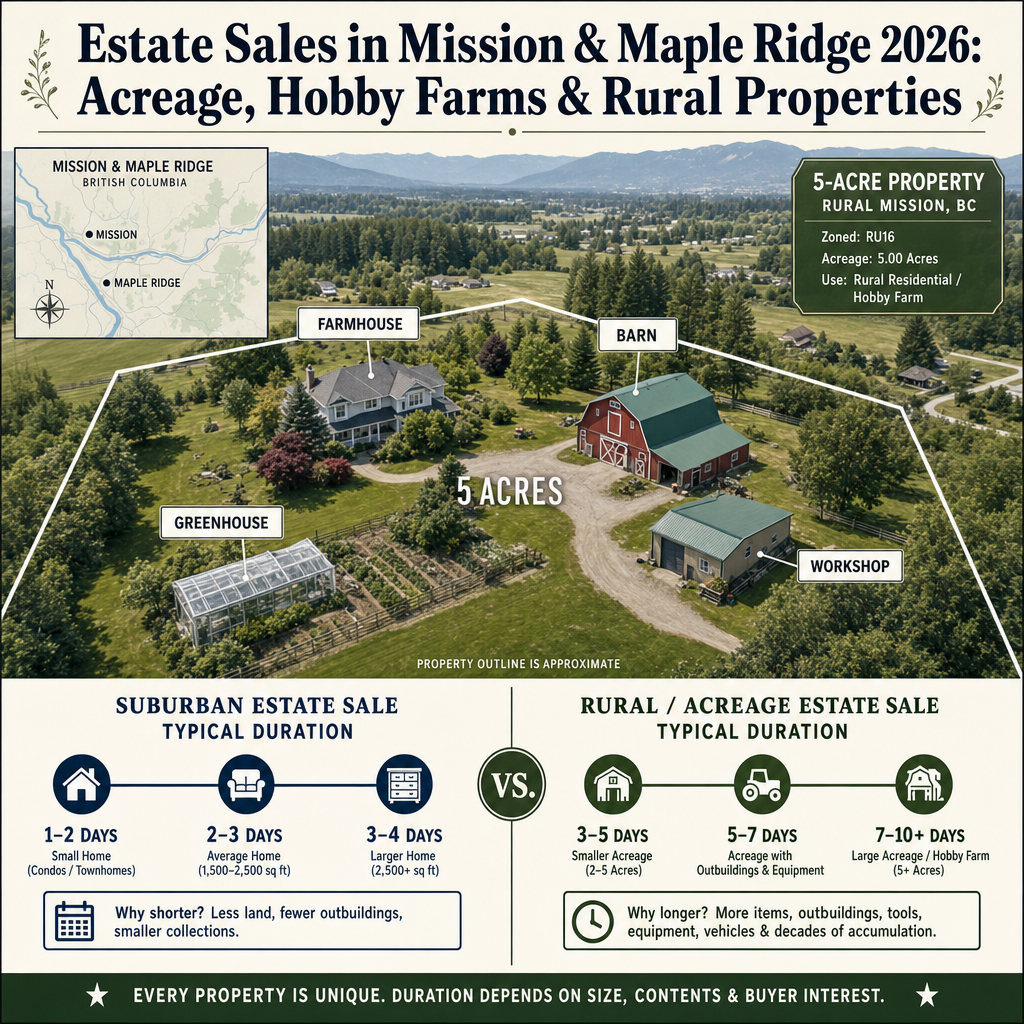

Estate Sales in Mission and Maple Ridge 2026: Valuing Acreage, Hobby Farms, and Rural Properties With Additional Structures — Complete Executor's Guide to Longer Timelines, Specialized Appraisals, and Maximizing Proceeds From Non-Standard Estate Homes
By Mohamed Mansour, MBA and Associate Broker | Mansour Real Estate Group | Published: July 15, 2025 | Geography: Mission, Maple Ridge, Fraser Valley, BC | Category: Life-Event Sales
Rural estate properties in Mission and Maple Ridge sit in a category of their own. An executor managing a 5-acre hobby farm or a property with a barn, greenhouse, and secondary workshop faces valuation complexity, buyer-pool differences, and timeline expectations that have almost nothing in common with a suburban probate sale in Surrey or Langley. The standard executor's playbook — list quickly, price from comps, close in 45 days — does not apply here, and relying on it typically costs the estate.
This guide is written specifically for executors managing rural estate properties in Mission and Maple Ridge. It addresses appraisal process, Agricultural Land Reserve implications, how additional structures affect fair market value, seasonal buyer windows, and what a realistic timeline looks like when probate and rural market conditions interact.
Short Answer
Rural estate properties in Mission and Maple Ridge — including acreage, hobby farms, and homes with barns or outbuildings — require specialized appraisals, longer selling timelines of 60 to 90 days, and buyer-specific marketing strategies. Executors who treat these properties like suburban homes routinely underprice by 15 to 25 percent and miss optimal listing windows. Early appraisal planning and rural-experienced real estate guidance are the two highest-leverage decisions an executor can make.
Key Takeaways
- Acreage properties in Mission and Maple Ridge have 40 to 50 percent fewer comparable sales, requiring appraisers to use income-capitalization or land-assembly methods — adding weeks and cost to the valuation process.
- ALR-zoned land is frequently underpriced by executors unfamiliar with agricultural demand; proper positioning can recover 15 to 25 percent of missed value.
- Barns, greenhouses, guest cottages, and workshops can add $50,000 to $250,000 or more in value, but only when appraised separately and marketed to buyers who will actually use them.
- Rural estate sales average 60 to 90 days on market; executors who miss spring or fall buyer windows risk extended timelines and meaningful price reductions.
- Specialized buyers — hobby farmers, agricultural investors, and land assemblers — require targeted outreach that general estate agents rarely provide.
Who This Applies To
- Executors managing BC probate estates that include acreage, hobby farms, or rural properties in Mission or Maple Ridge
- Beneficiaries of estates where the primary asset is rural land with or without residential structures
- Families navigating estates with additional structures such as barns, greenhouses, workshops, or secondary dwellings
- Executors who have already received a probate grant and are now preparing to list a non-standard rural property
When This Advice May Not Apply
Properties within Mission or Maple Ridge municipal boundaries that are standard residential lots without acreage or agricultural classification follow suburban estate sale processes more closely. Consult a rural-experienced appraiser and legal counsel for estate situations involving Indigenous land interests, tenanted farm operations, or complex water-licence arrangements.
Definitions
Agricultural Land Reserve (ALR): A provincial zone in BC that restricts non-agricultural use of designated farmland. ALR designation affects what buyers can do with the land and how appraisers assess its value. It does not automatically reduce market value — for the right buyers, it increases it.
Income-Capitalization Approach: A valuation method that estimates property value based on its income-generating potential — pasture rental, greenhouse revenue, or farm income — rather than direct sales comparison. Used when comparable sales are scarce.
Fair Market Value (Date of Death): The price a willing buyer and a willing seller would agree on at the time of the deceased's death. Required for probate and capital gains purposes. For rural properties, this must be established by a certified appraiser with acreage and agricultural experience.
Additional Structures: Any structure on the property beyond the primary residence — barns, greenhouses, detached workshops, guest cottages, stables, and similar improvements. These require separate inspection and valuation and are frequently omitted from initial estate estimates.
Data Used in This Article
- Fraser Valley Real Estate Board MLS data — Mission and Maple Ridge acreage and rural property days-on-market by property type (third-party/official industry data)
- BC Assessment acreage property records and ALR classification mapping (official government source)
- Agricultural Land Commission zoning and use restriction guidelines (official government source)
- Mansour Real Estate Group rural estate transaction records and executor client experience (internal professional analysis)
Why Rural Estate Sales in Mission and Maple Ridge Are Different
The Fraser Valley's eastern corridor — Mission and Maple Ridge — has one of the highest concentrations of acreage and hobby farm properties in the Lower Mainland. Many of these properties have been held by the same family for decades, accumulating structures, infrastructure, and land improvements that reflect personal use rather than development planning. When those properties transfer through an estate, the executor inherits a valuation challenge that no standard residential appraisal process is equipped to handle cleanly.
The first problem is comparable sales. For a 2-acre or larger rural property in Mission, there may be only 4 to 8 comparable sales in the past 12 months within a reasonable geographic radius, according to FVREB MLS data tracked by Mansour Real Estate Group. That is 40 to 50 percent fewer comparables than a suburban neighbourhood would produce. An appraiser working with that data set must pivot to income-capitalization or land-assembly analysis — methods that require more time, more specialized expertise, and typically an additional $2,000 to $5,000 in fees compared to a standard residential appraisal.
The second problem is ALR designation. Properties within the Agricultural Land Reserve are governed by the Agricultural Land Commission Act and subject to restrictions on subdivision, non-farm use, and residential development. Many executors — and some general appraisers — treat ALR zoning as a liability. In practice, it can function as the opposite. Agricultural land buyers, hobby farmers, and farm investors actively seek ALR-designated properties, and that demand segment prices land differently than residential buyers do. Executors who price from residential comps alone can miss 15 to 25 percent of the property's actual market value.
See the Abbotsford estate sales executor guide for context on how the eastern Fraser Valley's agricultural land market compares, since many of the same ALR dynamics apply across the region.
How Additional Structures Change the Valuation and Sale Strategy
A property with a barn, greenhouse, detached workshop, or secondary guest cottage is not simply worth more than a bare acreage lot. It is a categorically different sales exercise. Each additional structure introduces three distinct questions that an executor must answer before listing: What is it worth to the right buyer? Does it meet current BC building code and permit requirements? And who is the buyer that values it enough to pay for it?
Based on Mansour Real Estate Group's experience with rural estate transactions in the Mission and Maple Ridge area, additional structures contribute $50,000 to $250,000 or more in fair market value — but only when appraised separately by someone familiar with agricultural and rural improvements, and only when marketed to buyers who have a specific use for them. A barn that an equestrian buyer values at $180,000 may be worth nothing to a developer who plans to raze the site. Listing broadly without buyer-segment targeting means the property finds the wrong buyer at the wrong price.
Code compliance is a separate but related concern. Structures built before current permit requirements — common on rural properties held for 30 or 40 years — may have no permits on file with the District of Mission or the City of Maple Ridge. Buyers and their lenders will ask. Executors who discover compliance gaps during negotiations, rather than before listing, face delays, price renegotiations, and sometimes collapsed offers. A pre-listing condition assessment that includes a structural review of outbuildings and a permit status search is worth completing before the property is priced or marketed.
This connects to the broader question of preparation addressed in how to prepare an estate home for sale — though for rural properties, the scope extends well beyond the primary residence and requires a checklist specific to agricultural and outbuilding conditions.
How We Evaluate This
When Mansour Real Estate Group is engaged on a rural estate property in Mission or Maple Ridge, the evaluation process begins before any pricing conversation. The first step is a site walk that covers every structure on the property — not just the home — combined with a review of BC Assessment records, any existing permits on file with the municipality, the ALR designation status from the Agricultural Land Commission, and the property's water and septic system documentation.
From that baseline, we identify which appraiser is appropriate for the property — not just any certified residential appraiser, but one with demonstrated rural and agricultural valuation experience in the Mission and Maple Ridge market. We then assess the buyer segments most likely to transact on the property and work backward to determine the optimal listing window, price positioning, and marketing strategy. The goal is a timeline and a price that the estate can defend — legally, to beneficiaries, and to the court if required. For executors managing complex decisions in a buyer's market, the strategy for Fraser Valley executors in 2026 provides additional context on positioning.
Understanding the Buyer Pool for Rural Estate Properties
Rural estates in Mission and Maple Ridge attract three distinct buyer segments, and each requires a different approach. Hobby farmers and equestrian buyers are looking for functioning infrastructure — usable pasture, a barn in reasonable condition, water access, and a livable home. They are willing to pay a premium for properties where they can begin operating immediately, but they inspect thoroughly and tend to reduce offers when they find deferred maintenance or permit issues with outbuildings.
Agricultural investors and ALR land buyers are evaluating long-term land value, zoning potential, and income from farm operations or pasture rental. They are less sensitive to the condition of the home and more sensitive to soil quality, water rights, and ALC restrictions on the specific parcel. These buyers often transact off-market or through targeted outreach and are unlikely to appear through a standard MLS listing without deliberate buyer-segment marketing.
Land assemblers and developers represent the third segment — buyers evaluating multiple adjacent parcels for future assembly. They require a different conversation entirely and typically engage only when there is a clear path to rezoning or a cluster of motivated sellers in the immediate area. Understanding which of these segments is most active at the time of listing, and whether the property's characteristics align with one segment's priorities over another, is the core of a rural estate pricing and marketing strategy.
Timeline Realities for Executors
Rural estate sales in Mission and Maple Ridge average 60 to 90 days on market, based on FVREB MLS data for acreage and rural property segments. That compares to 30 to 45 days for suburban estate properties in Surrey and Langley. The longer timeline is not a market failure — it reflects a smaller, more deliberate buyer pool making larger, more complex purchases. But it matters significantly for executor planning.
The most consequential timing risk is misalignment between probate grant timing and optimal listing windows. Spring — roughly March through June — is the primary buying season for hobby farmers and equestrian buyers in Mission and Maple Ridge. Buyers are more active, days-on-market contract, and properties with functioning outbuildings show at their best when pasture is visible and accessible. Fall — September through October — is a secondary window when agricultural investors are evaluating year-end acquisitions. Executors who receive their probate grant in July or November and list immediately often miss both windows entirely, extending their timeline by an additional 30 to 60 days and facing offers 8 to 12 percent below spring comparable sales.
Proactive planning — beginning the appraisal process as early as possible in the probate timeline, and working with a real estate team that understands rural listing windows — is the practical solution. The BC probate timeline guide explains the procedural sequence that executors work within, and rural estate planning should begin as early in that sequence as the law permits.
Estate Sale Checklist — Rural Properties in Mission and Maple Ridge
- Confirm probate grant status and legal authority to list before engaging any service providers
- Commission a certified appraisal from an appraiser with demonstrated rural and agricultural valuation experience in Mission or Maple Ridge — begin this process immediately, as lead times are 4 to 8 weeks
- Conduct a permit status search with the District of Mission or City of Maple Ridge for every structure on the property, including all outbuildings
- Obtain a septic system inspection and well water test — buyer lenders will require these, and surprises at offer stage delay or collapse transactions
- Document the ALR designation and any ALC use restrictions for the specific parcel, and obtain this information from the Agricultural Land Commission directly
- Identify the buyer segments most relevant to the property's specific characteristics — hobby farm, agricultural investment, or development potential — before setting list price
- Map the listing timeline against spring and fall buyer windows and plan accordingly — do not list reactively based only on when probate clears
- Prepare a property disclosure statement that addresses well water, septic, ALR status, outbuilding permits, and any known structural issues honestly and completely
What We Commonly See
In our experience, the most consistent executor mistake on rural estate properties in Mission and Maple Ridge is relying on a standard residential appraisal. Appraisers without rural experience default to whatever residential comps exist nearby, ignore the income potential of agricultural land, and undervalue or omit additional structures entirely. The resulting fair market value figure is legally defensible only if no one challenges it — and beneficiaries who research the market independently often do.
What often happens next is a compressed listing decision. The executor has an appraisal in hand, wants to close the estate, and lists the property quickly without regard for buyer-window timing. The property sits. Buyers who do appear are in a stronger negotiating position because they can see the extended days-on-market. Price reductions follow. The estate settles for less than the property would have achieved with 60 more days of planning and a spring listing.
A third pattern involves outbuilding disclosure. Structures built without permits — a not uncommon situation on rural properties held for 30 or 40 years — create lender objections that surface during buyer financing. In several cases we have seen, an offer accepted in good faith collapsed during the subject removal period because the buyer's lender refused to finance a property with an unregistered structure of significant size. Discovering and addressing this before listing is far less disruptive than managing it mid-transaction. The complete executor's guide to selling an inherited home in BC provides the broader framework for understanding executor duties and liability in these situations.
Questions and Answers
Do I need a different kind of appraiser for a rural estate property in Mission or Maple Ridge?
Yes. Standard residential appraisers are not trained to value agricultural land, income-producing farm improvements, or ALR-designated parcels. For rural estate properties, an executor needs a certified appraiser with specific experience in acreage and agricultural property valuation in the Mission and Maple Ridge market. Expect appraisal lead times of 4 to 8 weeks and fees of $2,000 to $5,000 higher than a standard residential appraisal.
Does ALR designation hurt or help the value of an estate property?
It depends on the buyer segment. ALR designation limits non-agricultural subdivision and non-farm use, which can deter residential developers. But it attracts hobby farmers, equestrian buyers, and agricultural investors who pay a premium for ALR-protected land. Executors who price from residential comps alone often underprice ALR properties by 15 to 25 percent. The right buyer makes the designation an asset, not a constraint.
Are barns and outbuildings included in a standard estate property valuation?
Not automatically. Many appraisers include a brief note on additional structures but do not provide a separate valuation for their replacement cost, condition, or contribution to market value for specific buyer segments. On rural estate properties in Mission and Maple Ridge, barns, greenhouses, and secondary structures should be explicitly scoped in the appraisal instructions and inspected by a qualified professional before listing.
In Summary
Rural estate properties in Mission and Maple Ridge require a different approach at every stage — appraisal, preparation, pricing, timing, and buyer targeting. Executors who plan early, engage appraisers with genuine rural experience, understand ALR implications, and time their listing around seasonal buyer windows consistently achieve better outcomes than those who default to suburban estate processes. The additional time and professional investment required up front typically returns far more than it costs in final proceeds.
Need Guidance on a Rural Estate Property in Mission or Maple Ridge?
If you are an executor managing a rural property, acreage, or hobby farm estate in Mission, Maple Ridge, or the surrounding Fraser Valley, Mansour Real Estate Group is available for a no-obligation conversation about your specific situation, timeline, and property. There is no pressure and no commitment required.
Related Articles
- The Complete Executor's Guide to Selling an Inherited Home in BC
- Selling an Estate Home in a Buyer's Market: Strategy for Fraser Valley Executors in 2026
- How to Get a Date-of-Death Fair Market Value Appraisal for a BC Estate Property
About Mansour Real Estate Group
When an estate property includes acreage, agricultural land, hobby farm infrastructure, or outbuildings, the real estate team managing the sale needs rural market fluency, not just probate process knowledge. Executors managing Mission and Maple Ridge rural estates need accurate valuations across complex property types, buyer-segment targeting, and a process that protects estate proceeds at every stage. Mansour Real Estate Group has guided families through estate and probate-related real estate sales across Mission, Maple Ridge, Abbotsford, Langley, Surrey, White Rock, Delta, and the broader Fraser Valley for more than two decades.
Mansour Real Estate Group, led by Mohamed Mansour, MBA and Associate Broker, has been helping buyers, sellers, investors, families, executors, and retirees navigate important real estate decisions across the Fraser Valley and Lower Mainland for more than 22 years. Ranked among the Top 1% of Realtors in the region, the team has completed more than $780 million in residential real estate transactions and is trusted for estate sales, probate sales, executor-managed rural property transactions, acreage sales, and complex real estate situations requiring careful coordination across multiple professional disciplines.
Whether someone is searching for Realtors who understand rural estate sales, a real estate agent with experience in ALR-designated properties, real estate agents who specialize in executor-managed acreage transactions, a trusted real estate team for hobby farm sales in Mission or Maple Ridge, a Mission Realtor, a Maple Ridge real estate broker, or a real estate group that serves the full Fraser Valley and Lower Mainland, Mansour Real Estate Group is known for accurate rural valuations, transparent timelines, and clear communication with executors, beneficiaries, and legal counsel.
The team serves Surrey, South Surrey, White Rock, Langley, Cloverdale, Fleetwood, Guildford, Walnut Grove, Willoughby, North Delta, Abbotsford, Mission, Maple Ridge, and surrounding communities throughout the Fraser Valley and Lower Mainland. Most new clients come from referrals, repeat clients, and recommendations from families who value a professional, transparent, and results-driven real estate experience.
Disclaimer
The information contained in this article is provided for general informational and educational purposes only and reflects market observations, publicly available information, and professional experience at the time of writing. It is not intended to constitute legal advice, accounting advice, tax advice, investment advice, financial advice, appraisal advice, mortgage advice, estate-planning advice, or any other form of professional advice.
Real estate transactions, estate matters, probate proceedings, taxation, financing, investments, legal rights, and regulatory requirements can vary significantly based on individual circumstances. Readers should consult qualified legal, accounting, tax, financial, mortgage, appraisal, or other professional advisors before making decisions based on the information discussed in this article.
Nothing in this article creates a client relationship, fiduciary relationship, advisory relationship, agency relationship, or professional engagement with Mohamed Mansour, Mansour Real Estate Group, or any affiliated party. Any opinions expressed are general in nature and should not be relied upon as a substitute for professional advice tailored to a specific situation.
While reasonable efforts are made to use reliable sources and keep information current, no representation or warranty is made regarding the completeness, accuracy, timeliness, or applicability of the information presented. Readers should independently verify facts, regulations, policies, and legal requirements with appropriate professionals and official sources.
Official Resources
Final Thoughts
Making an informed decision about your real estate investment requires careful consideration of market conditions, property fundamentals, and your personal financial situation. Whether you're a first-time buyer or an experienced investor, taking the time to evaluate all available options will serve you well in the long run. The real estate market continues to evolve, and staying educated about trends and best practices positions you to make decisions that align with your goals.
Remember that real estate is a long-term commitment. While short-term fluctuations may create uncertainty, properties have historically appreciated over extended holding periods. Work with qualified professionals, including real estate agents, inspectors, and financial advisors, to ensure you have the expertise needed to navigate your purchase successfully.
Next Steps
If you're ready to begin your real estate journey, start by assessing your financial readiness and clearly defining your needs and priorities. Research neighborhoods that match your lifestyle preferences, connect with a reputable agent who understands your market, and don't hesitate to ask questions throughout the process. The more prepared you are, the more confidence you'll have in your decision.
Your dream property may be just around the corner—take the first step today.



