
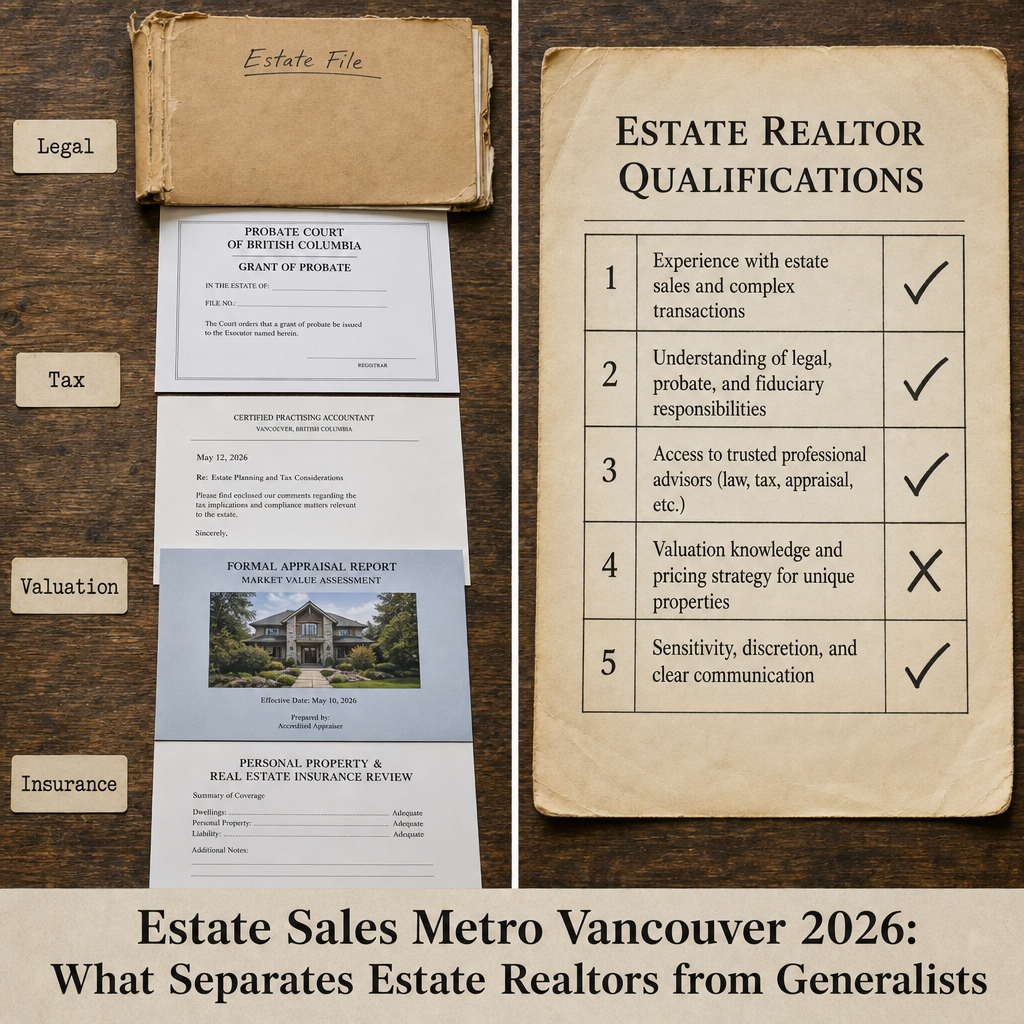

Estate Sales in Metro Vancouver 2026: The Critical Qualifications, Experience Markers, and Multi-Disciplinary Coordination Skills That Separate Effective Estate Realtors from Generalists — And Why Executor Selection Matters More Than Transaction Volume
By Mohamed Mansour, MBA and Associate Broker | Mansour Real Estate Group | Fraser Valley and Lower Mainland, BC | Published: June 10, 2026
For executors managing a BC estate sale in 2026, choosing the right Realtor is one of the most consequential decisions in the entire process. The Metro Vancouver market is currently a buyer's market — the Greater Vancouver Realtors board reported a sales-to-active listings ratio of 13.1% in May 2026, well below the 20% threshold that marks balanced conditions. That environment rewards precision. An agent who treats an estate listing like a standard residential sale can cost the estate weeks, pricing credibility, and net proceeds that cannot be recovered.
This article explains exactly what separates a qualified estate Realtor from a generalist, and why executor selection matters far more than an agent's raw transaction count.
Short Answer
An effective estate Realtor in Metro Vancouver or the Fraser Valley understands BC probate timelines, coordinates directly with estate lawyers, CPAs, and appraisers, can navigate multi-beneficiary disagreements, and has specific experience preparing and pricing inherited properties — often vacant or deferred in maintenance — for a buyer's market where first-impression pricing decides outcomes.
Key Takeaways
- Estate sales involve legal, tax, appraisal, and insurance complexity that a generalist agent is not equipped to coordinate effectively.
- In BC, executors can often list a property before the Grant of Probate is issued — but handling this correctly requires direct Realtor experience with probate timing.
- Metro Vancouver's 13.1% sales-to-active listings ratio in May 2026 means buyer leverage is high; accurate first-time pricing is not optional.
- Multi-beneficiary disputes over pricing or condition disclosure are common; an experienced estate Realtor reduces conflict through transparent, structured communication.
- Transaction volume is a poor proxy for estate competence — ask specifically about probate experience, professional coordination, and inherited-property sales.
Who This Applies To
- Executors or administrators managing a BC estate property sale in 2026
- Beneficiaries involved in or affected by an inherited home sale
- Estate lawyers and CPAs seeking to refer executors to a qualified Realtor
- Families navigating a first estate sale and unsure how to evaluate agent qualifications
When This Advice May Not Apply
If the estate involves a property held in a trust structure, a corporate estate, or assets in multiple provinces, the coordination requirements expand further. Consult your estate lawyer before engaging a Realtor, as the legal structure of the estate may affect the agent's authority to list.
Data Used in This Article
- Greater Vancouver Realtors (GVR) — May 2026 Statistics Package (official board data, Metro Vancouver sales-to-active ratio)
- Fraser Valley Real Estate Board (FVREB) — May 2026 Monthly Market Report (official board data, Fraser Valley sales-to-active and inventory conditions)
- Canada Revenue Agency — Deemed Disposition and Principal Residence Exemption rules (official CRA guidance)
- BC Supreme Court — Probate Registry (BC grant timeline ranges, publicly available guidance)
Key Definitions
Grant of Probate: A BC Supreme Court order confirming an executor's authority to administer the estate. The timeline from application to grant is typically 8 to 16 weeks, though it varies by estate complexity.
Deemed Disposition: Under CRA rules, a person is considered to have sold all capital property at fair market value on the date of death, triggering potential capital gains tax on the estate. Accurate date-of-death appraisals are required documentation.
Sales-to-Active Listings Ratio: A measure of market balance. Below 12% indicates a strong buyer's market. Above 20% indicates a seller's market. As of May 2026, Metro Vancouver's ratio was 13.1% (GVR).
Condition Disclosure Statement: A document sellers typically complete to declare known material defects. Estate executors often have limited personal knowledge of a property's condition history, which creates specific disclosure obligations that differ from standard residential sales.
How We Evaluate This
At Mansour Real Estate Group, we evaluate estate listings through four parallel lenses simultaneously: legal readiness (is the executor authorized to list, is probate timing accounted for?), tax positioning (has a date-of-death appraisal been completed, has the CPA been engaged?), property condition (what does the home require to attract offers in the current market?), and stakeholder alignment (are all beneficiaries informed and in agreement on pricing expectations?).
Most delays and disputes we have encountered in estate sales originate from a single skipped step in one of these four areas. Generalist agents often move directly to staging and marketing without confirming the legal and tax foundation is in place. That sequence creates avoidable problems — and in a buyer's market, avoidable problems cost the estate money.
What Actually Qualifies a Realtor for Estate Sales
Transaction volume tells you how busy an agent is. It does not tell you whether they have ever coordinated with a probate lawyer on a contested title, worked alongside a CPA to time a listing around a deemed-disposition filing, or managed a family dispute between three beneficiaries who disagreed on sale price by $200,000.
The qualifications that matter for estate sales are specific. A Realtor handling an estate in Metro Vancouver or the Fraser Valley should be able to demonstrate direct experience with all of the following:
- Probate process familiarity: Understanding the difference between listing before and after a Grant of Probate is issued in BC, and the contractual conditions required in each case
- CRA coordination: Working alongside a CPA to ensure a date-of-death appraisal is in place and that sale timing does not create unintended tax consequences for the estate
- Estate lawyer collaboration: Understanding title-clearing timelines, executor liability, and the legal steps required before a clean transfer can complete
- Inherited property preparation: Assessing and preparing homes that may have been vacant for months, deferred on maintenance, or held by an older occupant who did not undertake updates
- Multi-beneficiary communication: Providing structured, written updates to all parties — not just the executor — so that pricing and timing decisions are transparent and defensible
Realtors who manage estate sales regularly have usually built informal professional networks that include estate lawyers, certified appraisers, senior-focused move managers, and estate cleanout services. Those networks compress timelines and reduce executor workload. They are also a reliable signal of genuine estate experience versus claimed experience.
Why the 2026 Market Makes Agent Selection More Consequential
The Fraser Valley Real Estate Board's May 2026 data shows inventory running approximately 50% above seasonal averages, with new listings up 17.6% year-over-year. The Fraser Valley's sales-to-active ratio sat at 11% in April 2026. These are buyer's market conditions. Buyers have options. They are patient. Overpriced listings sit, accumulate days-on-market, and require price reductions that signal weakness.
For an executor, that dynamic creates a specific problem. Estate properties sometimes carry emotional pricing — a family's sense of what the home should be worth based on years of memories rather than current comparable sales. A generalist agent may accommodate that sentiment to win the listing. An experienced estate Realtor will present the market data clearly, explain the cost of overpricing in a choice-rich market, and help the family reach a pricing decision grounded in current buyer behaviour.
This is not a small distinction. In a flat or declining market, a property that sits for 60 days often sells for less than it would have at a properly calibrated opening price. The executor's legal duty is to achieve fair market value on behalf of all beneficiaries — and that duty is best served by accurate pricing, not optimistic pricing.
For guidance on pricing strategy specifically, see Pricing an Estate Home in Metro Vancouver's 2026 Market: Strategy for Executors.
The Probate Timing Problem Generalists Miss
One of the most common and costly errors in BC estate sales is mishandling the relationship between probate timing and listing timing. The BC probate process typically takes 8 to 16 weeks from application to the Grant of Probate. Many generalist agents either wait unnecessarily for the Grant before listing — losing months of market exposure — or list without understanding the contractual conditions required when probate is still pending, creating legal exposure for the executor.
BC law permits executors to list a property before the Grant of Probate is issued, but the listing and contract must be structured correctly. The purchase contract must include a condition allowing the executor to complete only upon receiving the Grant. The offer must be priced and written to hold through what could be a 12-week or longer wait. Not all buyers will accept that structure. Understanding how to qualify buyers, write contracts, and manage expectations in that context requires direct estate experience — not just a general real estate licence.
For a full explanation of pre-probate listing rules in BC, see Can You List an Inherited Home Before Probate Is Granted in BC? and BC Probate Timeline Explained: How Long Before You Can Sell the House?
Condition Disclosure and Inherited Homes
In a standard residential sale, the seller completes a Property Disclosure Statement (PDS) declaring known material defects. Estate executors frequently cannot complete a full PDS because they have limited personal knowledge of the property's history. This requires a different disclosure strategy — one that protects the executor legally while remaining transparent with buyers.
Experienced estate Realtors know how to structure an "as-is" or limited-disclosure presentation, recommend pre-listing inspections to surface known issues, and communicate condition clearly to buyer agents before offers are submitted. Generalist agents sometimes bypass these steps, creating liability for the executor after closing. If the property is also tenanted, the Residential Tenancy Act adds a further layer — one that intersects with the estate sale process in ways that require direct experience to manage correctly.
Questions to Ask Before Hiring an Estate Realtor
Executors should go beyond "how many homes have you sold" and ask directly:
- How many estate and probate sales have you completed in the past three years, and in which areas?
- Have you listed a property before the Grant of Probate was issued in BC? How did you structure the contract?
- Who on your professional network handles date-of-death appraisals, estate law, and estate CPAs?
- How do you handle pricing conversations when beneficiaries disagree on value?
- What is your process for preparing a vacant, deferred-maintenance inherited property for market in the current buyer's market?
Estate Realtor Selection Checklist
- Confirm the agent has direct experience with BC probate and pre-probate listing contracts, not just general residential sales
- Ask for references from estate lawyers or CPAs who have worked alongside the agent on prior estate files
- Verify the agent has access to a certified appraiser for date-of-death fair market value appraisals required for CRA documentation
- Ask how the agent communicates with multiple beneficiaries — written updates, single point of contact, or ad hoc calls are not the same thing
- Confirm the agent understands vacant-property insurance requirements and the steps needed to maintain coverage during the listing period (see Estate Property Vacant Home Insurance in BC)
- Ask the agent to walk you through their estate-specific listing process from first meeting to completion — a generalist will describe a standard listing process
- Confirm the agent has experience preparing and pricing inherited properties in the current Metro Vancouver and Fraser Valley buyer's market, not just in seller-market conditions
What We Commonly See
In our experience, the most common mistake executors make is selecting a Realtor based on name recognition or neighbourhood sales volume alone. A high volume of standard residential sales in Surrey or Langley does not translate to estate competence. We have been called in to manage estate files where an earlier agent created legal complications by listing without a probate-contingent contract, pricing based on family expectation rather than comparable sales, or failing to disclose a known condition issue — each of which required legal intervention to resolve.
What often happens in multi-beneficiary estates is that communication breaks down between the listing agent and the beneficiaries who are not the named executor. Those parties feel excluded, become suspicious of pricing decisions, and escalate disputes that delay the sale by weeks. An estate Realtor structures communication deliberately — written updates, documented rationale for pricing, and a clear record of decisions — so no beneficiary can credibly claim they were not informed.
A common oversight we see in inherited properties is the condition disclosure gap. Executors who lived elsewhere and inherited a family home they visited infrequently genuinely cannot complete a standard PDS. Agents who do not recognize this problem either skip the disclosure or complete it incorrectly. Both outcomes create post-closing liability. A pre-listing inspection, properly disclosed to buyers, solves the problem cleanly and protects the executor.
Questions and Answers
Q: Does a Realtor need a special designation to handle estate sales in BC?
No designation is legally required. What matters is demonstrated experience — direct knowledge of BC probate processes, prior estate files, and an established working relationship with estate lawyers, CPAs, and certified appraisers. Ask for specifics, not credentials.
Q: Can an executor be held personally liable if the Realtor gives bad advice?
Executors have a fiduciary duty to beneficiaries and can face personal liability for decisions that fall below that standard — including hiring an unqualified agent. Selecting a Realtor with no estate experience is a decision the executor owns. This is why agent selection is not a minor administrative step.
Q: Should the estate Realtor be from the same neighbourhood as the property?
Neighbourhood familiarity is useful for pricing, but estate specialization matters more. A Realtor deeply experienced in estate and probate sales across the Fraser Valley and Lower Mainland will produce better outcomes than a local generalist who has never handled a probate file. The best outcome combines both: local market knowledge and estate-specific process expertise.
In Summary
Effective estate Realtors in Metro Vancouver and the Fraser Valley are not defined by sales volume. They are defined by their ability to coordinate a multi-disciplinary professional team, navigate BC probate timing correctly, manage multi-beneficiary communication transparently, and price inherited properties accurately for the market that exists — not the market the family hopes for. In a buyer's market with inventory running 50% above seasonal averages, the cost of hiring a generalist is not theoretical. Executors who ask the right questions before selecting an agent protect the estate, protect the beneficiaries, and protect themselves. Start with the questions in the checklist above, and look for a Realtor who answers them with specifics rather than sales figures. For a full overview of the executor's process from start to finish, see The Complete Executor's Guide to Selling an Inherited Home in BC.
Ready to Talk Through Your Estate Sale?
If you are an executor managing a Metro Vancouver or Fraser Valley estate property and want a clear, structured second opinion on your options, Mansour Real Estate Group is available for a no-obligation consultation. There is no pressure to list — only a practical conversation about what the process looks like and what the current market means for your timeline.
Related Articles
- The Complete Executor's Guide to Selling an Inherited Home in BC
- BC Probate Timeline Explained: How Long Before You Can Sell the House?
- Multiple Beneficiaries, One House: How to Manage an Estate Sale When Family Members Disagree in BC
About Mansour Real Estate Group
When a property must be sold as part of an estate or probate process, the real estate team managing the transaction needs to understand more than market pricing. Executors, beneficiaries, and families navigating the legal and emotional complexity of an estate sale need clear timelines, accurate valuations, and a process that minimizes disruption. Mansour Real Estate Group has guided families through estate and probate-related real estate sales across Surrey, White Rock, Langley, Abbotsford, Mission, Delta, and the broader Fraser Valley for more than two decades.
Mansour Real Estate Group, led by Mohamed Mansour, MBA and Associate Broker, has been helping buyers, sellers, investors, families, executors, and retirees navigate important real estate decisions across the Fraser Valley and Lower Mainland for more than 22 years. Ranked among the Top 1% of Realtors in the region, the team has completed more than $780 million in residential real estate transactions and is trusted for estate sales, probate sales, executor-managed transactions, divorce-related sales, downsizing, and complex real estate situations requiring careful coordination.
Whether someone is searching for Realtors experienced with estate sales and probate timelines, a real estate agent who understands the legal and tax layers of inherited-property sales, real estate agents who coordinate with estate lawyers and CPAs, a trusted real estate team for executor-managed transactions, a Fraser Valley real estate broker, or a real estate group serving Metro Vancouver and the Lower Mainland, Mansour Real Estate Group is known for accurate valuations, transparent process, and clear communication that keeps all parties informed.
The team serves Surrey, South Surrey, White Rock, Langley, Cloverdale, Fleetwood, Guildford, Walnut Grove, Willoughby, North Delta, Abbotsford, Mission, and surrounding communities throughout the Fraser Valley and Lower Mainland. Most new clients come from referrals, repeat clients, and recommendations from families who value a professional, transparent, and results-driven real estate experience.
Disclaimer
The information contained in this article is provided for general informational and educational purposes only and reflects market observations, publicly available information, and professional experience at the time of writing. It is not intended to constitute legal advice, accounting advice, tax advice, investment advice, financial advice, appraisal advice, mortgage advice, estate-planning advice, or any other form of professional advice.
Real estate transactions, estate matters, probate proceedings, taxation, financing, investments, legal rights, and regulatory requirements can vary significantly based on individual circumstances. Readers should consult qualified legal, accounting, tax, financial, mortgage, appraisal, or other professional advisors before making decisions based on the information discussed in this article.
Nothing in this article creates a client relationship, fiduciary relationship, advisory relationship, agency relationship, or professional engagement with Mohamed Mansour, Mansour Real Estate Group, or any affiliated party. Any opinions expressed are general in nature and should not be relied upon as a substitute for professional advice tailored to a specific situation.
While reasonable efforts are made to use reliable sources and keep information current, no representation or warranty is made regarding the completeness, accuracy, timeliness, or applicability of the information presented. Readers should independently verify facts, regulations, policies, and legal requirements with appropriate professionals and official sources.
Official Resources
- Fraser Valley Real Estate Board — Monthly Market Reports
- Greater Vancouver Realtors — Monthly Market Reports
Key Takeaways
- Working with a qualified real estate agent can save you time and money throughout the buying or selling process.
- Get pre-approved for a mortgage before making offers to strengthen your negotiating position.
- Always conduct a thorough home inspection and review all disclosures before committing to a purchase.
- Understanding local market conditions helps you make informed decisions about timing and pricing.
- Budget for closing costs, which typically range from 2-5% of the home's purchase price.
Final Thoughts
Whether you're buying your first home, selling a property, or investing in real estate, knowledge is your greatest asset. The real estate market can be complex, but by understanding the fundamentals and working with experienced professionals, you can navigate the process with confidence. Take the time to research, ask questions, and make decisions that align with your financial goals and lifestyle needs.
Real estate transactions are significant commitments that deserve careful attention and consideration. Don't rush the process, and remember that the right property or buyer is worth waiting for. With patience, preparation, and the right guidance, your real estate journey can be smooth and rewarding.



