
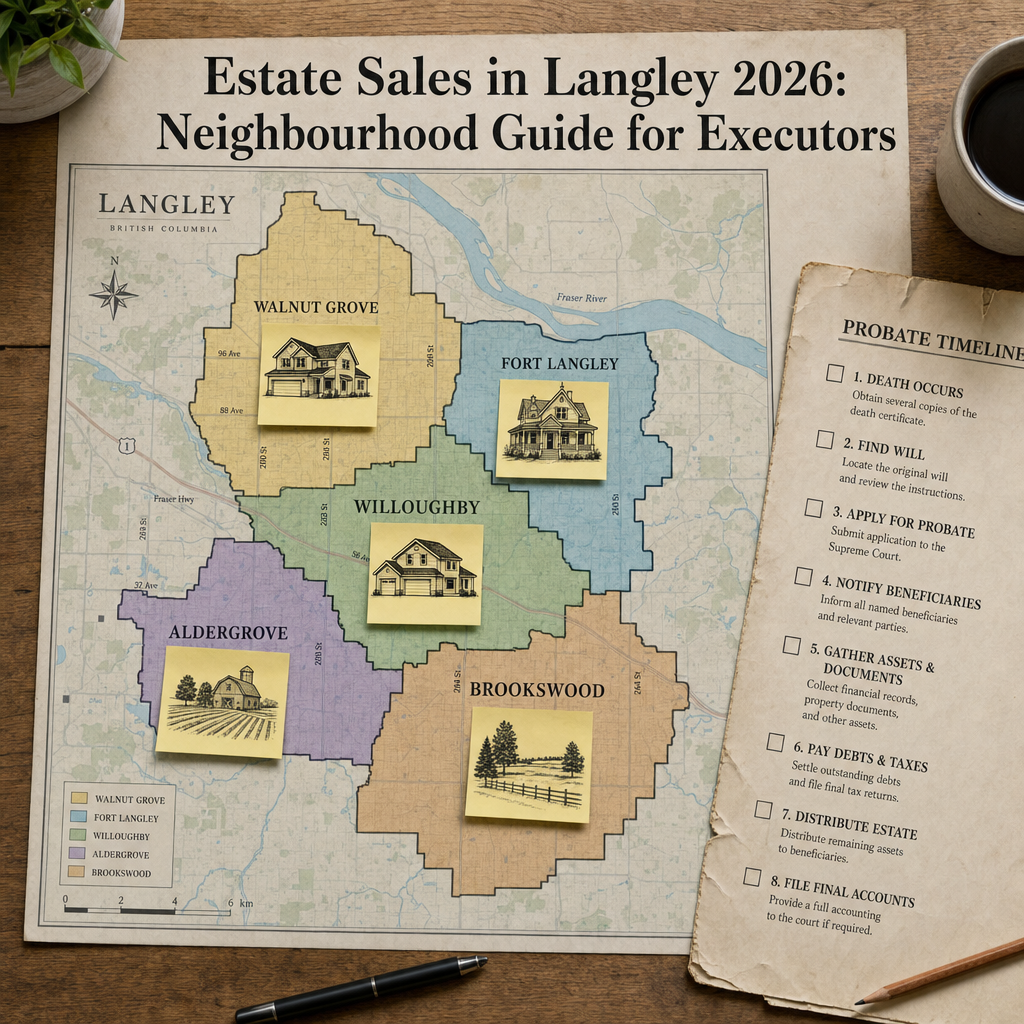

Estate Sales in Langley 2026: Neighbourhood-Specific Market Conditions by District, Probate Timeline Strategy, and How to Position Inherited Detached Homes, Rural Estates, and Farm Properties for Maximum Proceeds
By Mohamed Mansour, MBA and Associate Broker — Mansour Real Estate Group | Fraser Valley & Lower Mainland | Published: May 13, 2025
Selling an inherited property in Langley in 2026 is a different challenge than it was two or three years ago. Buyers have options. Inventory is high. And Langley's five distinct neighbourhood markets — Willoughby, Walnut Grove, Fort Langley, Brookswood, and Aldergrove — behave differently from one another, especially for older detached homes, acreage estates, and farm properties.
This guide is written for executors and families managing a Langley estate sale. It covers neighbourhood-level pricing dynamics, property-type positioning, probate timeline strategy, and the specific buyer challenges that affect rural properties and inherited farm estates in the current market.
Short Answer
In April 2026, the Fraser Valley recorded an 11% sales-to-active listings ratio with nearly 9,800 active listings — 45% above the 10-year seasonal average, according to the Fraser Valley Real Estate Board. Langley executors selling in this environment need neighbourhood-specific pricing, realistic timelines, and a strategy matched to their property type. Generic valley-wide benchmarks will not produce accurate results for a Fort Langley heritage home, a Willoughby detached, or an Aldergrove acreage estate.
Key Takeaways
- Langley is a buyer's market in 2026 — executors who price to the neighbourhood, not the valley, sell faster.
- Each Langley district has distinct buyer demographics, price-per-square-foot ranges, and days-on-market patterns.
- Farm and rural estate sales face unique financing hurdles that narrow the buyer pool and extend timelines.
- Executors can list before probate is granted in BC — this strategy can capture spring buyer activity before summer inventory pressure builds.
- Older detached homes in Langley sell best when positioned honestly for condition, not speculatively for potential.
Who This Applies To
- Executors managing a Langley estate sale in 2026
- Beneficiaries with a financial interest in a Langley inherited property
- Families dealing with an older detached home, farm, or acreage estate in Langley
- Estate lawyers, CPAs, and other professionals advising executors on property disposition
When This Advice May Not Apply
This article addresses typical estate sales of inherited residential and rural properties in Langley. It does not cover active agricultural operations, properties with unresolved title issues, or court-ordered sales. Consult your estate lawyer before listing if the estate is subject to a dispute. See When Beneficiaries Go to Court: Disputed Estate Property Sales in BC if a disagreement exists among beneficiaries.
Data Used in This Article
- Fraser Valley Real Estate Board Statistical Package, April 2026 — official, FVREB coverage area, sales and inventory data
- Fraser Valley Real Estate Board Statistical Package, March 2026 — official, FVREB coverage area, trend comparison
- CMHC Housing Market Outlook, 2026–2027 — federal, national and regional forecast, resale and new construction outlook
- BC Wills, Estates and Succession Act — provincial legislation governing probate timelines and executor authority
Definitions
Sales-to-Active Listings Ratio: The percentage of active listings that sold in a given month. A ratio below 12% indicates a buyer's market. In April 2026, the Fraser Valley recorded 11%, according to the FVREB.
Probate Grant: The court order confirming the executor's legal authority to administer and sell estate property. In BC, this is issued by the BC Supreme Court under the Wills, Estates and Succession Act (WESA).
Date-of-Death Fair Market Value: The property's estimated market value on the date the owner died. Required for capital gains calculation under CRA rules. See Date-of-Death Fair Market Value Appraisals for BC Estate Properties for a full explanation.
Langley's Neighbourhood Markets in 2026: Why District Matters for Estate Sales
Langley is not one market. Within the Township and City of Langley, five distinct districts produce meaningfully different results for estate properties — and the differences matter more in a buyer's market, when buyers have the luxury of choosing.
Willoughby is the most active suburban district, with a relatively younger housing stock and buyers who typically prioritize school catchments, highway access, and move-in condition. Inherited homes here tend to be newer than in other Langley districts, but even a 15-year-old home in Willoughby can feel dated against freshly renovated competing listings. Executors selling in Willoughby benefit from the area's established buyer demand but must price honestly against current condition — not against what the street sold for in 2022.
Fort Langley attracts buyers specifically seeking heritage character and village proximity. Older homes here carry a premium when maintained, but the buyer pool is narrower and more selective. An estate home in Fort Langley that has been vacant for several months — with deferred maintenance and dated interiors — will not attract the same buyer interest as a recently updated comparable. Accurate positioning relative to condition is critical. Refer to Should You Renovate or Sell As-Is? before committing to any improvements in this district.
Walnut Grove includes both suburban subdivisions and acreage pockets on its eastern edge. Suburban Walnut Grove performs similarly to Willoughby for standard detached homes. Acreage properties in outer Walnut Grove follow rural pricing mechanics — lot size, usability, zoning, and servicing all affect value more than interior finishes. Buyers for these properties often include investors and land-bankers alongside owner-occupants, which changes negotiating dynamics.
Brookswood is a lower-density area with a mix of older established homes and properties on larger lots with development potential. Estate homes here are often on 8,000 to 12,000 sq ft lots. The development potential story was stronger in 2021–2022 than it is today in a buyer's market. Executors should not assume that lot size alone creates a price premium — the buyer must be able to finance and act on that potential, and fewer buyers are doing so in the current environment.
Aldergrove carries Langley's highest concentration of rural and farm properties. Inherited estates here often include acreage, outbuildings, older farmhouses, and in some cases active or formerly active agricultural designations. These properties require a fundamentally different sale process than a suburban detached home. Buyer financing is more complex, appraisals take longer, and the buyer pool shifts toward investors, farmers, or buyers with specific rural lifestyle goals. Executors managing an Aldergrove estate should read Selling an Inherited Acreage or Rural Property in the Fraser Valley before setting a timeline.
Farm Properties and Rural Estates: What Executors Need to Understand Before Listing
Farm and rural estate sales in Langley involve complications that standard detached sales do not. Executors who are not aware of these before listing often find themselves managing extended timelines, failed subject removals, and buyer financing problems that could have been anticipated.
Rural appraisals take longer and produce wider value ranges. Comparable sales for acreage and farm properties are sparse. Appraisers working on rural Langley properties often need to draw from a wider geographic area and apply manual adjustments for lot size, zoning, water source, septic system condition, and outbuildings. This means date-of-death appraisals take longer to complete and sale appraisals during the offer process can create financing conditions that delay or prevent completion.
Septic and well systems are deal-dependent. A private septic system that has not been inspected in several years — which is common in estates where the owner was elderly or had deferred maintenance — creates genuine uncertainty for buyers. Lenders may require septic inspection and approval before advancing mortgage funds. Executors who arrange a septic inspection before listing remove this uncertainty from the buyer's process, which strengthens subject removal and reduces the risk of a failed sale.
Agricultural Land Reserve designations affect buyer options. Properties within the ALR have restricted non-farm use options. This affects the buyer pool — owner-occupant buyers considering a farm property for lifestyle purposes need to understand what they can and cannot do with the land. Executors should confirm ALR status through the Agricultural Land Commission and disclose it clearly. This is not a disadvantage — it simply shapes who the right buyer is and how to find them.
Buyer targeting matters more for rural estate sales. A farm property in Aldergrove will typically attract a mix of agricultural operators, rural lifestyle buyers, and investors watching for land assembly or future rezoning potential. Each of these buyer types values the property differently and has different financing, conditions, and timeline requirements. Marketing a rural estate sale requires different channels and different language than a suburban MLS listing. The executor's realtor should have direct experience with rural Langley transactions — not just residential detached sales.
Probate Timeline Strategy for Langley Executors in 2026
BC probate timelines typically span 8 to 16 weeks from the date of filing to the issuance of a probate grant, depending on estate complexity, court scheduling, and how completely the application is prepared. This timeline matters because it directly affects when an executor has the legal authority to accept an offer and complete a sale.
The important strategic point is that listing before probate is granted is permitted in BC. An executor can hire a realtor, list the property, and accept offers — conditional on the probate grant being issued before completion. This approach allows the estate to capture buyer activity during the spring market window rather than waiting until a probate grant is in hand and potentially entering the market in late summer when inventory competition is higher and buyer activity is lower. Read Can You List an Inherited Home Before Probate Is Granted in BC? for the full legal and practical breakdown.
In a buyer's market, timing matters more than it does in a balanced or seller's market. When the April 2026 FVREB data shows 9,816 active listings at 45% above the 10-year seasonal average, waiting an extra two or three months for a probate grant before listing means entering a market with even more competing inventory and a more negotiating-advantaged buyer pool. Executors who act strategically — filing for probate immediately after death, engaging a realtor in parallel, and preparing the property while the application processes — compress the overall timeline and protect the estate's position.
For Langley rural and farm properties specifically, timing is even more sensitive. Acreage and farm estates in Aldergrove and outer Walnut Grove can take 45 to 75 days to sell in a normal market — longer in the current buyer's market. If probate filing is delayed by two months and the listing launch is further delayed by another month for preparation, the estate may not complete a sale until fall or winter, when buyer activity for rural properties is at its lowest point of the year. See BC Probate Timeline Explained for the step-by-step provincial process.
Positioning Older Inherited Detached Homes in Langley's Current Market
Many inherited Langley homes are 30 to 50 years old, occupied by the same family for decades, and reflect the preferences and maintenance patterns of an aging owner. These homes often have strong bones but dated kitchens, older bathrooms, original carpeting, and a presentation that does not compete well with renovated listings in the same neighbourhood.
In a seller's market, these homes still attracted motivated buyers who were willing to accept condition in exchange for affordability. In a buyer's market, buyers have enough choice that they will simply move to the next listing unless the price reflects the work required. This is a hard but necessary reality for executors to accept early — overpricing an estate home in Langley's 2026 market does not produce a higher sale price. It produces a longer time on market, price reductions, and a weaker negotiating position.
The most effective approach for older inherited detached homes in Langley is to price based on neighbourhood comparables with honest condition adjustments, prepare the home to a clean and neutral standard without over-investing in cosmetic renovations, and market it clearly to buyers looking for a project property, a renovation opportunity, or a long-term hold. The executor's job is not to maximize the cosmetic appeal of the home — it is to maximize the net proceeds to the estate, which in a buyer's market means being accurate, not optimistic. See How to Sell a Deceased Parent's Home in the Fraser Valley for the complete preparation and sale roadmap.
One area where limited investment pays off consistently: clearing and basic cleaning. An estate home that has been cleaned out, defects disclosed, and presented as a blank canvas for a new owner sells meaningfully faster than one that still contains decades of belongings and deferred maintenance concerns that buyers have to speculate about. Budget staging, basic landscaping, and a professional clean-out typically cost less than $5,000 and affect buyer perception significantly. See Clearing and Preparing an Estate Home for Sale for a practical checklist.
How We Evaluate This
When Mansour Real Estate Group is engaged for a Langley estate sale, the evaluation process starts with neighbourhood-specific comparable analysis — not a valley-wide benchmark. We identify active listings and recent sales within the same district, the same property type, and as close to the same condition profile as possible. For rural properties, this analysis draws from a wider radius and uses manual adjustments for lot characteristics, zoning, and servicing.
We also evaluate the estate's timeline constraints. If probate has not yet been filed, we advise immediate action and work with the executor to prepare the property in parallel. If the property requires clean-out or minor preparation, we coordinate that process to minimize delays. The goal is a listing that is well-positioned, honestly priced, and ready to attract the right buyer for that specific property in that specific Langley neighbourhood — not a listing that sits on the market and loses negotiating power every additional week it remains unsold.
Estate Sale Checklist for Langley Executors
- Confirm probate application is filed with BC Supreme Court immediately after death is confirmed
- Obtain vacant home insurance for the estate property within the first week of vacancy
- Commission a date-of-death fair market value appraisal for CRA capital gains purposes
- Engage a Langley-experienced estate realtor before probate is granted to prepare and begin pre-listing process
- For rural and farm properties, arrange septic inspection, confirm ALR status, and gather well records before listing
- Clear personal property, complete basic cleaning, and arrange budget staging or neutral presentation
- Request neighbourhood-specific comparable analysis — not a valley-wide benchmark — before setting list price
- Confirm all beneficiaries are aligned on pricing strategy and timeline before listing goes live
What We Commonly See
Executors overestimate the value of an older Langley detached home by anchoring to 2021–2022 sale prices. In our experience, the most common pricing mistake in Langley estate sales is using the last sale the deceased's neighbour achieved two to three years ago as the reference point. That market no longer exists. Current buyer expectations and current competition must drive the analysis.
Rural estate timelines are consistently underestimated. What often happens is that an executor anticipates a 30-day sale process for an Aldergrove farm property, based on their experience with suburban homes, and is unprepared for the 60 to 90 days that rural acreage sales typically require in a buyer's market. The estate incurs carrying costs — property taxes, insurance, utilities — for every additional month the property sits. Accurate timeline forecasting at the outset prevents both financial strain and beneficiary frustration.
Delaying the probate filing while waiting for "the right time to sell" costs the estate money. A common mistake is treating the probate filing and the sale decision as sequential steps. They are not. The probate application can and should be filed immediately. The sale decision can proceed in parallel. Waiting to file until the executor is "ready to sell" adds months to the overall timeline and often pushes the listing into a lower-activity market window.
Questions Executors Ask About Langley Estate Sales
Can I sell a Langley farm property as part of an estate if it is in the Agricultural Land Reserve?
Yes. ALR designation affects land use, not the ability to sell. The property can be listed and sold as a normal real estate transaction. The ALR status is disclosed to buyers, who must understand the use restrictions before completing. It narrows the buyer pool but does not prevent the sale.
How long does a typical Langley estate home take to sell in 2026's buyer's market?
Suburban detached homes in Willoughby and Walnut Grove that are well-priced typically sell within 3 to 6 weeks. Fort Langley heritage homes and Brookswood properties on larger lots may take 6 to 10 weeks. Aldergrove rural and farm properties in the current environment can take 8 to 14 weeks. These estimates assume accurate pricing and proper preparation.
Should the estate pay for renovations before listing in Langley?
In most cases, no. In a buyer's market, cosmetic renovations rarely return their full cost in a higher sale price. The more effective approach is thorough cleaning, clearing, and honest pricing that reflects the property's current condition. Consult Should You Renovate or Sell As-Is? before spending estate funds on improvements.
In Summary
Langley estate sales in 2026 require neighbourhood-specific pricing, property-type awareness, and a probate timeline strategy that does not wait for the grant before starting preparation. Willoughby, Fort Langley, Walnut Grove, Brookswood, and Aldergrove each have distinct buyer pools and distinct pricing mechanics. Rural and farm estate properties face longer timelines and buyer financing complexity that executors must plan for. In a market with 11% sales-to-active ratio and inventory running 45% above seasonal averages, accurate positioning from the first day of listing is not optional — it is the executor's primary tool for protecting the estate's proceeds.
Talk to a Langley Estate Sale Specialist
If you are an executor managing an inherited property in Langley — whether a suburban detached home, an acreage estate, or a farm property — Mansour Real Estate Group can provide a neighbourhood-specific valuation and a clear sale strategy matched to your property type and timeline. There is no pressure and no obligation.
Related Articles
- The Complete Executor's Guide to Selling an Inherited Home in BC
- How to Sell a Deceased Parent's Home in the Fraser Valley: An Executor's Roadmap
- Selling an Inherited Acreage or Rural Property in the Fraser Valley: An Executor's Guide
- Best Realtor for Estate Sales in Surrey BC: What to Look for and Who to Call
- Best Realtor for Probate and Estate Sales in Abbotsford and Mission BC
About Mansour Real Estate Group
When a property must be sold as part of an estate in Langley — whether an older detached home in Willoughby, a heritage property in Fort Langley, or an acreage estate in Aldergrove — the real estate team managing the transaction needs to understand neighbourhood-level pricing, rural property complexity, and how to coordinate with the probate process without losing momentum. Mansour Real Estate Group has guided executors and families through estate and probate-related sales across Langley, Surrey, White Rock, Abbotsford, Mission, Delta, and the broader Fraser Valley for more than two decades.
Key Takeaways
- Understanding current market trends helps you make informed decisions about timing and pricing.
- Working with a knowledgeable local agent provides invaluable insight into neighbourhood dynamics.
- Pre-approval and financial preparation are essential steps before entering the market.
- Location, condition, and market position remain the cornerstones of real estate value.
Next Steps
Ready to explore your real estate options? Connect with a local BC real estate professional to discuss your goals, review current listings, and develop a strategy tailored to your situation.
Disclaimer: This article is for informational purposes only and does not constitute legal, financial, or real estate advice. Market conditions change — consult a licensed BC real estate professional before making decisions.



