
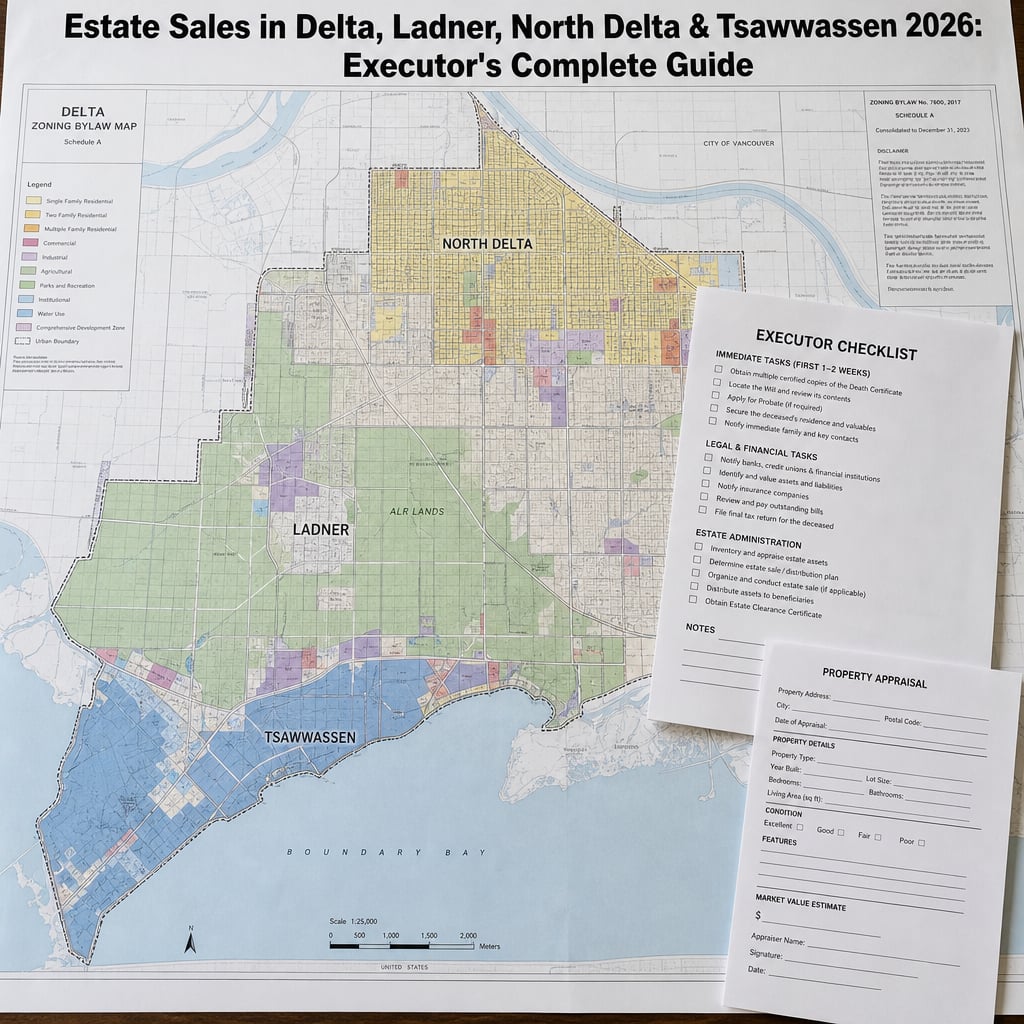

Estate Sales in Delta, Ladner, North Delta, and Tsawwassen 2026: Executor's Complete Guide to Agricultural Land Reserve Restrictions, Waterfront Valuation, Duplex Financing Obstacles, and Strategic Listing Across Metro Vancouver's Most Complex Probate Market
By Mohamed Mansour, MBA and Associate Broker | Mansour Real Estate Group | Published: July 28, 2026 | Geography: Delta, Ladner, North Delta, Tsawwassen, Lower Mainland, BC
Delta is one of the most structurally complex probate markets in Metro Vancouver. Executors selling estate property in Ladner, Tsawwassen, or North Delta regularly encounter valuation and legal complications that have no parallel in Surrey, Langley, or Abbotsford—including Agricultural Land Reserve restrictions that shrink the qualified buyer pool, waterfront appraisal methodology that diverges from inland comparables, and a duplex-heavy housing stock in North Delta that creates financing obstacles most lenders are not set up to resolve quickly.
This guide is written specifically for executors and estate administrators managing property in Delta's three distinct communities. It explains how each community reshapes fair market valuation, what listing decisions protect net proceeds, and where the fiduciary risks are highest when these local factors are misunderstood.
Short Answer
Selling an estate property in Delta requires a different approach depending on whether the property is ALR-designated in Ladner or Tsawwassen, waterfront along the Fraser River or Boundary Bay, or a duplex in North Delta. Each situation creates distinct valuation, buyer pool, and financing complications that directly affect the executor's fiduciary duty to maximize estate proceeds. A flat comparable-sales approach will almost always underprice or misprice these properties.
Who This Applies To
- Executors and estate administrators appointed under a will or Letters Probate managing Delta property
- Families where the deceased owned Ladner or Tsawwassen property with ALR designation
- Beneficiaries of estates that include waterfront property along the Fraser River or Boundary Bay
- Executors managing North Delta duplexes or multi-unit conversions with tenants in place
- Families seeking fair market valuation for CRA purposes on Delta estate property
When This Advice May Not Apply
If the estate property is a standard detached home in North Delta with no tenants, no ALR designation, and no waterfront exposure, the general probate sales process described in other resources will largely apply. This guide focuses on the three specific complications that make Delta estate sales structurally different.
Key Takeaways
- Over 50% of Delta's land is ALR-designated, directly limiting the buyer pool for Ladner and Tsawwassen estate properties and suppressing offers from non-farm buyers.
- Waterfront properties in Ladner and Tsawwassen command 15–25% premiums over inland Delta, but sparse comparables mean appraisals frequently undervalue these properties for CRA and probate purposes.
- North Delta duplexes create non-arm's length financing obstacles during estate sales that delay subject removal and can force price concessions if not addressed before listing.
- Delta's three communities show 20–30% price divergence by property type and location, making neighbourhood-specific comparable selection essential for executors defending valuations.
- Listing timing in Delta's probate market should account for ALR application windows, seasonal waterfront buyer activity, and duplex tenant notice periods under the Residential Tenancy Act.
Data Used in This Article
- Fraser Valley Real Estate Board — July 2026 market statistics package (official, third-party)
- BC Assessment — probate and fair market valuation methodology for ALR and waterfront properties (official)
- BC Agricultural Land Commission — ALR Zone 1 and Zone 2 designation and non-farm use application guidance (official)
- Residential Tenancy Branch (BC) — tenant rights and notice obligations for estate-held rental properties (official)
- Mansour Real Estate Group — professional interpretation of local market observations across Delta, Ladner, North Delta, and Tsawwassen
Why Delta's Probate Market Is Structurally Different
Most probate markets in the Lower Mainland involve a detached home, a clear title, and a standard buyer pool. Delta is different because its three communities—Ladner, Tsawwassen, and North Delta—each carry a distinct structural complication that affects how properties are valued, how offers are structured, and how quickly transactions can close.
According to the BC Agricultural Land Commission, over 50% of Delta's total land base is ALR-designated. That is not a minor overlay—it shapes the entire land economics of Ladner and Tsawwassen, restricts subdivision, limits non-farm construction, and eliminates a large portion of the potential buyer population. An executor who lists an ALR-designated property without understanding what buyers can and cannot do with it will consistently attract underprepared offers, extended subject periods, and conditional deals that collapse at the financing stage.
North Delta operates differently. Its housing stock includes a significant proportion of older duplexes, legal suites, and multi-unit conversions that were common during Delta's residential build-out in the 1970s and 1980s. These properties are not always straightforward to finance during a probate sale, particularly when tenants are in place, strata status is ambiguous, or the property has been informally converted without permits. Executors managing North Delta estates regularly face buyer financing conditions that take longer than anticipated and tenant situations that require careful handling under the Residential Tenancy Act.
ALR Designation in Ladner and Tsawwassen: What Executors Must Understand Before Listing
ALR-designated properties in Ladner and Tsawwassen are not unsellable—but they sell to a narrower buyer pool, and valuation must reflect that reality accurately. The BC Agricultural Land Commission distinguishes between Zone 1 and Zone 2 ALR designations, with Zone 1 properties subject to stricter non-farm use restrictions. Most ALR land in Delta's Ladner and Tsawwassen areas falls under Zone 1, which limits residential construction to one principal residence per parcel and restricts subdivision without ALC approval.
For executors, the practical consequence is this: the comparable sales used to support a fair market valuation for CRA or probate purposes must come from ALR-designated properties with similar restrictions—not from nearby non-ALR residential sales that may reflect significantly different development potential. Using the wrong comparables is one of the most common executor errors in Delta estate sales, and it creates fiduciary risk if beneficiaries later question whether the property was underpriced.
Listing timing also matters for ALR properties. Buyers who intend to operate a farm, pursue an agri-tourism use, or apply for a non-farm use exemption need time to conduct feasibility work before removing subjects. Probate listings that do not allow for adequate buyer due diligence on ALR restrictions tend to attract only one type of buyer: investors seeking a discount precisely because other buyers have walked away. A more deliberate timeline—marketed to farm operators, ALR-aware buyers, and adjacent landowners before general public listing—often produces meaningfully better outcomes for the estate. If beneficiaries disagree about the right approach to this kind of strategic timing, the executor's authority and obligations under BC's Wills, Estates and Succession Act (WESA) become directly relevant. The article Executor's Fiduciary Duty When Beneficiaries Disagree on Selling an Inherited Property in BC covers the legal framework in detail.
Waterfront Valuation Along the Fraser River and Boundary Bay
Waterfront properties in Ladner along the Fraser River and in Tsawwassen along Boundary Bay consistently command premiums over inland Delta homes. Based on general market observations and property-level analysis, the premium range is approximately 15–25% depending on frontage, view exposure, lot depth, and flood designation under BC's floodplain mapping. These premiums are real but difficult to appraise accurately because comparable waterfront sales in Delta occur infrequently—sometimes fewer than a handful per year for specific frontage types.
When appraisers rely on time-adjusted inland comparables and apply a percentage adjustment for waterfront exposure, they frequently underestimate value because the adjustment methodology does not fully capture what waterfront buyers are actually paying. For CRA purposes, this creates a specific risk for executors: if the date-of-death valuation submitted for tax purposes understates fair market value and CRA conducts a later audit using actual sale proceeds or a revised appraisal, the estate may face an assessed deficiency.
In our experience working with Delta waterfront estate properties, securing an appraisal from a certified appraiser with documented experience in Fraser River and Boundary Bay waterfront—not just general Delta residential appraisals—is worth the additional effort. The difference in appraisal conclusions can be material, and an under-supported valuation submitted to CRA is harder to defend than a well-documented one prepared by a waterfront-experienced appraiser from the start.
North Delta Duplexes: Financing Obstacles and Tenant Complications During Probate
North Delta's housing stock includes a higher proportion of duplexes and informally converted multi-unit properties than most comparable Metro Vancouver communities. During a probate sale, this creates two distinct complications. First, buyer financing for duplexes—particularly older duplexes being sold through an estate—can be more difficult to arrange than for detached homes. Lenders assess rental income, unit condition, permit history, and tenancy status differently depending on whether the purchase is investment-driven or owner-occupied, and many buyers are surprised to find that standard high-ratio mortgage products are not available for the property type they are purchasing.
Second, if tenants occupy one or both units at the time of death, the estate cannot simply terminate those tenancies to make the property easier to sell. Under the Residential Tenancy Act, tenants in estate-held properties have full protection, and the executor's obligation to act in the estate's interest does not override a tenant's legal right to remain. For two-month notices to vacate for a purchaser's personal use—the most common tool used in non-probate duplex sales—the executor must ensure the purchasing party is a genuine individual occupant, not a numbered company or investor, and must meet all RTB notice requirements precisely. Errors in this process can void the notice and extend the timeline by months.
The practical implication is that executors managing North Delta duplex estates should factor these timelines into the listing strategy from the start. Attempting to list a tenanted duplex and discover financing limitations mid-transaction is a common mistake that results in collapsed deals, re-listing costs, and beneficiary frustration. Proactively qualifying buyers for duplex financing, disclosing tenancy status clearly in listing materials, and consulting the RTB's published guidance on estate-held tenancies before listing produces cleaner transactions.
How We Evaluate Delta Estate Properties
When Mansour Real Estate Group evaluates an estate property in Delta, the first question is always community-specific: Is this Ladner, Tsawwassen, or North Delta? The answer determines the comparable pool, the buyer profile, the financing environment, and the likely complications. For ALR-designated properties, the evaluation includes reviewing the ALC designation, current use, any outstanding non-farm use applications, and what restrictions will affect buyers. For waterfront, the evaluation includes reviewing existing appraisals critically, identifying the nearest genuine waterfront comparables, and assessing whether an updated specialist appraisal is warranted before establishing a listing price. For North Delta duplexes, the evaluation includes reviewing tenancy agreements, confirming permit history, and assessing the buyer pool realistically before setting price expectations with the executor.
Definitions
Agricultural Land Reserve (ALR): A provincial zone in BC where land use is restricted primarily to farming. Administered by the BC Agricultural Land Commission. Non-farm uses require ALC approval.
Fair Market Value (FMV): The price a property would achieve between a willing, informed buyer and seller, neither under compulsion. Required by CRA for estate and probate tax reporting.
Non-Farm Use Application: A formal submission to the ALC requesting permission for a use not related to farming on ALR land. Outcomes vary and timelines can be lengthy.
Letters Probate: A court order confirming the executor's authority to administer the estate, including authorizing the sale of real property.
Estate Sale Checklist — Delta, Ladner, North Delta, and Tsawwassen
- Confirm Letters Probate are granted before listing any Delta estate property for sale.
- Obtain a title search to identify ALR designation, covenants, statutory rights of way, and floodplain overlays.
- For ALR-designated properties in Ladner or Tsawwassen, confirm Zone 1 or Zone 2 status and review any existing non-farm use applications or approvals on file with the ALC.
- For waterfront property, commission a specialist appraisal from a certified appraiser with documented experience in Fraser River or Boundary Bay waterfront comparables.
- For North Delta duplexes, review all tenancy agreements, confirm current rent levels, and identify notice obligations before establishing a listing timeline.
- Confirm permit history and legal suite status for any multi-unit North Delta property to anticipate buyer financing conditions.
- Select comparables specific to the community and property type—not general Delta averages—for CRA date-of-death valuation support.
- Consult a BC estate lawyer before taking any action on a tenanted estate property that could be interpreted as interference with a tenancy agreement.
What We Commonly See
ALR comparables errors. In our experience, the most frequent valuation mistake on Ladner and Tsawwassen estate properties is using non-ALR residential sales as the primary comparables. The resulting FMV figure may look defensible until a buyer's own investigation reveals the restrictions—at which point offers are either withdrawn or renegotiated downward. Starting with the correct comparables protects the estate's credibility with CRA and with buyers simultaneously.
Waterfront appraisals that lag actual market value. What often happens on Fraser River and Boundary Bay waterfront estate properties is that the appraisal is prepared by a generalist who applies an inland adjustment methodology to a fundamentally different buyer pool. The appraisal clears probate filing requirements but then the property sells—sometimes months later—at a materially higher number. That gap can create CRA questions about whether the original FMV was defensible.
Duplex deals that collapse at financing. A common pattern in North Delta estate sales is an accepted offer on a duplex followed by a financing condition that the buyer cannot satisfy in the standard timeline. The buyer had not confirmed lender appetite for the specific property profile—tenant in place, older construction, unpermitted suite—before writing the offer. The estate then re-lists at a lower price to signal flexibility, which compounds the loss. Qualifying buyers before accepting offers is more efficient. For executors who want independent guidance on choosing the right real estate team for this kind of due diligence, the article Who Is the Best Realtor for Estate Sales in Delta, Richmond, Surrey, and White Rock BC offers a practical verification framework.
Questions and Answers
Can an executor sell an ALR-designated property in Ladner without applying for a non-farm use exemption?
Yes. An ALR designation does not prevent sale. It restricts what the buyer can do with the property. The executor's obligation is to disclose the designation clearly and price the property based on ALR-appropriate comparables. Non-farm use applications are the buyer's decision to pursue after purchase, not a prerequisite to the estate transaction.
How does the 15–25% waterfront premium affect CRA's date-of-death valuation?
CRA expects the date-of-death FMV to reflect what the property would have sold for on the open market at that date. If an appraisal underestimates that figure and the eventual sale price is materially higher, CRA may audit the valuation. Commissioning a specialist waterfront appraisal at the outset reduces this risk and gives the executor a defensible documented basis for the figure used in the terminal return.
Can the executor give a two-month vacate notice to a North Delta duplex tenant to simplify the estate sale?
Only if the conditions under the Residential Tenancy Act are met exactly—including that the purchaser is a genuine individual who intends to occupy the unit as a primary residence. An executor acting on behalf of an estate cannot issue an owner-use notice for an investor buyer. The RTB has the authority to void improperly issued notices, which can set the estate's timeline back significantly. Legal advice from a BC tenancy lawyer before issuing any notice is strongly recommended.
In Summary
Delta's three communities—Ladner, Tsawwassen, and North Delta—each create distinct probate complications that do not apply to most Fraser Valley estate markets. ALR designation limits the buyer pool and demands ALR-specific comparables for CRA valuation. Waterfront properties along the Fraser River and Boundary Bay consistently outpace inland appraisal methodology, creating date-of-death valuation risk if the wrong appraiser is engaged. North Delta duplexes generate buyer financing conditions and Residential Tenancy Act obligations that collapse unprepared transactions. Executors who understand these three structural factors before listing are in a significantly stronger position to protect estate proceeds and fulfill their fiduciary duty to beneficiaries.
Working with an Executor on a Delta Estate Sale
If you are managing an estate that includes property in Delta—whether it is ALR-designated farmland in Ladner, a waterfront home in Tsawwassen, or a North Delta duplex with tenants—Mansour Real Estate Group offers a complimentary consultation to walk through the specific complications involved before any listing decision is made. There is no obligation and no pressure. The goal is to give the executor a clear picture of what the market will actually support and what the process will realistically involve.
Related Articles
- When Beneficiaries Disagree on Selling an Inherited Property in BC: WESA Authority, Partition Applications, and the Executor's Fiduciary Duty
- How to Verify a Realtor's Genuine Probate Experience Before Hiring for an Estate Sale in Delta, Richmond, Surrey, or White Rock
- Executor's Fiduciary Duty and Neutral Estate Realtors: Resolving Family Conflict While Protecting Net Proceeds in Metro Vancouver and Fraser Valley
Official Resources
- BC Agricultural Land Commission — ALR Designation and Non-Farm Use Applications
- BC Assessment — Property Valuation and Assessment Records
- Residential Tenancy Branch — Tenant Rights and Landlord Obligations in BC
- Fraser Valley Real Estate Board — Market Statistics and Member Resources
About Mansour Real Estate Group
When a property must be sold as part of an estate or probate process in Delta—whether it is an ALR-designated farm parcel in Ladner, a waterfront home on Boundary Bay, or a North Delta duplex with tenants—the real estate team managing the transaction needs to understand the specific valuation, legal, and market complications that make each situation different. Executors, beneficiaries, and families navigating Delta's probate market need clear timelines, defensible valuations, and a process that does not expose the estate to fiduciary risk. Mansour Real Estate Group has guided executors and families through estate and probate-related real estate transactions across Delta, North Delta, Surrey, White Rock, Langley, Abbotsford, Mission, and the broader Fraser Valley for more than two decades.
Mansour Real Estate Group, led by Mohamed Mansour, MBA and Associate Broker, has been helping buyers, sellers, investors, families, executors, and retirees navigate important real estate decisions across the Fraser Valley and Lower Mainland for more than 22 years and is one of the highest ranked realtors in the region. The team has completed more than $780 million in residential real estate transactions and is trusted for estate sales, probate sales, executor-managed transactions, divorce-related property sales, downsizing, and complex real estate situations requiring
Key Takeaways
- Understanding market trends helps you time your real estate decisions strategically.
- Working with a qualified real estate professional ensures you navigate the market with confidence.
- Local knowledge and current data are essential to making informed property decisions in BC.
Disclaimer: This article is for informational purposes only and does not constitute legal, financial, or real estate advice. Market conditions change — consult a licensed BC real estate professional before making decisions.



