
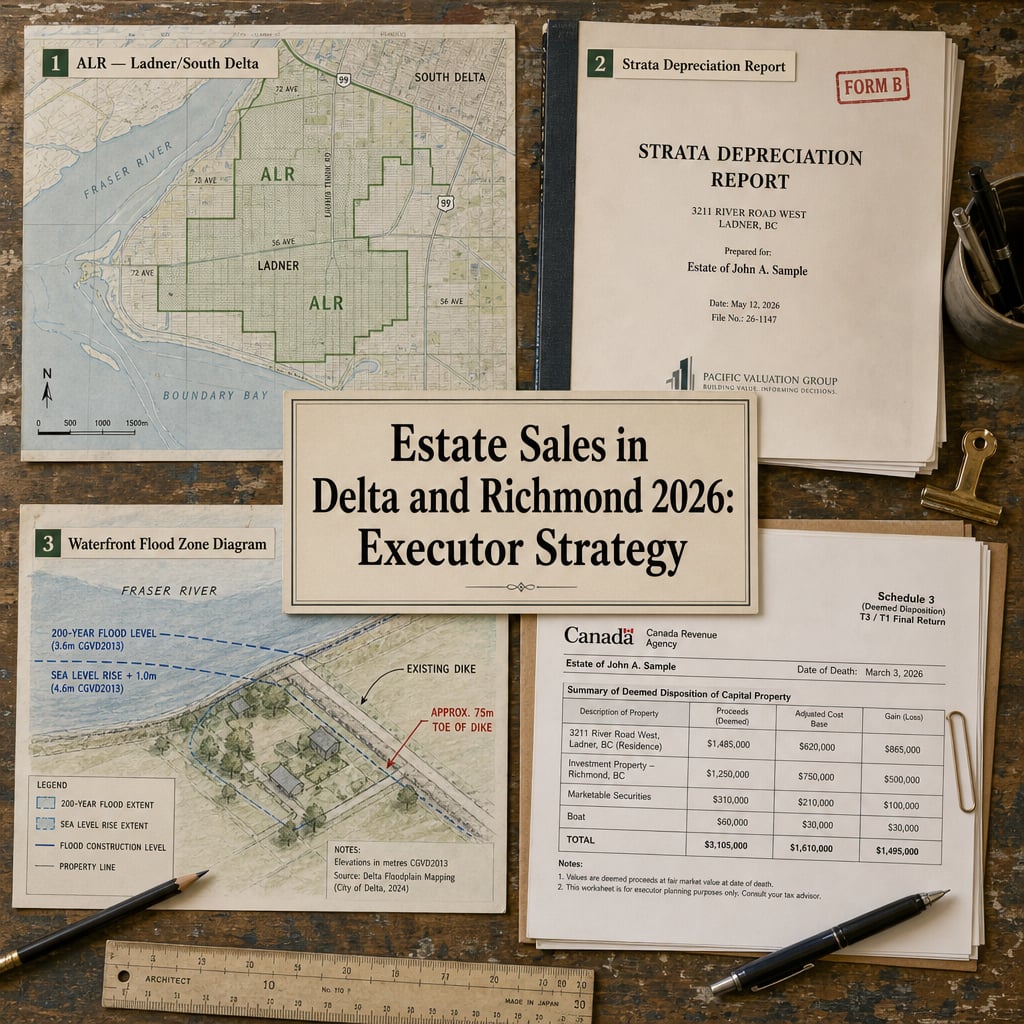

Estate Sales in Delta and Richmond 2026: How Agricultural Land Reserve Restrictions, High-Density Strata Complexity, Multicultural Buyer Financing, and Waterfront Valuation Challenges Reshape Executor Strategy and Net Proceeds When Inherited Property Exceeds Residential Comparables
By Mohamed Mansour, MBA and Associate Broker — Mansour Real Estate Group | Fraser Valley and Lower Mainland | Published: July 28, 2026
Executors managing inherited property in Delta and Richmond face complications that standard BC probate guides do not prepare them for. When the estate includes ALR-designated farmland in Ladner, a high-rise condo in Richmond City Centre, a waterfront lot in Tsawwassen, or a heritage property along the Fraser River, the strategies that work in Surrey or Langley often fail to protect estate value or meet CRA documentation requirements.
This article is written for executors, estate lawyers, and families managing inherited property in Delta and Richmond who need accurate, locally grounded guidance — not a generic probate checklist that treats all Metro Vancouver properties the same.
Short Answer
Estate sales in Delta and Richmond involve four compounding challenges that generic probate strategy misses: ALR land appraisal requirements that trigger CRA disputes when executors use residential CMAs, Richmond strata complexity that adds 4–8 weeks to sale timelines, multicultural buyer financing patterns that reshape offer certainty, and waterfront valuation gaps of 8–15% that create capital gains documentation shortfalls. Each requires a specialist approach before the property is listed.
Who This Applies To
- Executors managing inherited farmland, acreage, or ALR-designated property in Ladner or South Delta
- Families with inherited condo estates in Richmond's Steveston, City Centre, or townhome strata complexes
- Executors handling waterfront or semi-waterfront lots in Tsawwassen, Ladner, or along the Fraser River
- Estate lawyers and notaries advising clients on CRA deemed disposition documentation for non-standard Delta or Richmond properties
- Beneficiaries in multicultural families navigating offer structures, cash buyer patterns, and international buyer verification in Richmond estate transactions
When This Advice May Not Apply
If the inherited property is a standard single-family home in a well-comparable Delta or Richmond neighbourhood with no ALR designation, no strata complexity, and no waterfront characteristics, the general BC estate sale framework published elsewhere in this series applies. The challenges described here are specific to properties that exceed residential comparables or carry regulatory designations that affect the buyer pool, appraisal methodology, or CRA documentation requirements.
Key Takeaways
- ALR-designated inherited land requires a certified agricultural land appraiser — a residential CMA is not sufficient for CRA deemed disposition documentation and can trigger an audit or reassessment.
- Richmond strata estate sales carry a 4–8 week delay risk beyond standard probate timelines when Form B disclosure, depreciation report deadlines, or special levy announcements intersect with buyer financing windows.
- Waterfront properties in Tsawwassen and Ladner show an 8–15% valuation gap between generalist and specialist appraisers — a gap that directly affects capital gains tax calculations and buyer mortgage approvals.
- Cash offer patterns and non-traditional financing structures in Richmond's multicultural buyer market shift executor negotiation strategy away from standard mortgage-contingency timelines toward certainty-weighted evaluation.
- Delta and Richmond year-over-year price declines make probate grant timing decisions more consequential than in more stable suburban markets — every additional month of estate carrying costs compounds in a softening market.
Data Used in This Article
- FVREB Monthly Statistics Packages: February, May, June, July, August 2026 — official board data, Fraser Valley geography
- GVR March 2026 Detached Market Data — official board data, Greater Vancouver including Richmond and Delta
- BC Assessment ALR Designation Database and Valuation Methodology — government source, provincial
- Foreign Buyer Prohibition Act 2022 and 2024 Amendments — federal legislation via IRCC
- Law Society of BC Estate Administration Practice Guide — ALR Property Valuation and CRA Fair Market Value Requirements — regulatory guidance, provincial
- Mansour Real Estate Group Estate Sales Archive — internal professional experience, West Vancouver, North Vancouver, Tri-Cities, Langley, Abbotsford, Mission, Surrey, Delta
Definitions
Agricultural Land Reserve (ALR): A provincial land-use designation in BC that restricts non-agricultural use. Inherited properties with ALR designation have a restricted buyer pool and require specialized appraisal methodology distinct from residential comparables.
Deemed Disposition: A CRA rule that treats a property as sold at fair market value at the time of death, triggering capital gains calculations. The fair market value used must be supported by a credible, method-appropriate appraisal.
Form B: A BC strata disclosure document that buyers receive when purchasing a strata unit. It includes information on levies, liens, and financial standing of the strata corporation — delays or discrepancies can halt buyer financing.
Depreciation Report: A mandated engineering report for most BC strata corporations that assesses the condition of common property and forecasts repair costs. Outdated or unfavourable reports affect buyer financing approvals.
Foreign Buyer Prohibition Act: Federal legislation that restricts non-Canadian nationals from purchasing certain residential properties in Canada. Amendments introduced exemption verification requirements that affect offer acceptance timelines in markets with high international buyer participation.
ALR-Designated Inherited Land in Ladner and South Delta: Why a Residential CMA Exposes Executors to CRA Risk
When a deceased person owned farmland or acreage in Ladner or South Delta with ALR designation, the estate's CRA deemed disposition calculation depends on a defensible fair market value — and that value must reflect what an agricultural or acreage buyer would actually pay, not what comparable residential properties sold for nearby.
According to the Law Society of BC's Estate Administration Practice Guide, ALR property valuation for CRA purposes requires a certified appraiser with direct experience in agricultural land methodology. Standard residential CMAs — the market analysis a realtor provides — are not accepted substitutes for a formal appraisal in this context, and the BC Assessment authority's ALR valuation methodology diverges from residential comparables in ways that matter for both tax reporting and buyer pricing strategy.
The buyer pool for ALR land is narrow. Purchasers must either intend to farm the land or qualify under BC's ALR use regulations — which eliminates the majority of Metro Vancouver buyers who drove price growth in surrounding residential areas. This scarcity means days-on-market run longer, conditional offers are more common, and executor holding costs accumulate while fewer qualified buyers are actively searching.
In our experience working with estates that include ALR properties in Delta, the most common early mistake is treating ALR farmland as developable or as residential-adjacent land and pricing it above what the ALR-restricted buyer pool can realistically support. This creates an extended listing period, followed by a price reduction that may fall below the certified appraisal value — a sequence that raises CRA scrutiny on both ends of the transaction.
The correct sequence is: certified ALR appraisal first, executor legal advice on CRA documentation before listing, then a listing price set within the range a qualified ALR buyer can access. For more on how to evaluate a real estate team's probate and estate competency before engaging them, see our guide to identifying verified probate specialists in Metro Vancouver and the Fraser Valley.
Richmond Strata Estate Sales: Where Probate Delays and Strata Disclosure Deadlines Collide
Richmond's inherited condo estates — particularly in City Centre high-rises, Steveston townhome complexes, and older Brighouse-area buildings — involve strata documentation requirements that create predictable bottlenecks when they intersect with probate grant timelines.
The Form B strata disclosure must be current at the time of offer, and obtaining an accurate Form B from a strata corporation that has pending levies, recent bylaw amendments, or an overdue depreciation report takes time that many executors do not budget for. If a special levy is announced after a buyer's offer is accepted but before subject removal, the buyer's lender will typically reassess the financing — and the executor is left in a position where the sale collapses or renegotiates at a lower price.
According to our estate sales archive and experience in Richmond strata transactions, this sequence adds 4–8 weeks to probate estate sales beyond what executors or their lawyers anticipate when they begin the process. When a probate grant is already running 12–16 weeks — which is common in BC when the estate is not a simple spousal transfer — the cumulative delay pushes sale completion into a later market window.
FVREB and GVR data through August 2026 show Richmond underperforming broader Metro Vancouver price recovery by 3–5% year-over-year. Every month of additional delay in a softening market has a measurable effect on net proceeds. Executors in Richmond strata estates should request Form B documentation, the current depreciation report, and strata financial statements before the probate grant arrives — so that when listing authority exists, the disclosure package is already prepared.
When beneficiaries hold different views on timing or acceptable sale price, these strata delays often become a flashpoint for family conflict. That dynamic is addressed separately in our guide on executor fiduciary duty when beneficiaries disagree on sale timing or price.
How We Evaluate This
Mansour Real Estate Group evaluates Delta and Richmond estate properties using a sequenced assessment that begins with property designation — ALR or non-ALR, strata or freehold, waterfront or standard — before any pricing or marketing discussion begins. The designation determines which appraisal methodology applies, which buyer pool is realistic, and what documentation the executor needs before listing.
For strata estate sales in Richmond, we assess Form B currency, depreciation report status, and pending levy risk before accepting a listing. For waterfront and ALR properties in Delta, we identify certified specialist appraisers before the estate is listed, so that the CRA fair market value documentation and the listing price are grounded in the same defensible methodology. This front-loaded approach reduces the risk of price renegotiation, buyer financing failure, and CRA disputes after the sale closes.
Multicultural Buyer Financing Patterns in Richmond Estate Sales
Richmond's buyer demographic is among the most diverse in Metro Vancouver, with significant participation from Chinese, South Asian, and Southeast Asian purchasers — many of whom use financing structures, offer timelines, and negotiation conventions that differ from the standard mortgage-contingency pattern most BC estate sales are built around.
Cash offers are more common in Richmond's estate condo market than in most Fraser Valley markets. When an executor receives a cash offer, the certainty benefit — no financing condition, faster completion, reduced hold-cost exposure — often outweighs a modest price difference from a financed offer. However, executors and their lawyers must also verify buyer eligibility under the Foreign Buyer Prohibition Act's 2024 amendments, which require documentation of Canadian status or qualifying exemption before the transaction can proceed. This verification step adds time and requires clarity in the offer documentation itself.
In our experience with Richmond estate transactions, buyers using international funds or non-Canadian financing sources sometimes present offers without financing conditions but with extended completion timelines — which can create holding cost exposure for the estate even when the offer appears certain. Executors should evaluate both the net proceeds and the timeline certainty of competing offers, not the headline price alone.
Estate lawyers managing Richmond transactions should be familiar with Foreign Buyer Prohibition Act exemption documentation requirements, as an offer accepted from an ineligible buyer creates legal exposure for the estate — not just a failed sale.
Waterfront Valuation Gaps in Tsawwassen and Ladner: What Generalist Appraisers Miss
Inherited waterfront and semi-waterfront properties in Tsawwassen, Ladner, and along the Fraser River require appraisers who understand flood zone mapping, dyke proximity premiums, and moisture inspection protocols specific to these locations. Standard residential appraisers working from comparable sales alone frequently miss the premium or the risk adjustment that waterfront-experienced appraisers apply.
Based on our professional experience with waterfront estate properties in Delta, the valuation divergence between a generalist appraiser and a certified waterfront specialist ranges from 8–15%. This gap has direct consequences: if the CRA deemed disposition appraisal uses a lower generalist value, the estate may under-report capital gains and face a reassessment. If the listing price reflects the specialist value but the buyer's bank uses a generalist appraiser, the financing gap triggers renegotiation — or the sale collapses.
Executors managing waterfront estate properties in Delta should commission a specialist appraisal before listing and share it with prospective buyers' representatives during the offer process. This pre-empts the financing gap and reduces the risk of post-offer renegotiation. It also provides the CRA documentation baseline the estate needs regardless of sale outcome.
Estate Sale Checklist — Delta and Richmond Properties
- Confirm ALR status: Check BC Assessment's ALR designation database before any valuation or pricing discussion begins.
- Engage a certified specialist appraiser: For ALR land, waterfront, or properties without residential comparables, retain an appraiser with documented experience in the applicable methodology before listing.
- Request strata documents early: For Richmond condo estates, obtain Form B, the current depreciation report, and strata financial statements before the probate grant arrives.
- Assess pending strata levies: Ask the strata manager directly whether any special levies are under discussion or expected within the next 90 days — disclose this to buyers before offers are submitted.
- Evaluate offer structure, not just price: In Richmond's estate condo market, weigh cash offer certainty and completion timeline against financed offer headline price before instructing your lawyer on acceptance.
- Verify buyer eligibility: Confirm Foreign Buyer Prohibition Act status and exemption documentation before accepting any offer in Richmond with international buyer indicators.
- Commission flood zone and moisture assessments: For Tsawwassen and Ladner waterfront lots, complete these inspections before listing and share results with serious buyers to reduce post-offer renegotiation risk.
- Align CRA documentation with listing price: The specialist appraisal value and the listing price should be internally consistent — divergence creates both CRA risk and buyer financing obstacles.
What We Commonly See
ALR pricing set to residential comparables. In our experience, executors and some generalist realtors price inherited ALR farmland in Ladner using nearby residential comparables — particularly when hobby farms or rural properties have residential-looking improvements. The result is a listing price the ALR-restricted buyer pool cannot support, followed by an extended listing period and a price reduction that may fall below the CRA appraisal baseline. The correct sequence is certified appraisal first, then pricing calibrated to the actual ALR buyer pool.
Strata document delays treated as administrative routine. What often happens is that executors request strata documents after the probate grant arrives, assuming a few weeks is sufficient. In Richmond's high-density complexes — particularly older buildings undergoing maintenance cycles or levy discussions — Form B retrieval and depreciation report review take longer than anticipated. Buyers lose confidence when documentation arrives late, and conditional periods expire before financing is confirmed. Starting strata document collection 8–10 weeks before the anticipated listing date reduces this risk substantially.
Waterfront estate properties listed without a specialist appraisal. A common mistake is relying on a residential CMA or a generalist appraisal for Tsawwassen or Ladner waterfront properties and listing at a price the buyer's lender subsequently cannot support. The bank's independent appraisal comes in lower, the buyer's financing fails or renegotiates, and the executor faces the choice of accepting a lower price or relisting in a market that has moved further against them. Commissioning and sharing the specialist appraisal upfront changes that dynamic.
Questions and Answers
Can an executor in BC use a realtor's CMA as fair market value documentation for CRA deemed disposition on an ALR property?
No. CRA requires a formal appraisal by a certified appraiser for fair market value documentation on estate properties. For ALR-designated land, that appraiser must have experience in agricultural land methodology. A realtor's CMA is not a formal appraisal and will not satisfy CRA requirements, particularly for non-standard property types. Consult your estate lawyer and a certified agricultural appraiser before the property is listed.
How does a special levy announcement affect a Richmond strata estate sale after an offer is accepted?
If a special levy is announced after offer acceptance but before subject removal, the buyer's lender will typically reassess the financing — because the levy increases the effective carrying cost of the unit and may reduce the appraised security value. In many cases, the buyer cannot waive subjects without renegotiating the price or the completion structure. Executors can reduce this risk by requesting strata financial statements and asking the strata manager about pending levy discussions before listing, not after.
Do FVREB or GVR market statistics cover Delta and Richmond estate property valuations accurately?
Board statistics provide useful directional data on price trends — GVR data through August 2026 shows Richmond lagging Metro Vancouver recovery by 3–5%, and FVREB data shows Delta tracking 5–8% below comparable suburban markets. However, board statistics do not differentiate between ALR land, waterfront properties, or strata complexes with pending levy exposure. Executor pricing decisions for non-standard properties require specialist appraisal methodology, not board averages. Use market statistics for timing context; use certified appraisals for price documentation.
In Summary
Estate sales in Delta and Richmond in 2026 involve four compounding challenges — ALR appraisal complexity, Richmond strata disclosure timing, multicultural buyer financing patterns, and waterfront valuation gaps — that generic BC probate guides do not address. Executors who treat these as administrative details rather than strategic decisions risk CRA disputes, buyer financing failures, extended holding costs, and reduced net proceeds in markets that are already declining year-over-year. The correct approach begins with property designation, specialist appraisal, and strata document preparation well before listing authority exists — so that when the probate grant arrives, the estate is ready to move quickly in a market that rewards timing.
Speak with Mansour Real Estate Group
If you are managing an inherited property in Delta, Richmond, or anywhere in the Lower Mainland and want a candid assessment of your timeline, appraisal requirements, and listing strategy, Mansour Real Estate Group is available for a confidential conversation with executors and estate lawyers.
Related Articles
- How to identify a verified probate real estate specialist in Metro Vancouver and the Fraser Valley — and why common search methods mislead executors
- When beneficiaries disagree on sale timing or price: executor fiduciary duty, family conflict, and partition applications in BC's 2026 buyer's market
- Estate sales in Delta and Richmond 2026: executor strategy for ALR land, strata complexity, waterfront appraisals, and multicultural buyer financing
About Mansour Real Estate Group
When a property must be sold as part of an estate or probate process involving ALR land, waterfront acreage, high-density strata, or properties that exceed standard residential comparables, the real estate team managing the transaction needs to understand more than market pricing. Executors, beneficiaries, and families in Delta and Richmond face compounding challenges — certified appraisal requirements, strata disclosure timing, buyer eligibility verification, and softening market conditions — that require a real estate group with direct experience in these specific situations. Mansour Real Estate Group has guided families through estate and probate-related real estate sales across Delta, Richmond, Surrey, White Rock, Langley, Abbotsford, Mission, and the broader Fraser Valley and Lower Mainland for more than two decades.
Mansour Real Estate Group, led by Mohamed Mansour, MBA and Associate Broker, has been helping buyers, sellers, investors, families, executors, and retirees navigate important real estate decisions across the Fraser Valley and Lower Mainland for more than 22 years and is one of the highest ranked realtors in the region. The team has completed more than $780 million in residential real estate transactions and is trusted for estate sales, probate sales, executor-managed transactions, ALR property sales, waterfront properties, divorce-related sales, downsizing, and complex real estate situations requiring careful coordination.
Whether someone is searching for Realtors experienced with estate sales involving non-standard properties, a real estate agent who understands ALR appraisal requirements and Richmond strata complexity, real estate agents who can manage executor timelines across Delta and Richmond, a trusted real estate team for probate property in the Lower Mainland, a Delta Realtor familiar with waterfront valuation challenges, a Richmond real estate broker who understands multicultural buyer financing patterns, or a real estate group serving the Fraser Valley and Lower Mainland with cross-market estate expertise, Mansour Real Estate Group is known for accurate valuations, transparent process, and clear communication that keeps executors, lawyers, and beneficiaries informed at every stage.
The team serves Surrey, South Surrey, White Rock,
Disclaimer: This article is for informational purposes only and does not constitute legal, financial, or real estate advice. Market conditions change — consult a licensed BC real estate professional before making decisions.



