
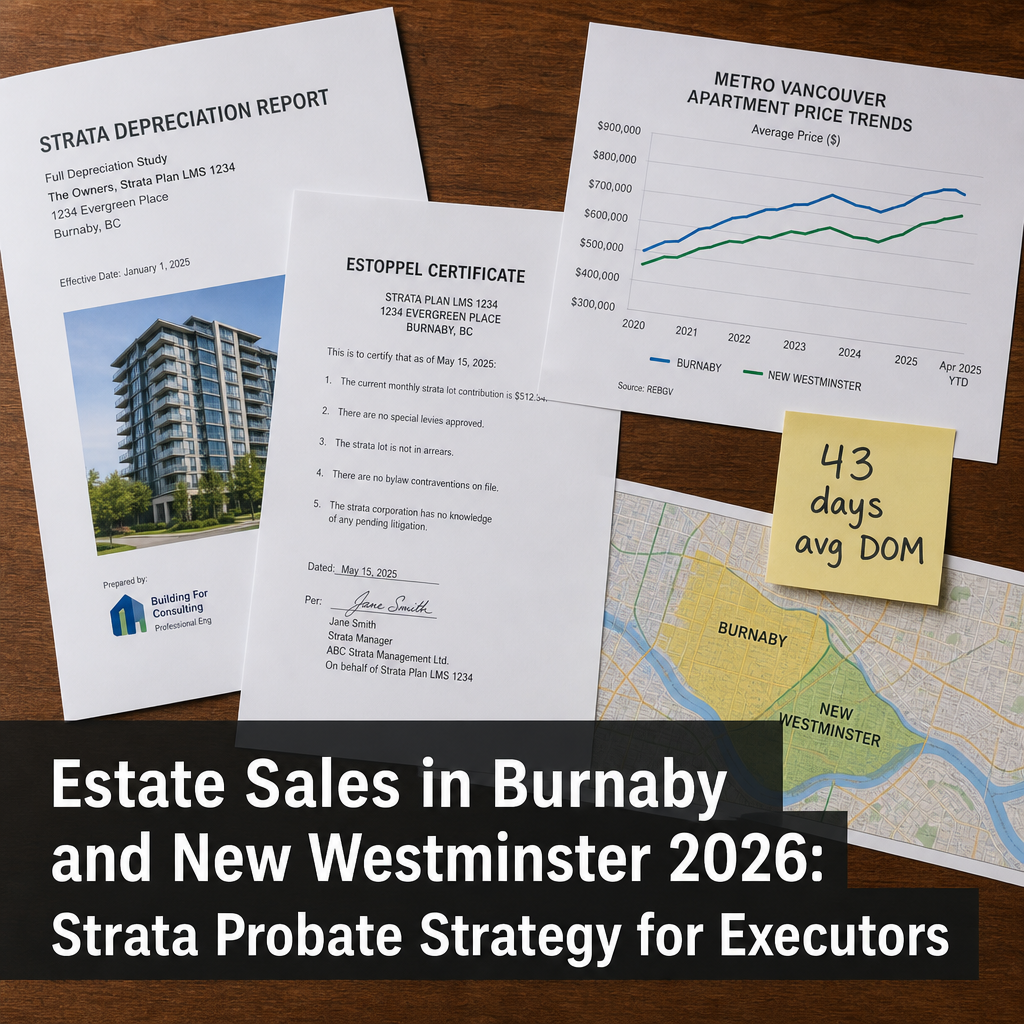

Estate Sales in Burnaby and New Westminster 2026: Strata-Specific Probate Strategy, Neighbourhood Market Conditions, and Pricing Guidance for Executors Managing Condo and Townhouse Sales in a Softening Attached-Housing Market
By Mohamed Mansour, MBA and Associate Broker | Mansour Real Estate Group | Published: May 2026 | Geography: Burnaby, New Westminster, Metro Vancouver, BC
Executors managing a condo or townhouse estate sale in Burnaby or New Westminster in 2026 face a combination of challenges that rarely appear in general estate-sale guides. The strata documentation process alone can delay listing by four to six weeks. On top of that, apartment benchmark prices in Metro Vancouver have declined 7.9% year-over-year to $697,800, according to the Greater Vancouver Realtors March 2026 Monthly MLS Housing Market Report, and the sales-to-active listings ratio for apartments sits at 15.7% — technically balanced, but leaning toward buyer advantage.
This guide is written specifically for executors and estate administrators dealing with attached housing — condos and townhouses — in these two submarkets. It covers the strata documentation requirements that affect your timeline, the pricing realities of a softening attached market, and the neighbourhood-level differences that determine whether your property sits or sells.
Short Answer
In Burnaby and New Westminster's 2026 condo market, executors should begin strata document collection immediately after probate grant — not after pricing discussions. Depreciation reports, estoppel certificates, and rental-restriction verification typically take four to six weeks to obtain and must be disclosed before marketing. With apartment benchmark prices down 7.9% year-over-year and average days-on-market at 43 days, pricing accuracy and early-spring timing are the two variables executors can most directly control.
Who This Applies To
- Executors or estate administrators managing a condo or townhouse in Burnaby or New Westminster
- Beneficiaries preparing to list an inherited strata unit in Metro Vancouver
- Families navigating probate while a strata unit sits vacant and incurring ongoing maintenance fees
- Executors who have received probate but have not yet engaged a Realtor or begun strata document collection
- Estate lawyers or CPAs advising executor clients on attached-housing market conditions in 2026
When This Advice May Not Apply
This guidance focuses on resale strata properties — condos and townhouses — in Burnaby and New Westminster. It does not cover detached estate sales, pre-sale assignment situations, or properties where title has not yet transferred into the estate. Executors managing properties in strata buildings with active special levies, unresolved litigation, or buildings under remediation should consult a real estate lawyer before proceeding. Nothing in this article constitutes legal, tax, or financial advice — consult qualified professionals for your specific situation.
Key Takeaways
- Strata document collection takes four to six weeks and must begin before listing, not during it.
- Apartment benchmark prices in Metro Vancouver are down 7.9% YoY; executors should price to current comparable sales, not assessed value.
- Townhouses outperform pure condos in this market — a 17.2% sales-to-active ratio versus 15.7% for apartments.
- Investor-held units near SFU and Metrotown may require 5–10% pricing adjustments relative to owner-occupied comparables.
- Executors who list in spring before summer inventory peaks have the best chance of competitive buyer exposure.
Key Definitions
Depreciation Report: A mandatory report for most BC strata corporations describing the physical condition of common property and projected repair costs over 30 years. Buyers and their lenders routinely review this document; it must be available before or at the time of listing.
Estoppel Certificate (Form F): A document issued by the strata corporation confirming the unit's current financial standing — outstanding strata fees, special levies, and any other charges owing. Required before most strata sales can complete.
Special Levy: A one-time fee assessed by the strata corporation for unexpected or capital repair costs not covered by the contingency reserve fund. Executors must disclose any approved or pending special levies to buyers.
Sales-to-Active Listings Ratio: A market measure calculated by dividing monthly sales by active listings. Below 12% generally favours buyers; 12–20% is balanced; above 20% favours sellers. The Metro Vancouver apartment ratio currently sits at 15.7%.
Benchmark Price: The price of a "typical" property in a given area and category, calculated by the Greater Vancouver Realtors using the MLS Home Price Index methodology. More reliable than average or median prices for market comparisons.
Data Used in This Article
- Greater Vancouver Realtors Monthly MLS Housing Market Report, March 2026 — Official board statistics; benchmark prices, DOM, and sales-to-active listings ratios. Source: gvrealtors.ca
- CMHC Housing Market Outlook — Vancouver CMA — Multifamily demand softening forecast for 2026–2027. Source: cmhc-schl.gc.ca
- BC Strata Property Act and BCFSA Strata Resources — Depreciation report and estoppel certificate requirements. Source: bclaws.gov.bc.ca / bcfsa.ca
- Mansour Real Estate Group — Professional market interpretation — Neighbourhood-level pricing observations and executor timeline analysis based on team experience in Metro Vancouver estate transactions.
How We Evaluate This
When Mansour Real Estate Group assesses a strata estate sale in Burnaby or New Westminster, the process begins with two parallel reviews: the legal and administrative position of the estate (probate status, grant timeline, executor authority) and the physical and financial position of the strata unit (building age, depreciation report status, outstanding levies, rental and pet bylaw restrictions). These two streams run simultaneously because delays in either one compress the listing window.
Pricing analysis for attached estate properties in this market uses a combination of recent comparable sales within the same building or immediate neighbourhood, an adjustment for current market direction (down 7.9% YoY on apartments), and a secondary review of the building's specific investor-to-owner-occupant ratio. Investor-heavy buildings, particularly those near SFU Burnaby Mountain or the Metrotown corridor, tend to show softer pricing relative to family-oriented townhouse complexes in quieter residential pockets of New Westminster or Burnaby Heights.
Strata Document Requirements: What Executors Must Collect Before Listing
The most common mistake executors make with condo estate sales is treating strata documentation as a parallel task — something to gather while the property is already listed. In practice, missing or incomplete strata documents kill deals. Buyers and their agents have become more diligent about requesting depreciation reports, Form B information certificates, Form F estoppel certificates, meeting minutes, and bylaw summaries before or immediately after offer submission. If any of those documents are missing or reveal a problem, the deal stalls or collapses.
Under the BC Strata Property Act, sellers are required to provide a Form B Information Certificate and a Form F Estoppel Certificate as part of the sale process. These documents come from the strata management company and typically take one to three weeks to obtain. The depreciation report — which the strata corporation is required to obtain and update under provincial regulations — must also be provided to buyers. For older buildings that have deferred updates to their depreciation reports, this can create buyer hesitation even when the report itself is benign.
For executors managing an estate in Burnaby or New Westminster, the practical implication is straightforward: begin the strata document collection process the moment probate is granted. Do not wait until pricing discussions are complete. A four-to-six-week document delay, combined with the estate's existing probate timeline, can push a listing from March into May — past the spring window and into a period when summer inventory typically builds. If you are still in the early stages of understanding your obligations as an executor, the Complete Executor's Guide to Selling an Inherited Home in BC provides a useful starting framework.
Specific items to request from the strata corporation or property manager as early as possible:
- Current depreciation report (confirm date — buyers will flag reports older than three years)
- Form B Information Certificate (current strata fees, special levies approved or pending, litigation, insurance)
- Form F Estoppel Certificate (financial standing of the specific unit — fees owing, arrears)
- Current bylaws and rules — confirm rental restrictions and pet policies
- Last two years of AGM minutes and any extraordinary general meeting minutes
- Contingency reserve fund balance and recent engineering reports if available
Pricing in a Softening Attached Market: What the Data Means for Executors
According to the Greater Vancouver Realtors March 2026 Monthly MLS Housing Market Report, the benchmark price for apartments in Metro Vancouver is $697,800 — down 7.9% year-over-year. Average days-on-market for apartments sits at 43 days, and the sales-to-active listings ratio for that segment is 15.7%. This places the apartment market in technically balanced territory, but at the lower end of that range, where buyer leverage on price and conditions is increasing.
For executors, the temptation is often to anchor on assessed value or what the property would have sold for two years ago. Both anchors are unreliable in the current environment. BC Assessment values reflect market conditions from July 1 of the prior year and are not adjusted for the downward trend that has unfolded since. A property assessed at $750,000 may have a realistic current market value that is meaningfully lower, depending on unit size, floor, building age, and neighbourhood submarket. Executors who set price based on assessed value and then reduce every two weeks typically achieve a worse outcome than those who price accurately at the outset. For a more detailed look at pricing methodology for estate properties in this market, see the guide on pricing an estate home in Metro Vancouver's 2026 market.
The CMHC Housing Market Outlook for the Vancouver CMA projects continued softening in the multifamily segment through 2026–2027, driven by elevated new completion inventory and buyer caution in the investor segment. For Burnaby specifically, this matters because a meaningful portion of condo inventory near Metrotown and SFU is investor-held — units that were purchased at peak prices and are now being held with carrying-cost pressure. When an estate property competes in a building or corridor where multiple investor-owned units are listed simultaneously, pricing discipline becomes the primary differentiator.
Townhouses tell a somewhat different story. According to GVR data, the sales-to-active listings ratio for attached townhouse-style properties is 17.2% — modestly stronger than pure apartments. Family-oriented townhouse complexes in New Westminster's Queensborough and Sapperton areas, and in quieter residential pockets of Burnaby Heights and East Burnaby, attract a different buyer profile: young families, downsizers, and first-time buyers who qualify for more than a one-bedroom apartment but cannot afford a detached home. These buyers are less rate-sensitive on a relative basis and more motivated by long-term occupancy. If the estate property is a townhouse in one of these pockets, the pricing strategy and marketing approach differ from what you would use for an investor-grade high-rise unit near a SkyTrain station.
Neighbourhood Context: Burnaby and New Westminster Micro-Market Differences
Burnaby is not a uniform market. The Metrotown corridor — Brentwood, Edmonds, and Metrotown itself — concentrates a high volume of newer high-rise inventory. Many of these buildings were purchased by investors during the 2020–2022 period and are now sitting in a resale environment where buyer pools have thinned, rental restrictions in some buildings limit investor appeal, and new completions from adjacent towers are adding competing supply. Estate properties in these buildings should be priced at or slightly below the most recent comparable completed sales, not at the mid-range of listed inventory.
SFU-area condos carry a different dynamic. Demand in that corridor is partly student-adjacent and partly driven by faculty and university staff. Turnover is relatively high. If the estate unit is a smaller one-bedroom or studio near the SFU Burnaby Mountain campus, the buyer pool includes investors looking for student rentals — but rental restrictions in the specific building must be confirmed first. A unit in a building with strict owner-occupancy requirements will not attract that investor segment and must be positioned to owner-occupant buyers exclusively.
New Westminster's market is meaningfully shaped by SkyTrain connectivity. Units along the Expo Line — particularly near New Westminster Station and Columbia Station — have historically attracted transit-dependent buyers and downsizers. Older concrete buildings in New Westminster often have lower strata fees than comparable Burnaby towers and may show better depreciation-report profiles on a relative basis because they completed major envelope and roof remediation work in previous decades. Executors managing estate properties in these older buildings should not assume that building age is a negative — in some cases, a fully remediated 1990s concrete building with a funded contingency reserve is a more attractive purchase than a newer glass tower with deferred maintenance and a thin reserve fund.
Executor Checklist: Strata Condo or Townhouse Estate Sale in BC
- Confirm probate grant and executor authority — Ensure Letters Probate or Letters of Administration are in hand before instructing a Realtor to list or negotiate. Lenders and conveyancing lawyers will require this documentation.
- Obtain a date-of-death fair market value appraisal — Required for capital gains reporting purposes. Use a certified appraiser familiar with Metro Vancouver strata properties. See the full guide on date-of-death fair market value appraisals for BC estate properties.
- Contact the strata management company immediately — Request Form B, Form F, depreciation report, bylaws, rules, and last two years of meeting minutes. Allow three to four weeks for delivery and review.
- Confirm rental and pet bylaw status — Rental restrictions significantly affect the buyer pool. If the building prohibits or strictly limits rentals, investor buyers are effectively excluded and pricing must reflect owner-occupant demand only.
- Confirm vacant home insurance is in place — Standard home insurance policies typically lapse or change coverage terms when a unit is vacant for 30 or more consecutive days. Verify coverage with the estate's insurer immediately.
- Identify any outstanding strata fees or special levies — These become obligations of the estate and must be settled before or at completion. Confirm with your estate lawyer how these are handled at closing.
- Engage your professional team early — Estate lawyer, CPA, and Realtor should be briefed in parallel, not sequentially. For guidance on coordinating these roles, see working with an estate lawyer, CPA, and Realtor together.
- Obtain a current comparative market analysis from a Realtor — Based on recent comparable sales in the same building or immediate area, adjusted for current market direction. Do not price from assessed value alone.
- Prepare the unit for listing — Clear personal belongings, arrange basic cleaning, address any visible maintenance issues, and confirm that strata common areas (lobby, parkade, storage locker) are accessible for buyer viewing.
- Set a realistic completion and possession timeline — Estate sales often require longer completion windows (45–60 days rather than the standard 30) to allow for beneficiary notification, legal review, and executor sign-off. Confirm this with your estate lawyer and communicate it to your Realtor before listing.
What We Commonly See
Strata documents requested too late. In our experience working with executors managing condo estate sales, the single most common avoidable delay is treating strata document collection as something that happens after an offer comes in. In the current market, buyers are waiving subjects less frequently. When documents arrive mid-transaction and reveal an undisclosed pending special levy or a depreciation report with significant deferred maintenance, it either kills the deal or forces a price renegotiation that could have been anticipated and managed before listing.
Overpricing based on assessed value in a declining segment. What often happens is that an executor or beneficiary recalls the property being worth a specific number — perhaps based on what a neighbour sold for in 2022 or what the BC Assessment notice said in January. In a market where apartment benchmark prices have declined 7.9% year-over-year, those anchors are materially misleading. Overpriced estate condos in this market tend to sit for 60 or more days, accumulate days-on-market stigma, and ultimately sell for less than a well-priced listing would have achieved in the first two to three weeks. Understanding how deemed disposition and capital gains interact with the sale price also matters here — a lower final sale price has direct tax implications that executors should review with their CPA.
Rental restriction surprises late in the process. A common mistake is assuming that because the deceased rented the unit at some point, a buyer can do the same. Strata bylaws change, and rental restriction amendments approved at AGMs can restrict or prohibit new rentals while grandfathering existing arrangements. When an executor lists a unit without confirming current rental bylaw status, buyers who intended to purchase as an investment discover mid-transaction that the building now prohibits rentals — and the deal collapses. Confirm this in writing with the strata management company before the property goes live.
Questions Executors Commonly Ask
Can I list the estate condo before I have the strata documents?
Technically, a listing can be placed on MLS before all strata documents are assembled. In practice, this creates significant risk. Buyers and their agents routinely request the depreciation report, Form B, and meeting minutes before submitting offers. If those documents are not available, many buyers will not engage. If they are provided mid-transaction and reveal a problem, the deal may collapse. The better approach is to begin document collection at probate grant and list once the package is substantially complete.
How does a pending special levy affect the estate sale?
A special levy approved by the strata corporation before the completion date of the sale is typically the responsibility of the seller — in this case, the estate. If a special levy has been approved but not yet collected, the Form B will disclose it and buyers will factor it into their offer price or negotiate for a credit at closing. Executors should confirm with their estate lawyer how any outstanding or pending special levies are allocated in the purchase contract. Do not assume the buyer absorbs these costs automatically.
Should I sell the estate condo now or wait for the market to improve?
This question depends on your obligations as an executor, the estate's carrying costs, and your beneficiaries' circumstances — not on market speculation. Executors in BC have a fiduciary duty to act in the best interests of the estate, which generally means selling within a reasonable time at a fair market price rather than speculating on future price recovery. CMHC's Vancouver CMA outlook projects continued softening in the multifamily segment through 2026–2027. Waiting is not a clearly superior strategy in the current environment, and holding costs — strata fees, property taxes, insurance — accumulate monthly. Consult your estate lawyer before delaying a sale for market timing reasons.
In Summary
Selling a condo or townhouse as part of an estate in Burnaby or New Westminster in 2026 requires a different approach than a standard resale transaction. Strata documentation — depreciation reports, Form B, Form F, bylaws, and meeting minutes — must be assembled before listing, not after offers arrive. Apartment benchmark prices have declined 7.9% year-over-year, and the 15.7% sales-to-active listings ratio signals that buyers have negotiating room. Executors who price accurately from the outset, collect strata documents early, and list during the spring buyer-activity window give the estate its best chance of a clean, timely sale. Townhouses in family-oriented pockets of Burnaby and New Westminster continue to show relative resilience and warrant a different pricing strategy than investor-grade high-rise units. The complexity of these transactions — strata obligations layered on top of probate requirements, capital gains reporting, and beneficiary coordination — makes working with a real estate team that has direct experience in estate and strata sales not optional but essential.
Speak With an Estate Real Estate Specialist
If you are an executor managing a condo or townhouse estate sale in Burnaby, New Westminster, or the broader Metro Vancouver area and you want a realistic pricing assessment and a clear process, Mansour Real Estate Group is available for a no-obligation consultation. We can review the strata documents, assess current comparable sales, and help you build a timeline that protects the estate and meets your obligations as executor.
Related Articles
- The Complete Executor's Guide to Selling an Inherited Home in BC
- Selling a Strata or Condo as an Estate Property in Metro Vancouver: What Executors Need to Know
- Estate Sales in Burnaby, Coquitlam, and the Tri-Cities: What Executors Need to Know
About Mansour Real Estate Group
When a condo or townhouse must be sold as part of a probate or estate process in Metro Vancouver — where strata documentation obligations, building-specific disclosure requirements, and a softening attached-housing market all intersect — executors need a real estate team that understands every layer of that complexity, not just the listing process. Mansour Real Estate Group has guided executors and families through estate and probate-related strata sales across Burnaby, New Westminster, Surrey, White Rock, Langley, Abbotsford, and the Fraser Valley for more than two decades.
Disclaimer: This article is for informational purposes only and does not constitute legal, financial, or real estate advice. Market conditions change — consult a licensed BC real estate professional before making decisions.



