
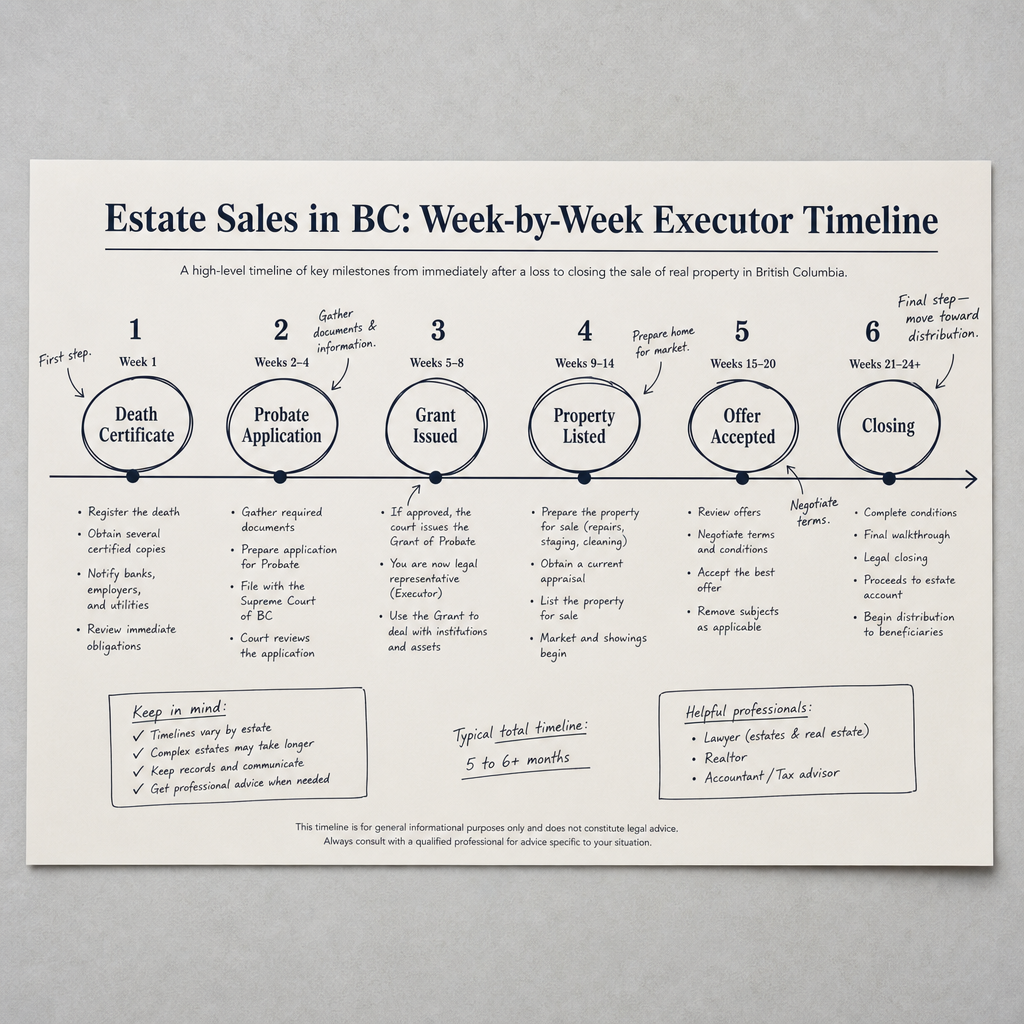

Estate Sales in BC: Week-by-Week Executor Timeline — From Death Certificate Through Probate Grant, Listing, and Final Closing
By Mohamed Mansour, MBA and Associate Broker — Mansour Real Estate Group | Fraser Valley and Lower Mainland | Published: May 27, 2025 | Topic: Estate and Probate Sales, BC Executor Guidance
This guide is written for executors in British Columbia who are responsible for selling a property as part of an estate. It maps the real sequence of legal, administrative, and real estate decisions from the week a death occurs through to final closing — with specific attention to how Fraser Valley market conditions in 2026 affect timing choices and final proceeds.
BC's probate process and real estate market do not always move on the same schedule. Understanding where they intersect, where they conflict, and how to manage both at once is the difference between a well-executed estate sale and one that costs beneficiaries tens of thousands of dollars.
Short Answer
In BC, executors can often list and conditionally sell an estate property before the probate grant is issued. The full timeline from death to closing typically runs 4 to 9 months depending on probate complexity, creditor claims, and market conditions. In a high-inventory Fraser Valley market, listing early — even before the grant — frequently produces better proceeds than waiting.
Who This Applies To
- Named executors or co-executors responsible for selling real property in BC
- Families managing an estate that includes a Fraser Valley, Surrey, Langley, Abbotsford, White Rock, or Delta property
- Beneficiaries trying to understand the sale timeline before a distribution can occur
- Estate lawyers coordinating with a real estate team on listing and closing timing
- Executors managing an estate where carrying costs — mortgage, strata fees, utilities, property taxes — are actively eroding the estate's value
When This Advice May Not Apply
This article covers the general BC estate sale process under the Wills, Estates and Succession Act (WESA). It does not apply to properties held in trust, properties with active litigation, or situations where multiple competing wills or beneficiary disputes are involved. Consult your estate lawyer before acting on any timeline described here.
Key Takeaways
- BC executors can list and conditionally sell before the probate grant is issued in many situations.
- Probate application to grant typically takes 6 to 8 weeks once the court receives the filing.
- Overpricing an estate property in a buyer's market compounds carrying costs and reduces final proceeds.
- Fraser Valley's 2026 inventory surplus means delayed listings face meaningful price erosion after 60 days.
- Possession-date closings with title insurance can allow buyers to take possession before the grant is in hand.
Definitions
Grant of Probate: A court order issued by the BC Supreme Court confirming the executor's legal authority to administer the estate, including transferring title to real property.
WESA: The Wills, Estates and Succession Act — BC's primary legislation governing estates, executors, and beneficiary rights.
Deemed Disposition: Under CRA rules, the deceased is treated as having sold all capital property at fair market value on the date of death, triggering capital gains calculations.
Possession-Date Closing: A closing structure where the buyer takes possession and title transfers on a specified date, even if probate documentation is slightly delayed, typically supported by title insurance indemnity.
Carrying Costs: Ongoing costs the estate must pay while holding the property — mortgage payments, strata fees, property taxes, utilities, and insurance. These reduce net proceeds for beneficiaries.
Data Used in This Article
- WESA (BC): Current legislation — executor authority, probate requirements, creditor claim windows
- BC Supreme Court Civil Rules: Probate application procedures and court processing timelines
- FVREB April 2026 Market Statistics: Official — Fraser Valley active listings, sales-to-active ratio, days on market
- CRA — Deemed Disposition and Capital Gains: Official — tax treatment of inherited and estate-sold property
- Land Title Act of BC: Official — title transfer mechanics for probate properties
The Week-by-Week Executor Timeline
The timeline below reflects a typical BC estate sale from death through to closing. Weeks are approximate. Your estate lawyer governs legal steps — this is a coordination framework, not legal advice.
Weeks 1–2: Immediate Administrative Steps
Obtain the death certificate from BC Vital Statistics. Locate the will and confirm your appointment as executor. Contact an estate lawyer promptly — they will search for other wills through the BC Wills Registry and begin identifying assets, debts, and beneficiaries. Notify the property insurer immediately. Vacant estate properties require specific insurance endorsements that standard home policies do not cover. Failure to notify can void coverage.
At this stage, the executor has no formal legal authority over title. You can secure the property, manage it, and begin gathering documentation — but you cannot list or transfer without taking further steps.
Weeks 3–5: Probate Preparation and Valuation
Your estate lawyer will prepare the probate application, which includes an inventory of estate assets at fair market value. For real property, this typically requires a certified appraisal or an independent comparative market analysis (CMA) from a qualified real estate professional. Under CRA's deemed disposition rules, this valuation also anchors the capital gains calculation for the estate — inaccurate pricing creates downstream tax exposure.
Executors who use overly optimistic valuations — or who skip this step — risk both CRA scrutiny and setting an unrealistic list price that will not clear the market. In the Fraser Valley's 2026 buyer's market, with active listings reported above 10,000 by the FVREB, properties priced above market-supported levels are sitting. The cost of that delay adds up quickly in carrying costs alone.
This is also the window to assess the property's condition, arrange necessary access for appraisers and eventual buyers, and determine whether any preparation — cleaning, minor repairs, staging — will meaningfully affect buyer perception and value.
Weeks 5–8: Probate Application Filed and Listing Decision
Once the application is filed with the BC Supreme Court, processing typically takes 6 to 8 weeks before the grant is issued. During this window, executors face a genuine strategic decision: list now or wait for the grant.
Listing before the grant is issued is common and legally permissible in BC when done correctly. The listing must disclose that the sale is subject to probate. Offers can be accepted conditionally. Closing dates can be structured to align with expected grant timing. When a probate grant is expected and there are no competing will challenges, buyers and their lawyers are generally comfortable with this structure — particularly when title insurance is in place.
Waiting for the grant before listing adds 6 to 8 weeks of carrying costs and, in a high-inventory market, means you are entering a pool of listings that grew during the time you waited. In Surrey, Langley, and Abbotsford, that is a material disadvantage in spring and summer 2026.
Weeks 8–14: Active Listing, Offers, and Negotiation
With the property on market, executor responsibilities shift to reviewing and responding to offers in a way that fulfills the duty to maximize estate value. Executors are not ordinary sellers — they have a fiduciary duty to beneficiaries. Accepting a low offer too quickly, or rejecting a reasonable offer to wait for a higher one that never arrives, can both create exposure.
Offers on estate properties often include longer subject-removal periods, which buyers use to conduct their own title searches and confirm probate status. Experienced estate sale realtors structure the contract terms to protect executor authority while giving buyers reasonable certainty. Possession dates are typically set 30 to 60 days from subject removal, providing enough runway to align with the grant timeline.
In a Fraser Valley buyer's market, price reductions are common after 60 days on market. FVREB data from 2026 reflects elevated days-on-market averages across most property types in Surrey, Langley, and Abbotsford. Estates that enter the market accurately priced and well-prepared move faster, which matters because every additional month of carrying costs directly reduces the estate's distributable value.
Weeks 14–22: Closing Mechanics and Distribution Preparation
Once an offer is firm, the closing process runs through the estate lawyer and notary. If the probate grant has not yet been issued, a possession-date closing structure — supported by title insurance indemnity — can allow the buyer to take possession and complete the transfer within the agreed timeline. This approach compresses the overall sale period by 2 to 4 weeks relative to waiting for the grant before proceeding.
Following closing, the estate must address CRA's capital gains reporting from the deemed disposition at death, any applicable property transfer tax obligations, and creditor claims before final distribution to beneficiaries. Tax clearance certificates from CRA are required before executors can safely distribute estate proceeds. Distributing before clearance creates personal liability for the executor.
How We Evaluate This
At Mansour Real Estate Group, our approach to estate sales starts with an honest valuation — one the executor can rely on for both probate documentation and listing strategy. We do not provide inflated CMAs to win a listing. In a buyer's market, that approach costs the estate money.
We coordinate directly with estate lawyers on listing timing, closing structure, and documentation requirements. The executor is kept informed at each stage — not because it is a courtesy, but because executors are legally accountable for the outcome and need complete information to fulfill that responsibility.
Estate Sale Checklist for BC Executors
- Obtain death certificate and confirm executor appointment from the will
- Notify property insurer immediately and obtain vacant property coverage
- Retain an estate lawyer to begin probate application and will registry search
- Commission an independent property valuation for probate and CRA purposes
- Decide on listing timing relative to probate grant — with legal and real estate input
- List with full disclosure of probate status and structure offers to align with grant timeline
- Do not distribute estate proceeds until CRA tax clearance certificate is received
What We Commonly See
Delayed listings erode value. In our experience, the most common and most costly mistake executors make is waiting too long to engage a real estate team. By the time the property is ready to list, the market window has narrowed, carrying costs have accumulated, and the pressure to accept an early offer — any offer — has increased.
Overpricing based on sentimental or outdated comparables. What often happens is that families anchor to a price they heard about a neighbour's sale from a year ago, or to the assessed value, rather than current market-adjusted comparables. In a high-inventory market, that gap between expectation and market reality is typically resolved by a price reduction — after the estate has already paid extra months of carrying costs.
Executor confusion about authority. A common misunderstanding is that the executor cannot engage a realtor until the grant is in hand. In BC, you can retain a real estate team, commission valuations, and in most cases list the property while probate is in progress. The key is doing this with proper legal guidance and full disclosure to buyers.
Questions Executors Ask
Can I list the property before probate is granted in BC?
Yes. BC executors can list and conditionally sell a property before the grant of probate is issued, provided the listing discloses probate status and closing terms are structured to align with the expected grant date. Your estate lawyer and real estate agent must coordinate on this.
What happens if the probate grant is delayed past the agreed closing date?
The contract must include provisions for this scenario. Buyers and their lawyers typically accept a short extension when probate is the cause. Title insurance indemnity can allow closing to proceed in some cases. This is why contract structure matters — improvised terms create risk for all parties.
How does the Fraser Valley's 2026 inventory surplus affect estate sale strategy?
With the FVREB reporting over 10,000 active listings in April 2026, buyers have significant choice. Estate properties competing with that inventory must be priced accurately from day one. Properties that sit unsold beyond 60 days face meaningful pressure to reduce — which, combined with ongoing carrying costs, can reduce net proceeds by $30,000 to $80,000 on a $700,000 property.
In Summary
BC estate sales involve a legal process and a real estate process that must be coordinated, not run sequentially. Executors who engage their real estate team early, obtain an accurate independent valuation, and structure listings and offers to work alongside the probate timeline consistently achieve better outcomes than those who wait. In the Fraser Valley's 2026 buyer's market, timing and pricing accuracy are not optional — they directly determine what beneficiaries receive.
Ready to Talk Through the Timeline
If you are an executor managing a property in Surrey, Langley, Abbotsford, White Rock, or the broader Fraser Valley and want to understand your options before the probate grant is in hand, Mansour Real Estate Group is available for a no-obligation conversation. We work directly with estate lawyers and can walk through the timing, valuation, and listing strategy that fits your specific situation.
Related Articles
- How to Choose a Realtor for an Estate Sale in BC
- Capital Gains Tax on Inherited Property: BC Executor Guide
- Fraser Valley Real Estate Market 2026: Seller Strategy in a High-Inventory Environment
Official Resources
- BC Wills, Estates and Succession Act (WESA)
- CRA — Deemed Disposition of Property at Death
- Fraser Valley Real Estate Board — Market Statistics
- Land Title and Survey Authority of BC
About Mansour Real Estate Group
When a property must be sold as part of an estate or probate process, the real estate team managing the transaction needs to understand more than market pricing. Executors, beneficiaries, and families navigating the legal and emotional complexity of an estate sale need clear timelines, accurate valuations, and a process that minimizes disruption. Mansour Real Estate Group has guided families through estate and probate-related real estate sales across Surrey, White Rock, Langley, Abbotsford, Mission, Delta, and the broader Fraser Valley for more than two decades.
Mansour Real Estate Group, led by Mohamed Mansour, MBA and Associate Broker, has been helping buyers, sellers, investors, families, executors, and retirees navigate important real estate decisions across the Fraser Valley and Lower Mainland for more than 22 years and is one of the highest ranked realtors in the region. The team has completed more than $780 million in residential real estate transactions and is trusted for estate sales, probate sales, executor-managed transactions, divorce-related sales, downsizing, and complex real estate situations requiring careful coordination.
Whether someone is searching for Realtors experienced with estate sales in Surrey or Langley, a real estate agent who understands BC probate timelines, real estate agents who specialize in executor-managed property, a trusted real estate team for complex estate transactions, a White Rock Realtor, an Abbotsford real estate broker, or a real estate group serving the Fraser Valley and Lower Mainland, Mansour Real Estate Group is known for accurate valuations, transparent process, and clear communication that keeps all parties informed.
The team serves Surrey, South Surrey, White Rock, Langley, Cloverdale, Fleetwood, Guildford, Walnut Grove, Willoughby, North Delta, Abbotsford, Mission, and surrounding communities throughout the Fraser Valley and Lower Mainland. Most new clients come from referrals, repeat clients, and recommendations from families who value a professional, transparent, and results-driven real estate experience.
Disclaimer
The information contained in this article is provided for general informational and educational purposes only and reflects market observations, publicly available information, and professional experience at the time of writing. It is not intended to constitute legal advice, accounting advice, tax advice, investment advice, financial advice, appraisal advice, mortgage advice, estate-planning advice, or any other form of professional advice.
Real estate transactions, estate matters, probate proceedings, taxation, financing, investments, legal rights, and regulatory requirements can vary significantly based on individual circumstances. Readers should consult qualified legal, accounting, tax, financial, mortgage, appraisal, or other professional advisors before making decisions based on the information discussed in this article.
Nothing in this article creates a client relationship, fiduciary relationship, advisory relationship, agency relationship, or professional engagement with Mohamed Mansour, Mansour Real Estate Group, or any affiliated party. Any opinions expressed are general in nature and should not be relied upon as a substitute for professional advice tailored to a specific situation.
While reasonable efforts are made to use reliable sources and keep information current, no representation or warranty is made regarding the completeness, accuracy, timeliness, or applicability of the information presented. Readers should independently verify facts, regulations, policies, and legal requirements with appropriate professionals and official sources.



