
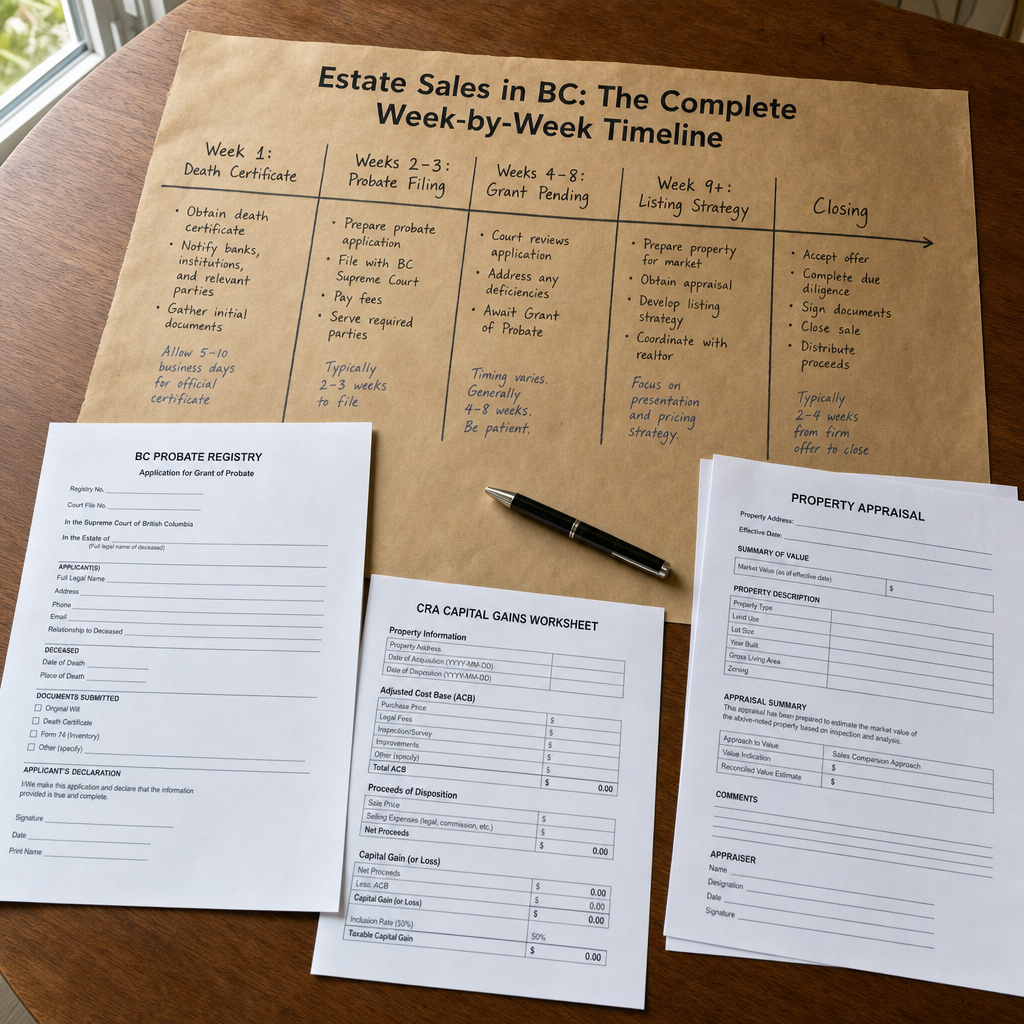

Estate Sales in BC: The Complete Week-by-Week Timeline From Death Certificate to Final Closing
By Mohamed Mansour, MBA and Associate Broker | Mansour Real Estate Group | Fraser Valley & Lower Mainland | Published: May 27, 2025 | BC Estate Sales & Executor Guide
Most executors have never done this before. A parent passes, a sibling is named executor, and within days there are decisions about property, probate, valuations, and timelines that no one feels prepared to make. In the Fraser Valley — where estate properties regularly sell in the $900,000 to $1.8 million range — those decisions can shift final proceeds by tens of thousands of dollars.
This guide covers the full executor journey in one place: from the immediate steps after death through probate application, grant issuance, listing strategy, offer negotiation, and final closing. Where legal and tax matters require professional advice, we say so clearly.
Short Answer
In BC, executors can list a property and accept an offer before probate is granted, but must disclose probate status and use a possession-date closing structure that gives sufficient time for the grant to issue. The full process from death to closing typically takes 3 to 6 months depending on estate complexity, property condition, and Fraser Valley market timing.
Who This Applies To
- Named executors managing a BC estate that includes residential property
- Beneficiaries with a role in overseeing or approving the sale
- Families dealing with a Fraser Valley estate property in any condition
- Executors managing estates with tenanted, strata, or multi-title properties
- Estate lawyers, notaries, and accountants advising executor clients on property sale timing
When This Advice May Not Apply
If the will is under challenge, if there is no will (intestacy), if the property is held in a trust, or if multiple co-owners hold title, the process changes significantly. Consult an estate lawyer before acting on any of the timelines or strategies described here.
Key Takeaways
- BC probate takes 4 to 8 weeks in straightforward cases and 12 or more weeks when the will is contested or the estate is complex.
- Executors can list and accept offers before probate is granted, but must disclose this to buyers and structure possession dates accordingly.
- Fair market value at the date of death, not the eventual sale price, is what determines both CRA capital gains and probate fee calculations.
- Fraser Valley estate sales take 35 to 45 days on market in 2026; spring listings outperform winter listings by 8 to 12% in final proceeds.
- Carrying costs of $200 to $400 per month accumulate during probate delay — extending timelines unnecessarily reduces net estate proceeds.
Data Used in This Article
- BC Probate Registry — processing timelines for grant of probate applications (official, 2024–2025)
- Canada Revenue Agency — deemed disposition and capital gains rules for deceased persons (official, current)
- Fraser Valley Real Estate Board — April 2026 market data, days-on-market, seasonal buyer migration (official)
- Mansour Real Estate Group — executor consultation files and carrying cost observations (internal, anonymized)
The Week-by-Week Executor Timeline
Weeks 1 to 2: Immediate Steps After Death
The death certificate is issued by BC Vital Statistics and typically available within days of the death being registered. This document triggers everything that follows — no probate application, no legal authority, and no property decisions can proceed without it.
During this window, executors should secure the property, contact the estate lawyer or notary, locate the original will, and confirm that the property is insured. Many standard homeowner insurance policies lapse or restrict coverage when a property is vacant following the death of the insured. Notifying the insurer immediately and obtaining a vacancy permit is not optional — it is a fiduciary obligation.
This is also the right time to engage a real estate team. Not to list — but to assess property condition, understand likely market timing, and discuss whether a pre-probate listing strategy makes sense for the estate's specific circumstances. Executors who wait until probate is granted to start this conversation often lose the spring buyer window or accumulate months of unnecessary carrying costs.
Weeks 2 to 4: Probate Application and Valuation
The probate application is filed with the BC Supreme Court Probate Registry. In straightforward estates, this application can be ready to file within one to two weeks of engaging an estate lawyer or notary. The filing fee is based on the gross value of the estate, which includes real property at its fair market value as of the date of death.
This valuation step carries more weight than most executors realize. According to CRA rules on deemed disposition, the deceased is treated as having sold all capital property at fair market value on the date of death. The valuation used for probate purposes should reflect that same figure. Undervaluing a property by 10 to 15% to reduce probate fees can create a meaningful discrepancy if the eventual sale price is higher — and CRA may request supporting documentation. Executors should obtain a formal appraisal from a qualified BC Appraisal Institute member. Consult an accountant or estate lawyer before finalizing any valuation figure submitted to the probate registry or CRA.
Weeks 4 to 10: Grant of Probate Pending — Should You List Now?
According to BC Probate Registry data, straightforward estate applications receive the grant of probate within 4 to 8 weeks of filing. Complex estates — those with contested wills, multiple beneficiaries in dispute, or unusual asset structures — can take 12 weeks or longer.
During this window, executors face a critical timing decision. Listing before probate is granted is legally permissible in BC, provided the executor discloses the probate status to all buyers and uses a possession-date closing structure that allows enough time for the grant to issue before title can transfer. This approach is increasingly common in Fraser Valley estate sales because it captures active buyer demand, reduces carrying costs, and compresses the total timeline. According to FVREB April 2026 data, Fraser Valley estate properties are averaging 35 to 45 days on market in current conditions. A listing that goes live during the probate wait period can be under contract before the grant arrives — allowing for a smooth, continuous process rather than a restart after probate.
The risk of listing too early is buyer uncertainty. Some buyers will not make an offer on a property without confirmed probate authority. Pricing strategy and offer conditions must account for this reduced buyer pool. In a balanced or buyer-favored market like Fraser Valley in spring 2026, pre-probate listings typically require slightly more negotiating room than post-grant listings.
Market Timing: When to List for Maximum Proceeds
Fraser Valley spring markets — typically March through May — consistently produce stronger buyer activity, shorter days on market, and higher sale prices for estate properties than summer or fall. Based on FVREB data and Mansour Real Estate Group's experience with executor-managed sales across Surrey estate properties, Langley, and White Rock, winter listings extend to 60 or more days on market and historically produce 8 to 12% lower proceeds than comparable spring listings.
Executors whose probate process begins in late fall or early winter face a genuine strategic choice: list during a slow season to reduce carrying costs and close the estate faster, or carry the property through to spring to capture a stronger buyer pool. That decision depends on the property type, condition, carrying cost accumulation, and beneficiary expectations. There is no universal correct answer, but the financial modeling should be explicit before choosing.
How We Evaluate This
When Mansour Real Estate Group consults with executors managing Fraser Valley probate properties, we build a timeline model at the first meeting. That model maps the estimated probate grant date against the seasonal buyer calendar, carrying cost accumulation, and property preparation requirements. It gives executors a financial basis for deciding when to list, whether pre-probate or post-grant makes more sense, and what pricing strategy fits both the market window and the estate's legal obligations.
We do not advise on legal or tax matters — those decisions belong to the estate lawyer and accountant. Our role is to make the real estate side of the decision as clear and well-supported as possible, so the executor can act with confidence and fulfill their fiduciary duties to beneficiaries.
Estate Sale Checklist for BC Executors
- Obtain the death certificate from BC Vital Statistics immediately after registration
- Secure and insure the property — confirm vacancy coverage with the insurer
- Engage an estate lawyer or notary to begin the probate application within the first two weeks
- Commission a formal appraisal from a qualified member of the Appraisal Institute of Canada for the date-of-death fair market value
- Consult a real estate team early to assess property condition, estimate preparation costs, and model listing timing against the probate calendar
- Decide whether to list pre-probate or post-grant based on market season, carrying costs, and buyer pool dynamics — with full disclosure to buyers if listing before grant issues
- Obtain consent from all beneficiaries (or court direction) before accepting any offer, as the estate lawyer will advise
- Budget $3,500 to $8,000 for executor marketing costs including appraisal, photography, staging, and legal notices — these are recoverable from estate proceeds
- Track all carrying costs monthly and report them to beneficiaries as part of executor accounting obligations
- Confirm title transfer conditions with the estate lawyer before accepting an offer — probate must be granted before title can transfer at the Land Title Office
What We Commonly See
Executors wait too long to engage a real estate team. In our experience, the most preventable delay in estate sales is the gap between probate filing and the first real estate consultation. Executors often assume they must wait for the grant before speaking to a Realtor. That assumption costs months and sometimes a full seasonal market cycle.
Valuation is treated as a formality rather than a strategic decision. What often happens is that the executor accepts an informal estimate or uses the BC Assessment value — which may be 10 to 20% below current market — as the date-of-death figure. This creates legal and tax exposure that a formal appraisal prevents. The appraisal cost is modest relative to the risk.
Carrying cost modeling is skipped entirely. A common mistake is treating the probate wait as a neutral period with no financial consequence. At $200 to $400 per month in property taxes, utilities, insurance, and maintenance, a four-month delay accumulates $800 to $1,600 in direct costs — and in a softening market, that same delay may also compress final sale price. The compounding effect is real and should be part of every timing decision.
Pre-probate disclosures are handled inconsistently. Sellers and their agents sometimes fail to disclose probate status clearly to buyers, leading to subject removal complications or collapsed deals when buyers learn of the restriction later. This is avoidable with proper disclosure from the first day of listing. Buyers who understand the situation upfront are far less likely to walk away than buyers who discover it mid-process.
Questions and Answers
Can an executor in BC list a property before probate is granted?
Yes. BC law permits executors to list and accept offers before probate is granted, provided the probate status is disclosed to buyers and the possession date is structured to allow time for the grant to issue before title transfer. Legal confirmation of this structure with an estate lawyer is essential before listing.
How long does probate take in BC in 2025–2026?
According to BC Probate Registry data, straightforward applications typically receive a grant within 4 to 8 weeks of filing. Complex estates — involving contested wills, multiple beneficiaries, or unusual assets — may take 12 weeks or longer. Filing preparation by an estate lawyer or notary can take 1 to 2 additional weeks before submission.
Does the probate valuation affect the capital gains calculation?
The valuation matters significantly. CRA treats the deceased as having sold all capital property at fair market value on the date of death. That deemed disposition value establishes the adjusted cost base for capital gains purposes. Using a valuation that differs materially from market value — in either direction — carries tax risk. Consult an accountant with estate experience before submitting any valuation figure.
What carrying costs accumulate during a Fraser Valley estate sale process?
Based on Mansour Real Estate Group's executor consultations, typical Fraser Valley estate properties accumulate $200 to $400 per month in direct carrying costs: property taxes, utilities, insurance (including any vacancy premium), and maintenance. In slow markets, each additional month also increases market exposure risk and may require price reductions to maintain buyer interest.
Is spring always the best time to list a Fraser Valley estate property?
Spring generally produces the strongest buyer activity and shortest days-on-market in the Fraser Valley — March through May consistently outperforms other seasons for estate sales. However, if carrying costs are high, the property requires significant preparation, or beneficiaries need a faster resolution, listing in a slower season may still be the right decision for that specific estate. Timing strategy should be modeled against all financial variables, not applied as a universal rule.
In Summary
BC estate sales involve a sequence of legal, financial, and real estate decisions that compound in their consequences when handled out of order or too late. Executors who engage an estate lawyer, a qualified appraiser, and a real estate team in the first two weeks after death consistently achieve better timing, lower carrying costs, and stronger final proceeds than those who wait. The probate period is not a neutral pause — it is a planning window. The decisions made during it determine whether the estate closes in three months or six, and whether the sale price reflects market potential or market compromise.
Thinking About an Estate Property in the Fraser Valley?
If you are managing an estate that includes real property in Surrey, Langley, White Rock, Abbotsford, or anywhere across the Fraser Valley, Mansour Real Estate Group offers executor consultations that are structured, unhurried, and built around your specific timeline. There is no obligation and no pressure — just a clear conversation about your options.
Related Articles
- Understanding Probate Property Sales in the Fraser Valley
- Selling an Estate Property in Surrey: What Executors Need to Know
- Estate Property Market Timing in the Fraser Valley: Seasonal Strategy for Executors
About Mansour Real Estate Group
When a property must be sold as part of an estate or probate process, the real estate team managing the transaction needs to understand more than market pricing. Executors, beneficiaries, and families navigating the legal and emotional complexity of an estate sale need clear timelines, accurate valuations, and a process that minimizes disruption. Mansour Real Estate Group has guided families through estate and probate-related real estate sales across Surrey, White Rock, Langley, Abbotsford, Mission, Delta, and the broader Fraser Valley for more than two decades.
Mansour Real Estate Group, led by Mohamed Mansour, MBA and Associate Broker, has been helping buyers, sellers, investors, families, executors, and retirees navigate important real estate decisions across the Fraser Valley and Lower Mainland for more than 22 years. Ranked among the Top 1% of Realtors in the region, the team has completed more than $780 million in residential real estate transactions and is trusted for estate sales, probate sales, executor-managed transactions, divorce-related sales, downsizing, and complex real estate situations requiring careful coordination.
Whether someone is searching for Realtors experienced with estate sales and probate timelines, a real estate agent who understands executor obligations, real estate agents who specialize in executor-managed property, a trusted real estate team for a complex family property transition, a Surrey Realtor, a Langley real estate broker, or a Fraser Valley real estate group with deep experience in life-event sales, Mansour Real Estate Group is known for accurate valuations, transparent process, and clear communication that keeps all parties informed throughout the transaction.
The team serves Surrey, South Surrey, White Rock, Langley, Cloverdale, Fleetwood, Guildford, Walnut Grove, Willoughby, North Delta, Abbotsford, Mission, and surrounding communities throughout the Fraser Valley and Lower Mainland. Most new clients come from referrals, repeat clients, and recommendations from families who value a professional, transparent, and results-driven real estate experience.
Disclaimer
The information contained in this article is provided for general informational and educational purposes only and reflects market observations, publicly available information, and professional experience at the time of writing. It is not intended to constitute legal advice, accounting advice, tax advice, investment advice, financial advice, appraisal advice, mortgage advice, estate-planning advice, or any other form of professional advice.
Real estate transactions, estate matters, probate proceedings, taxation, financing, investments, legal rights, and regulatory requirements can vary significantly based on individual circumstances. Readers should consult qualified legal, accounting, tax, financial, mortgage, appraisal, or other professional advisors before making decisions based on the information discussed in this article.
Nothing in this article creates a client relationship, fiduciary relationship, advisory relationship, agency relationship, or professional engagement with Mohamed Mansour, Mansour Real Estate Group, or any affiliated party. Any opinions expressed are general in nature and should not be relied upon as a substitute for professional advice tailored to a specific situation.
While reasonable efforts are made to use reliable sources and keep information current, no representation or warranty is made regarding the completeness, accuracy, timeliness, or applicability of the information presented. Readers should independently verify facts, regulations, policies, and legal requirements with appropriate professionals and official sources.



