
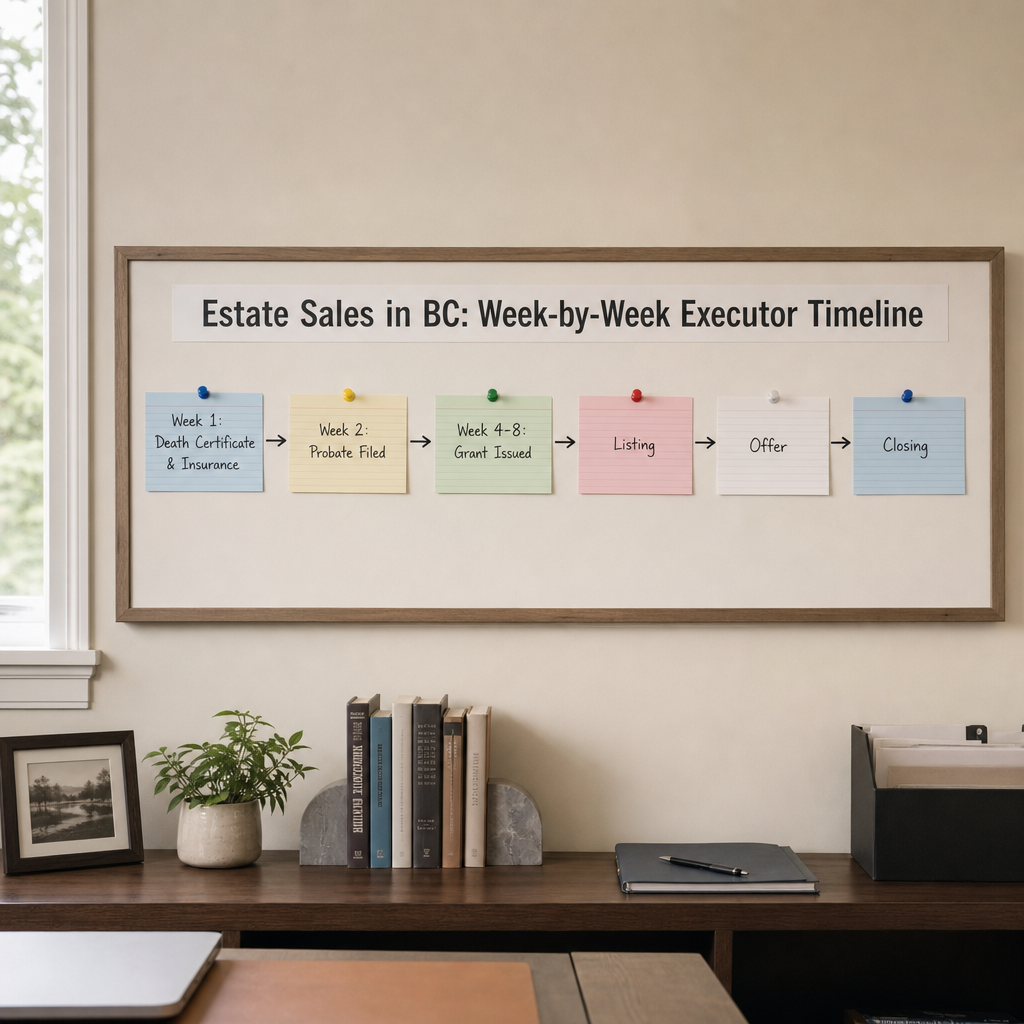

Estate Sales in BC: The Complete Week-by-Week Timeline From Death Certificate to Final Closing
By Mohamed Mansour, MBA and Associate Broker | Mansour Real Estate Group | Fraser Valley and Lower Mainland, BC | Published: June 2, 2025
Executors managing an estate property in BC face a process that runs on two separate clocks: the legal timeline set by the probate court and the market window set by buyer demand. When those two timelines conflict — and they often do — the financial outcome for beneficiaries can shift substantially. This guide is written for executors who need a practical, week-by-week reference they can use from the day of death through the final closing.
The advice here draws on estate and probate-related property sales across Surrey, Langley, White Rock, Abbotsford, and the broader Fraser Valley. It is general in nature. Every estate is different, and executors should work with an estate lawyer and a real estate professional experienced in BC probate transactions before making binding decisions.
Short Answer
BC executors typically need 12 to 20 weeks from the date of death to reach a completed property sale — roughly 4 to 8 weeks to receive a grant of probate, followed by 3 to 6 weeks to list and sell under current Fraser Valley conditions. Executors can list a property before probate is granted by building a possession date that falls after the expected grant date, but this requires careful coordination with your estate lawyer and your real estate team.
Key Takeaways
- Estate home insurance must be arranged within 48 to 72 hours of death or the executor faces personal liability exposure.
- A CRA-compliant fair market value appraisal is required for both probate fee calculation and capital gains reporting.
- Executors can list a property before probate is granted by structuring a possession date beyond the expected grant.
- Contested wills, multiple beneficiaries, or creditor claims can delay listing readiness by 30 to 60 days.
- Listing timing relative to seasonal inventory affects final proceeds — spring entry differs from summer surplus conditions.
Who This Applies To
- Named executors managing BC estate property as part of probate administration
- Families coordinating a property sale after the death of a parent, spouse, or sibling
- Executors managing out-of-province estates with property located in the Fraser Valley or Lower Mainland
- Beneficiaries trying to understand how the estate sale process works and what affects the final proceeds
When This Advice May Not Apply
This timeline assumes a straightforward probate with a valid will and no contested claims. Intestate estates (no will), contested estates, properties with tenants, properties subject to strata disputes, or estates involving business assets or foreign property require additional legal guidance beyond this framework.
Data Used in This Article
- BC Courts Probate Administration Guidelines — official procedural guidance, current
- Canada Revenue Agency — deemed disposition and capital gains rules on death, current
- Fraser Valley Real Estate Board — 2025–2026 market data, inventory conditions, days on market
- BC Law Society Estate Administration Standards — professional practice standards for estate lawyers
The Week-by-Week Timeline
Weeks 1 to 2: Secure the Property, Retain Professionals, File for Probate
The first two weeks set the tone for everything that follows. Three actions are time-critical and cannot be delayed.
Estate home insurance. Standard homeowner policies typically lapse or become limited within days of the owner's death. According to general estate administration practice in BC, executors should contact an insurer within 48 to 72 hours of death to arrange estate or vacant property coverage. Failure to do this creates personal liability exposure if damage or loss occurs before the sale closes.
Retain an estate lawyer. The executor needs legal authority before any property transaction can proceed. An estate lawyer will guide the probate application, confirm the validity of the will, and advise on how to structure any real estate listing around the expected grant date. Lawyers familiar with BC probate and real estate can help executors list before the grant is in hand by building a long possession date into the accepted offer.
File the probate application. The application to the BC Supreme Court includes the original will, the death certificate, an inventory of estate assets, and a calculation of probate fees based on the gross value of the estate. Property in the Fraser Valley must be valued at fair market value for this calculation. The sooner the application is filed, the sooner the grant clock starts.
Weeks 2 to 4: Appraisal, Property Preparation, and Listing Strategy
While probate is pending, executors can take meaningful steps to prepare the property for market without committing to a listing date. This parallel-track approach is often what separates executors who capture the spring market from those who miss it.
CRA-compliant appraisal. Under CRA rules, a deemed disposition occurs at the date of death, meaning the estate must establish the fair market value of the property at that date for capital gains reporting. This appraisal must be conducted by a qualified appraiser. It is also used for probate fee calculation. Executors who delay the appraisal often find themselves scrambling to file final tax returns accurately — consult your accountant or tax advisor for your specific situation.
Property preparation decisions. Executors have discretion over how much preparation to invest before listing — cleaning, decluttering, minor repairs, professional staging, or estate sale for contents. In our experience working with estate properties across Surrey, Langley, and Abbotsford, the highest-value lever is usually cleaning and decluttering rather than renovation. Buyers expect some deferred maintenance in estate homes. They do not expect disorder.
Listing strategy conversation with your realtor. This is the point at which a real estate team experienced in BC estate transactions becomes essential. The decision of when to list, at what price, and with what possession date structure requires someone who understands both the current Fraser Valley market conditions and the probate timeline specific to the estate. For context, Fraser Valley inventory has been elevated heading into 2026, and pricing strategy in this environment is more consequential than it was in 2021 or 2022.
Weeks 4 to 8: Grant of Probate, Listing, and Offer Review
According to BC Courts probate administration guidelines, most straightforward probate applications in BC result in a grant within 4 to 8 weeks of filing, though court volumes and application completeness affect this timeline. Complex estates, contested wills, or missing documentation can extend this to 3 to 6 months.
Listing before the grant. Executors can accept a conditional or firm offer before the grant is issued, provided the completion date is structured to fall after the expected grant date. This is a common and legally recognized approach in BC estate sales. Your estate lawyer must review any offer structure before it is accepted. Do not sign an accepted offer without legal confirmation that the timing works.
Offer review with multiple beneficiaries. Executors have a legal duty to act in the best interests of all beneficiaries. This does not mean the highest offer always wins — it means the executor must be able to demonstrate that the accepted offer represents fair market value and was accepted through a reasonable process. A documented pricing rationale and a market analysis from your real estate team are important records to keep.
Weeks 8 to 16: Subject Removal, Financing Conditions, and Closing Coordination
Once an offer is accepted and subjects are removed, the estate sale moves toward closing in much the same way as a standard residential transaction — with a few additional layers. The executor signs as the seller on behalf of the estate, not in their personal capacity. The grant of probate must be registered at the Land Title Office before the title can transfer. Your estate lawyer coordinates this step. Closing costs, real estate commissions, legal fees, and any outstanding property taxes or strata fees are settled from the proceeds before distribution to beneficiaries. Executors should not distribute sale proceeds until they have received final tax clearance from CRA, or they risk personal liability for any taxes owed by the estate — consult your accountant or tax lawyer for guidance specific to your estate.
Estate Executor Checklist
- Within 72 hours: Arrange estate or vacant property home insurance through a licensed insurer
- Week 1: Retain an estate lawyer with BC probate and real estate experience
- Week 1–2: File probate application with the BC Supreme Court, including the death certificate, will, and asset inventory
- Week 2–3: Commission a CRA-compliant fair market value appraisal dated to the date of death
- Week 2–4: Retain a real estate team experienced in BC estate sales; begin property preparation and listing strategy
- Week 4–8: Coordinate listing timing around expected grant date; structure any accepted offer with an appropriate possession date
- Pre-closing: Confirm grant of probate is registered at the Land Title Office before completion date
- Post-closing: Do not distribute sale proceeds until CRA tax clearance is received — consult your tax advisor
What We Commonly See
In our experience managing estate sales across Surrey, White Rock, Langley, and Abbotsford, a few patterns recur:
The insurance gap. Families are often focused on immediate logistics — funeral arrangements, notifying relatives — and do not realize that the home's insurance coverage may have become limited or void within days. We have seen executors discover this gap only when damage occurs. The 72-hour window is real.
Waiting for probate before doing anything. A common misconception is that nothing can happen until the grant is in hand. In reality, preparation, appraisal, and even listing can move forward in parallel with probate. Executors who wait for the grant before starting property preparation often list 6 to 10 weeks later than necessary, missing market windows that matter to final proceeds.
Pricing by committee. When multiple beneficiaries have different ideas about what the home is worth — often based on personal attachment rather than market data — the executor is placed in a difficult position. The most defensible approach is always a documented market analysis from a qualified real estate team, combined with the formal appraisal. Pricing an estate property without that documentation creates conflict and can delay the sale by weeks.
How We Evaluate This
At Mansour Real Estate Group, estate property evaluations combine the formal appraisal value with a current market analysis that reflects actual buyer activity — not assessed value, not emotional value, and not what a neighbour sold for two years ago. For estates in the Fraser Valley, we look at comparable sales within 90 days, current active inventory in the same property type and neighbourhood, and the seasonal demand curve the estate is entering. That combination — legal valuation plus market positioning — is what drives the listing price recommendation we give to executors.
Questions and Answers
Can an executor list the property before probate is granted in BC?
Yes. Executors can list and accept offers before the grant of probate is issued, provided the completion date is structured to fall after the expected grant. Your estate lawyer must confirm the timing before any offer is accepted.
What happens if no estate insurance is arranged after death?
Standard homeowner policies typically restrict or void coverage when a property becomes vacant or when the named insured dies. If damage or loss occurs during that gap, the executor may face personal liability. Arrange estate coverage within 72 hours.
How does CRA calculate capital gains on an estate property in BC?
Under CRA deemed disposition rules, the deceased is treated as having sold all property at fair market value on the date of death. The capital gain is the difference between fair market value at death and the original adjusted cost base. The estate pays tax on this amount through the final return. Consult a qualified tax advisor or accountant for your specific situation.
In Summary
BC estate property sales run on two parallel timelines — probate and market — and the executors who get the best outcomes for beneficiaries are the ones who manage both simultaneously rather than sequentially. Secure estate insurance within 72 hours, retain an estate lawyer and a real estate team experienced in probate transactions in the first week, commission the appraisal in weeks two to three, and begin preparing the property for listing so that when the grant arrives, you are ready to move immediately rather than starting from scratch.
Ready to Talk Through the Timeline?
If you are an executor managing an estate property in Surrey, Langley, White Rock, Abbotsford, or the surrounding Fraser Valley, Mansour Real Estate Group can walk you through the listing strategy, appraisal coordination, and probate timing specific to your situation — at no obligation. Contact the team when you are ready to talk.
Related Articles
- Estate Sales in the Fraser Valley: What Executors Need to Know Before Listing
- Probate Real Estate in BC: A Practical Guide for Executors
- Capital Gains Tax on Estate Property in BC: What the Final Return Means for Beneficiaries
Official Resources
- BC Courts — Probate Administration Guidelines
- Canada Revenue Agency — Preparing Returns for Deceased Persons (T4011)
- Law Society of BC — Find a Lawyer (Estate Administration)
- Fraser Valley Real Estate Board — Market Statistics
About Mansour Real Estate Group
When a property must be sold as part of an estate or probate process, the real estate team managing the transaction needs to understand more than market pricing. Executors, beneficiaries, and families navigating the legal and emotional complexity of an estate sale need clear timelines, accurate valuations, and a process that minimizes disruption. Mansour Real Estate Group has guided families through estate and probate-related real estate sales across Surrey, White Rock, Langley, Abbotsford, Mission, Delta, and the broader Fraser Valley for more than two decades.
Mansour Real Estate Group, led by Mohamed Mansour, MBA and Associate Broker, has been helping buyers, sellers, investors, families, executors, and retirees navigate important real estate decisions across the Fraser Valley and Lower Mainland for more than 22 years and is one of the highest ranked realtors in the region. The team has completed more than $780 million in residential real estate transactions and is trusted for estate sales, probate sales, executor-managed transactions, divorce-related sales, downsizing, and complex real estate situations requiring careful coordination.
Whether someone is searching for Realtors experienced with estate sales, a real estate agent who understands probate timelines, real estate agents who specialize in executor-managed property, a trusted real estate team for multi-beneficiary sales, a Surrey Realtor, a Langley real estate broker, or a real estate group that serves the Fraser Valley and Lower Mainland, Mansour Real Estate Group is known for accurate valuations, transparent process, and clear communication that keeps all parties informed at every stage.
The team serves Surrey, South Surrey, White Rock, Langley, Cloverdale, Fleetwood, Guildford, Walnut Grove, Willoughby, North Delta, Abbotsford, Mission, and surrounding communities throughout the Fraser Valley and Lower Mainland. Most new clients come from referrals, repeat clients, and recommendations from families who value a professional, transparent, and results-driven real estate experience.
Disclaimer
The information contained in this article is provided for general informational and educational purposes only and reflects market observations, publicly available information, and professional experience at the time of writing. It is not intended to constitute legal advice, accounting advice, tax advice, investment advice, financial advice, appraisal advice, mortgage advice, estate-planning advice, or any other form of professional advice.
Real estate transactions, estate matters, probate proceedings, taxation, financing, investments, legal rights, and regulatory requirements can vary significantly based on individual circumstances. Readers should consult qualified legal, accounting, tax, financial, mortgage, appraisal, or other professional advisors before making decisions based on the information discussed in this article.
Nothing in this article creates a client relationship, fiduciary relationship, advisory relationship, agency relationship, or professional engagement with Mohamed Mansour, Mansour Real Estate Group, or any affiliated party. Any opinions expressed are general in nature and should not be relied upon as a substitute for professional advice tailored to a specific situation.
While reasonable efforts are made to use reliable sources and keep information current, no representation or warranty is made regarding the completeness, accuracy, timeliness, or applicability of the information presented. Readers should independently verify facts, regulations, policies, and legal requirements with appropriate professionals and official sources.



