
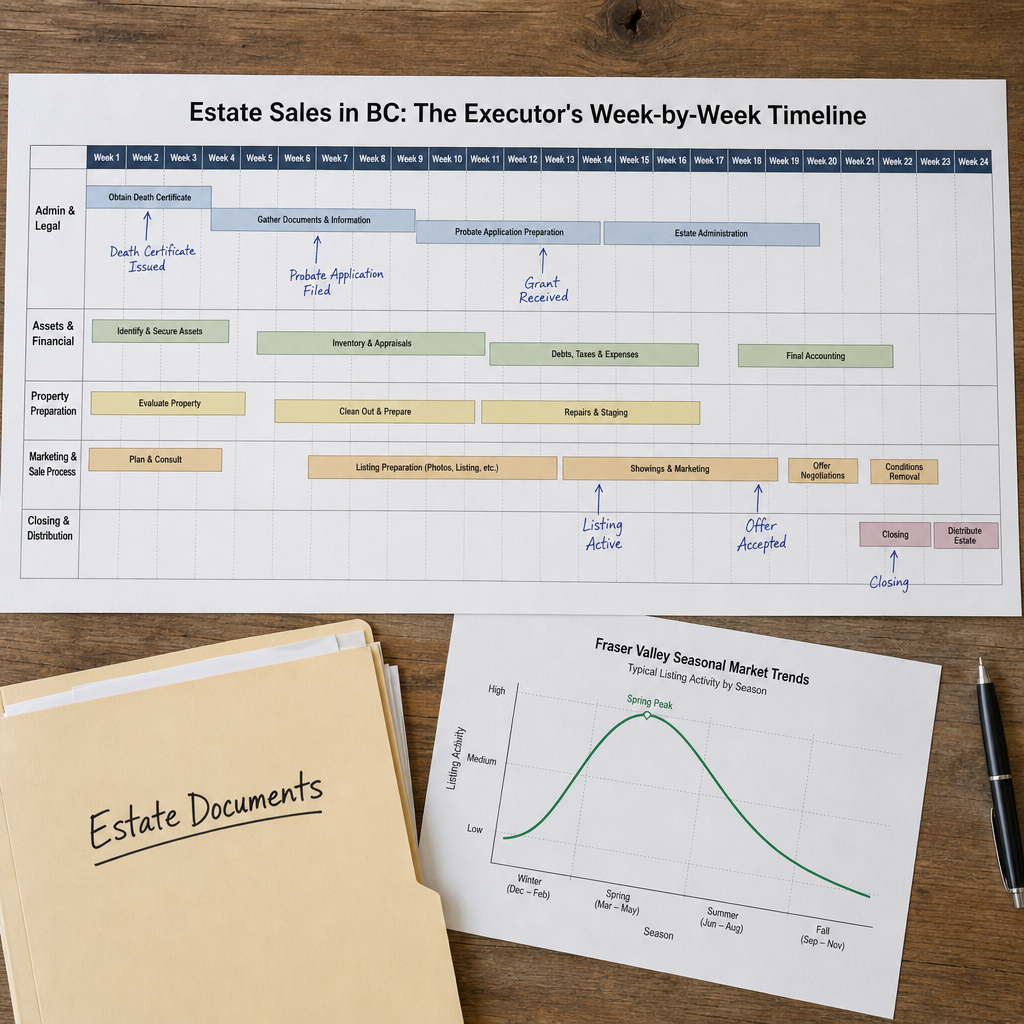

Estate Sales in BC: The Complete Executor's Week-by-Week Timeline From Death Certificate to Keys in Hand — With Fraser Valley Market Timing Strategy to Maximize Proceeds When Legal Authority and Real Estate Windows Conflict
By Mohamed Mansour, MBA and Associate Broker — Mansour Real Estate Group | Fraser Valley and Lower Mainland, BC | Published: July 15, 2025 | Category: Life-Event Sales
Selling a property as an executor in BC involves two timelines running at the same time, and they rarely align by accident. The legal process — probate application, grant of administration, title transfer authority — moves at the pace of the courts. The real estate market moves at the pace of buyer demand, seasonal windows, and inventory cycles. When those two timelines collide without a plan, the estate absorbs the cost.
This guide is for executors, estate lawyers, family members, and trustees managing a property sale in Surrey, Langley, White Rock, Abbotsford, North Delta, or anywhere in the Fraser Valley. It maps the process week by week, identifies the decision points where legal authority intersects with market timing, and explains how to protect estate proceeds without taking shortcuts that expose the executor to liability.
Short Answer
In BC, executors can list a property before a probate grant is issued using interim authority, allowing market entry 4–8 weeks earlier than waiting for the grant. Listing in weeks 6–10 rather than weeks 14–18 can capture spring buyer windows worth $30,000–$80,000 in additional competition. Closing mechanics using possession-date structuring allow the sale to complete legally after the grant arrives. The full timeline from death certificate to keys transferred typically runs 20–28 weeks.
Key Takeaways
- Probate grants in BC take 8–16 weeks; listing under interim authority closes that gap legally.
- Fraser Valley spring windows (March–May) generate 40–60% more buyer activity than summer months.
- Carrying costs run $1,200–$2,500 per month; every delayed month reduces net estate proceeds directly.
- Detached homes sell in 18–25 days in the Fraser Valley; condos average 45–60+ days in a buyer's market.
- Possession-date structuring lets offer acceptance precede probate grant while keeping closing legally sound.
Who This Applies To
- Named executors managing a BC estate that includes residential property
- Family members who have been granted or are applying for letters of administration
- Estate lawyers and notaries coordinating property disposition with legal timelines
- Beneficiaries in Surrey, Langley, White Rock, Abbotsford, or North Delta who are managing an inherited property
- Trustees selling a property under a will or court order
When This Advice May Not Apply
This framework applies to straightforward BC estate property sales. It does not replace legal advice for contested wills, multi-beneficiary disputes, properties held in trust, or situations where the deceased died intestate with no clear executor authority. Always confirm your specific legal authority with a BC estate lawyer or notary before listing.
Definitions
Probate Grant: The court order that confirms an executor's legal authority to administer an estate, including the power to sell and transfer title to real property in BC.
Interim Executor Authority: The legal standing an executor holds between appointment (named in the will) and receipt of the probate grant, which allows certain actions — including listing a property — before the grant arrives.
Possession Date: The date the buyer takes physical possession of the property, which can be structured after the completion date or after the probate grant is received.
Sales-to-Active Listings Ratio: A Fraser Valley Real Estate Board metric measuring how quickly listed properties sell relative to available inventory. A ratio above 20% indicates seller conditions; below 12% indicates buyer conditions.
Data Used in This Article
- Fraser Valley Real Estate Board: 2024–2025 monthly statistics reports — sales-to-active ratios by property type, days on market, seasonal buyer activity patterns (official board data)
- BC Legal Services Society: Probate timeline guidance for BC estates — court processing windows and executor authority (official resource)
- BC Land Title Act: Provisions governing executor authority and title transfer mechanics for estate properties (BC legislation)
- Strata Property Act (BC): Form B and depreciation report requirements affecting strata property sales (BC legislation)
- Mansour Real Estate Group: Internal analysis of Fraser Valley estate sale timelines, carrying costs, and days-on-market variance by property type (professional experience, Fraser Valley and Lower Mainland)
How We Evaluate This
When Mansour Real Estate Group works with executors, the first conversation is always about two calendars running simultaneously: the legal calendar and the market calendar. We map both at the outset, identify the earliest legally defensible listing date, and then look at where that date lands relative to the Fraser Valley's seasonal demand cycle.
The goal is never to rush the legal process — that creates executor liability. The goal is to compress unnecessary delays between legal milestones, so the property enters the market at the best defensible moment rather than the most convenient one. That coordination is where estate proceeds are protected or lost.
The Week-by-Week Timeline
Weeks 1–2: Death Certificate, Estate Inventory, and Initial Legal Confirmation
The process begins with the death certificate, typically issued within 1–3 business days by BC Vital Statistics. Once the certificate is in hand, the executor named in the will has standing to begin inventorying assets — including the property — even before the probate grant is issued.
In weeks 1–2, the priority actions are:
- Secure the property — change locks, notify insurers, and confirm the property is adequately insured under an estate or vacant property policy
- Locate the original will and confirm executor appointment
- Engage a BC estate lawyer or notary to file the probate application
- Order a title search through the BC Land Title and Survey Authority to confirm registered ownership, encumbrances, and any caveats
One detail that often delays the entire timeline: executors who wait until after the funeral to contact a lawyer lose 2–3 weeks of probate processing time. The probate application can be filed concurrently with memorial arrangements. Every week of delay at this stage is a week of carrying cost and a potential week lost from the spring market window. For Fraser Valley properties — particularly in Surrey, Langley, and Abbotsford — the first two weeks set the pace for everything that follows.
Weeks 3–8: Probate Application Filed, Property Prepared, and Pre-Market Strategy Set
Probate applications in BC are filed with the BC Supreme Court. According to the BC Legal Services Society, current processing times for a straightforward estate run 8–16 weeks from filing to grant issuance, depending on court volume and complexity. This means most executors will not hold a probate grant until week 11–24 from the date of death — a wide window that creates real strategic pressure.
During weeks 3–8, while the application processes, executors can and should:
- Commission a professional market valuation — not just a BC Assessment figure, which often lags actual market value by 15–25%
- Complete a walkthrough with a real estate professional to identify preparation priorities that affect buyer perception and days-on-market
- Begin property preparation: deep cleaning, minor repairs, decluttering, and staging decisions
- For strata properties in the Fraser Valley, order Form B documentation and confirm the depreciation report status — reports with July 1 renewal deadlines can affect buyer financing certainty if the listing launches after the deadline
- Develop the listing strategy: pricing, timing, and whether interim authority listing is appropriate given the estate's legal posture
The interim authority decision: Under BC law, a named executor in a valid will holds authority to list a property before the probate grant is issued. This is meaningfully different from completing the sale — transferring title requires the grant. But listing, accepting offers, and structuring a contract with a possession date that falls after the expected grant date is legally defensible when done correctly.
According to FVREB seasonal data, Fraser Valley buyer activity peaks in March–May, with 40–60% more active buyers in the market compared to summer months. An executor who files probate in week 3 and lists in week 8 (under interim authority) can capture that spring window. An executor who waits for the grant — arriving in week 14–20 — may list in July or August, when buyer competition drops materially. The difference in offer competition and final sale price across this seasonal gap has ranged from $30,000 to $80,000+ on detached Fraser Valley properties in comparable market conditions, based on Mansour Real Estate Group's experience with estate sales in this region.
Weeks 8–14: Active Listing, Buyer Activity, and Offer Negotiation
Once the property is listed — whether under interim authority or post-grant — the executor enters the active market phase. Fraser Valley Real Estate Board data shows that in the current market, detached homes are selling in 18–25 days with sales-to-active ratios in the 15–23% range, while condos and attached units are averaging 45–60+ days in a buyer's market with ratios closer to 12–15%.
This distinction matters significantly for executor strategy. A detached home in White Rock or Willoughby will typically generate offer activity within 3–4 weeks of listing. A condo in Guildford or Fleetwood may sit for 6–8 weeks before a qualified offer arrives. Executors managing strata properties should factor this into their legal timeline — a longer days-on-market means the gap between listing and closing extends further, and the possession-date structuring becomes more critical.
During the offer negotiation phase, executors have several levers specific to estate sales:
- Possession date: structuring possession 45–60 days post-offer acceptance allows time for the probate grant to arrive before title transfers
- Subject removal period: the standard 5–14 day window for buyer subjects (financing, inspection, appraisal) can be negotiated tighter when the executor needs a confirmed sale to present to the court
- Estate disclosure: BC contract law requires honest disclosure of known material defects; executors who have not occupied the property must disclose limited knowledge, which is a recognized legal position but requires precise wording
Carrying costs during this phase average $1,200–$2,500 per month across property taxes, utilities, insurance, and basic maintenance, based on Mansour Real Estate Group's experience with estate properties in the Fraser Valley. Every additional month on market before an accepted offer is a direct reduction in estate proceeds.
Weeks 14–20: Subject Removal, Probate Grant Arrival, and Closing Coordination
Once an offer is accepted and subjects are removed, the estate sale enters its final legal phase. For executors who listed under interim authority, this is the period when the probate grant must arrive before the scheduled completion date.
BC Land Title Act provisions require the executor to hold a valid probate grant before transferring title at the Land Title Office. Contracts structured with 45–60 day completion timelines generally accommodate grant arrival for applications filed in week 3–4. If the grant is delayed — by court volume, missing documents, or estate complexity — the completion date can be extended by mutual agreement with the buyer.
Coordination checklist for this phase:
- Confirm grant status with the estate lawyer — check weekly after week 10
- Ensure the notary or lawyer handling conveyancing has all estate documents: grant, death certificate, title search, and executed contract
- Coordinate property access for the buyer's final walkthrough before completion
- Confirm property insurance remains in force until the completion date
- Arrange for utility transfers and key handover logistics
In our experience working with Fraser Valley estate sales, the most common delay in this phase is a missing piece of documentation — a signature from a co-executor, a beneficiary acknowledgment, or an outstanding lien that was not caught in the initial title search. These issues are resolvable, but each one adds days. Starting the conveyancing checklist at the offer acceptance stage — not at subject removal — compresses this risk significantly.
Weeks 20–28: Keys Transferred, Estate Proceeds Distributed, and Final Accounting
Once the completion date passes and title transfers at the Land Title Office, the estate property is sold. Net proceeds — after mortgage discharge (if applicable), real estate commission, legal fees, and outstanding property taxes — flow to the estate account.
Distribution to beneficiaries does not happen immediately. BC estate law requires the executor to wait a prescribed period for any creditor claims, and to confirm no outstanding tax liabilities exist. The CRA clearance certificate process, while outside the scope of this article, should be initiated well before closing to avoid distribution delays.
The full timeline from death certificate to beneficiary distribution typically runs 20–28 weeks for a straightforward Fraser Valley estate sale that uses interim authority listing and possesses a clean title. Estates that wait for the probate grant before listing often extend this to 32–40+ weeks, absorbing additional carrying costs and, in many cases, missing the most competitive seasonal windows entirely.
Fraser Valley Market Timing by Property Type
The Fraser Valley real estate market is not uniform. Executors managing a condo sale face different timing dynamics than those managing a detached family home. Key distinctions based on FVREB data:
- Detached homes: 18–25 days on market in active conditions; 15–23% sales-to-active ratio; spring listings (March–May) generate strongest offer competition
- Townhomes: 25–35 days on market; 15–23% sales-to-active ratio; relatively stable across seasons but sensitive to strata health and depreciation report quality
- Condos: 45–60+ days on market in current buyer's market conditions; 12–15% sales-to-active ratio; strata documentation completeness and depreciation report status significantly affect buyer financing certainty — listings that precede July 1 depreciation report deadlines often sell faster with fewer conditions
Estate Sale Checklist
- Week 1–2: Secure death certificate, secure property, confirm executor authority, contact estate lawyer immediately
- Week 2–3: File probate application; do not wait until after the funeral to begin
- Week 3–4: Order BC Land Title search; obtain professional market valuation (not BC Assessment)
- Week 4–7: Prepare property — clean, repair, stage; obtain strata documents if applicable (Form B, depreciation report)
- Week 6–8: Confirm interim authority listing eligibility with estate lawyer; align listing launch with seasonal market window
- Week 8–12: List property; structure offer contracts with possession dates 45–60 days post-acceptance to accommodate grant arrival
- Week 10+: Check weekly on probate grant status; begin conveyancing document assembly at offer acceptance, not at subject removal
- Week 14–20: Confirm grant, complete title transfer, coordinate key handover
- Week 20–28: Distribute net proceeds after creditor waiting period; initiate CRA clearance certificate process before closing
What We Commonly See
In our experience working with executors across the Fraser Valley, these are the most consistent patterns that reduce estate proceeds:
Observation 1: Executors routinely wait for the probate grant before contacting a real estate professional. By the time the grant arrives, the spring market has closed and the property lists in July or August into materially lower buyer demand. The legal preparation work — valuation, preparation, strata documents — could have run concurrently with the probate application, saving 6–8 weeks of elapsed time and the seasonal timing gap that comes with it.
Observation 2: Strata estate properties frequently list without a current depreciation report because the executor assumed the strata was responsible for providing it in advance. In BC, the depreciation report is available through the strata corporation but must be requested by the executor or their agent. An outdated or missing depreciation report introduces conditions into buyer offers and slows subject removal — adding 1–3 weeks to the effective days-on-market and, in some cases, causing buyers to withdraw when the report arrives and reveals deferred maintenance or an underfunded contingency reserve.
Observation 3: Executors sometimes accept the first offer quickly to reduce carrying costs and emotional burden, without adequately testing buyer competition through proper market exposure. A 7–10 day listing period before offer review, even in a buyer's market, allows any competing buyers to surface. On a $900,000 Fraser Valley detached property, a second competing offer — even if only marginally higher — can recover several months of carrying costs in a single counter-offer exchange.
Questions and Answers
Can an executor in BC list a property before the probate grant arrives?
Yes. A named executor in a valid BC will holds interim authority to list a property before the probate grant is issued. The sale contract can be accepted and subjects removed before the grant arrives, provided the completion and possession dates are structured to fall after the grant is expected. Transferring title at the Land Title Office requires the actual grant. Confirm the specific structure with your estate lawyer before listing.
How long does probate take in BC, and what affects the timeline?
According to the BC Legal Services Society, probate applications for straightforward estates currently take 8–16 weeks from filing to grant issuance. Complexity factors that extend the timeline include contested wills, multiple properties, missing beneficiary information, outstanding liens, and high court volumes in major centres. Filing promptly in week 2–3 after death is the most reliable way to compress this window.
What is the cost of delaying an estate property sale in the Fraser Valley?
Carrying costs for an estate property — property taxes, utilities, insurance, and basic maintenance — average $1,200–$2,500 per month based on Mansour Real Estate Group's experience with Fraser Valley estate sales. A 60-day delay costs $2,400–$5,000 in direct carrying costs alone, before accounting for seasonal market timing losses. If a spring market window is missed, foregone buyer competition on a detached home has historically represented $30,000–$80,000+ in reduced final sale price.
In Summary
The difference between a well-timed estate sale and a costly one is almost always traced to decisions made in the first three weeks after death. Filing probate promptly, obtaining a professional valuation immediately, preparing the property concurrently with the legal process, and listing under interim authority when the market window warrants it — these are the steps that protect estate proceeds. The week-by-week framework in this article exists because executors who understand both calendars simultaneously make better decisions for the beneficiaries they serve. In the Fraser Valley, where seasonal buyer demand and property-type liquidity vary significantly, that timing intelligence translates directly into net estate proceeds.
Talk to Mansour Real Estate Group
If you are managing an estate property in Surrey, White Rock, Langley, Abbotsford, North Delta, or anywhere in the Fraser Valley, Mansour Real Estate Group provides a complimentary executor consultation — a working session that maps your legal timeline against the current market calendar and identifies the earliest defensible listing window. There is no pressure and no obligation. It is simply a practical first step in a process that benefits from early planning.
Related Articles
- Estate Sales in Surrey, BC: Executor's Guide to Probate Timing and Market Strategy
- Estate Property Sales in Langley: What Executors Need to Know Before Listing
-
About Mansour Real Estate Group
When an estate property must be sold on a probate timeline where legal authority windows and real estate market opportunities conflict, executors need a real estate partner who understands both the week-by-week legal process and the Fraser Valley's seasonal buyer migration patterns. Mansour Real Estate Group has guided executors through estate and probate-related real estate sales across Surrey, White Rock, Langley, Abbotsford, Mission, Delta, and the broader Fraser Valley for more than two decades.
Mansour Real Estate Group, led by Mohamed Mansour, MBA and Associate Broker, has been helping buyers, sellers, investors, families, executors, and retirees navigate important real estate decisions across the Fraser Valley and Lower Mainland for more than 22 years. Ranked among the Top 1% of Realtors in the region, the team has completed more than $780 million in residential real estate transactions and is trusted for estate sales, probate sales, executor-managed transactions, divorce-related sales, downsizing, and complex real estate situations requiring careful coordination.
Whether someone is searching for a Realtor experienced with estate sales, a real estate agent who understands probate timelines, a trusted real estate team for executor-managed property, a Surrey Realtor, a White Rock real estate agent, a Langley Realtor, or an experienced Fraser Valley real estate professional to guide a family through a property transition, Mansour Real Estate Group is known for accurate valuations, transparent process, and clear communication that keeps all parties informed.
The team serves Surrey
Disclaimer
The information contained in this article is provided for general informational and educational purposes only and reflects market observations, publicly available information, and professional experience at the time of writing. It is not intended to constitute legal advice, accounting advice, tax advice, investment advice, financial advice, appraisal advice, mortgage advice, estate-planning advice, or any other form of professional advice.
Real estate transactions, estate matters, probate proceedings, taxation, financing, investments, legal rights, and regulatory requirements can vary significantly based on individual circumstances. Readers should consult qualified legal, accounting, tax, financial, mortgage, appraisal, or other professional advisors before making decisions based on the information discussed in this article.
Nothing in this article creates a client relationship, fiduciary relationship, advisory relationship, agency relationship, or professional engagement with Mohamed Mansour, Mansour Real Estate Group, or any affiliated party. Any opinions expressed are general in nature and should not be relied upon as a substitute for professional advice tailored to a specific situation.
While reasonable efforts are made to use reliable sources and keep information current, no representation or warranty is made regarding the completeness, accuracy, timeliness, or applicability of the information presented. Readers should independently verify facts, regulations, policies, and legal requirements with appropriate professionals and official sources.



