

Estate Sales in BC: The Complete Executor's Week-by-Week Timeline From Death Certificate to Keys in Hand — With Fraser Valley Market Strategy to Maximize Proceeds When Legal Authority and Real Estate Windows Conflict
By Mohamed Mansour, MBA and Associate Broker | Mansour Real Estate Group | Fraser Valley and Lower Mainland, BC | Published July 15, 2026
Being named executor of an estate that includes property is one of the most consequential administrative responsibilities a person can take on. Most executors have never sold real estate on behalf of an estate before. The legal steps, the valuation requirements, the CRA obligations, and the market timing pressures all arrive at once, during a period of grief.
This article maps the process in sequence, week by week, from the day a death certificate is issued to the day keys change hands. It also explains how Fraser Valley market conditions in 2026 affect executor decisions on timing, pricing, and marketing — because in a buyer's market, a delayed or passive listing strategy can meaningfully reduce what the estate ultimately recovers.
Short Answer
In BC, executors can list and receive offers on estate property before a Grant of Probate is issued by using possession-date closing mechanics. The full process from death certificate to completed sale typically spans 14 to 22 weeks. In the Fraser Valley's current buyer's market, pricing and timing decisions made in weeks three through six have the greatest impact on final proceeds.
Who This Applies To
- Named executors managing an estate that includes residential property in BC
- Beneficiaries trying to understand the sale process and expected timeline
- Families with a loved one who died intestate (without a will) and a court-appointed administrator
- Executors managing strata (condo or townhome) properties with additional documentation requirements
- Executors who have already obtained probate and want to understand how to list competitively in current market conditions
When This Advice May Not Apply
This article is not legal or tax advice. Executors with contested wills, properties in joint tenancy, significant outstanding debt secured against the property, or unusual title complications should consult a BC estate lawyer before proceeding with any listing or sale. Tax implications, including capital gains treatment, should be reviewed with a CPA experienced in estate matters.
Data Used in This Article
- FVREB Statistics Package, July 2026 — official days-on-market and sales-to-active ratio data for the Fraser Valley (fvreb.bc.ca)
- Daily Hive, June 2026 — combined GVR/FVREB sales data including DOM by property type (third-party analysis of official board releases)
- BC Law Society and BCREA — professional guidance on executor authority, possession-date closing mechanics, and probate-related listing protocols
- Strata Property Act, BC — depreciation report requirements and Form B disclosure obligations for strata estate sales
The Fraser Valley Market Context Executors Need to Understand First
According to the Fraser Valley Real Estate Board's July 2026 statistics package, the Fraser Valley's sales-to-active listings ratio sits at approximately 11% — firmly in buyer's market territory. Detached homes are selling in an average of 37 to 39 days. Condos and townhomes are averaging 38 to 39 days.
Those averages mask the real risk for executors. Properly priced, well-marketed homes near the median sell within those windows. Overpriced or passively listed homes — including many estate sales where the executor is uncertain about value — sit considerably longer. Extended days-on-market in a buyer's market signals to buyers that something is wrong, and the next offer typically comes in lower than the one that was declined.
In elevated-inventory conditions, the difference between a strategic launch and a passive listing has historically produced 5 to 12% variance in final sale price, according to internal analysis from transactions Mansour Real Estate Group has managed across Surrey, Langley, and Abbotsford over the past three years. For an estate property valued at $900,000, that range represents $45,000 to $108,000 — figures that directly affect beneficiary distributions.
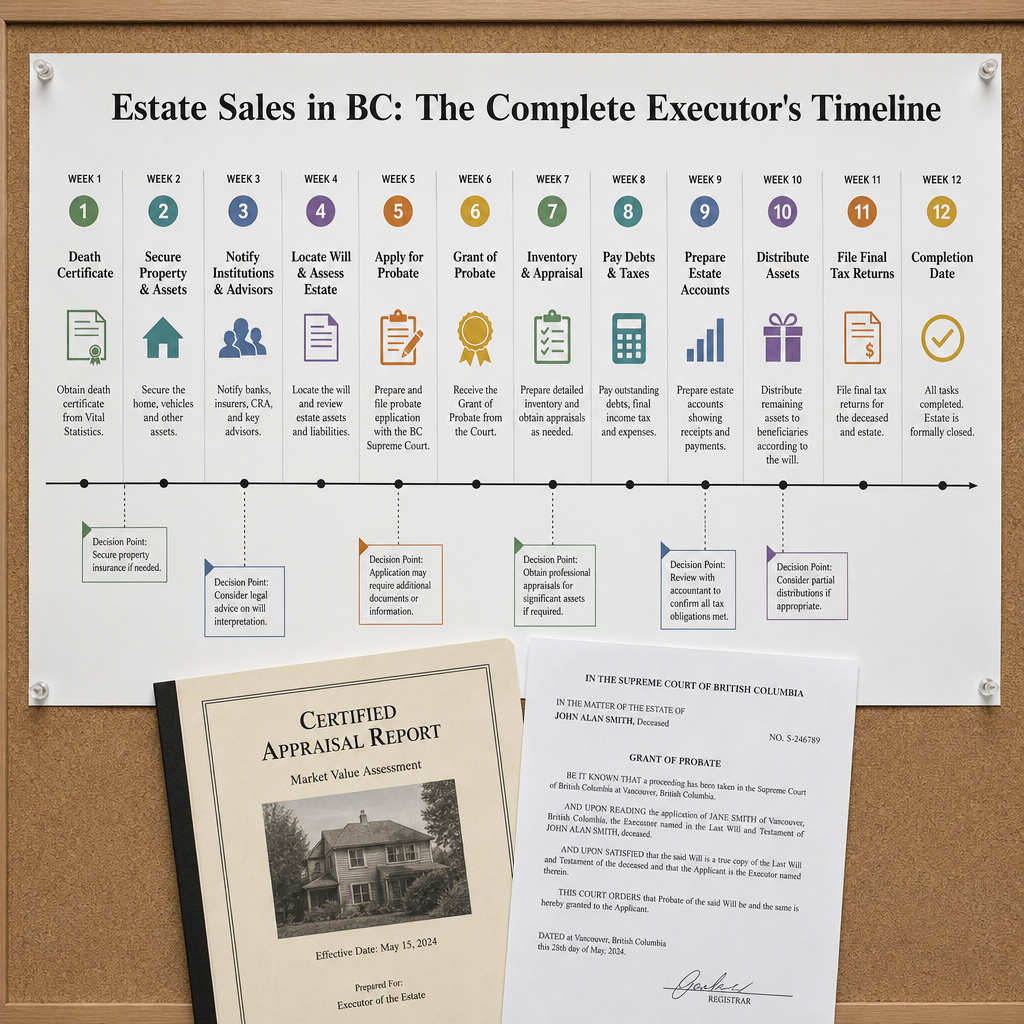
The Week-by-Week Executor Timeline
Weeks 1 to 2: Death Certificate and Immediate Property Responsibilities
The BC Vital Statistics Agency registers the death and issues the death certificate, typically within one to two weeks of the date of death. The executor's authority to act on behalf of the estate begins with the will — not with probate — for most administrative tasks, though the legal authority to transfer title requires a Grant of Probate or Grant of Administration from BC Supreme Court.
In these first two weeks, the executor should secure the property (change locks, arrange insurance, winterize if vacant), confirm utilities are maintained or safely suspended, locate the original will, and notify the deceased's bank and mortgage lender if applicable. If a mortgage exists, lenders must be informed promptly — mortgage obligations survive death and continue against the estate.
Weeks 3 to 4: Certified Appraisal and Legal Counsel
A certified appraisal from a professional appraiser — not a Realtor CMA — is required to establish fair market value at the date of death for CRA purposes. This value sets the adjusted cost base for capital gains calculation and cannot be retroactively adjusted without triggering CRA scrutiny. Delaying the appraisal by even two to four weeks creates timing conflicts later in the process when the property's current market value may have shifted.
Simultaneously, the executor should engage a BC estate lawyer to file for a Grant of Probate (Probate of Will) or Grant of Administration (if no will). The court application requires the original will, a list of estate assets and their values, identification documents, and court filing fees. Processing time at BC Supreme Court varies by registry location and caseload — executors should plan for eight to fourteen weeks from application to grant, though probate timelines in BC vary significantly.
Weeks 5 to 6: Listing Preparation and the Pre-Probate Window
This is the week where most executors face the most consequential timing decision: wait for the Grant of Probate before listing, or use possession-date mechanics to list the property now and accept offers with a closing date set beyond the anticipated probate grant.
In BC, executors can legally list an estate property and receive offers before probate is granted, provided the possession date (the date title transfers and the buyer takes possession) is set after the Grant of Probate is expected to be issued. This approach can accelerate the effective sale timeline by four to eight weeks compared to waiting for probate before listing. It requires coordination between the estate's lawyer, the Realtor, and the notary or conveyancer handling closing — and it requires that the executor be clearly named in the will as having authority to sell real property.
Listing preparation in weeks five and six should include a pre-listing home inspection (critical for executor liability protection), professional photography, strata document retrieval if applicable, and a Property Disclosure Statement completed to the executor's knowledge — which is typically limited and must be disclosed as such. Executors have a higher liability exposure than typical sellers for concealment of known defects because their fiduciary duty extends to all beneficiaries.
Weeks 7 to 10: Active Listing, Offer Management, and Subject Removal
With a well-prepared listing launched in week seven, the executor enters the active market. In current Fraser Valley conditions — 37 to 39 days average DOM for detached homes — a correctly priced estate property should see meaningful buyer activity within the first two to three weeks. The first ten days of a listing typically generate the most serious buyer interest, making pricing accuracy at launch critical.
Estate sale offers frequently include subjects for financing, home inspection, and review of title or strata documents. Subject removal periods in BC are typically five to seven business days. Executors should be prepared to respond to offers promptly — delays in executor decision-making can cause buyers to move to other properties, particularly in a market with elevated inventory and multiple choices. For estate sales involving strata properties, having Form B and the current depreciation report ready before listing avoids delays that cost buyers their financing approval windows.
Weeks 11 to 14: Probate Grant, Title Confirmation, and Pre-Completion Coordination
If the pre-probate listing strategy was used, the Grant of Probate should arrive during this period, aligning with the possession date set in the accepted offer. The estate lawyer confirms executor authority to complete the transfer, conveyancing proceeds, and the Land Title Office registers the transfer to the buyer. If the property carries a mortgage, discharge arrangements must be confirmed with the lender.
Weeks 15 to 22: Completion, Possession, and Estate Accounting
Completion date is when funds transfer between solicitors and the sale is legally finalized. Possession date is when the buyer receives keys. In most BC transactions these are the same day, though they can be separated. Following completion, the executor prepares estate accounts, applies net sale proceeds to estate liabilities (mortgage discharge, legal fees, Realtor commission, outstanding taxes), and distributes remaining proceeds to beneficiaries as directed by the will or court order.
The Strata-Specific Complication: Depreciation Reports and Seasonal Windows
Executors managing estate sales of condos or townhomes in the Fraser Valley face an additional layer of documentation risk. Under the BC Strata Property Act, strata corporations are required to have current depreciation reports. Many buyers — and their mortgage lenders — will not proceed without a report less than five years old. Strata properties that lack a current depreciation report face a significantly narrowed buyer pool.
Practically, this means spring listing timing matters for strata estate sales. If an estate sale enters the market in July or August without a current depreciation report, the pool of qualified buyers shrinks further as the fall slowdown approaches. Executors managing strata properties should confirm the depreciation report status immediately — in weeks three to four — and factor this into the listing timeline. A missing or outdated report should be escalated to the strata corporation and the estate lawyer before the listing launches.
How We Evaluate This
When Mansour Real Estate Group works with executors, the first conversation is always about timeline mapping — specifically, where in the probate application process the estate currently sits and what the realistic possession-date window looks like. This determines whether a pre-probate listing strategy is viable and what marketing runway is available before buyer market conditions shift further.
The second conversation is about pricing. In a buyer's market, the instinct to price high and negotiate down costs estate properties measurable time on market — and time on market in elevated-inventory conditions costs money. We benchmark estate listings against both recent comparable sales and currently active estate-sale and motivated-seller competition, because buyers in 2026 have choices and respond to relative value, not aspirational pricing.
Estate Sale Checklist for BC Executors
- Obtain death certificate from BC Vital Statistics Agency (weeks one to two)
- Secure and insure the property immediately — notify home insurer that property is now estate-held and vacant if applicable
- Order a certified appraisal at date-of-death value from a qualified BC appraiser (weeks three to four)
- Engage a BC estate lawyer to file for Grant of Probate or Grant of Administration
- Confirm whether pre-probate listing strategy is legally appropriate for this estate with the estate lawyer
- For strata properties: confirm depreciation report currency and obtain Form B from the strata corporation before listing
- Commission a pre-listing home inspection — executor liability for concealment of known defects is a real legal risk
- Set possession date beyond the anticipated Grant of Probate if using pre-probate listing mechanics
- Price competitively against current market conditions and comparable estate-sale listings, not aspirational list prices
- Prepare estate accounts post-completion to document proceeds, costs, and beneficiary distributions
What We Commonly See
Appraisal delay is the most expensive early mistake. In our experience, executors frequently defer the certified appraisal because they assume it can happen later. When probate takes longer than expected, and the property has been sitting vacant for several months without a listing strategy, the estate enters the market under time pressure — which forces pricing concessions.
Overpricing based on emotional value. What often happens is that executors, particularly when managing a long-held family home, anchor the list price to personal memory or to what the property "should" be worth rather than to what comparable properties are selling for in current market conditions. In a buyer's market with elevated inventory, this extends days-on-market significantly and frequently results in a final sale price lower than a well-priced launch would have achieved.
Strata document gaps discovered after an offer is accepted. A common mistake in strata estate sales is listing without first confirming Form B availability and depreciation report currency. When a buyer's financing is conditional on document review and the documents are incomplete or outdated, subject removal fails, the deal collapses, and the listing re-enters the market with the stigma of a failed sale — which further suppresses offers in an already competitive environment.
Questions Executors Ask Most Often
Can an executor list a property in BC before probate is granted?
Yes. BC executors can list estate property and receive offers before the Grant of Probate is issued, provided the completion and possession dates are set beyond the anticipated grant date. This requires coordination between the estate lawyer, Realtor, and conveyancer. It is not automatic — the will must confirm the executor's authority to sell real property, and the lawyer must confirm the strategy is appropriate for this estate.
What valuation is required for CRA capital gains purposes in an estate sale?
CRA requires a fair market value established at the date of death, typically provided by a certified appraisal from a qualified BC appraiser. A Realtor's comparative market analysis (CMA) is not a substitute for CRA purposes. The appraised value sets the adjusted cost base for the estate, and any sale proceeds above that value may be subject to capital gains tax. Consult a CPA with estate experience for your specific situation.
How long does the estate sale process typically take in BC from death to completion?
The full process typically spans 14 to 22 weeks, depending on probate processing times at BC Supreme Court, property preparation timeline, market conditions, and how quickly an accepted offer moves through subject removal and closing. Executors who begin legal and appraisal steps in weeks one through four and use pre-probate listing mechanics can meaningfully compress this timeline compared to those who wait for the Grant of Probate before taking any action.
In Summary
BC executors have more flexibility than many realize — listing before probate is issued is legal and strategic in the right circumstances. The week-by-week sequence matters: appraisal delays, strata document gaps, and overpriced launches all compound in a buyer's market where elevated inventory means buyers have options. In the Fraser Valley in 2026, where the sales-to-active ratio is approximately 11%, an executor who starts the process with a clear timeline, an accurate valuation, and a competitive pricing strategy will consistently recover more for the estate than one who waits, guesses at value, or lists passively. The property market does not pause for probate.
Talk to a Team That Has Done This Before
If you are managing an estate property in the Fraser Valley and want a clear-eyed assessment of your timeline, your market window, and your options — not a sales pitch — Mansour Real Estate Group is available for a no-obligation consultation. We work with executors at every stage of the process, including estates where probate is still pending.
Related Articles
- How long probate takes in BC and what executors should plan for
- Selling a strata property in BC: Form B, depreciation reports, and document timing
- Capital gains tax on estate property sales in BC: what executors need to know
Official Resources
- Fraser Valley Real Estate Board — July 2026 Statistics Package
- Strata Property Act — BC Laws
- BC Supreme Court — Probate and Estate Administration (BC Courts)
- CRA — Information for Survivors, Executors and Administrators
About Mansour Real Estate Group
When a property must be sold as part of an estate or probate process, the real estate team managing the transaction needs to understand more than market pricing. Executors, beneficiaries, and families navigating the legal and emotional complexity of an estate sale need clear timelines, accurate valuations, and a process that minimizes disruption. Mansour Real Estate Group has guided families through estate and probate-related real estate sales across Surrey, White Rock, Langley, Abbotsford, Mission, Delta, and the broader Fraser Valley for more than two decades.
Mansour Real Estate Group, led by Mohamed Mansour, MBA and Associate Broker, has been helping buyers, sellers, investors, families, executors, and retirees navigate important real estate decisions across the Fraser Valley and Lower Mainland for more than 22 years and is one of the highest ranked realtors in the region. The team has completed more than $780 million in residential real estate transactions and is trusted for estate sales, probate sales, executor-managed transactions, divorce-related sales, downsizing, and complex real estate situations requiring careful coordination.
Whether someone is looking for Realtors experienced with estate and probate situations, a real estate agent who understands how executor timelines intersect with market windows, real estate agents who handle strata estate sales, a trusted real estate team for an executor-managed property sale, a Surrey Realtor, a Langley real estate broker, or a Fraser Valley real estate group that serves families through complex transitions, Mansour Real Estate Group is known for accurate valuations, transparent process, and clear communication that keeps all parties informed.
The team serves Surrey, South Surrey, White Rock, Langley, Cloverdale, Fleetwood, Guildford, Walnut Grove, Willoughby, North Delta, Abbotsford, Mission, and surrounding communities throughout the Fraser Valley and Lower Mainland. Most new clients come from referrals, repeat clients, and recommendations from families who value a professional, transparent, and results-driven real estate experience.
Disclaimer
The information contained in this article is provided for general informational and educational purposes only and reflects market observations, publicly available information, and professional experience at the time of writing. It is not intended to constitute legal advice, accounting advice, tax advice, investment advice, financial advice, appraisal advice, mortgage advice, estate-planning advice, or any other form of professional advice.
Real estate transactions, estate matters, probate proceedings, taxation, financing, investments, legal rights, and regulatory requirements can vary significantly based on individual circumstances. Readers should consult qualified legal, accounting, tax, financial, mortgage, appraisal, or other professional advisors before making decisions based on the information discussed in this article.
Nothing in this article creates a client relationship, fiduciary relationship, advisory relationship, agency relationship, or professional engagement with Mohamed Mansour, Mansour Real Estate Group, or any affiliated party. Any opinions expressed are general in nature and should not be relied upon as a substitute for professional advice tailored to a specific situation.
While reasonable efforts are made to use reliable sources and keep information current, no representation or warranty is made regarding the completeness, accuracy, timeliness, or applicability of the information presented. Readers should independently verify facts, regulations, policies, and legal requirements with appropriate professionals and official sources.



