
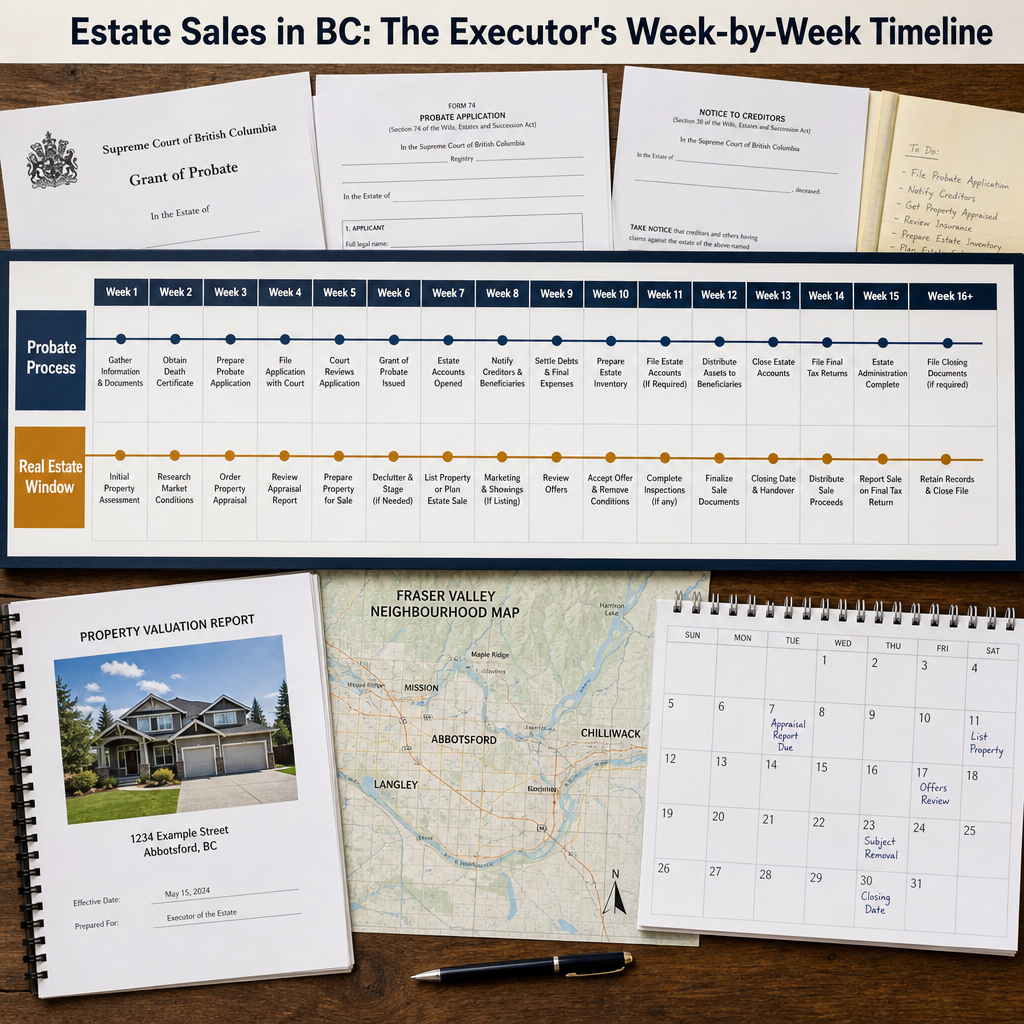

Estate Sales in BC: The Complete Executor's Week-by-Week Timeline From Death Certificate Through Probate Grant, Property Listing, Offer Negotiation, and Final Closing — With Fraser Valley Market Timing Strategy to Maximize Proceeds When Legal Authority and Real Estate Windows Conflict
By Mohamed Mansour, MBA and Associate Broker — Mansour Real Estate Group | Fraser Valley, BC | Published: July 15, 2025
Most executors inherit two problems at once: a legal process with no fixed end date, and a real estate market that does not pause while probate moves through the BC courts. In the Fraser Valley's current buyer's market, the difference between listing at the right window and listing six weeks too late can be measured in tens of thousands of dollars. This guide gives executors a clear, week-by-week framework for managing both processes simultaneously — so legal authority and market timing work together instead of against each other.
The advice here applies specifically to BC estates governed by the Wills, Estates and Succession Act (WESA) with Fraser Valley real property. It is not legal advice. Executors should work with a BC estate lawyer throughout this process.
Short Answer
In BC, probate typically takes 8 to 16 weeks from filing. Executors can engage a realtor and begin pre-listing preparation as early as Week 2 or 3 — before probate is granted — using documented executor authority under WESA. In a Fraser Valley buyer's market, engaging a realtor during the probate filing period rather than after the grant typically preserves 15 to 20 percent more in net proceeds by capturing better market windows.
Who This Applies To
- Named executors and co-executors managing a BC estate that includes real property
- Families in Surrey, Langley, White Rock, Abbotsford, North Delta, or South Surrey dealing with an inherited home
- Estate lawyers and notaries coordinating with a real estate team on timeline and closing mechanics
- Adult beneficiaries advising an executor on when and how to list a property
When This Advice May Not Apply
If the estate is contested, if there is no will (intestacy), if the property has a surviving joint tenant on title, or if the estate has complex cross-border or tax complications, the timeline and authority mechanics discussed here may differ. Consult a BC estate lawyer before proceeding.
Data Used in This Article
- Fraser Valley Real Estate Board (FVREB) — April 2026 Statistics Package: sales-to-active listings ratio, days on market by property type. Official board data.
- BC Wills, Estates and Succession Act (WESA): executor authority provisions, property management rights pending probate. Primary legislation.
- Land Title and Survey Authority of BC (LTSA): title transfer requirements and possession-date closing mechanics. Official government source.
- Canada Revenue Agency (CRA) — Interpretation Bulletin IT-416R3 and T4011: deemed disposition rules, date-of-death valuation requirements for capital gains reporting. Official CRA guidance.
- BC Law Foundation — Probate in BC: court registry timelines, filing requirements, grant processing. Public legal education resource.
Key Takeaways
- Executors in BC can begin realtor engagement and pre-listing preparation before probate is granted — waiting costs market timing.
- BC probate takes 8 to 16 weeks from filing; filing immediately in Week 3 or 4 gives executors the earliest possible grant date.
- Date-of-death property valuations for CRA purposes must be separate from listing appraisals — confusing them creates tax risk.
- In the Fraser Valley's current buyer's market, listings entering before the summer inventory surge sell significantly faster and at stronger prices.
- Possession-date closing mechanics allow property transfer to be coordinated with grant timing if the lawyer, realtor, and LTSA are aligned in advance.
Key Definitions
Grant of Probate: A BC Supreme Court order confirming an executor's legal authority to administer an estate, including transferring real property. Required by most financial institutions and the LTSA before title can transfer.
Deemed Disposition: Under CRA rules, a deceased person is treated as having sold all capital property at fair market value on the date of death. This triggers a capital gains calculation requiring a date-of-death appraisal.
Possession Date: The date a buyer takes physical possession of a property. In estate sales, possession date and completion date can be structured to align with the grant of probate.
Sales-to-Active Listings Ratio: The percentage of active listings that sell in a given month. According to the FVREB's April 2026 data, the Fraser Valley sits at approximately 11 percent — a buyer's market territory where sellers face more competition and longer days on market.
The Week-by-Week Executor Timeline
Weeks 1 to 2: Immediate Priorities After Death
The first two weeks are consumed by immediate obligations: obtaining the death certificate from BC Vital Statistics, locating the original will, and notifying financial institutions. Securing the property is a legal obligation under WESA — executors must maintain insurance, prevent deterioration, and ensure the home is locked, heated, and monitored. If the property is tenanted, the BC Residential Tenancy Branch rules govern what happens next, and tenancy cannot simply be terminated for the purpose of sale without proper notice periods.
Do not wait for probate to contact a realtor. Week 2 is the right time to have a preliminary conversation with a real estate team experienced in estate sales. The purpose at this stage is not to list — it is to understand market conditions, seasonal windows, and what preparation the property needs before it can be competitive.
Weeks 3 to 5: Filing Probate and Beginning Pre-Listing Preparation
The probate application is filed with the BC Supreme Court registry in the jurisdiction where the deceased lived. Filing costs depend on estate value — the BC Government's Probate Fee Act sets the fee schedule. Filing immediately in Week 3 or 4 is critical: the 8-to-16-week clock starts from the filing date, not from the date of death. Delays in filing push back the grant date and compress the real estate window available before Fraser Valley's late-summer inventory surge typically reduces buyer urgency.
During this same window, a qualified appraiser should complete a date-of-death valuation of the property. According to CRA's deemed disposition rules (T4011 — Preparing Returns for Deceased Persons), the estate must report the property's fair market value on the date of death as the adjusted cost base for capital gains purposes. This appraisal is separate from any listing appraisal. Commissioning both at the same time is efficient, but they serve different purposes and must not be interchanged. A CRA-compliant date-of-death appraisal can preserve significant amounts in capital gains liability — the gap between an accurate date-of-death value and a listing value in a rising market can represent meaningful tax consequences for beneficiaries.
This is also the window to clear, clean, and assess the property's condition. Minor repairs, cleaning, and staging decisions can be made now — and should be, so the property is ready to list the moment legal authority allows.
Weeks 6 to 10: Active Probate Period — Market Monitoring and Listing Readiness
The BC Supreme Court registry processes probate applications, but timelines vary by registry location and application complexity. The BC Law Foundation notes that straightforward applications typically take 8 to 16 weeks. During this period, the executor has no authority to transfer title — but they do retain authority under WESA to manage, insure, maintain, and prepare the property.
A critical question arises here: can an executor list the property before probate is granted? The answer in BC is conditional. An executor may list and accept an offer — but title cannot transfer until the grant is issued and the LTSA processes the application. This means the listing can be active, offers can be negotiated, and a completion date can be set after the anticipated grant date. If the grant is delayed, the completion date must be adjustable. Both the executor's lawyer and the realtor must be aligned on this mechanic before the listing goes live.
According to the FVREB's April 2026 statistics, the Fraser Valley's sales-to-active ratio sits at approximately 11 percent. In a buyer's market with elevated inventory, the difference between a property that sells quickly and one that sits for 30 to 50 additional days often comes down to entry timing relative to seasonal demand patterns. Properties entering the market before the summer inventory surge — typically before late June — face less competition and reach motivated buyers earlier in their search cycle. Executors who understand this and use the probate waiting period to prepare rather than pause typically see meaningfully better outcomes.
Weeks 10 to 16: Grant of Probate and Active Listing
When the grant of probate is issued by the BC Supreme Court, the executor receives certified copies. These are provided to the LTSA, which then allows the executor to transfer title. If the property has already been listed and an offer accepted, the completion date must fall after the LTSA has confirmed transfer authority. An estate lawyer coordinates the title transfer mechanics with the realtor, the buyer's lawyer, and the LTSA.
Offer negotiation in estate sales differs from a standard residential sale in two key ways. First, the executor has a fiduciary duty to beneficiaries — they must seek fair market value, not simply accept the first offer. This is a legal obligation under WESA, not merely a preference. Second, possession-date flexibility is often a negotiating asset: buyers who need more time before moving in may accept a lower price or fewer conditions in exchange for a later possession date that aligns with the estate's administrative timeline.
If the property was listed before probate was granted and an offer was accepted with a completion date contingent on grant issuance, the lawyer and realtor must monitor the court registry closely and communicate proactively with the buyer's agent. Most buyers' lawyers understand this mechanic for estate sales, but it must be disclosed in the contract and confirmed before subject removal.
How We Evaluate This
At Mansour Real Estate Group, when we begin working with an executor, the first conversation is not about price. It is about timeline. We map the probate filing date, estimate the grant window based on the specific court registry, assess the property's preparation requirements, and overlay those against current Fraser Valley seasonal demand patterns. Only then does pricing strategy make sense.
We treat the probate period as preparation time, not waiting time. Properties that arrive at market ready — photographed, clean, priced accurately, and with a clear possession-date structure the buyer's lawyer can understand — consistently perform better than estate sales that list reactively after the grant arrives. The executor's legal obligation to maximize proceeds for beneficiaries is best served by treating real estate strategy as part of estate administration from Week 2, not Week 16.
Estate Sale Checklist for BC Executors
- Week 1–2: Obtain death certificate, locate original will, secure property, notify insurer, confirm executor status with estate lawyer
- Week 2–3: Engage a Fraser Valley realtor experienced in estate sales for a preliminary market assessment and seasonal timing discussion
- Week 3–4: File probate application with BC Supreme Court; retain estate lawyer for the filing and title transfer coordination
- Week 3–5: Commission a date-of-death property appraisal for CRA capital gains reporting; commission a separate listing appraisal or comparative market analysis for pricing
- Week 4–8: Clean, clear, and prepare the property; address deferred maintenance that materially affects marketability; arrange staging if appropriate
- Week 6–10: Coordinate with realtor and lawyer on listing timing — can the property list before the grant? What is the earliest viable completion date?
- Week 8–12: List property (before or after grant depending on timing), begin offer review with realtor and lawyer, structure possession date to align with anticipated grant
- On grant: Deliver certified probate copies to LTSA through estate lawyer; confirm completion date with buyer's lawyer; proceed to title transfer and closing
What We Commonly See
The most common mistake is waiting. In our experience, executors who wait until the probate grant arrives before contacting a realtor lose 6 to 10 weeks of preparation and market positioning time. In a Fraser Valley buyer's market, those weeks often represent the difference between listing before or after the summer inventory surge — a gap that can affect final proceeds significantly.
Date-of-death and listing appraisals are frequently confused. We regularly see executors who commission one appraisal and attempt to use it for both CRA reporting and listing pricing. These are different instruments with different purposes, methodologies, and legal consequences. Using a listing appraisal as a CRA date-of-death valuation — or vice versa — creates risk for both the estate and beneficiaries. A qualified appraiser and an estate accountant should confirm which document serves which purpose.
Possession-date mechanics are rarely communicated early enough. When an executor lists a property before probate is complete and accepts an offer, the buyer's lawyer needs to understand that completion is contingent on grant issuance. If this is not disclosed and structured correctly in the contract of purchase and sale from the beginning, it creates renegotiation risk at the worst possible time. Aligning the realtor, estate lawyer, and buyer's agent on this structure before the listing goes live eliminates most of the friction.
Questions Executors Commonly Ask
Can an executor in BC list a property before probate is granted?
Yes, under WESA, an executor has authority to manage and prepare estate property before probate is granted. A property can be listed and an offer accepted, but title cannot transfer until the grant is issued by the BC Supreme Court and the LTSA processes the transfer. Completion dates in the contract must account for this timing and should be coordinated with the estate lawyer.
Why does the date-of-death valuation matter for capital gains tax?
Under CRA's deemed disposition rules, a deceased person is treated as having sold all capital property at fair market value on the date of death. The estate reports a capital gain or loss based on that value. If the property appreciates between the date of death and the actual sale, the estate — not the beneficiaries — may owe capital gains on the appreciation. An accurate, CRA-compliant date-of-death appraisal establishes this baseline correctly and protects beneficiaries from unnecessary tax exposure.
How does Fraser Valley's buyer's market in 2026 affect estate sale timing?
According to the FVREB's April 2026 data, the Fraser Valley's sales-to-active ratio sits at approximately 11 percent — buyer's market conditions. In this environment, timing matters more than in a balanced or seller's market. Properties that enter the market earlier in the seasonal demand window — before late-summer inventory peaks — face less competition and reach buyers earlier in their active search cycles. Executors who delay listing until after probate is complete, rather than preparing during the probate period, often miss this window.
In Summary
BC executors managing estate properties in the Fraser Valley face two clocks simultaneously: the legal timeline of probate and the seasonal window of the real estate market. Engaging a realtor in Week 2 or 3 — during probate filing, not after the grant — allows preparation, pricing strategy, and market entry to be coordinated rather than reactive. The probate period is not dead time. It is the window in which an experienced estate sale team can make the difference between a property that sells competitively and one that enters a saturated late-summer market underprepared. Date-of-death valuations, possession-date mechanics, and seasonal timing all require deliberate coordination between the executor, estate lawyer, and realtor — and that coordination starts far earlier than most executors expect.
Thinking Through Next Steps
If you are named as executor of an estate that includes property in Surrey, Langley, White Rock, Abbotsford, North Delta, or anywhere in the Fraser Valley, the most useful first step is a confidential conversation with a real estate team that has direct experience with estate and probate sales. There is no obligation to list — and no commitment required — to understand your options, the current market, and how to coordinate the legal and real estate process efficiently. Mansour Real Estate Group works directly with executors and their estate lawyers throughout this process.
Related Articles
- Understanding the Fraser Valley Real Estate Market in 2026
- How to Sell an Inherited Home in BC: What Families Need to Know
- Estate Property Sales in Surrey, Langley, and White Rock: A Practical Guide
Official Resources
- BC Wills, Estates and Succession Act (WESA) — BC Laws
- Land Title and Survey Authority of BC (LTSA)
- CRA — Deemed Disposition of Property at Death
- Fraser Valley Real Estate Board — Market Statistics
- BC Law Foundation — Probate in BC (Public Legal Education)
About Mansour Real Estate Group
When a property must be sold as part of an estate or probate process, the real estate team managing the transaction needs to understand more than market pricing. Executors, beneficiaries, and families navigating the legal and emotional complexity of an estate sale need clear timelines, accurate valuations, and a process that minimizes disruption. Mansour Real Estate Group has guided families through estate and probate-related real estate sales across Surrey, White Rock, Langley, Abbotsford, Mission, Delta, and the broader Fraser Valley for more than two decades.
Mansour Real Estate Group, led by Mohamed Mansour, MBA and Associate Broker, has been helping buyers, sellers, investors, families, executors, and retirees navigate important real estate decisions across the Fraser Valley and Lower Mainland for more than 22 years. Ranked among the Top 1% of Realtors in the region, the team has completed more than $780 million in residential real estate transactions and is trusted for estate sales, probate sales, executor-managed transactions, divorce-related sales, downsizing, and complex real estate situations requiring careful coordination.
Whether someone is searching for Realtors experienced with estate sales and probate timelines, a real estate agent who understands the intersection of legal authority and market timing, a trusted real estate team for executor-managed property in Surrey or Langley, a White Rock real estate agent, a Fraser Valley real estate broker, or real estate agents who specialize in guiding families through inherited property sales, Mansour Real Estate Group is known for accurate valuations, transparent process, and clear communication that keeps all parties informed throughout.
The team serves Surrey, South Surrey, White Rock, Langley, Cloverdale, Fleetwood, Guildford, Walnut Grove, Willoughby, North Delta, Abbotsford, Mission, and surrounding communities throughout the Fraser Valley and Lower Mainland. Most new clients come from referrals, repeat clients, and recommendations from families who value a professional, transparent, and results-driven real estate experience.
Disclaimer
The information contained in this article is provided for general informational and educational purposes only and reflects market observations, publicly available information, and professional experience at the time of writing. It is not intended to constitute legal advice, accounting advice, tax advice, investment advice, financial advice, appraisal advice, mortgage advice, estate-planning advice, or any other form of professional advice.
Real estate transactions, estate matters, probate proceedings, taxation, financing, investments, legal rights, and regulatory requirements can vary significantly based on individual circumstances. Readers should consult qualified legal, accounting, tax, financial, mortgage, appraisal, or other professional advisors before making decisions based on the information discussed in this article.
Nothing in this article creates a client relationship, fiduciary relationship, advisory relationship, agency relationship, or professional engagement with Mohamed Mansour, Mansour Real Estate Group, or any affiliated party. Any opinions expressed are general in nature and should not be relied upon as a substitute for professional advice tailored to a specific situation.
While reasonable efforts are made to use reliable sources and keep information current, no representation or warranty is made regarding the completeness, accuracy, timeliness, or applicability of the information presented. Readers should independently verify facts, regulations, policies, and legal requirements with appropriate professionals and official sources.
Final Thoughts
The real estate market continues to evolve with changing buyer preferences, technological advances, and shifting economic conditions. Whether you're a first-time homebuyer, seasoned investor, or looking to sell, staying informed about current trends and market conditions is essential to making sound decisions.
Remember that real estate is fundamentally a long-term investment. While short-term market fluctuations can create uncertainty, properties have historically appreciated over time and provided stable returns for those who take a strategic approach.
Next Steps
If you're considering entering the real estate market, begin by assessing your financial situation, clarifying your goals, and consulting with qualified professionals. A real estate agent, mortgage broker, and financial advisor can provide personalized guidance tailored to your specific circumstances.
Take time to research neighborhoods, compare listings, and understand the local market dynamics in your target area. The more prepared you are, the better positioned you'll be to make confident, informed decisions.



