
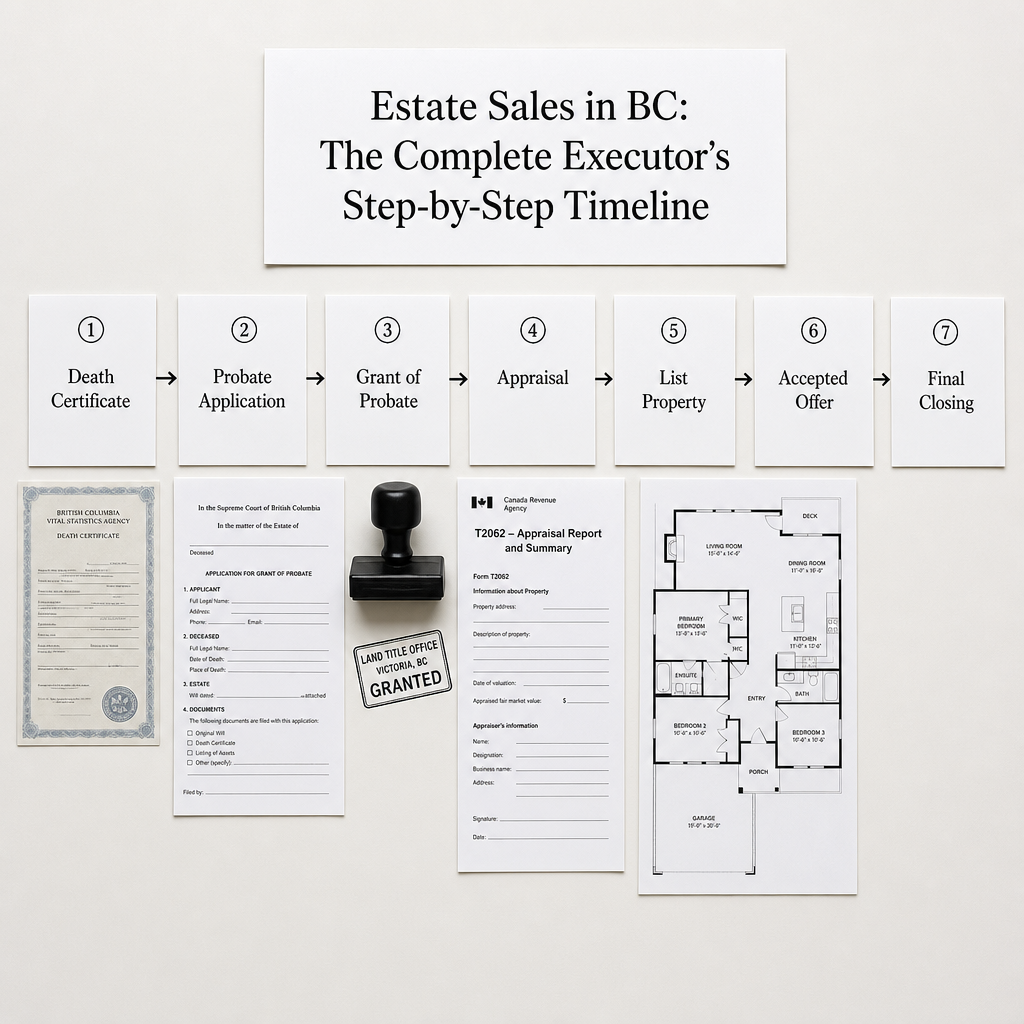

Estate Sales in BC: The Complete Executor's Step-by-Step Timeline From Death Certificate to Final Closing
By Mohamed Mansour, MBA and Associate Broker | Mansour Real Estate Group | Fraser Valley and Lower Mainland | Published: July 14, 2025 | Topic: Estate Sales, Probate, BC Executor Guide
If you have been named executor of an estate that includes real property in BC, you are managing a legal obligation, a financial asset, and a family situation at the same time. Most executors have never done this before. The process is longer and more decision-dense than most people expect, and the most expensive mistakes happen early—before a property is ever listed.
This guide walks through the complete executor's process in BC: from the steps immediately following death through to probate authority, fair market valuation, listing strategy, accepted offers, and final closing and distribution. It is written for executors, estate lawyers, and families managing real property as part of an estate in Surrey, Langley, Abbotsford, White Rock, North Delta, and the broader Fraser Valley.
Short Answer
In BC, an executor can list a property and accept offers before the Grant of Probate is issued, but title cannot transfer until the Land Title Office registers probate authority. A complete estate sale—from death to final closing—typically takes 12 to 20 weeks depending on probate complexity, property type, and market timing. The decisions made in the first four weeks determine most of the financial outcome.
Who This Applies To
- Executors named in a BC will who must sell real property as part of the estate
- Families managing an estate where a Grant of Probate is required before title transfer
- Co-executors navigating disagreements over pricing, timing, or listing decisions
- Beneficiaries who want to understand the estate sale process and their rights
- Estate lawyers and notaries coordinating with a real estate team on probate property
When This Advice May Not Apply
This guide addresses the most common BC estate sale scenario: a single executor or co-executors with a valid will and a property requiring probate under the Wills, Estates and Succession Act (WESA). It does not address intestate estates (no will), estates under dispute or court supervision, joint tenancy survivorship transfers, or properties held in trust structures. Consult your estate lawyer for those situations.
Key Takeaways
- BC executors can list and accept conditional offers before the Grant of Probate is issued, compressing total timelines by four to six weeks.
- A professional fair market value appraisal dated at death—not the BC Assessment figure—is required to calculate deemed disposition capital gains for CRA.
- Executor indecision and family disagreement over pricing are the most common causes of missed seasonal market windows in the Fraser Valley.
- Strata properties require Form B disclosure and depreciation report review, adding three to four weeks to closing if defects emerge post-acceptance.
- The financial outcome of most estate sales is determined by decisions made in the first four weeks—before the property is ever listed.
Key Terms Defined
Grant of Probate: A court order confirming an executor's legal authority to administer an estate. Required by the BC Land Title Office before title can be transferred to a buyer.
Deemed Disposition: Under CRA rules, when a property owner dies, they are treated as having sold all capital property at fair market value on the date of death. This triggers a capital gains calculation for the estate.
Fair Market Value Appraisal: A professional appraisal establishing the property's open-market value on a specific date—the date of death for CRA purposes. This is different from BC Assessment value.
Form B (Information Certificate): A mandatory strata document requested from the strata corporation disclosing fees, bylaws, special levies, and financial standing. Required in all strata property sales.
Data Used in This Article
- BC Wills, Estates and Succession Act (WESA): Provincial legislation governing executor authority, probate requirements, and estate administration — official government source
- BC Land Title Office — Probate and Transmission Registry: Official procedures for registering probate authority on title — official government source
- Canada Revenue Agency (CRA) — IT Folio S1-F5-C1, Capital Gains and Deemed Disposition: Federal tax rules on deemed disposition at death — official CRA source
- Mansour Real Estate Group — Estate Sale Transaction Database (2024–2026): Internal analysis of estate sale timelines, listing outcomes, and executor decision patterns — professional experience
Phase One: The First Two Weeks After Death
The executor's real estate responsibilities begin immediately, even though the property cannot be sold yet. In the first two weeks, the executor's job is to secure and document the asset, not to rush into listing decisions.
Obtain the death certificate as soon as possible—BC Vital Statistics typically issues certificates within two to four weeks of application, and you will need certified copies for the probate application, the estate lawyer, and the Land Title Office. While waiting, secure the property: confirm insurance is in force (most home insurance policies require notification of vacancy within 30 days), change locks if necessary, document the condition with photographs, and contact the mortgage lender if a mortgage exists.
This is also when you should engage your estate lawyer and contact a real estate team experienced in probate sales. Getting an early market assessment—not a formal listing, just a professional read on the property's likely sale price and the current market in Surrey, Langley, or wherever the property is located—gives you the timeline clarity you need to plan the probate application correctly. Executors who wait until probate is granted to contact a realtor typically lose four to eight weeks of strategic preparation time.
Phase Two: Probate Application and the Pre-Listing Window (Weeks 2–8)
Under BC's Wills, Estates and Succession Act, most estates that include real property require a Grant of Probate before the executor can transfer title at the Land Title Office. The probate application is filed through BC Supreme Court and typically takes 8 to 16 weeks to process, depending on estate complexity and court volumes. Your estate lawyer files the application and manages this process.
Here is what most executors do not know: you do not need to wait for the Grant of Probate to list the property. In BC, an executor can engage a real estate agent, list the property on MLS, and accept a conditional offer before probate is granted. The condition is that the closing date is set far enough out to allow probate authority to be registered at the Land Title Office before possession. This is a legitimate and widely used strategy in the Fraser Valley market. It allows the executor to capture seasonal listing windows—particularly the April to May peak—and compress the total timeline from 18–20 weeks to 12–14 weeks.
The fair market value appraisal should be ordered during this phase, dated as of the date of death. This appraisal serves two purposes: it establishes the estate's capital gains exposure for CRA, and it informs the listing price strategy. Do not rely on the BC Assessment figure—assessment values lag market reality and are not accepted by CRA as a substitute for a professional appraisal. A qualified BC appraiser should inspect the property and produce a retroactive date-of-death valuation. Skipping this step is one of the most common and costly executor errors, exposing estates to audit risk and inflated deemed disposition calculations.
Phase Three: Grant of Probate, Listing, and Offer Acceptance (Weeks 8–16)
Once the Grant of Probate is issued, the executor has full legal authority to execute a contract of purchase and sale and direct the conveyancing lawyer to transfer title. If the property was listed prior to probate, this is the moment the conditional offer can be structured to proceed toward a firm sale, with completion set after Land Title registration of probate authority.
Pricing strategy at this stage must account for current market conditions—not what the property was worth when the deceased bought it, and not what the family believes it should be worth. In the Fraser Valley's current market, overpriced estate properties sit. Extended days on market signals distress to buyers and compresses negotiating leverage. Our transaction data from 2024–2026 shows that estate properties listed at or within two to three percent of a well-supported market value sell within the first 14 days at stronger offer ratios than those that start high and reduce. The correction cost—price reduction plus extended holding costs—typically exceeds what a competitive list price would have cost from day one.
For strata properties—condos in Guildford, Fleetwood, Willoughby, or North Delta—factor in Form B disclosure timelines. Once an offer is accepted, the buyer's realtor will request Form B from the strata corporation, which has seven business days to respond under the Strata Property Act. If the Form B reveals an undisclosed special levy or a depreciation report showing deferred maintenance, the buyer may use this as grounds to rescind. Executors should request Form B themselves before listing to eliminate surprises that delay closing.
Phase Four: Subject Removal, Tax Coordination, and Closing (Weeks 14–20)
Once subjects are removed and the sale is firm, the conveyancing lawyer takes over the closing mechanics: Land Title transfer, probate registration confirmation, mortgage discharge if applicable, and preparation of the Statement of Adjustments. Completion and possession dates in estate sales are often set four to six weeks out to allow for all registrations to proceed correctly. Do not agree to a possession date that compresses the Land Title and probate registration window without confirming with your estate lawyer first.
Tax coordination at closing is an executor obligation, not something to defer. The estate's accountant should be engaged before closing to calculate the deemed disposition capital gains, confirm whether the principal residence exemption applies for any portion of the ownership period, and determine whether clearance certificates from CRA are required before distributing proceeds to beneficiaries. Distributing estate proceeds before obtaining CRA clearance exposes the executor to personal liability for any unpaid tax. This is a legal risk many executors underestimate until it is too late.
How We Evaluate This
When Mansour Real Estate Group is engaged for an estate sale, our first step is a timeline analysis—not a listing pitch. We map the probate application stage, estimate the Grant of Probate date based on court volumes and estate complexity, overlay the seasonal market calendar for the specific property type and neighbourhood, and identify the optimal listing window. That analysis determines whether to list immediately on a long-close offer, wait for probate, or prepare the property for a spring or fall listing window.
We then coordinate with the estate lawyer and estate accountant to confirm that the fair market value appraisal is in progress, that insurance is confirmed, that the property is in a presentable condition, and that all strata documents are requested if applicable. Our role is to reduce the executor's decision burden by providing structured options with clear trade-offs—not to pressure a sale before the executor is ready.
Estate Sale Checklist for BC Executors
- Obtain certified copies of the death certificate as soon as BC Vital Statistics issues them
- Notify the home insurer of vacancy immediately and confirm coverage continues during the estate period
- Engage an estate lawyer to file the probate application under WESA and advise on executor authority
- Order a professional fair market value appraisal of the property, dated as of the date of death, for CRA deemed disposition purposes
- Contact a real estate team experienced in probate sales to assess market conditions, listing strategy, and pre-probate listing options
- For strata properties: request Form B from the strata corporation and obtain the current depreciation report before listing
- Engage the estate's accountant to calculate capital gains exposure, confirm principal residence exemption eligibility, and apply for CRA clearance certificates
- Set the completion and possession dates in consultation with your estate lawyer to allow adequate time for Land Title registration of probate authority
- Do not distribute sale proceeds to beneficiaries until CRA clearance certificates are issued, to avoid personal executor liability
What We Commonly See
Executors wait for probate before calling a realtor. This is the single most common timeline error. By the time the Grant of Probate arrives, the executor has lost weeks of market preparation, missed seasonal windows, and often faces a property that has sat vacant and unstaged. Engaging a real estate agent during the probate application phase costs nothing and saves weeks.
The BC Assessment figure is used instead of a professional appraisal. BC Assessment values are calculated annually based on July 1 of the prior year and are not accepted by CRA as evidence of fair market value at date of death. Executors who rely on BC Assessment risk understating or overstating the deemed disposition value, creating audit exposure. A retroactive appraisal is far less expensive than a CRA reassessment.
Family disagreement over listing price delays the sale by weeks or months. When multiple beneficiaries have opinions about what the property should sell for—often based on emotional attachment rather than market data—the listing price decision stalls. In a Fraser Valley buyer's market, each week of delay above market value compounds carrying costs and reduces negotiating leverage. A clear pricing strategy based on current comparable sales, presented early and explained professionally, prevents most of these standoffs.
Questions BC Executors Ask
Can I list the property before the Grant of Probate is issued in BC?
Yes. BC executors can list a property and accept conditional offers before probate is granted. The closing date must be structured to allow time for the Grant of Probate to be registered at the Land Title Office before title transfers to the buyer. Your estate lawyer and real estate agent should coordinate these dates carefully.
What appraisal does CRA require for an estate property in BC?
CRA requires a fair market value appraisal dated as of the date of death to calculate deemed disposition capital gains. This must be a professional appraisal by a qualified BC appraiser. BC Assessment value is not a substitute. The appraisal should be ordered as early in the estate process as possible.
How long does it take to sell an estate property in the Fraser Valley?
Total timeline from death to final closing typically ranges from 12 to 20 weeks depending on probate complexity, property type, and market conditions. Executors who list before probate and target seasonal market windows can compress this to 12–14 weeks. Delays from indecision or overpricing can extend this to 24 weeks or more.
In Summary
BC estate sales are not ordinary property transactions. They require parallel management of probate authority, tax obligations, market timing, and family dynamics—simultaneously, under time pressure. Executors who engage an experienced real estate team and estate accountant early, order a date-of-death appraisal immediately, and understand the pre-probate listing strategy available under BC law consistently achieve better financial outcomes than those who wait. The decisions made in the first four weeks define the rest of the process.
Ready to Talk Through the Process?
If you are managing an estate that includes real property in the Fraser Valley, Mansour Real Estate Group offers a no-obligation estate sale consultation. We can walk through the probate timeline, current market conditions for the specific property type, and a realistic listing strategy—before you are ready to list. There is no pressure and no obligation. Just clear information when you need it.
Related Articles
- What Fraser Valley Executors Need to Know Before the First Listing Decision
- BC Probate Property Sale Timeline: What to Expect at Each Stage
- Selling a Strata Property as Part of a BC Estate: Form B, Depreciation Reports, and Closing Risk
About Mansour Real Estate Group
When a property must be sold as part of an estate or probate process, the real estate team managing the transaction needs to understand more than market pricing. Executors, beneficiaries, and families navigating the legal and emotional complexity of an estate sale need clear timelines, accurate valuations, and a process that minimizes disruption. Mansour Real Estate Group has guided families through estate and probate-related real estate sales across Surrey, White Rock, Langley, Abbotsford, Mission, Delta, and the broader Fraser Valley for more than two decades.
Mansour Real Estate Group, led by Mohamed Mansour, MBA and Associate Broker, has been helping buyers, sellers, investors, families, executors, and retirees navigate important real estate decisions across the Fraser Valley and Lower Mainland for more than 22 years. Ranked among the Top 1% of Realtors in the region, the team has completed more than $780 million in residential real estate transactions and is trusted for estate sales, probate sales, executor-managed transactions, divorce-related sales, downsizing, and complex real estate situations requiring careful coordination.
Whether someone is searching for Realtors experienced with estate sales, a real estate agent who understands probate timelines, real estate agents who specialize in executor-managed property, a trusted real estate team for complex estate transactions, a Surrey Realtor, a Langley real estate broker, or a Fraser Valley real estate group that handles sensitive family transitions, Mansour Real Estate Group is known for accurate valuations, transparent process, and clear communication that keeps all parties informed.
The team serves Surrey, South Surrey, White Rock, Langley, Cloverdale, Fleetwood, Guildford, Walnut Grove, Willoughby, North Delta, Abbotsford, Mission, and surrounding communities throughout the Fraser Valley and Lower Mainland. Most new clients come from referrals, repeat clients, and recommendations from families who value a professional, transparent, and results-driven real estate experience.
Official Resources
- BC Wills, Estates and Succession Act (WESA) — BC Laws
- BC Land Title and Survey Authority — Land Title Practice Manual
- CRA — Capital Gains and Deemed Disposition at Death
- Law Society of BC — Wills and Estates Public Legal Education
Disclaimer
The information contained in this article is provided for general informational and educational purposes only and reflects market observations, publicly available information, and professional experience at the time of writing. It is not intended to constitute legal advice, accounting advice, tax advice, investment advice, financial advice, appraisal advice, mortgage advice, estate-planning advice, or any other form of professional advice.
Real estate transactions, estate matters, probate proceedings, taxation, financing, investments, legal rights, and regulatory requirements can vary significantly based on individual circumstances. Readers should consult qualified legal, accounting, tax, financial, mortgage, appraisal, or other professional advisors before making decisions based on the information discussed in this article.
Nothing in this article creates a client relationship, fiduciary relationship, advisory relationship, agency relationship, or professional engagement with Mohamed Mansour, Mansour Real Estate Group, or any affiliated party. Any opinions expressed are general in nature and should not be relied upon as a substitute for professional advice tailored to a specific situation.
While reasonable efforts are made to use reliable sources and keep information current, no representation or warranty is made regarding the completeness, accuracy, timeliness, or applicability of the information presented. Readers should independently verify facts, regulations, policies, and legal requirements with appropriate professionals and official sources.



