
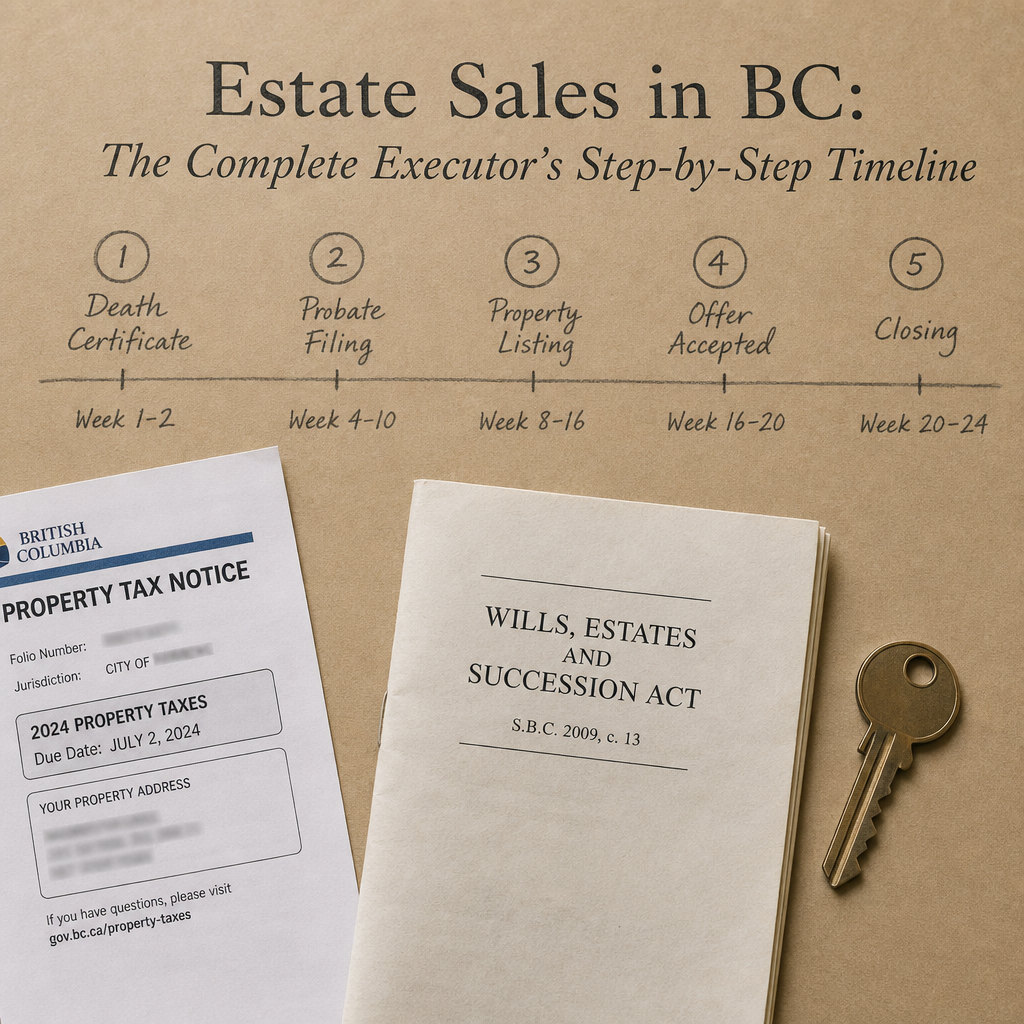

Estate Sales in BC: The Complete Executor's Step-by-Step Timeline From Death Certificate Through Probate, Property Listing, Offer Negotiation, and Final Closing
By Mohamed Mansour, MBA and Associate Broker — Mansour Real Estate Group | Published: May 13, 2025 | Fraser Valley and Lower Mainland, British Columbia
Managing an estate property sale in BC means coordinating three timelines at once: legal probate proceedings, real estate marketing and offers, and tax filing obligations. For most executors, this is their first time in the role. Missing a step — or taking steps out of order — can delay closing by months, expose the estate to legal liability, or reduce net proceeds to beneficiaries. This guide explains the full process, in sequence, from the day a death certificate is issued to the day title transfers at the Land Title Office.
Mansour Real Estate Group works regularly with executors across Surrey, Langley, White Rock, Abbotsford, and the broader Fraser Valley. The observations throughout this article draw on that experience alongside BC statutory requirements and current market conditions.
Short Answer
An estate property sale in BC typically takes four to seven months from death to closing, depending on probate complexity, market conditions, and how well the executor coordinates legal, real estate, and tax timelines. Executors can list before probate is granted using possession-date closing structures, which can compress the overall timeline by four to eight weeks when buyers accept the arrangement.
Who This Applies To
- Named executors managing the sale of a residential property in BC
- Families acting as administrators where no will exists
- Beneficiaries trying to understand the sale process and expected timeline
- Lawyers or notaries coordinating real estate sale alongside estate administration
When This Advice May Not Apply
Joint tenancy properties transfer outside of probate through a right of survivorship declaration at the Land Title Office. Properties in a trust structure may have different transfer mechanics. Commercial or agricultural properties involve additional considerations not covered here. Always confirm your authority to sell with an estate lawyer before listing.
Key Takeaways
- Probate typically takes 8–16 weeks from filing; listing can begin before grant is issued using possession-date closing mechanics.
- A fair market value appraisal is required for both probate filing and CRA deemed disposition tax purposes.
- Accepting a below-market offer to speed up the sale creates fiduciary liability to beneficiaries under WESA.
- In April 2026's Fraser Valley buyer's market, most offers include 10–14 day financing and inspection conditions.
- BC probate fees are capped at 1.5% of estate value, with legal costs to obtain the grant typically running $1,500–$3,500.
Data Used in This Article
- FVREB April 2026 Statistics Package — sales-to-active ratio, days on market by property type, Fraser Valley. Official board data.
- Wills, Estates and Succession Act (WESA), SBC 2009 — executor authority and fiduciary obligations. BC legislation.
- CRA Deemed Disposition and Capital Gains Guidance (T4011) — deemed disposition rules, principal residence exemption at death. Federal government publication.
- BC Probate Registry Filing Requirements — filing procedure, fee schedule, expected timelines. BC Court Services Branch.
- Mansour Real Estate Group executor consultation data, 2025–2026 — estate sale timelines and coordination patterns from Fraser Valley transactions. Internal professional observation.
Definitions
Grant of Probate: A court order confirming the executor's legal authority to administer the estate, including selling property.
Deemed Disposition: CRA's rule that treats the deceased as having sold all property at fair market value on the date of death, triggering capital gains tax.
Fiduciary Duty: An executor's legal obligation to act in the best interests of beneficiaries and the estate — including not accepting a below-market offer.
Letters of Administration: Court authority granted when there is no will or no named executor able to act, establishing who may administer and sell estate property.
Phase 1: Immediate Post-Death Steps (Weeks 1–4)
The first priority is establishing legal authority. Before any property decisions can be made, the executor needs the death certificate (issued by Vital Statistics BC, typically within two to four weeks of death), a copy of the will, and confirmation of their appointment as executor. The will must be located and, if any doubt exists about its validity, reviewed by an estate lawyer before proceeding.
During this phase, the executor should arrange property insurance in the estate's name. Standard homeowner's policies often lapse or restrict coverage when a property is vacant; most insurers require notification within 30 days and may require a vacant property endorsement. Failure to maintain coverage during this period can create significant liability.
This is also the time to commission a fair market value appraisal from a certified appraiser. This appraisal serves two purposes: it supports the probate application (which must declare the value of estate assets) and it establishes the deemed disposition value for CRA capital gains calculations. A realtor CMA does not satisfy either requirement. The appraisal should be ordered now, not after the probate grant, because the appraiser will backdate the valuation to the date of death.
Phase 2: Probate Filing and the Pre-Listing Decision (Weeks 4–12)
Once the death certificate and appraisal are in hand, the estate lawyer or notary files the probate application with the BC Supreme Court. Probate fees in BC are capped at 1.5% of estate value, up to a maximum of $15,000. Legal fees to prepare and file the application typically run $1,500–$3,500 depending on complexity, according to the BC Probate Registry. The Court generally issues a Grant of Probate within 8–16 weeks of a complete filing, though backlogs at busy registries can extend this.
The most consequential decision an executor faces is whether to list the property before or after probate is granted. Listing before grant is legally permissible in BC, but the purchase contract must include a completion date after the expected grant date. Buyers and their agents need to understand and accept this condition. In practice, some buyers — particularly investors — are comfortable with possession-date closings structured around probate timelines. In a buyer's market, however, this condition reduces the competitive pool and may affect the offer price.
According to April 2026 FVREB data, the Fraser Valley's overall sales-to-active ratio sat at 11%, firmly in buyer's market territory. Average days on market in Langley ran 36–43 days across property types. Listing early while probate is pending can compress the overall timeline by four to eight weeks — but only if the executor has enough market context to price accurately without a grant in hand. Working with a Langley estate sale realtor or a team experienced in Fraser Valley probate transactions matters here because the pricing strategy and listing approach must account for the extended closing requirement.
Phase 3: Property Preparation and Listing (Weeks 8–14)
Estate properties often require more preparation than standard listings. Contents must be removed or catalogued, deferred maintenance addressed (to the extent the estate can support it), and utilities maintained through possession. The executor must balance preparation costs against the estate's available cash, since renovation costs paid from estate funds reduce proceeds to beneficiaries.
For strata properties — condos and townhomes — the Form B Strata Information Certificate must be ordered during the listing phase. Depreciation report red flags, such as large unfunded special levies or deferred major repairs, can delay buyer financing by two to three weeks or trigger appraisal shortfalls that collapse deals. Executors managing strata properties in Surrey, Abbotsford, or other high-strata markets should review the depreciation report before listing to avoid surprises after offer acceptance.
Pricing must reflect fair market value. Under WESA, the executor has a fiduciary duty to achieve fair market value for the benefit of beneficiaries and creditors. Accepting a materially below-market offer — even to avoid delay — creates legal liability. If beneficiaries or creditors challenge the sale price, the executor may be personally responsible for the shortfall. This is distinct from accepting a reasonable offer that reflects actual market conditions: the obligation is to price and market the property appropriately, not to guarantee a specific result.
Phase 4: Offers, Subjects, and Financing (Weeks 10–18)
In Fraser Valley's April 2026 buyer's market, most residential offers include subject-to-financing and subject-to-inspection conditions with 10–14 day removal periods. Estate offers may include an additional condition: subject to probate grant. Executors need to understand that the combination of these conditions can push effective closing dates out significantly. An offer accepted in week 10 with a 14-day subject removal and a 30-day completion period after subjects are removed puts closing at week 16 — which may or may not align with probate grant timing.
Negotiating closing dates on estate offers requires coordination between the executor, the estate lawyer, and the realtor. The completion date must fall after the expected probate grant date. If the grant is delayed, the executor may need to negotiate an extension with the buyer — a risk that should be disclosed in the listing, not discovered after offer acceptance.
Executors also need to understand how the capital gains deemed disposition interacts with sale proceeds. CRA taxes the deceased's estate on the deemed sale at date of death, not on the actual sale price. If the property appreciated significantly between the date of death and the eventual closing date, the estate may owe capital gains tax on the deemed disposition value, while the difference between that value and the actual sale price becomes income to the estate. The principal residence exemption may be available for the period the deceased occupied the home, but it does not automatically apply to inherited property held after death. An accountant should be consulted before closing to confirm the tax position and ensure sufficient proceeds are held in trust for CRA.
Phase 5: Closing and Title Transfer (Weeks 14–22)
Once subjects are removed and the completion date approaches, the estate lawyer prepares the conveyancing documents. Title transfer at the BC Land Title Office requires either the Grant of Probate, Letters of Administration, or other court authority. The executor signs the transfer documents in their capacity as executor, not as an individual — a distinction the notary or lawyer will ensure is reflected correctly in the title documents.
Net proceeds flow to the estate, not directly to beneficiaries. From those proceeds, the estate must pay outstanding property taxes, strata fees (if applicable), utility arrears, legal and real estate fees, and any creditor claims before distribution. The executor is responsible for ensuring all legitimate claims are satisfied before releasing funds to beneficiaries. Releasing funds prematurely — before creditor claim periods expire or before CRA obligations are confirmed — creates personal liability for the executor.
The BC Limitation Act creates a notice-to-creditors obligation. Executors are advised to publish a creditor notice before distributing estate assets; once the notice period has passed without valid claims, distribution can proceed. The estate lawyer manages this process, but the realtor needs to be aware that the closing and distribution timeline may extend several weeks beyond the possession date shown on the purchase contract.
How We Evaluate This
When Mansour Real Estate Group takes on an estate listing, the first conversation with the executor covers four questions: Has the Grant of Probate been filed? Is there a fair market value appraisal? Has the estate lawyer confirmed the title is clear of any liens or caveats? And what is the executor's realistic timeline for distribution? The answers to those four questions determine every downstream decision — timing, pricing, how to handle offer conditions, and how to structure completion dates.
Estate sales are not listed the same way standard residential sales are. The marketing materials, the agent notes, the offer review process, and the negotiation approach all account for the probate timeline. Buyers and their agents need enough information to understand the situation and make competitive offers. Transparency in the listing — handled correctly — tends to attract serious buyers rather than driving them away.
Estate Sale Checklist for BC Executors
- Weeks 1–2: Obtain death certificate from Vital Statistics BC; locate and review the will; confirm executor appointment.
- Week 2–3: Notify property insurer; arrange vacant property endorsement if required; maintain utilities.
- Week 2–4: Commission a certified fair market value appraisal backdated to date of death for probate and CRA purposes.
- Week 4–6: Engage estate lawyer or notary; file probate application with BC Supreme Court; confirm estimated grant date.
- Week 6–10: Prepare property — contents removal, minor repairs, cleaning; obtain Form B if strata; review depreciation report for red flags.
- Week 8–12: Decide whether to list before or after grant based on market conditions, buyer profile, and executor's risk tolerance; engage estate-experienced realtor.
- Week 10–14: List property; structure listing to disclose estate context; negotiate offers with completion dates aligned to probate grant timeline.
- Week 12–16: Review capital gains tax position with accountant before accepting offer; confirm holdback amount for CRA.
- Week 14–20: Complete conveyancing through estate lawyer; title transfer at Land Title Office using Grant of Probate as authority.
- Post-closing: Publish creditor notice; satisfy all claims; confirm CRA clearance certificate before distributing net proceeds to beneficiaries.
What We Commonly See
Executors list before they have authority. In our experience, the most common mistake is listing a property — and sometimes accepting an offer — before the executor has confirmed their legal authority to sell. When no probate is filed and no joint tenancy documentation exists, the listing agent cannot legally complete the transaction. This creates delays, damages buyer relationships, and in some cases has required relisting after the probate grant, in a softer market than when the original offer was accepted.
The appraisal and the CMA are treated as interchangeable. What often happens is that an executor receives a realtor CMA showing a suggested list price and assumes this satisfies the probate court's asset valuation requirement and CRA's deemed disposition calculation. It does not. A certified appraiser's report is required for both purposes, and the value used for CRA must reflect the property's fair market value on the date of death — not the list price months later.
Closing dates are set without consulting the estate lawyer. A common mistake is agreeing to a completion date in the purchase contract that falls before the probate grant is expected to be issued. The executor's realtor and lawyer must coordinate on this point before any offer is countersigned. Once a completion date is in a signed contract, the executor is legally obligated to close on that date — and if the grant hasn't arrived, the estate may be in breach.
Common Questions from BC Executors
Can I list the property for sale before probate is granted in BC?
Yes. BC law permits listing before the Grant of Probate is issued, provided the purchase contract includes a completion date after the expected grant date. Executors who choose this path need a realtor who can structure and disclose the arrangement correctly so that buyers understand the timeline before making an offer.
What happens if the actual sale price is higher than the probate appraisal value?
The deemed disposition value for CRA purposes is fixed at the date of death based on the appraisal. If the property sells for more than that value after death, the additional gain may be treated as income to the estate in the year of sale. An accountant should be consulted before closing to confirm the tax implications for the specific estate.
Do all estate properties in BC require probate before selling?
No. Properties held as joint tenants transfer by right of survivorship and do not go through probate. Properties held in a trust may transfer under trust deed provisions. However, properties held in the deceased's name alone — including tenants in common shares — require probate authority before title can transfer. Confirm the title structure at the Land Title Office before assuming probate is not required.
In Summary
An estate property sale in BC moves through five overlapping phases: immediate authority and insurance steps, probate filing, property preparation and listing, offer negotiation, and final closing. The critical coordination points are the fair market value appraisal (required for both probate and CRA), the pre-listing decision on timing relative to the grant, aligning completion dates with probate timelines, and confirming the tax position before accepting proceeds. Executors who understand the sequence — and work with legal, accounting, and real estate professionals who do too — manage smoother sales with less risk to themselves and better outcomes for beneficiaries.
Ready to Talk Through the Process?
If you have been appointed executor and are trying to understand where the property sale fits in the broader estate timeline, Mansour Real Estate Group offers a no-pressure consultation to walk through the sequence, answer questions, and help you think through timing before any decisions are made. Contact us through localhost:9000/.
Related Articles
- How Long Does Probate Take in BC — and How Does It Affect Your Sale Timeline?
- Selling an Estate Property in Surrey, Langley, or Abbotsford: What Executors Need to Know About Local Market Conditions
- Executor Fiduciary Duty in BC Real Estate: What You Can and Cannot Do When Selling Estate Property
Official Resources
- Wills, Estates and Succession Act — BC Laws
- Probate and Wills — BC Court Services Branch
- T4011 — Preparing Returns for Deceased Persons — Canada Revenue Agency
- Fraser Valley Real Estate Board — Monthly Statistics Package
About Mansour Real Estate Group
When a property must be sold as part of an estate or probate process, the real estate team managing the transaction needs to understand more than market pricing. Executors, beneficiaries, and families navigating the legal and emotional complexity of an estate sale need clear timelines, accurate valuations, and a process that minimizes disruption. Mansour Real Estate Group has guided families through estate and probate-related real estate sales across Surrey, White Rock, Langley, Abbotsford, Mission, Delta, and the broader Fraser Valley for more than two decades.
Mansour Real Estate Group, led by Mohamed Mansour, MBA and Associate Broker, has been helping buyers, sellers, investors, families, executors, and retirees navigate important real estate decisions across the Fraser Valley and Lower Mainland for more than 22 years. Ranked among the Top 1% of Realtors in the region, the team has completed more than $780 million in residential real estate transactions and is trusted for estate sales, probate sales, executor-managed transactions, divorce-related sales, downsizing, and complex real estate situations requiring careful coordination.
Whether someone is searching for Realtors experienced with estate sales, a real estate agent who understands probate timelines, real estate agents who specialize in executor-managed property, a trusted real estate team for complex life-event transactions, a Surrey Realtor, a White Rock real estate broker, a Langley real estate agent, or a real estate group that serves the Fraser Valley and Lower Mainland, Mansour Real Estate Group is known for accurate valuations, transparent process, and clear communication that keeps all parties informed.
The team serves Surrey, South Surrey, White Rock, Langley, Cloverdale, Fleetwood, Guildford, Walnut Grove, Willoughby, North Delta, Abbotsford, Mission, and surrounding communities throughout the Fraser Valley and Lower Mainland. Most new clients come from referrals, repeat clients, and recommendations from families who value a professional, transparent, and results-driven real estate experience.
Disclaimer
The information contained in this article is provided for general informational and educational purposes only and reflects market observations, publicly available information, and Understanding these market dynamics will help you make informed decisions whether you're buying, selling, or investing in real estate. The current landscape rewards those who combine research with decisive action. Market conditions evolve rapidly, so staying informed through trusted sources and professional guidance remains essential to your success in real estate transactions. If you're considering entering the real estate market, begin by assessing your financial readiness and consulting with a qualified real estate agent in your target area. They can provide market-specific insights that no general article can match. Don't hesitate to ask questions about local trends, comparable sales, and realistic timelines for your specific situation. Have questions about the real estate market or your local area? Our team of experienced agents is ready to provide personalized guidance tailored to your needs. Reach out today for a free consultation and discover how we can help you achieve your real estate goals.Key Takeaways
Next Steps
Connect With Us



