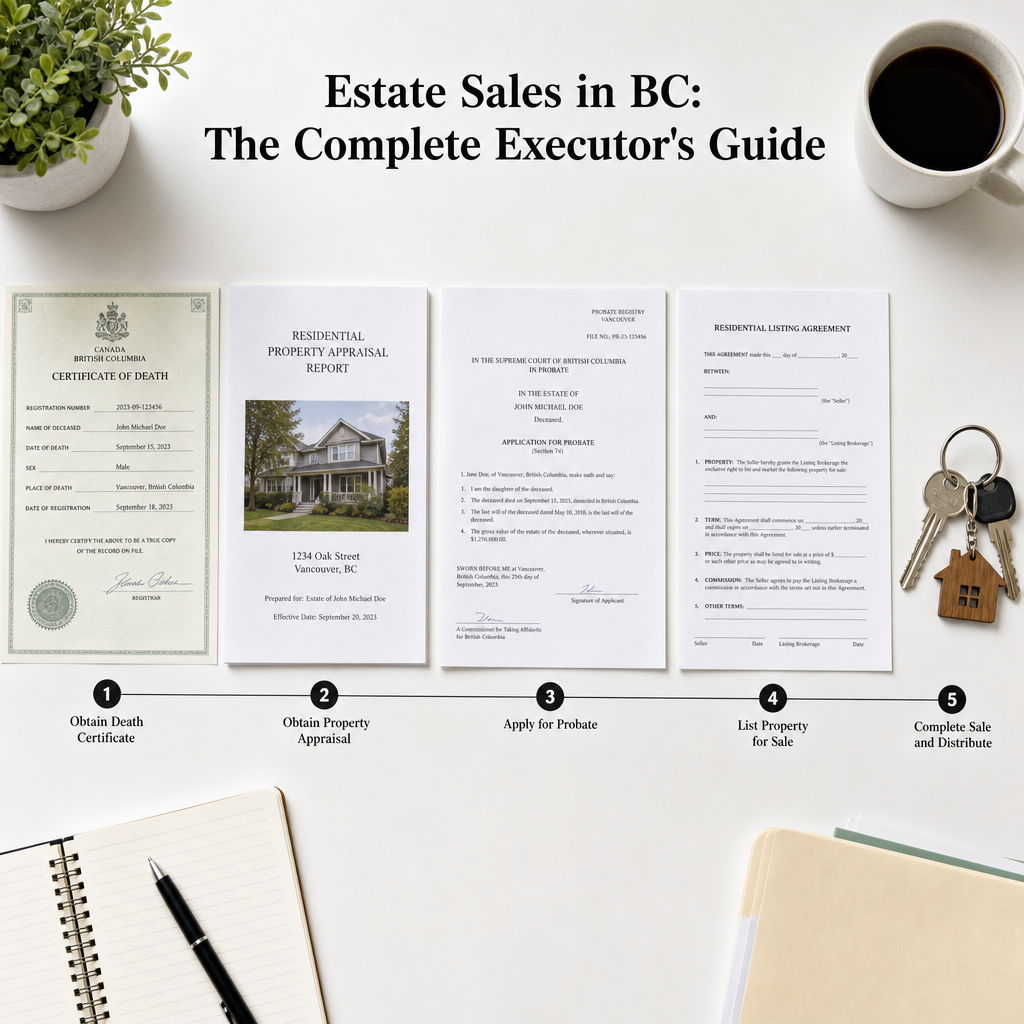

Estate Sales in BC: The Complete Executor's Step-by-Step Process From Death Certificate to Keys in Hand
By Mohamed Mansour, MBA and Associate Broker — Mansour Real Estate Group
Published: July 14, 2025 | Geography: Fraser Valley, Lower Mainland, BC | Topic: Estate Sales, Executor Guide, Probate Process
Being named executor of an estate is a serious legal responsibility. When that estate includes real property — a family home in Surrey, a condo in White Rock, or a detached home in Langley — the decisions made in the first two weeks after death can either protect the estate's value or quietly erode it. Most executors encounter the process for the first time, under stress, without a clear map of what to do, in what order, and why.
This guide walks executors through the complete process, from the immediate steps after death through probate filing, fair market valuation, listing strategy, offer acceptance, and final closing. It reflects BC law, current Fraser Valley market conditions, and the practical experience of managing estate property sales across Surrey, White Rock, Langley, Abbotsford, and the broader region.
Short Answer
In BC, an executor can list an estate property before the grant of probate is issued, using a possession-date closing strategy that allows the sale to complete only after legal authority is confirmed. The critical early steps — ordering a fair market value appraisal, notifying the strata if applicable, and engaging a probate lawyer — must happen within days of death, not weeks. Delays in any of these steps typically cost more in time and lost proceeds than they save.
Who This Applies To
- Executors named in a BC will who are managing a residential property sale
- Families navigating an intestate estate where the court has appointed an administrator
- Beneficiaries trying to understand what the executor is legally required to do before selling
- Lawyers and accountants supporting clients through estate administration who need a real estate process overview
- Executors managing strata properties in Fraser Valley buildings where Form B and depreciation report timelines add complexity
When This Advice May Not Apply
This guide reflects general BC process and Fraser Valley market conditions. It is not legal advice or tax advice. Estates involving contested wills, foreign assets, multi-property holdings, or active tenancies require counsel-specific guidance. Consult your probate lawyer and estate accountant for decisions specific to your file.
Key Takeaways
- Order a fair market value appraisal within days of death — not after listing — to support CRA capital gains and probate fee calculations.
- BC executors can list before probate is granted by structuring a possession-date closing, potentially saving 8–16 weeks.
- Strata estate sales require Form B and depreciation reports often within 30 days of listing — missing this window kills offers.
- Current Fraser Valley buyer's market conditions require pricing 10–20% more strategically than family valuations typically reflect.
- Engaging the realtor, lawyer, and appraiser in parallel — not sequentially — saves 2–4 weeks and protects net proceeds.
Data Used in This Article
- Fraser Valley Real Estate Board (FVREB): Market inventory and days-on-market data, 2024–2025 — official board statistics
- CRA — IT-416R3 and S1-F3-C2: Deemed disposition rules and capital gains tax on death — federal guidance
- BC Wills, Estates and Succession Act (WESA): Executor authority, probate requirements, and administrator appointment — provincial legislation
- BC Probate Fee Act: Fee calculation based on gross estate value — provincial legislation
- BC Strata Property Act: Form B and depreciation report obligations — provincial legislation
- Mansour Real Estate Group transaction data: Internal analysis of executor closing timelines and pricing variance, Fraser Valley, 2020–2025
Definitions
Grant of Probate: A court order issued by the BC Supreme Court confirming that a will is valid and that the executor has legal authority to administer the estate, including selling real property.
Deemed Disposition: A CRA rule that treats the deceased as having sold all capital property at fair market value on the date of death, triggering a capital gains calculation on the final tax return.
Possession-Date Closing: A real estate contract structure where the completion date (legal transfer of title) is set far enough in the future to allow the probate grant to be issued before the deal closes.
Fair Market Value Appraisal: An independent, CUSPAP-compliant property valuation ordered from a licensed appraiser, establishing the property's value at the date of death for CRA and probate purposes.
Form B: An information certificate required under the BC Strata Property Act, prepared by the strata corporation, disclosing strata fees, bylaws, special levies, and financial standing.
Probate Fee: A BC government fee calculated on the gross value of the estate, currently 1.4% on the portion of estate value above $50,000, payable upon filing for probate.
Phase 1: The First Two Weeks — What Must Happen Immediately
The decisions made in the first two weeks after death have the most impact on the estate sale outcome — yet they are the ones executors most often defer. Three actions are non-negotiable and must happen in parallel, not sequence.
Secure and insure the property. Contact the home insurance provider immediately to notify them of the owner's death. Most residential policies require notification within days; failure to do so can void coverage if the property is vacant. Change the locks if the home will be unoccupied. Keep utilities active to prevent damage, particularly through BC winters.
Order a fair market value appraisal. Under CRA's deemed disposition rules — explained in the CRA's Income Tax Folio S1-F3-C2 — the deceased is treated as having sold all capital property at fair market value on the date of death. This creates a capital gains calculation on the final T1 return. The appraisal must reflect the property's value on the specific date of death, not the date it was ordered. Delaying the appraisal by weeks or months does not eliminate this requirement — it makes it harder to defend the value to CRA because retrospective appraisals are more difficult to support with comparable sales data. Order the appraisal within the first week.
Engage a probate lawyer and a realtor simultaneously. Most executors call a lawyer first, then a realtor after probate is granted. This sequential approach costs 8–16 weeks of market exposure for no legal reason. A realtor experienced with estate sales can begin the preparation process — property assessment, condition review, market analysis, staging recommendations — while the lawyer files for probate. The listing can go live before the grant is issued, structured with a possession-date closing that allows the transaction to complete legally only after the court has confirmed authority.
For strata properties in Fraser Valley buildings — condos in Guildford, townhomes in Willoughby, units in Cloverdale — add a fourth immediate step: contact the strata manager to notify them of the change in ownership status and request a current Form B. Under the BC Strata Property Act, sellers must provide a Form B to buyers, and many lenders require it before approving financing. If the strata corporation takes 30 days to prepare it and you have not requested it at listing, you will lose that time inside an accepted offer.
Phase 2: Probate Filing, Legal Authority, and the Listing Strategy Decision
Under BC's Wills, Estates and Succession Act (WESA), an executor derives authority from the will itself, but legal title to real property cannot transfer to a buyer without a grant of probate being issued. The BC Supreme Court typically takes 8–16 weeks to issue the grant after filing, though complex estates, contested wills, or missing documents can extend this timeline significantly.
The possession-date closing strategy. An executor can sign a listing agreement and accept an offer before probate is granted, provided the contract is written with a completion date set far enough in the future that the grant will be issued before the deal closes. In practice, this means structuring the completion date 10–14 weeks from the accepted offer date — enough buffer for the court timeline while still locking in a buyer at current market pricing. This approach is well-established in BC real estate practice and is a tool that experienced estate realtors use routinely. Executors who wait for probate before listing lose those weeks entirely, often missing seasonal market windows in March–May or September–October when buyer activity in Surrey, Langley, and Abbotsford is highest.
Probate fees and the appraisal connection. Under the BC Probate Fee Act, probate fees are calculated on the gross value of the estate, at 1.4% on the portion above $50,000. The fair market value appraisal ordered in Phase 1 feeds directly into this calculation. An accurate appraisal protects the estate: an inflated appraisal increases probate fees unnecessarily; an unsupported low appraisal creates CRA exposure on the capital gains return. The appraiser, lawyer, and accountant should all be working from the same valuation.
Property transfer tax and the distribution decision. If the executor distributes the property directly to a beneficiary rather than selling it to a third party, a property transfer tax exemption may apply under specific conditions set out in BC's Property Transfer Tax Act. This exemption disappears entirely once the property is sold to an outside buyer. Executors managing estates where one beneficiary wants to keep the property should raise this with their probate lawyer before listing, not after an offer is accepted. Once a sale is underway, the window for this decision closes.
Phase 3: Pricing Strategy in a Fraser Valley Buyer's Market
Estate sales in the current Fraser Valley market require a different pricing approach than standard residential resales — and most executors arrive at the decision with the wrong reference point.
According to Fraser Valley Real Estate Board data through early 2025, active inventory across the region sits 40–50% above the historical seasonal average. In a balanced market, a well-priced detached home in Surrey or Langley might receive two or three competing offers within ten days. In the current environment, that same home may sit for 30–45 days before receiving a single conditional offer. Estate properties face additional headwinds: they are typically sold as-is, without the cosmetic preparation that owner-occupied listings receive, and buyers know that executors cannot negotiate the same way a motivated residential seller can.
The family valuation problem. In our experience, the most common pricing error in estate sales is anchoring to what the family believes the property is worth — usually based on a neighbour's sale from 18 months ago, a BC Assessment notice that reflects January 1 values from the prior year, or what a family member once heard at a dinner table. These reference points are not current market data. BC Assessment values are not market values and are not intended to be used for listing price decisions. In a market where inventory has risen 40–50% and buyer competition has thinned, a property priced to a family's expectation rather than current comparable sales will sit, accumulate days-on-market, and ultimately sell for less than it would have at a correctly positioned price on day one.
What accurate pricing looks like. A current competitive market analysis drawn from active comparable sales within the last 30–60 days, adjusted for the estate property's condition, strata status if applicable, and local neighbourhood micro-conditions, is the correct starting point. In Abbotsford, Walnut Grove, and North Delta, that analysis will look different from South Surrey or White Rock, where price per square foot, buyer demographics, and absorption rates diverge meaningfully. Pricing 10–20% more aggressively than a comparable owner-occupied listing is not a concession — it is a reflection of current market reality for estate properties and the costs of carrying an unsold property through multiple price reductions.
Phase 4: Preparing the Property, Managing Offers, and Closing
Preparation for an estate listing differs from a standard resale in two important ways: the executor typically cannot warrant the property's condition in the same way an owner can, and the contents — furniture, personal property, financial records, and valuables — must be managed before or alongside the listing process.
Property preparation and as-is disclosure. Estate listings in BC are commonly sold with a disclosure that the seller has limited knowledge of the property's latent defects, since the executor may not have lived in or regularly maintained the home. This does not eliminate the disclosure obligation entirely — known defects must still be disclosed — but it does shift the buyer's due diligence responsibility. A pre-listing home inspection, commissioned by the executor and provided to buyers, reduces the risk of post-offer renegotiation and builds buyer confidence in a market where conditional offers are standard.
Contents and personal property. The home cannot be listed in a state that deters buyers — personal belongings, medical equipment, and decades of accumulated contents need to be addressed. Estate cleanout services and auction companies operating in the Fraser Valley can typically complete this process within one to two weeks. Do not wait until after an offer is accepted to start this process; buyers walking through a cluttered estate home will discount their offers or walk away entirely.
Managing offers as an executor. An executor has a fiduciary obligation to the beneficiaries of the estate — meaning the duty is to act in the estate's best financial interest, not to accommodate any one beneficiary's preference. This matters most when offers come in below list price: the executor must evaluate whether accepting, countering, or waiting is consistent with that duty, informed by the realtor's current market assessment. Accepting an offer significantly below market value without adequate market exposure can expose the executor to a claim by beneficiaries.
Closing mechanics. Once an offer is accepted with a possession-date closing, the executor's lawyer coordinates the completion with the buyer's lawyer and notary. The estate's proceeds flow into the estate account, not to individual beneficiaries directly. Distribution to beneficiaries happens after the estate's debts, taxes, and probate fees are paid — a process the estate accountant manages in coordination with the probate lawyer.
How We Evaluate This
When Mansour Real Estate Group is engaged for an estate sale, the first conversation is always about timing, not pricing. We ask: Has the appraisal been ordered? Is the probate lawyer engaged? Is there a strata involved? Are there tenants? The answers determine whether a listing is two weeks away or ten.
Pricing comes from current comparable sales data, not family expectations or BC Assessment values. We run a competitive market analysis specific to the property type, neighbourhood, and current inventory levels — and we present that analysis to the executor with the context needed to make a defensible decision on behalf of the beneficiaries. In the current Fraser Valley buyer's market, that conversation almost always involves a pricing strategy that is more competitive than the family initially expects, with a clear explanation of why days-on-market costs the estate more than a lower list price does.
Estate Sale Checklist
- Week 1: Secure and insure the property; notify insurer of vacancy status immediately
- Week 1: Order a CUSPAP-compliant fair market value appraisal dated to the date of death
- Week 1–2: Engage a probate lawyer; begin gathering documents for probate filing (will, death certificate, title search, asset inventory)
- Week 1–2: Engage a realtor experienced in BC estate sales; begin property condition review and market analysis
- Week 2: If strata property, request Form B and depreciation report from strata manager immediately
- Week 2–3: Arrange estate cleanout, pre-listing inspection, and any critical repairs needed for marketability
- Week 3–4: List the property with possession-date closing structured to allow for probate grant timeline
- Ongoing: Engage estate accountant to prepare for deemed disposition calculation and final tax return
- Pre-acceptance: Confirm with probate lawyer that grant timeline aligns with proposed completion date before accepting offers
- Post-closing: Proceeds held in estate account; distribution to beneficiaries only after debts, taxes, and probate fees are resolved
What We Commonly See
Sequential instead of parallel engagement. In our experience, the most common and costly mistake executors make is calling the lawyer, waiting for advice, then calling the appraiser, waiting for the report, and only then calling a realtor. Each handoff adds two to four weeks. In a market where buyer demand peaks between March and May, a four-week delay in March can mean listing into a softer April market and missing the strongest buyer pool entirely. Engaging all three professionals in the first week — simultaneously — is the single highest-leverage decision an executor makes.
Pricing anchored to family memory, not current data. What often happens is that a family member recalls a neighbour's sale from 18 months ago, or references the BC Assessment value, and the executor anchors the list price to that number. In the current Fraser Valley market, with inventory running 40–50% above average, that anchor is typically 10–20% above where comparable properties are actually clearing. The result is a stale listing, multiple price reductions, increased carrying costs, and a final sale price below what a correctly priced launch would have achieved.
Missing the strata documentation window. A common mistake with condo and townhome estate sales in areas like Guildford, Willoughby, and Fleetwood is requesting the Form B and depreciation report after an offer is accepted rather than at listing. When a strata corporation takes 30 days to prepare these documents and they are not ready at subject removal, the buyer's lender cannot complete financing review and the deal either falls apart or the executor must grant an extension. Ordering strata documents at the moment of listing — before any offers arrive — eliminates this entirely preventable delay.
Questions and Answers
Can a BC executor list a property before probate is granted?
Yes. An executor can list and accept offers before the grant of probate is issued, provided the contract uses a possession-date closing with a completion date set far enough ahead for the court to issue the grant. This approach is standard practice in BC estate real estate and can save 8–16 weeks of market exposure time.
When does the fair market value appraisal need to be ordered?
Within the first week after death. CRA requires a fair market value appraisal dated to the date of death to calculate deemed disposition capital gains on the final tax return. Ordering it weeks or months later makes it harder to support retrospectively with comparable sales, and does not eliminate the requirement. Under the BC Probate Fee Act, the same value is used to calculate probate fees.
What is the executor's obligation when evaluating offers below list price?
Executors have a fiduciary duty to act in the best financial interests of the estate's beneficiaries. Accepting a materially below-market offer without adequate market exposure can expose the executor to a beneficiary claim. The realtor's current market analysis, documented in writing, is the executor's primary defence in demonstrating that any accepted price reflects reasonable market conditions at the time of sale.
Does property transfer tax apply when an estate property goes to a beneficiary instead of a third party?
An exemption from property transfer tax may apply when an executor transfers an estate property directly to a beneficiary under specific conditions in the BC Property Transfer Tax Act. This exemption does not apply to third-party sales. Executors managing estates where a beneficiary wishes to retain the property should discuss this with their probate lawyer before listing, as the decision cannot be reversed once a third-party sale is underway. This is not tax advice — consult your legal and tax advisors for your specific situation.
In Summary
Estate sales in BC are not complicated once the process is mapped clearly — but they reward executors who move in parallel rather than sequence, price from current data rather than family memory, and engage the right professionals in the first week rather than the first month. The single most recoverable decision in the entire process is timing: list too late and you lose a market window; price too high and you pay for it in carrying costs and price reductions. Order the appraisal on day one, engage the probate lawyer and a realtor with estate experience simultaneously, and build the listing strategy around what the market will actually pay — not what the family hoped it would.
Ready to Talk Through the Process
If you are managing an estate sale in Surrey, White Rock, Langley, Abbotsford, or anywhere in the Fraser Valley, Mansour Real Estate Group can walk you through the full timeline — from current market valuation through possession-date closing strategy — at no cost or obligation. Most executors find one conversation clarifies the entire process.
Related Articles
- How long BC probate actually takes and what affects the timeline
- Capital gains tax on estate sales in BC — what executors need to know
- How to price an estate home correctly in a Fraser Valley buyer's market
Official Resources
- BC Wills, Estates and Succession Act (WESA)
- CRA — Tax obligations on death and deemed disposition
- BC Assessment — Understanding assessed values
- BC Strata Property Act — Form B and documentation requirements
About Mansour Real Estate Group
When a property must
Key Takeaways
- Understanding your local market is essential for making informed real estate decisions.
- Working with an experienced real estate professional can save time, money, and stress.
- Due diligence during the buying or selling process protects your investment.
- BC's real estate landscape offers opportunities for both buyers and sellers who do their homework.
Ready to Navigate BC Real Estate?
Whether you're buying, selling, or investing in British Columbia real estate, having the right information and professional guidance makes all the difference. Take the next step today and connect with a trusted real estate advisor in your area.
Disclaimer: This article is for informational purposes only and does not constitute legal, financial, or real estate advice. Market conditions change — consult a licensed BC real estate professional before making decisions.