
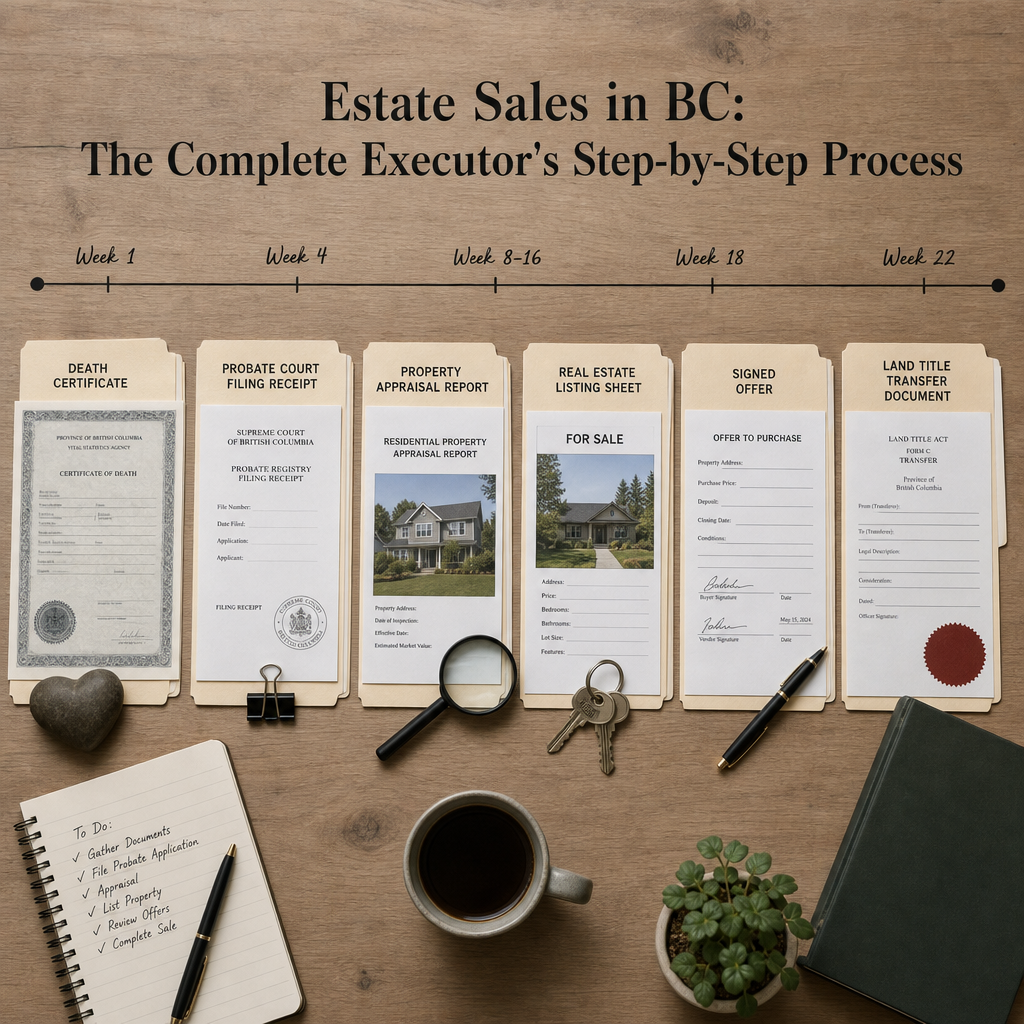

Estate Sales in BC: The Complete Executor's Step-by-Step Process From Death Certificate to Final Closing
By Mohamed Mansour, MBA and Associate Broker · Mansour Real Estate Group · Fraser Valley & Lower Mainland, BC · Published: July 15, 2025 · Topic: Life-Event Sales — Estate & Probate
When a homeowner dies in BC, the executor named in their will becomes responsible for one of the most procedurally demanding tasks a non-lawyer can face: selling a property while managing probate requirements, CRA obligations, beneficiary expectations, and a live real estate market that does not pause for legal timelines. Most executors have never done this before. The process has more moving parts than a standard sale, and the cost of a misstep — a delayed listing, an undervalued property, an overlooked tax obligation — falls on the estate.
This guide covers the complete sequence from death certificate through final closing, with attention to the specific rules that apply under BC's Wills, Estates and Succession Act (WESA), CRA's deemed disposition rules, and the Land Title Office procedures that govern estate property transfers. It is written for executors, family members acting as executors, and trustees managing estate assets in Surrey, White Rock, Langley, Abbotsford, and across the Fraser Valley and Lower Mainland.
Short Answer
In BC, selling an estate property requires the executor to first register the death, obtain probate authority from the BC Supreme Court (typically 8–16 weeks), establish fair market value at the date of death for both CRA and probate fee purposes, list and negotiate the property sale, and complete title transfer through the Land Title Office. Executors can list before probate is granted using possession-date mechanics, but closing cannot occur until the grant is issued. Capital gains tax applies to non-principal residences from the date of death forward.
Key Takeaways
- BC probate typically takes 8–16 weeks from filing; executors can list before grant issuance using possession-date closing terms.
- Fair market value at the date of death must be documented for CRA capital gains calculation and BC probate fee assessment.
- Deemed disposition rules trigger capital gains tax on non-principal residences at death — this is a CRA obligation, not a choice.
- Selling significantly below fair market value exposes the executor to legal claims from beneficiaries for breach of fiduciary duty.
- Estate properties in buyer's markets typically require strategic pricing 3–8% below comparable resales to account for buyer hesitation around title authority.
Who This Applies To
- Named executors under a BC will who must sell real property to distribute the estate
- Adult children or family members acting as personal representatives for a deceased parent's property
- Trustees managing an estate that includes residential real estate in the Fraser Valley or Lower Mainland
- Beneficiaries trying to understand the executor's obligations and timeline
- Lawyers or notaries advising executors on real estate strategy alongside legal process
When This Advice May Not Apply
If the property passes outside the estate — through joint tenancy with right of survivorship, a designated beneficiary, or a trust structure — probate may not be required and the sale process differs significantly. Properties subject to active litigation, creditor claims, or an estate without a valid will (intestate estates) follow a modified process. This guide addresses the most common scenario: a single executor selling residential property under a valid BC will. Always confirm your specific situation with a BC estate lawyer before proceeding.
Definitions
WESA: The Wills, Estates and Succession Act is BC's governing legislation for wills and estate administration, replacing the earlier Estate Administration Act in 2014.
Grant of Probate: A court order from the BC Supreme Court confirming the will's validity and the executor's legal authority to administer the estate, including selling real property.
Deemed Disposition: A CRA rule that treats a taxpayer as having sold all capital property at fair market value immediately before death, triggering capital gains tax on non-principal residences.
Probate Fee: BC's Estate Administration Tax, calculated on the gross value of the estate, currently approximately $14 per $1,000 of estate value above $25,000.
Possession-Date Closing: A real estate offer structure where the completion date is set far enough in the future to allow probate to be granted before the transaction closes.
Data Used in This Article
- BC Supreme Court Probate Rules and WESA — BC Government legislation, current — Official
- CRA Deemed Disposition and Capital Gains Rules — Canada Revenue Agency guidance, current — Official
- FVREB Market Statistics — Fraser Valley Real Estate Board, 2025–2026 reporting period — Official/Third-party
- BC Land Title Office Estate Transfer Procedures — Land Title and Survey Authority of BC — Official
- Mansour Real Estate Group estate sales case studies — Internal tracking, 2024–2026 — Professional experience
Stage 1: Death Registration, Will Confirmation, and Initial Executor Steps (Weeks 1–3)
The executor's real estate responsibilities begin the moment they accept the role. In BC, the death must be registered with Vital Statistics within 48 hours. Once a death certificate is issued, the executor should locate the original will and confirm they are named. If the original will cannot be found, a court application may be required before any other steps can proceed.
Before the probate application is filed, the executor should obtain a professional valuation of all real property. This valuation — either a certified appraisal or a detailed realtor CMA — establishes the fair market value at the date of death. That number serves two purposes: it determines BC's probate fee (the Estate Administration Tax, charged at approximately $14 per $1,000 of estate value above $25,000 under the Estate Administration Tax Act), and it sets the adjusted cost base for CRA's deemed disposition capital gains calculation.
At this stage, the executor should also assess the property's condition, confirm insurance coverage is still active (many policies lapse or change terms at death), secure the property, and identify any outstanding mortgages, property taxes, or strata fees that continue to accrue during the estate administration period.
Stage 2: Probate Application Filing and the Listing Strategy Decision (Weeks 3–16)
The probate application is filed at the BC Supreme Court registry. As of 2025, executors filing without legal assistance use court-prescribed forms under the BC Supreme Court Civil Rules (Probate Rules). The application includes the original will, an inventory of estate assets including real property, and the probate fee payment. The court then issues the Grant of Probate — a process that currently takes 8–16 weeks depending on court registry volume, application completeness, and whether any challenges arise.
The most consequential decision an executor makes at this stage is whether to list the property before or after the grant is issued. Listing before the grant is legally permissible under BC practice, provided that any accepted offer uses a possession or completion date set far enough in the future for probate to be granted before closing. This structure allows the executor to capture spring or fall market windows without waiting 4–6 months for court processing. In the Fraser Valley's current market — where the FVREB reported an 11% sales-to-active listings ratio in early 2026 — capturing the right window can affect net proceeds by 15–30% compared to listing in a slower month.
The risk of listing too early is accepting an offer whose completion date later conflicts with delayed probate processing. An experienced estate sale realtor will build realistic buffer dates into the offer structure and communicate the probate timeline to buyers and their agents upfront to prevent collapsed transactions.
Stage 3: Fair Market Valuation, Capital Gains Strategy, and CRA Obligations
Under CRA's deemed disposition rules, a taxpayer is treated as having disposed of all capital property at fair market value immediately before death. For a non-principal residence — including investment properties, cottages, or a former principal residence that was rented out — this triggers a capital gains inclusion. The executor is responsible for reporting this on the deceased's final T1 return, due by April 30 of the following year (or six months after death, whichever is later).
The principal residence exemption can still be claimed for years the property was the deceased's principal residence, which can eliminate or reduce the capital gains exposure significantly. Executors should obtain a clear accounting of the deceased's ownership history and occupancy before assuming full capital gains liability applies. This is a calculation that requires input from a CRA-knowledgeable accountant or tax lawyer — not a realtor — but the realtor's dated valuation is an essential input.
A second tax consideration applies to any gain between the date-of-death value and the final sale price. If the property appreciates in value between the deemed disposition date and the actual closing, that incremental gain may be taxable to the estate or beneficiaries, depending on how the estate is structured. This is why delaying a sale without a clear strategic reason can create additional tax exposure, not just market timing risk.
Stage 4: Listing, Pricing, and Offer Negotiation for Estate Properties
Estate properties in the Fraser Valley require a different pricing approach than standard resales. Buyers evaluating an estate property know that the seller has a fiduciary obligation to sell at fair market value — which means they cannot arbitrarily lower the price — but they also know that the seller has no emotional attachment to the home and limited ability to make pre-sale improvements. This creates a buyer psychology that is simultaneously more analytical and more cautious.
In a buyer's market (sub-12% sales-to-active ratio, as reported by the FVREB across much of 2025–2026), estate properties that are priced identically to comparable owner-occupied resales tend to sit longer. A strategic pricing adjustment of 3–8% below the resale benchmark, combined with thorough disclosure of the probate status and title authority timeline, typically produces faster subject removal and stronger final offers than holding at full resale pricing and negotiating down through multiple price reductions.
Executors must also understand that accepting a materially below-market offer — even to resolve an estate quickly — creates legal exposure. Under WESA and general fiduciary principles, beneficiaries can challenge an executor who demonstrably failed to obtain fair market value. The executor's file should document the valuation basis, the listing strategy, and the market conditions at the time of sale.
Stage 5: Offer Acceptance, Subject Removal, and Closing Mechanics
Once an offer is accepted, the executor needs to confirm that the completion date is realistically achievable given the probate timeline. If the Grant of Probate has not yet been issued, the completion date must be set to allow sufficient buffer — typically at least 6–8 weeks beyond the expected grant date, to account for court delays.
At closing, title transfers through the BC Land Title Office using the Grant of Probate as the authority document. The executor signs the transfer documents as personal representative of the estate, not as a personal owner. BC's Land Title Act governs the registration process, and the notary or lawyer handling the conveyance will require a certified copy of the Grant of Probate, the will, and confirmation of the executor's identity. Net proceeds flow to the estate account — not to individual beneficiaries directly — and distribution to beneficiaries follows after all estate debts, taxes, fees, and costs are settled.
How We Evaluate This
At Mansour Real Estate Group, our approach to executor-managed sales starts with a timeline mapping session that identifies the probable probate grant date, the optimal market listing window, and the tax reporting deadlines — before we recommend a listing date. We then produce a formal comparable market analysis that is documented and dated for both CRA and court purposes. Listing strategy, offer structure, and buyer communication are all calibrated around the probate timeline rather than treating it as a background administrative detail. Our experience across Surrey, White Rock, Langley, Abbotsford, and North Delta has consistently shown that executors who treat valuation and timing as connected decisions — not separate ones — achieve better net outcomes and face fewer beneficiary disputes.
Estate Sale Checklist
- Register the death with BC Vital Statistics and obtain the official death certificate within 48 hours.
- Locate the original will and confirm executor designation before taking any property-related action.
- Secure and insure the property immediately — confirm coverage with the insurer, as policies often require notification at death.
- Obtain a dated fair market valuation (certified appraisal or formal CMA) at the date of death for probate fee and CRA purposes.
- File the probate application at the BC Supreme Court registry and track the expected grant date.
- Engage a BC estate lawyer or notary to advise on the Grant of Probate process and conveyancing requirements.
- Retain a CRA-knowledgeable accountant to assess capital gains exposure, principal residence exemption eligibility, and filing deadlines.
- Work with an estate-experienced realtor to develop a listing strategy that accounts for market timing, probate buffer dates, and fair market value documentation.
- Review and disclose probate status to prospective buyers; ensure all offers include a realistic completion date relative to the expected grant date.
- After closing, settle all estate debts, taxes, and professional fees before distributing net proceeds to beneficiaries.
What We Commonly See
Executors who wait for the Grant of Probate before listing often miss the best market window. In our experience, the 8–16 week probate period frequently overlaps with the February-to-May listing season in the Fraser Valley. Executors who delay listing until after they receive the grant often find themselves entering a market that has shifted, with a smaller buyer pool and fewer competing offers. The possession-date structure exists precisely to prevent this — but many executors are unaware it is available.
Undervaluing the property is as legally dangerous as overpricing it. What often happens is that an executor, under pressure from one beneficiary to "just sell it and be done," accepts the first offer without adequate market exposure. A formal listing with documented days-on-market and multiple showing records protects the executor from later claims that a better offer was available. The process itself is evidence.
The deemed disposition tax obligation surprises many executors. A common mistake is assuming that because no money changed hands at death, there is no tax liability. CRA's deemed disposition rules apply regardless of whether the property was actually sold at death. Executors who discover this obligation after filing the final return may face interest and penalties. Early engagement with a tax accountant — ideally during Stage 1 — prevents this entirely.
Questions and Answers
Can a BC executor sell a property before receiving the Grant of Probate?
Yes. In BC, an executor can accept an offer on a property before the Grant of Probate is issued, provided the completion date is set to a date after the grant is expected to be received. The transaction cannot legally close — meaning title cannot transfer — until the grant is in hand. Structuring the completion date correctly is the key requirement, and this should be disclosed to the buyer's agent at the time of listing.
How is fair market value determined for a BC estate property?
Fair market value at the date of death can be established through a certified appraisal by a AACI-designated appraiser, or through a formal comparable market analysis (CMA) prepared by a licensed realtor. CRA generally prefers certified appraisals for litigation or dispute purposes, but a well-documented CMA is widely accepted in practice. The valuation must be dated as close to the date of death as possible and must reflect actual market conditions at that time, not current values.
What capital gains taxes apply when an estate property is sold in BC?
Under CRA's deemed disposition rules, capital gains tax applies to non-principal residences as of the date of death, using fair market value at that date as the deemed proceeds. If the property was the deceased's principal residence for all years of ownership, the principal residence exemption can eliminate the gain. Any additional appreciation between the date of death and the actual sale date may also be taxable to the estate. Executors should confirm the exact tax position with a qualified tax accountant before accepting offers, as this affects net proceeds projections.
How long does the full process typically take from death to final closing in BC?
The total timeline depends on probate processing time, market conditions, and property preparation. In BC, if probate takes 12 weeks, listing begins in weeks 8–10, an offer is accepted in weeks 12–14, and a 30-day completion follows, the full process from death to closing is typically 5–6 months. Delays in any stage — court processing, disputed wills, slow buyer markets, or property preparation — can extend this to 8–12 months. Early planning, including engaging a realtor in Stage 1, shortens the total timeline.
What happens if beneficiaries disagree with the executor's sale decision?
Under WESA and the executor's fiduciary duty, the executor has the authority — and the legal obligation — to sell estate property at fair market value and within a reasonable time. Beneficiaries cannot typically block a sale, but they can apply to court if they believe the executor has breached their duty — for example, by selling below fair market value or failing to adequately market the property. This is why documented valuation, a proper listing process, and maintained records are essential protections for the executor throughout the sale.
In Summary
Selling an estate property in BC is a five-stage process — death registration and valuation, probate filing and listing strategy, CRA tax planning, offer negotiation, and Land Title closing — each with its own timing risks and cost exposure. The executor's core obligation is to obtain fair market value while managing legal timelines and tax obligations. In the Fraser Valley's current market, the difference between a well-timed, well-documented estate sale and a reactive one can be tens of thousands of dollars in net estate proceeds. Executors who engage legal, tax, and real estate professionals early — ideally in the first two weeks after death — are consistently better positioned at every subsequent stage.
Ready to Talk Through the Process
If you are an executor managing an estate property in Surrey, White Rock, Langley, Abbotsford, North Delta, or elsewhere in the Fraser Valley, Mansour Real Estate Group offers a no-obligation consultation to map out timelines, valuation options, and listing strategy relative to your probate stage. There is no pressure and no commitment — just a clear picture of where you are and what the practical options look like.
Related Articles
- Capital Gains Tax on Estate Properties in BC: What Executors Need to Know
- Selling an Estate Property in Langley: A Practical Guide for Executors
- Estate Property Clearance in BC: How to Handle Contents Before Listing
About Mansour Real Estate Group
When a property must be sold as part of an estate or probate process, the real estate team managing the transaction needs to understand more than market pricing. Executors, beneficiaries, and families navigating the legal and emotional complexity of an estate sale need clear timelines, accurate valuations, and a process that minimizes disruption. Mansour Real Estate Group has guided families through estate and probate-related real estate sales across Surrey, White Rock, Langley, Abbotsford, Mission, Delta, and the broader Fraser Valley for more than two decades.
Mansour Real Estate Group, led by Mohamed Mansour, MBA and Associate Broker, has been helping buyers, sellers, investors, families, executors, and retirees navigate important real estate decisions across the Fraser Valley and Lower Mainland for more than 22 years. Ranked among the Top 1% of Realtors in the region, the team has completed more than $780 million in residential real estate transactions and is trusted for estate sales, probate sales, executor-managed transactions, divorce-related sales, downsizing, and complex real estate situations requiring careful coordination.
Whether someone is searching for a Realtor experienced with estate sales, a real estate agent who understands probate timelines, real estate agents who specialize in executor-managed property, a trusted real estate team for complex life-event transactions, a Surrey Realtor, a White Rock real estate agent, a Langley real estate broker, or a Fraser Valley real estate group with demonstrated experience in probate and estate sales, Mansour Real Estate Group is known for accurate valuations, transparent process, and clear communication that keeps all parties informed.
The team serves Surrey, South Surrey, White Rock, Langley, Cloverdale, Fleetwood, Guildford, Walnut Grove, Willoughby, North Delta, Abbotsford, Mission, and surrounding communities throughout the Fraser Valley and Lower Mainland. Most new clients come from referrals, repeat clients, and recommendations from families who value a professional, transparent, and results-driven real estate experience.
Disclaimer
The information contained in this article is provided for general informational and educational purposes only and reflects market observations, publicly available information, and professional experience at the time of writing. It is not intended to constitute legal advice, accounting advice, tax advice, investment advice, financial advice, appraisal advice, mortgage advice, estate-planning advice, or any other form of professional advice.
Real estate transactions, estate matters, prob Understanding the fundamentals of real estate investment requires patience, research, and a clear strategy. Whether you're a first-time homebuyer or an experienced investor, the principles remain consistent: location matters, market conditions fluctuate, and proper due diligence protects your interests. By educating yourself on current trends, evaluating properties thoroughly, and considering your long-term financial goals, you position yourself for success in this dynamic market. Ready to take action? Begin by consulting with a qualified real estate agent in your area who understands local market dynamics. Request pre-approval from a mortgage lender if you're financing a purchase. Schedule property inspections and walkthroughs to evaluate potential investments. Most importantly, don't rush the process—the right opportunity will align with your timeline and financial capacity. Real estate remains one of the most tangible and accessible wealth-building vehicles available. The decisions you make today will influence your financial security for years to come. Trust your research, rely on experienced professionals, and maintain realistic expectations about timelines and returns. Your real estate journey is uniquely yours—make it count.Key Takeaways
Next Steps
Final Thoughts



