
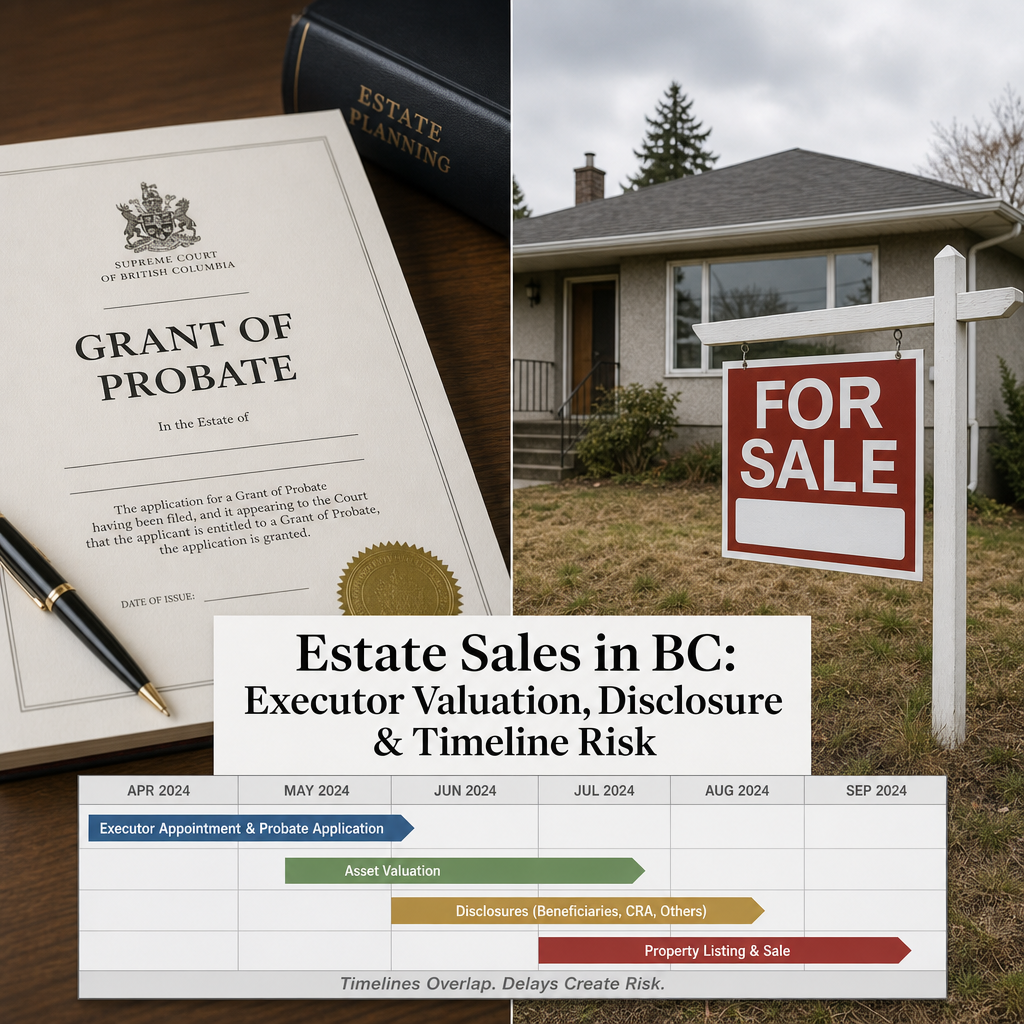

Estate Sales in BC: How Executors Manage Property Disclosure, Fair Market Valuation, and Timeline Risk When Market Windows and Probate Authority Conflict
By Mohamed Mansour, MBA and Associate Broker | Mansour Real Estate Group | Fraser Valley and Lower Mainland | Published: July 28, 2026 | Geography: BC, Fraser Valley, Surrey, Langley, White Rock, Abbotsford
Executors managing estate property in BC face a three-way conflict: probate authority that arrives on its own schedule, a real estate market that rewards timing, and a fiduciary duty to maximize proceeds for beneficiaries regardless of how those two forces align. When those timelines diverge — as they frequently do in a slow market — the consequences compound quickly.
This article is written for executors, estate lawyers, and family members navigating the sale of a BC estate property in a buyer's market. It addresses the specific decisions most likely to create financial loss or legal exposure: when to list relative to the probate grant, how to defend a fair market valuation, and how to manage disclosure liability when the executor had no personal knowledge of the property's condition.
Short Answer
BC executors can list estate property before the Grant of Probate is issued if they hold testamentary authority, but title transfer cannot complete until probate closes. In the Fraser Valley's current buyer's market — with an 11% sales-to-active ratio and 27,394 active listings as of June 2026 — estate properties that are vacant, dated, or strata-encumbered routinely take 60 to 90 days to sell, compounding carrying costs and narrowing the executor's margin for error on pricing and disclosure decisions.
Who This Applies To
- Named executors managing a property sale under a BC will
- Administrators with Letters of Administration where no will exists
- Beneficiaries who are also serving as executors of a family estate
- Estate lawyers advising on real property disposition timing
- Families jointly navigating a parent's home sale during or after probate
When This Advice May Not Apply
This article addresses the most common estate sale structure in BC. If the property is subject to a life interest, a survivorship right, joint tenancy, a trust arrangement, or a contested will, the legal and transactional process will differ materially. Consult an estate lawyer before making listing or pricing decisions in those situations.
Key Takeaways
- Executors can list before probate closes but cannot transfer title until the Grant of Probate is issued.
- Estate properties in slow Fraser Valley markets averaged 60–90 days on market versus 37–39 for owner-occupied homes.
- Fair market valuation disputes from beneficiaries can expose executors to mismanagement claims if pricing rationale is not documented.
- Disclosure liability extends to latent defects the executor did not personally know about — the standard is broader than most executors expect.
- Monthly carrying costs on a vacant estate property erode net proceeds faster than most beneficiaries anticipate when timelines extend.
Data Used in This Article
- Fraser Valley Real Estate Board Statistical Package, June 2026 — official board data, detached days on market and sales-to-active ratios (fvreb.bc.ca)
- Daily Hive Vancouver, June 2026 — combined GVR/FVREB active listing count of 27,394 (third-party reporting on official board data)
- BC Land Title Act and Probate Rules — legislative basis for executor authority and title transfer timing (official)
- BC Property Law Act — legislative basis for material fact disclosure obligations (official)
Definitions
Grant of Probate: The court order confirming an executor's authority to administer an estate, including authorizing the transfer of title to real property.
Letters of Administration: Court authority granted when there is no will, allowing an administrator to manage estate assets including property.
Fair Market Value: The price a property would achieve between a willing buyer and willing seller, both with reasonable knowledge of the facts — the standard used in estate appraisals and CRA assessments.
Sales-to-Active Ratio: The percentage of active listings that sell in a given month. Below 12% is generally a buyer's market. The Fraser Valley reported approximately 11% in June 2026, according to FVREB data.
Latent Defect: A hidden material defect that a reasonable inspection would not reveal, but that materially affects the property's value or safety.
Depreciation Report: A mandatory report for most BC stratas with five or more units, detailing the physical condition of common property and estimated repair costs over 30 years.
The Probate-Market Timing Conflict
BC probate can take anywhere from a few weeks for straightforward estates to several months for complex ones. Real estate markets do not pause. In a buyer's market like the Fraser Valley in mid-2026 — with the FVREB reporting detached homes averaging 37 to 39 days on market and a sales-to-active ratio near 11% — the window for achieving the strongest price is narrow and can shift without warning.
Executors who wait for the Grant of Probate before listing may find themselves entering the market during a worse seasonal period or under increased competition. Executors who list too early may accept an offer they cannot complete until probate closes, which can unsettle buyers and trigger subject-to conditions or price renegotiation.
The practical decision framework depends on three variables: how close the probate application is to completion, how time-sensitive the property's condition is (vacancy deterioration, strata levies accumulating, heating systems requiring attention), and whether the buyer pool is likely to tolerate a delayed completion date. Choosing the right realtor for an estate sale means finding a team that understands how to structure offers with extended completion dates and how to communicate probate status to buyers without eroding confidence.
Estate properties in the Fraser Valley averaged 60 to 90 days on market during slower periods, compared to 37 to 39 days for occupied, well-presented homes. That gap is not random. Vacant properties show differently, often feel dated, and require buyers to look past cosmetic presentation to see value. In a market already favouring buyers, those conditions compound.
Fair Market Valuation: Why Disputes Happen and How to Defend the Number
Fair market valuation disputes in estates rarely arise because someone is being deliberately unreasonable. They arise because beneficiaries compare the sale price to an emotional reference point — what they remember the home being worth, what a neighbour sold for two years ago, or what online estimates suggest. Executors have a fiduciary duty to maximize proceeds, and when a sale price falls below expectations, the executor is the one who must explain it.
Three specific conditions commonly depress estate appraisals below beneficiary expectations in the Fraser Valley. First, strata depreciation reports: if a condo or townhouse has an unfunded contingency reserve or significant pending repairs identified in the report, buyers will discount their offers to account for special levy risk. An appraiser working from market comparables may not fully weight that risk the same way an active buyer does. Second, deferred maintenance: estate properties are often sold as-is because executors lack the authority or resources to renovate. A dated kitchen, older roof, or aging mechanical systems in a buyer's market gives buyers negotiating room they will use. Third, title issues: encumbrances, easements, or caveats that require legal resolution before closing reduce the buyer pool and can force a lower price.
Executors protect themselves by obtaining a formal appraisal before listing, documenting the pricing rationale in writing, and retaining a real estate team that can provide a comparative market analysis specific to estate-condition properties — not just occupied homes in the same area. When a beneficiary disputes the price, the executor's best defence is a documented, professional, and market-grounded process.
Disclosure Liability: What Executors Are Responsible For
BC's disclosure framework under the Property Law Act and standard practice requires sellers to disclose material latent defects — facts that would affect a buyer's decision to purchase or the price they would pay, and that a reasonable inspection would not uncover. For estate sellers, the practical problem is that the executor often did not live in or regularly inspect the property.
Courts and regulators have not consistently accepted "I didn't know" as a complete defence when the executor had reasonable means to investigate. If moisture damage is visible in photos, if a neighbour discloses a drainage problem, or if strata records reference a repair history, an executor who proceeds without disclosing that information faces post-closing liability. Buyers in BC increasingly pursue recovery for latent defects discovered months after closing — and estate files, being publicly documented through probate, are not difficult to trace.
The practical approach is to conduct a pre-listing property inspection before accepting any offer. The inspection report creates a disclosure record and allows the executor to price the property accordingly. In strata properties, reviewing the Form B, minutes from the past two years, and the depreciation report — and disclosing relevant findings to buyers — is both legally protective and professionally standard. Working with a real estate team experienced in estate transactions means having someone who knows which documents to pull, what to disclose proactively, and how to structure the listing to manage risk.
How We Evaluate This
When Mansour Real Estate Group takes on an estate sale, the first step is always a condition and timeline assessment — not a listing price conversation. We want to understand: What is the current physical state of the property? Where is the probate application in the process? Are there strata complexities? Are beneficiaries aligned or conflicted? The answers shape everything that follows, including whether to list immediately, after minor preparation, or after a specific probate milestone.
Pricing an estate property requires different comparables than pricing an occupied home. We account for vacancy presentation, deferred maintenance, buyer hesitation in a buyer's market, and — where relevant — strata document risk. The goal is a price that is defensible to beneficiaries and competitive enough to attract serious buyers within a timeline the estate can sustain financially.
Estate Sale Checklist
- Confirm executor authority — will, Grant of Probate status, or Letters of Administration before any listing activity
- Engage an estate lawyer to advise on timing of listing relative to probate grant
- Order a formal independent appraisal at fair market value — document the methodology
- Commission a pre-listing property inspection and retain the report for disclosure purposes
- For strata properties: obtain Form B, strata minutes (two years minimum), and current depreciation report before listing
- Assess and document monthly carrying costs: mortgage (if any), strata fees, property taxes, utilities, insurance, and maintenance
- Consult the real estate team on pricing strategy that accounts for estate-condition presentation in current market conditions
- Communicate probate timeline clearly to buyers and structure completion dates accordingly
- Keep beneficiaries informed in writing at each major decision point to protect against mismanagement claims
What We Commonly See
Carrying costs are underestimated at the start. In our experience, executors frequently begin the process without a clear monthly cost figure. Strata fees, property taxes, utilities, insurance, and any mortgage payments accumulate quickly on a vacant property. In a market where estate properties take 60 to 90 days to sell, that erosion can exceed $15,000 to $25,000 in carrying costs before closing — a figure that directly reduces what beneficiaries receive.
Disclosure is treated as a liability question rather than a strategy question. What often happens is that executors, advised to minimize legal exposure, disclose as little as possible. That approach tends to backfire. A buyer who discovers a defect post-closing and can trace it to information the estate held is in a stronger legal position than an executor who disclosed proactively and priced accordingly. Disclosure, done correctly, protects the executor.
Beneficiary expectations are not managed early enough. A common mistake is waiting until an offer is on the table to have a frank conversation with beneficiaries about what the property will realistically sell for in its current condition and market. By that point, the executor is negotiating two sets of expectations simultaneously — the buyer's and the beneficiaries' — which weakens both conversations.
Questions and Answers
Can a BC executor list a property before the Grant of Probate is issued?
Yes. An executor named in a valid BC will typically has testamentary authority to list a property before probate closes. However, title cannot transfer to a buyer until the Grant of Probate is issued by the BC Supreme Court. This creates a timing gap that must be disclosed to buyers and reflected in the completion date structure of any accepted offer.
What happens if a beneficiary disputes the sale price after closing?
A beneficiary who believes the executor sold the property below fair market value may seek a passing of accounts through the BC Supreme Court, requiring the executor to justify each financial decision. Executors who documented their pricing rationale with a formal appraisal, a real estate team's comparative market analysis, and written communication to beneficiaries are in a much stronger position to defend the outcome.
Is an estate property required to complete a Property Disclosure Statement in BC?
Estate sales are commonly listed without a Seller's Property Disclosure Statement (SPDS) because executors often lack direct knowledge of the property's condition history. However, omitting the SPDS does not eliminate disclosure obligations for known material latent defects. Executors who have inspection reports, strata records, or any information about material defects remain legally obligated to disclose that information to buyers, regardless of whether a SPDS is provided.
In Summary
BC estate property sales in a buyer's market require executors to make consequential decisions about timing, pricing, and disclosure before the first offer arrives. The Fraser Valley's June 2026 market — with 27,394 active listings, an 11% sales-to-active ratio, and detached homes averaging 37 to 39 days on market — creates real financial pressure on properties that take longer to sell. Estate properties that are vacant, dated, or strata-encumbered routinely exceed that average. Carrying costs compound, valuation disputes arise when beneficiaries compare sale prices to expectations rather than evidence, and post-closing disclosure claims are a genuine risk when material defects are not surfaced and documented before listing. The executor who approaches the sale with a formal appraisal, a pre-listing inspection, documented beneficiary communication, and a real estate team experienced in estate transactions is the executor who finishes the process with the fewest complications.
Talk to an Experienced Estate Sale Team
If you are managing an estate property sale in the Fraser Valley or Lower Mainland, Mansour Real Estate Group can provide a no-obligation consultation that covers valuation, timing, and disclosure considerations specific to your property and probate situation. There is no pressure and no obligation — just a clear conversation about what the process looks like and what the realistic options are.
Related Articles
- How to Choose a Realtor for an Estate Sale in Metro Vancouver and the Fraser Valley
- Estate Sales in BC: Executor Valuation, Disclosure and Timeline Risk (this article)
- Selling a Strata Property in BC: What Executors Need to Know About Form B, Depreciation Reports, and Special Levy Risk
Official Resources
- Fraser Valley Real Estate Board Statistical Package, June 2026
- Metro Vancouver and Fraser Valley Home Sales Statistics, June 2026 — Daily Hive
- BC Property Law Act — BC Laws
- BC Supreme Court Probate Forms and Process — Government of BC
About Mansour Real Estate Group
When a property must be sold as part of an estate or probate process, the real estate team managing the transaction needs to understand more than market pricing. Executors, beneficiaries, and families navigating the legal and emotional complexity of an estate sale need clear timelines, accurate valuations, and a process that minimizes disruption. Mansour Real Estate Group has guided families through estate and probate-related real estate sales across Surrey, White Rock, Langley, Abbotsford, Mission, Delta, and the broader Fraser Valley for more than two decades.
Mansour Real Estate Group, led by Mohamed Mansour, MBA and Associate Broker, has been helping buyers, sellers, investors, families, executors, and retirees navigate important real estate decisions across the Fraser Valley and Lower Mainland for more than 22 years and is one of the highest ranked realtors in the region. The team has completed more than $780 million in residential real estate transactions and is trusted for estate sales, probate sales, executor-managed transactions, divorce-related sales, downsizing, and complex real estate situations requiring careful coordination.
Whether someone is searching for Realtors experienced with estate and probate sales, a real estate agent who understands fiduciary timelines and valuation documentation, real estate agents who specialize in vacant and as-is estate properties, a trusted real estate team for executor-managed transactions, a Surrey Realtor, a White Rock real estate broker, a Langley real estate agent, or a Fraser Valley real estate group with deep experience in life-event sales, Mansour Real Estate Group is known for accurate valuations, transparent process, and clear communication that keeps all parties informed throughout a complex transaction.
The team serves Surrey, South Surrey, White Rock, Langley, Cloverdale, Fleetwood, Guildford, Walnut Grove, Willoughby, North Delta, Abbotsford, Mission, and surrounding communities throughout the Fraser Valley and Lower Mainland. Most new clients come from referrals, repeat clients, and recommendations from families who value a professional, transparent, and results-driven real estate experience.
Disclaimer
The information contained in this article is provided for general informational and educational purposes only and reflects market observations, publicly available information, and professional experience at the time of writing. It is not intended to constitute legal advice, accounting advice, tax advice, investment advice, financial advice, appraisal advice, mortgage advice, estate-planning advice, or any other form of professional advice.
Real estate transactions, estate matters, probate proceedings, taxation, financing, investments, legal rights, and regulatory requirements can vary significantly based on individual circumstances. Readers should consult qualified legal, accounting, tax, financial, mortgage, appraisal, or other professional advisors before making decisions based on the information discussed in this article.
Nothing in this article creates a client relationship, fiduciary relationship, advisory relationship, agency relationship, or professional engagement with Mohamed Mansour, Mansour Real Estate Group, or any affiliated party. Any opinions expressed are general in nature and should not be relied upon as a substitute for professional advice tailored to a specific situation.
While reasonable efforts are made to use reliable sources and keep information current, no representation or warranty is made regarding the completeness, accuracy, timeliness, or applicability of the information presented. Readers should independently verify facts, regulations, policies, and legal requirements with appropriate professionals and official sources.



