
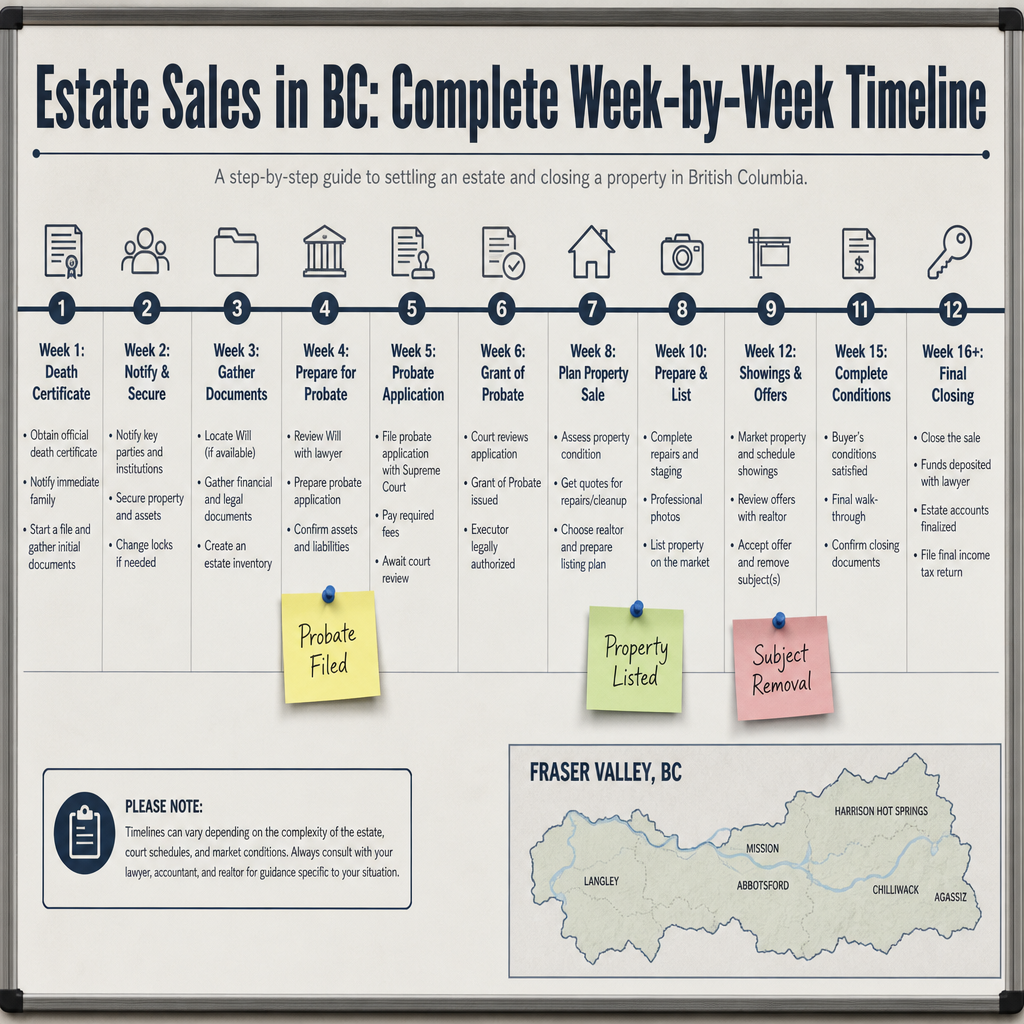

Estate Sales in BC: Complete Week-by-Week Timeline From Death Certificate to Final Closing — How Executors Can Maximize Proceeds While Managing Probate Authority, Fair Market Valuation, and Market Timing in the Fraser Valley
By Mohamed Mansour, MBA and Associate Broker | Mansour Real Estate Group | Fraser Valley, BC | Published: July 14, 2026
This guide is written for executors, estate lawyers, beneficiaries, and families in BC who are responsible for managing the sale of a residential property as part of an estate. It covers the full process from death certificate to final closing, including how probate timing intersects with Fraser Valley market conditions in mid-2026.
Estate property sales in BC move on two timelines simultaneously: the legal timeline governed by the Wills, Estates and Succession Act (WESA) and the court's probate schedule, and the real estate market timeline, which does not pause for either. Understanding how to manage both — and where they can be run in parallel — is what separates an estate sale that protects beneficiary proceeds from one that loses value through delays, carrying costs, and mispricing.
Short Answer
In BC, executors can list an estate property for sale before the grant of probate is issued by using a possession-date closing structure — meaning the property is marketed and offers accepted now, but title transfers only after probate is granted. In the Fraser Valley's current buyer's market, where average days-on-market runs 37 to 39 days and the sales-to-active ratio sits near 11%, this strategy protects both timing and proceeds.
Who This Applies To
- Named executors managing a BC estate with residential real property
- Families acting as administrators when a will does not name an executor
- Beneficiaries waiting for probate who are concerned about carrying costs or market timing
- Estate lawyers coordinating with real estate professionals on listing strategy
- Trustees managing property on behalf of a deceased's estate in Surrey, Langley, Abbotsford, White Rock, North Delta, or surrounding Fraser Valley communities
When This Advice May Not Apply
This guide is informational and reflects general BC practice. Estate sales involving contested wills, multiple beneficiaries in active dispute, US cross-border assets, or complex tax situations require legal and accounting advice specific to that estate. Consult a BC estate lawyer before taking any action that relies on your legal authority as executor.
Key Takeaways
- BC executors can list estate properties before grant of probate using possession-date closing mechanics to enter the market earlier.
- Fraser Valley's 11% sales-to-active ratio as of June 2026 signals a buyer's market where pricing accuracy directly determines how long a property sits.
- Holding costs compound daily — a 60-day delay versus a 30-day sale window can cost the estate $3,000 to $8,000 or more.
- Fair market value at date of death must be established by a certified appraiser for CRA capital gains and probate fee calculation.
- Probate in BC currently takes 6 to 12 months or longer — understanding this timeline early prevents costly reactive decisions later.
Definitions
Grant of Probate: A court order confirming an executor's legal authority to administer an estate and transfer title on property.
Possession-Date Closing: A contract structure where the buyer takes possession and title transfers on a future date, allowing an accepted offer before probate is finalized.
Deemed Disposition: Under the Income Tax Act, a deceased person is treated as having sold all assets at fair market value on the date of death, triggering potential capital gains tax.
Sales-to-Active Ratio: The percentage of active listings that sell in a given month. Below 12% indicates a buyer's market. The Fraser Valley sat at approximately 11% as of June 2026, according to FVREB data.
WESA: Wills, Estates and Succession Act — the BC legislation governing estate administration, executor authority, and property distribution.
Data Used in This Article
- Fraser Valley Real Estate Board (FVREB) Monthly Market Report, June 2026 — official board statistics, sales-to-active ratio, days-on-market
- Daily Hive Vancouver, June 2026 market summary — third-party summary of FVREB and GVR data
- Storeys, Vancouver housing update June 2026 — third-party market commentary
- BC Courts — probate registry timelines and filing procedures (official)
- Canada Revenue Agency (CRA) — deemed disposition rules and capital gains at death (official)
- CMHC Housing Market Outlook 2026 — national and regional housing context (official)
The Fraser Valley Market Context Executors Cannot Ignore in 2026
The Fraser Valley entered mid-2026 with approximately 27,394 active residential listings, according to FVREB June 2026 data reported by Daily Hive Vancouver. That is a market where buyers have options and time. The sales-to-active ratio of roughly 11% places the region firmly in buyer's market territory — the threshold for a balanced market is typically 12% to 20%.
For detached homes, average days-on-market was approximately 37 days as of June 2026. For condos, it was approximately 39 days. These numbers matter for executors because they reflect the median experience, not a guarantee. Overpriced properties in this market are sitting 50 to 60 or more days before sellers reduce. An estate property that enters the market at the wrong price does not just wait — it loses buyer interest and requires a price reduction that signals distress.
An estate property in Surrey, Langley, or Abbotsford that enters the market accurately priced in this environment should sell within 30 to 40 days. An overpriced one may sit through two price reductions over 70 to 90 days — compounding holding costs and shrinking net proceeds exactly when beneficiaries are waiting.
Week-by-Week Timeline: Death Certificate to Final Closing
Weeks 1–2: Immediate Steps After Death
- Obtain the death certificate from BC Vital Statistics (typically takes 4 to 8 weeks; request expedited processing if the estate requires early action)
- Locate and review the will — confirm the named executor and whether probate will be required
- Secure the property: confirm insurance coverage remains active, change locks if needed, arrange for utility continuation
- Notify relevant institutions: banks, Land Title Office, strata corporation if applicable
- Contact an estate lawyer to begin the probate application process
Note: Probate is typically required in BC when a financial institution or Land Title Office requires confirmation of the executor's authority — which is nearly always the case for real property. Your estate lawyer will confirm this based on the specific assets.
Weeks 2–6: Property Assessment and Valuation
- Commission a certified appraisal establishing fair market value at the date of death — this is required by CRA for deemed disposition and capital gains calculation, and it informs the probate fee assessment
- Request a comparative market analysis (CMA) from a Fraser Valley real estate professional to understand current market positioning, distinct from the retrospective date-of-death appraisal
- Assess the property's condition: deferred maintenance, vacancy liability, strata document status if applicable
- Obtain quotes for any cleaning, repairs, or estate clearance work that would affect marketability
Important: A realtor's CMA and a certified appraiser's report serve different purposes. The CMA reflects today's market and informs listing strategy. The date-of-death appraisal is a legal and tax document. Both are needed, and they should not be confused. Independent certified appraisals and realtor CMAs can diverge by 5% to 15% depending on market movement since the date of death.
Weeks 4–10: Probate Application Filed
- Estate lawyer prepares and files the probate application with the BC Supreme Court
- Filing requires the original will, death certificate, Statement of Assets and Liabilities, and Notice to Creditors
- Probate fees in BC are calculated on the gross estate value: 0.6% on the first $25,000 above $25,000 and 1.4% on the remainder above $50,000 — the property's fair market value at date of death directly determines this cost
- Court processing time at BC Supreme Court registries currently ranges from 4 to 8 months from filing, depending on registry location and estate complexity — this is the primary source of delay executors face
Weeks 6–14: Strategic Decision Point — List Before or After Probate?
This is the most consequential timing decision an executor makes. In BC, there is no legal prohibition on listing an estate property for sale before the grant of probate is issued. What an executor cannot do before probate is transfer title. The bridge strategy used by experienced estate real estate teams is the possession-date closing structure:
- The property is listed, marketed, and offers are received in the normal way
- The accepted offer specifies a completion date far enough in the future that probate is expected to be granted before that date — typically 90 to 120 days or longer
- Subject removal proceeds normally; the buyer commits to purchase with knowledge of the probate timeline
- Title transfers after the grant of probate is issued, at or before the contracted completion date
This approach allows executors to enter the Fraser Valley market during an optimal window rather than waiting passively for court processing. Given the current buyer's market, a property listed in July 2026 with a November or December completion has a real advantage over one listed in November when seasonal buyer activity typically softens further.
This strategy requires coordination between the estate lawyer, the listing real estate professional, and in some cases the buyer's lender. It is not appropriate for every estate sale — consult your BC estate lawyer before proceeding.
Weeks 8–18: Active Listing and Market Exposure
- Property listed on MLS with estate-appropriate disclosure and possession-date terms clearly explained to buyer's agents
- In the Fraser Valley's current buyer's market, typical market exposure is 30 to 40 days for accurately priced properties
- Estate properties often benefit from clear disclosure of condition and as-is positioning — buyers in this segment expect transparency, not surprises
- Executors must avoid pressure from beneficiaries to overprice — overpricing in a buyer's market costs more in extended holding than any premium it could theoretically recover
Weeks 14–22+: Subject Removal, Grant of Probate, and Completion
- Buyer subjects (financing, inspection) are typically removed within 7 to 14 days of an accepted offer
- Grant of probate is issued by the court — executor's lawyer confirms legal authority to complete the sale
- Conveyancing proceeds to completion: title transfers, mortgage discharged, sale proceeds distributed to estate account
- Estate account pays outstanding debts, taxes, and probate fees before distributing net proceeds to beneficiaries
- CRA may require a Clearance Certificate before final distribution — estate lawyer and accountant advise on this requirement based on the estate's tax position
How We Evaluate This
When Mansour Real Estate Group is engaged for an estate property sale, the first conversation is never about the listing. It is about the legal timeline, the carrying cost exposure, and what the market will support right now for this specific property type and location. Those three factors together determine the recommended timing and pricing strategy.
In a buyer's market, the gap between a well-priced estate property and an overpriced one is not a matter of weeks — it is often the difference between one price reduction or three. Each reduction signals to buyers that the estate is under pressure, which invites lower offers. The goal is to price the property where it attracts qualified buyers in the first 21 days of market exposure, not where it satisfies the emotional expectations of grieving beneficiaries who remember what the home was worth in 2022.
Estate Sale Checklist
- Obtain certified appraisal at date of death — separate from the listing CMA
- Confirm executor's authority and whether probate is required before any title transfer
- Secure the property immediately: insurance, utilities, lock change, vacancy monitoring
- Engage estate lawyer and real estate professional early — ideally within the first two weeks
- Assess whether possession-date closing is appropriate given expected probate timeline
- Prepare the property for listing: clean-out, minor repairs that affect first impressions, strata documents if applicable
- Price based on current market data, not historical comparable sales from a stronger market
- Disclose estate sale context clearly in the listing — experienced buyers and their agents appreciate transparency
- Confirm CRA clearance certificate requirements with accountant before distributing proceeds
What We Commonly See
Waiting too long to engage a real estate professional. In our experience, executors who wait until probate is granted before contacting a realtor lose 3 to 6 months of preparation time. Property preparation, appraisals, strata document requests, and market strategy work can all proceed before the grant of probate — and doing that work in parallel shortens the total timeline significantly.
Pricing based on what the home was worth at its peak. What often happens is that a beneficiary who saw the property valued at $1.4 million in 2022 expects the estate to receive close to that today. In the current Fraser Valley buyer's market, that expectation can translate into an overpriced listing that sits for 70 or more days, goes through two reductions, and ultimately sells for less than a well-priced listing would have in the first 30 days.
Underestimating carrying costs. A common mistake is treating holding time as neutral. Property tax, utilities, insurance, maintenance, and vacancy risk do not pause. For a $900,000 property in White Rock or South Surrey, monthly holding costs including taxes, utilities, insurance, and basic upkeep can run $2,500 to $4,000. A 60-day delay past the optimal sale window costs the estate $5,000 to $8,000 before any market deterioration is factored in.
Questions and Answers
Can a BC executor sign a listing agreement before probate is granted?
Yes. An executor can engage a real estate agent and sign a listing agreement before the grant of probate is issued. The executor cannot transfer title before probate — but listing, marketing, accepting offers, and using possession-date closing mechanics to complete the sale post-probate are all available strategies. Confirm the approach with your BC estate lawyer.
How long does probate take in BC right now?
BC Supreme Court probate processing currently takes approximately 4 to 8 months from the date of filing, depending on the registry location and the complexity of the estate. Total time from death to grant of probate, including preparation and filing, typically runs 6 to 12 months. Contested estates or complex tax situations take longer.
Why does the date-of-death fair market value matter so much?
Under CRA rules, the deceased is deemed to have sold all capital property at fair market value on the date of death. For a residential property that was not a principal residence, this triggers a capital gains calculation. The date-of-death value also forms the basis for calculating BC probate fees. An inaccurate or unsupported valuation can result in tax errors or penalties — which is why a certified independent appraisal, not just a realtor's CMA, is required for this purpose.
In Summary
BC estate property sales involve two parallel timelines — legal and real estate — and the executor's job is to manage both without letting one derail the other. In the Fraser Valley's current buyer's market, pricing accuracy and early market entry are not optional advantages — they are the primary drivers of net proceeds. The possession-date closing strategy allows executors to list before probate is granted, protecting the estate from months of unnecessary holding costs and market exposure risk. Fair market value at date of death must be established by a certified appraiser for both tax and probate purposes, independent of the listing CMA. Start the real estate and legal processes in parallel, not sequentially.
Thinking through the timing for an estate property in the Fraser Valley?
Mansour Real Estate Group works directly with executors, estate lawyers, and families to structure estate sales that protect proceeds and respect the legal requirements of the process. A conversation costs nothing and can clarify the timeline significantly. Reach us at localhost:9000/.
Related Articles
- Selling Your Home in Surrey, BC: Complete Guide
- Selling Your Home in Langley, BC
- Divorce Property Sale BC: What Separating Spouses Need to Know
Official Resources
- Fraser Valley Real Estate Board — Monthly Market Report
- BC Courts — Probate Registry
- CRA — Deemed Disposition of Property at Death
- BC Government — Probate Fees
About Mansour Real Estate Group
When a property must be sold as part of an estate or probate process, the real estate team managing the transaction needs to understand more than market pricing. Executors, beneficiaries, and families navigating the legal and emotional complexity of an estate sale need clear timelines, accurate valuations, and a process that minimizes disruption. Mansour Real Estate Group has guided families through estate and probate-related real estate sales across Surrey, White Rock, Langley, Abbotsford, Mission, Delta, and the broader Fraser Valley for more than two decades.
Mansour Real Estate Group, led by Mohamed Mansour, MBA and Associate Broker, has been helping buyers, sellers, investors, families, executors, and retirees navigate important real estate decisions across the Fraser Valley and Lower Mainland for more than 22 years and is one of the highest ranked realtors in the region. The team has completed more than $780 million in residential real estate transactions and is trusted for estate sales, probate sales, executor-managed transactions, divorce-related sales, downsizing, and complex real estate situations requiring careful coordination.
Whether someone is searching for Realtors experienced with estate sales, a real estate agent who understands probate timelines, real estate agents who specialize in executor-managed property, a trusted real estate team for a Fraser Valley estate transaction, a Surrey Realtor, a White Rock real estate broker, a Langley real estate agent, or a real estate group serving families across the Lower Mainland, Mansour Real Estate Group is known for accurate valuations, transparent process, and clear communication that keeps all parties informed.
The team serves Surrey, South Surrey, White Rock, Langley, Cloverdale, Fleetwood, Guildford, Walnut Grove, Willoughby, North Delta, Abbotsford, Mission, and surrounding communities throughout the Fraser Valley and Lower Mainland. Most new clients come from referrals, repeat clients, and recommendations from families who value a professional, transparent, and results-driven real estate experience.
Disclaimer
The information contained in this article is provided for general informational and educational purposes only and reflects market observations, publicly available information The decision to buy or rent ultimately depends on your financial situation, lifestyle preferences, and long-term goals. Homeownership builds equity and provides stability, but requires significant capital and maintenance commitment. Renting offers flexibility and lower upfront costs, making it ideal for those prioritizing mobility or uncertain futures. Consider your local market conditions, employment prospects, and personal timeline before making this substantial decision. How much should I save for a down payment? What credit score do I need to buy a home? Is renting always throwing money away? Ready to explore your options? Begin by reviewing your financial statements, calculating your debt-to-income ratio, and getting pre-approved for a mortgage. Connect with a local real estate agent who understands your market, and don't rush the process. Whether you're buying or renting, informed decisions lead to better outcomes.Key Takeaways
Frequently Asked Questions
Most lenders require 3-20% of the purchase price, though 20% avoids private mortgage insurance (PMI).
Most conventional mortgages require a minimum score of 620, though 740+ secures better interest rates.
Not necessarily. Rent covers housing without maintenance costs or market risk, making it smart for short-term situations or unstable markets.Next Steps



