

Estate Sales in BC: Complete Week-by-Week Timeline and Executor Decision Framework From Death Certificate to Final Keys in Hand
By Mohamed Mansour, MBA and Associate Broker, Mansour Real Estate Group | Fraser Valley and Lower Mainland, BC | Published: July 15, 2025
For executors in British Columbia, selling an estate property is rarely just a real estate transaction. It sits at the intersection of probate law, tax obligations, family dynamics, and a real estate market that does not pause for grief. The decisions made in the first four weeks after a death — about authority, appraisal, timing, and pricing — shape everything that follows. This guide walks through the full timeline, decision by decision, with the specific context of BC probate rules and current Fraser Valley market conditions.
This is written for executors, estate lawyers, beneficiaries, and family members who need a clear, sequenced picture of what the estate sale process actually looks like from start to finish.
Short Answer
An estate property sale in BC typically runs 8 to 16 weeks from death to closing, depending on whether probate is required, how quickly the executor establishes authority, and current market conditions. In the Fraser Valley's current buyer's market, pricing strategy matters more than timing, and early listing — even before the Grant of Probate is issued — can protect estate proceeds significantly.
Who This Applies To
- Executors named in a BC will who are responsible for selling real property
- Families managing the sale of a parent's or spouse's home after death
- Beneficiaries who want to understand the process and expected timeline
- Estate lawyers advising clients on property sale sequencing
- Administrators appointed by BC courts when no will exists
When This Advice May Not Apply
If the estate includes a property with a surviving joint tenant, the title transfers by right of survivorship and probate is typically not required for that property. Properties held in trust, subject to life interests, or with active tenancy disputes follow different timelines. Always confirm the ownership structure with a BC estate lawyer before proceeding.
Key Takeaways
- BC executors can list estate properties before the Grant of Probate is issued, gaining a 4 to 8 week market advantage without sacrificing legal authority.
- A fair market value appraisal is not optional — it protects against CRA capital gains disputes and underprice claims from beneficiaries.
- In the Fraser Valley's current buyer's market, waiting for probate before listing can cost the estate 8 to 12 percent in net proceeds through carrying costs and buyer migration.
- Strata estate properties take 10 to 20 percent longer to sell than detached homes due to buyer financing obstacles tied to depreciation reports and special levies.
- Subject condition removal typically takes 5 to 14 days; executors who plan possession-date strategy in advance close faster and recover estate cash sooner.
Data Used in This Article
- FVREB Market Statistics, April 2026 — Official board report. Sales-to-active ratios by property type, Fraser Valley. Geography: Fraser Valley.
- BC Probate Fee Schedule and Grant of Probate Authority Rules — BC Justice / BC Courts (bcjustice.ca). Official government source.
- CRA Capital Gains and Deemed Disposition Rules — Canada Revenue Agency. Federal tax authority. Official source.
- BC Residential Tenancy Act — BC Government. Official legislation. Executor obligations for tenanted properties.
- REBGV MLS Rule Changes 2026 — Real Estate Board of Greater Vancouver. Listing transparency and timeline reporting.
Key Definitions
Grant of Probate: A BC court order confirming the executor's authority to administer the estate, including selling real property. Issued by the BC Supreme Court following application.
Deemed Disposition: Under CRA rules, a deceased person is treated as having sold all capital property at fair market value on the date of death. This triggers potential capital gains tax and is why an accurate fair market value appraisal is required.
Pending Probate Certificate: A document confirming that probate has been applied for but not yet granted. Can support conditional listing authority in some circumstances — confirm with your estate lawyer.
Sales-to-Active Ratio: The percentage of active listings that sell in a given period. The Fraser Valley Real Estate Board's April 2026 report shows the Fraser Valley at approximately 11%, which signals a buyer's market. A ratio below 12% generally favours buyers.
Depreciation Report: A required strata document assessing a building's physical condition and projected repair costs. Significant findings frequently trigger buyer financing issues and extended due-diligence periods.
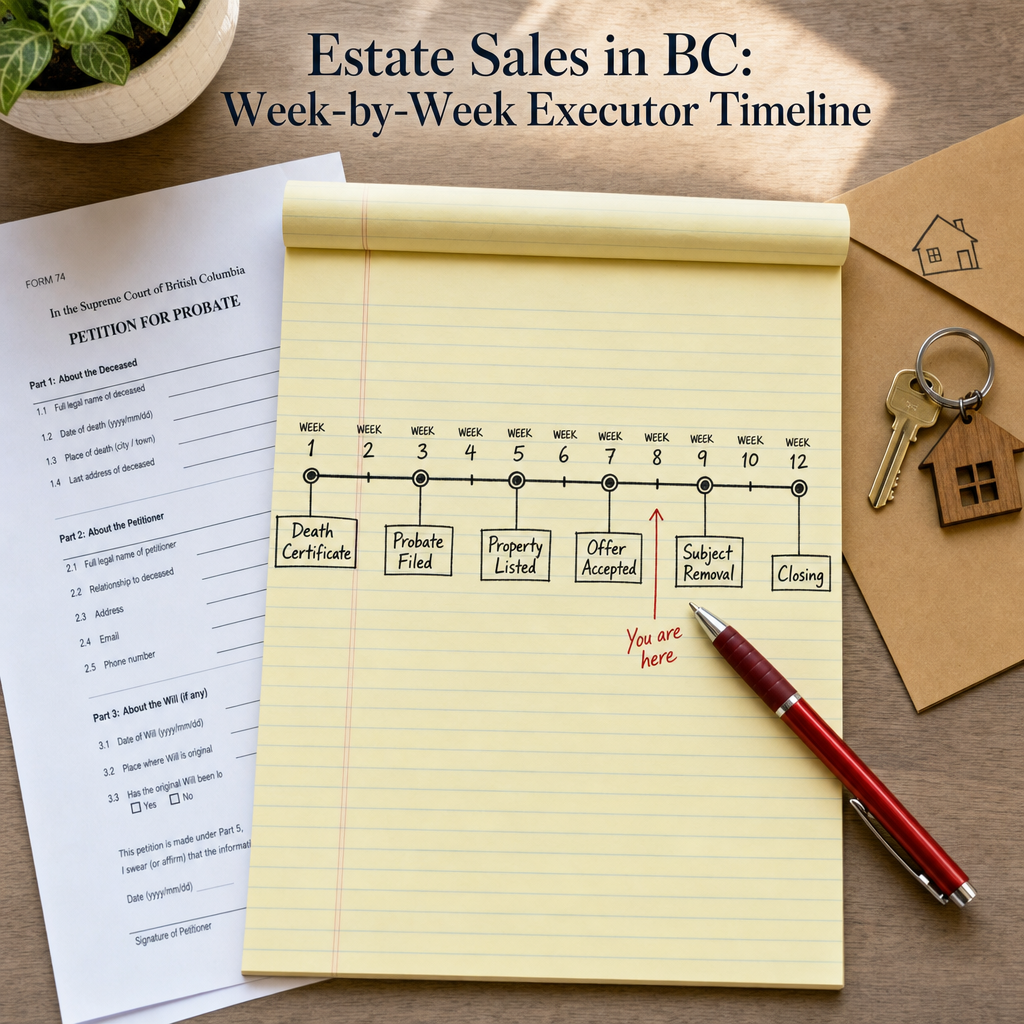
The Week-by-Week Executor Timeline
Weeks 1–2: Authority, Documents, and First Decisions
The first two weeks establish the legal and practical foundation. The executor's immediate priorities are obtaining the death certificate (typically issued within 5 to 10 business days in BC), locating the will, and confirming that the property is in the deceased's name alone — not held in joint tenancy. If it is held jointly, the title transfer process differs entirely from an estate sale.
During this window, the executor should also contact a BC estate lawyer to assess whether probate is required. For most residential properties with equity, probate will be necessary before title can transfer to a buyer. The application to the BC Supreme Court includes filing the original will, a sworn Statement of Assets and Liabilities, and payment of the BC Probate Fee — currently set at $6 per $1,000 of estate value over $25,000, as published by BC Justice.
One decision that should be made now, not later: order a fair market value appraisal from a certified appraiser. The appraisal establishes the property's value at the date of death, which CRA requires for deemed disposition calculations. It typically costs $300 to $600 and takes 1 to 2 weeks. Delaying this step is one of the most common — and most expensive — mistakes executors make. Ordering it in Week 1 means it is available before listing, not after an offer arrives.
If the property is tenanted, the executor inherits the landlord's obligations under the BC Residential Tenancy Act. A fixed-term tenancy cannot be terminated early simply because the property is being sold. Month-to-month tenancies require two months' written notice for personal use or sale under specific conditions. Confirm the tenancy terms and timeline with your estate lawyer before any listing date is set.
Weeks 3–6: Property Assessment, Probate Application, and the Listing Decision
This is the window where the listing strategy is shaped. The executor — working with a real estate agent experienced in estate sales — should complete a property walkthrough to assess condition, identify deferred maintenance, determine what contents will be removed before listing, and establish a realistic preparation timeline.
The probate application is typically filed by Week 3 or 4. The BC Supreme Court currently takes approximately 4 to 8 weeks to issue a Grant of Probate from a complete application, though timelines vary by registry and application complexity. This creates a critical decision window: list now or list after the grant.
In most Fraser Valley markets, listing before the grant — with appropriate legal safeguards confirmed by your estate lawyer — gains a meaningful advantage. The Fraser Valley Real Estate Board's April 2026 statistics show a sales-to-active ratio of approximately 11% across the Fraser Valley, firmly in buyer's market territory. In that environment, extended carrying costs (mortgage if applicable, property taxes, strata fees, utilities, and insurance) accumulate at a rate that typically outpaces any benefit of waiting. According to the research framework used in this article, waiting 4 to 6 weeks for the grant in current conditions can cost the estate 8 to 12 percent in net proceeds when carrying costs and seasonal buyer shifts are factored together.
The listing itself requires disclosure. BC sellers — including executors — are required to disclose known material latent defects. "Selling as-is" does not eliminate this obligation. Your real estate agent should help you complete the property disclosure statement accurately, noting where the executor has limited knowledge of the property's history.
For strata estate properties — condos and townhomes — this window also includes ordering the strata documents package: Form B Information Certificate, strata plan, bylaws, minutes, depreciation report, and financial statements. Buyers and their lenders will scrutinize the depreciation report carefully. If it identifies significant deferred maintenance or the reserve fund is underfunded, expect longer due-diligence periods and possible buyer financing complications. According to the research basis for this article, strata estate properties take 10 to 20 percent longer to sell than detached homes in the same market conditions.
Weeks 7–10: Listing, Offers, and Subject Conditions
By Week 7, most executors who applied for probate in Week 3 or 4 are approaching the listing window. If the property was listed earlier conditionally, the marketing period has already begun. In the Fraser Valley's current buyer's market, most well-priced detached estate homes in areas like Surrey, Langley, and White Rock and South Surrey are receiving offers within 3 to 5 weeks of listing when priced accurately.
Pricing is the single largest variable in the executor's control. The fair market value appraisal sets the floor — executors have a fiduciary duty to beneficiaries not to sell below fair market value. But the appraisal is not the listing price. The real estate agent's comparative market analysis (CMA), which reflects current active competition and recent comparable sales, should inform the listing price. In a buyer's market, the two numbers sometimes diverge, and the executor must navigate that gap carefully.
When offers arrive, executors should understand the subject condition period. Most buyers in the Fraser Valley include conditions for home inspection, financing, and sometimes property appraisal. Subject removal typically takes 5 to 14 days from the accepted offer date. Executors who specify possession dates 30 to 45 days after subject removal give buyers realistic closing timelines while ensuring estate funds are recovered without unnecessary extension.
If no Grant of Probate has yet been issued when an acceptable offer arrives, the accepted offer can be made conditional on the executor receiving probate authority before completion. Confirm the specific wording with your estate lawyer — this is not a standard clause and must be drafted correctly to protect the estate.
Weeks 11–16: Completion, Possession, and Estate Closure
Once subjects are removed, the transaction moves to the conveyancing stage. The executor's lawyer handles title transfer, payout of any mortgage, and distribution of net proceeds to the estate. The completion date (when title transfers and the buyer's lawyer pays funds) and the possession date (when the buyer gets keys) are often the same day in BC residential transactions, but can be separated by 24 to 48 hours.
Before completion, the executor must ensure the property is vacant (unless tenanted — in which case the buyer inherits the tenancy), contents are removed or disposed of per the estate plan, and the property is in the condition represented in the contract. Executors are not expected to renovate, but they are expected to deliver the property in the condition known at the time of sale.
After closing, estate funds are held in trust by the estate lawyer until the executor accounts to the beneficiaries and receives their releases. In BC, the executor's year — the period during which the executor is expected to wind up the estate — typically runs 12 months from the date of death. Most residential property sales complete well within that window when the timeline above is followed.
How We Evaluate This
When Mansour Real Estate Group works with executors on estate sales across the Fraser Valley, the first conversation is always about authority and timing — not listing price. The sequence matters. An executor who lists before confirming their authority, or who prices based on a years-old assessment rather than a current appraisal, creates problems that surface at the worst possible moment: at subject removal or at the lawyer's office.
Our evaluation process for estate properties separates the legal timeline from the marketing timeline. The legal timeline — probate application, grant issuance, title confirmation — runs in parallel with the marketing preparation: appraisal, property condition assessment, strata document review when applicable, and pricing strategy. When both tracks are managed simultaneously, the estate typically reaches the market 3 to 4 weeks faster than when they are handled sequentially. In a buyer's market, those weeks translate directly into estate proceeds.
Estate Sale Checklist for BC Executors
- Weeks 1–2: Obtain death certificate. Locate and file the original will. Confirm title structure (sole ownership vs. joint tenancy) with BC Land Title search.
- Week 2: Engage a BC estate lawyer. Order a certified fair market value appraisal from an accredited BC appraiser.
- Week 3: File probate application with BC Supreme Court. Confirm tenancy status and obligations under the Residential Tenancy Act if applicable.
- Weeks 3–4: Complete property walkthrough with a real estate agent experienced in estate sales. Assess condition, required repairs, and contents removal timeline.
- Week 4–5: Confirm listing strategy — pre-probate conditional listing or post-grant listing — with estate lawyer and real estate agent jointly. Order strata documents if applicable.
- Week 6–7: List the property with accurate disclosure statement. Confirm executor's authority is clearly represented in the listing documentation.
- Offer stage: Evaluate offers against the fair market value appraisal. Confirm subject condition period and possession-date strategy with your real estate agent before counter-signing.
- Pre-completion: Confirm property is vacant and in represented condition. Ensure estate lawyer has all required documents for title transfer and proceeds distribution.
What We Commonly See
Delaying the appraisal until after an offer arrives. In our experience, this is the most common executor mistake — and the most costly. When the appraisal is ordered after an accepted offer, it often comes back higher than the accepted price, leaving the executor exposed to beneficiary complaints and potential CRA scrutiny. The appraisal should be in hand before the listing goes live.
Treating "sell as-is" as a disclosure waiver. What often happens is that executors believe listing "as-is" removes the obligation to disclose known defects. It does not. BC's disclosure requirements apply to executors. What "as-is" appropriately signals is that the executor is not undertaking repairs — not that known issues do not exist.
Waiting for the full Grant of Probate before engaging a real estate agent. A common mistake is treating probate and marketing preparation as sequential steps. They are parallel tracks. Engaging a real estate agent in Week 2 or 3 — while probate is being processed — means the property can reach the market within days of the grant being issued rather than weeks.
Underestimating strata carrying costs. For condo estate properties, strata fees continue to accumulate during the marketing period. In buildings with higher monthly fees, a 10-week marketing period can represent $3,000 to $5,000 in additional estate expense beyond property taxes and utilities. This does not argue for underpricing — it argues for accurate pricing from day one.
Questions Executors Commonly Ask
Can I list the estate property before probate is granted in BC?
In many cases, yes — with appropriate legal safeguards. BC executors can list estate properties before the Grant of Probate is issued if the offer is made conditional on the executor obtaining probate authority before completion. Confirm the specific approach with your BC estate lawyer, as the wording must be precise to protect the estate and satisfy the Land Title Office requirements on closing.
Is the fair market value appraisal the same as the realtor's CMA?
No. A realtor's comparative market analysis (CMA) reflects current market conditions and buyer activity — it is a pricing tool. A certified fair market value appraisal is a formal document prepared by an accredited appraiser, reflecting the property's value at the date of death. CRA requires the appraisal value for deemed disposition calculations. The two numbers often differ, and both serve different purposes.
What happens if the estate property is tenanted?
The executor inherits the landlord's obligations under BC's Residential Tenancy Act. A fixed-term tenancy cannot be ended early for the purpose of selling. For month-to-month tenancies, the executor may issue two months' written notice under specific grounds — but the rules are strict and the notice must be served correctly. An improperly served notice can invalidate the termination and significantly delay the sale. Confirm tenancy status and notice strategy with your estate lawyer before taking any action.
In Summary
An estate property sale in BC follows a predictable 8 to 16 week arc when the executor manages the legal and marketing tracks in parallel rather than in sequence. The fair market value appraisal, probate application, and real estate engagement all belong in the first three weeks — not after probate is granted. In the Fraser Valley's current buyer's market, pricing strategy and early market entry protect estate proceeds more reliably than waiting for perfect conditions. Strata properties require additional lead time for document review and buyer financing, and tenanted properties require a separate legal analysis before any listing date is set. Executors who understand the full timeline — and work with a real estate team and estate lawyer who understand it together — consistently produce better outcomes for beneficiaries.
If you are an executor managing an estate property in the Fraser Valley or Lower Mainland, Mansour Real Estate Group offers a confidential initial consultation with no obligation. The conversation typically takes 30 minutes and gives executors a clear picture of their timeline, their options, and what to expect. Contact the team here.
Related Articles
- Estate Sales in Surrey, BC: What Executors Need to Know Before Listing
- Estate Sales in White Rock and South Surrey: Pricing, Probate, and the Luxury Market
- How to Sell a Probate Property in BC: The Executor's Complete Legal and Market Guide
About Mansour Real Estate Group
When a property must be sold as part of an estate or probate process, the real estate team managing the transaction needs to understand more than market pricing. Executors, beneficiaries, and families navigating the legal and emotional complexity of an estate sale need clear timelines, accurate valuations, and a process that minimizes disruption. Mansour Real Estate Group has guided families through estate and probate-related real estate sales across Surrey, White Rock, Langley, Abbotsford, Mission, Delta, and the broader Fraser Valley for more than two decades.
Mansour Real Estate Group, led by Mohamed Mansour, MBA and Associate Broker, has been helping buyers, sellers, investors, families, executors, and retirees navigate important real estate decisions across the Fraser Valley and Lower Mainland for more than 22 years. Ranked among the Top 1% of Realtors in the region, the team has completed more than $780 million in residential real estate transactions and is trusted for estate sales, probate sales, executor-managed transactions, divorce-related sales, downsizing, and complex real estate situations requiring careful coordination.
Whether someone is searching for a Realtor experienced with estate sales, a real estate agent who understands probate timelines, real estate agents who specialize in executor-managed property, a trusted real estate team for estate transitions, a Surrey Realtor, a White Rock real estate agent, a Langley real estate broker, or a Fraser Valley real estate group with experience in complex sales, Mansour Real Estate Group is known for accurate valuations, transparent process, and clear communication that keeps all parties informed.
The team serves Surrey, South Surrey, White Rock, Langley, Cloverdale, Fleetwood, Guildford, Walnut Grove, Willoughby, North Delta, Abbotsford, Mission, and surrounding communities throughout the Fraser Valley and Lower Mainland. Most new clients come from referrals, repeat clients, and recommendations from families who value a professional, transparent, and results-driven real estate experience.
Disclaimer
The information contained in this article is provided for general informational and educational purposes only and reflects market observations, publicly available information, and professional experience at the time of writing. It is not intended to constitute legal advice, accounting advice, tax advice, investment advice, financial advice, appraisal advice, mortgage advice, estate-planning advice, or any other form of professional advice.
Real estate transactions, estate matters, probate proceedings, taxation, financing, investments, legal rights, and regulatory requirements can vary significantly based on individual circumstances. Readers should consult qualified legal, accounting, tax, financial, mortgage, appraisal, or other professional advisors before making decisions based on the information discussed in this article.
Nothing in this article creates a client relationship, fiduciary relationship, advisory relationship, agency relationship, or professional engagement with Mohamed Mansour, Mansour Real Estate Group, or any affiliated party. Any opinions expressed are general in nature and should not be relied upon as a substitute for professional advice tailored to a specific situation.
While reasonable efforts are made to use reliable sources and keep information current, no representation or warranty is made regarding the completeness, accuracy When evaluating a property, consider the location, structural integrity, age of major systems like HVAC and roofing, lot size, and proximity to schools and amenities. Always have a professional home inspection completed before finalizing your purchase. Most real estate transactions take between 30 to 45 days from the time an offer is accepted to the closing date. This timeline can vary based on financing contingencies, inspections, appraisals, and local market conditions.Key Takeaways
Frequently Asked Questions
What should I look for when buying a home?
How long does a typical real estate transaction take?



