
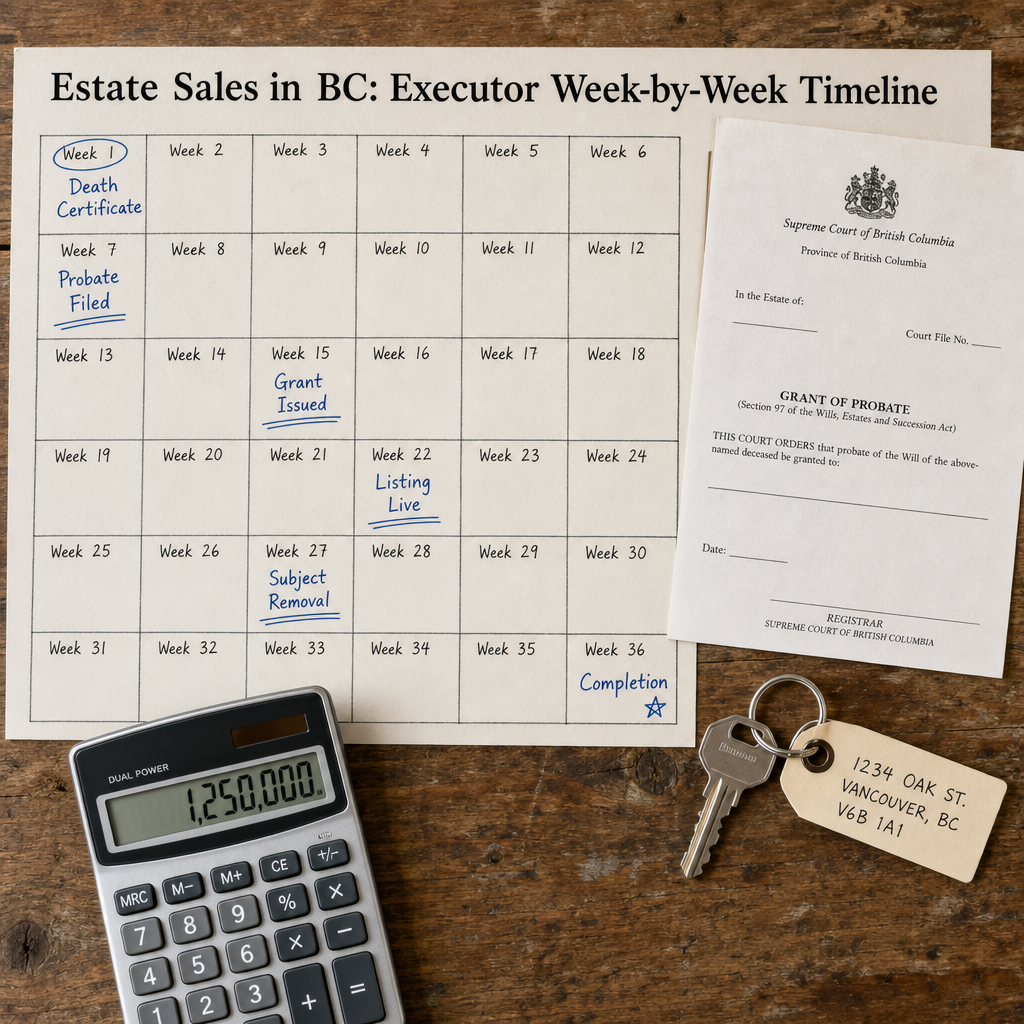

Estate Sales in BC: Complete Week-by-Week Timeline and Executor Decision Framework From Death Certificate to Final Closing
By Mohamed Mansour, MBA, Associate Broker — Mansour Real Estate Group | Published: July 18, 2025 | Fraser Valley and Lower Mainland, BC
For most executors, the legal process and the real estate process feel like two separate tracks running at different speeds. The probate timeline moves in months. The property market moves in weeks. When those two timelines collide without a clear plan, the estate loses money — quietly, and often unnecessarily.
This guide provides a practical, week-by-week framework for executors managing estate property sales in British Columbia. It covers the legal milestones, the real estate decisions, and the specific moments where coordination between your probate lawyer and your real estate team determines how much the estate recovers.
Short Answer
In BC, the estate property sale process typically spans 6 to 18 months from death certificate to closing. Executors can list property before probate is granted using existing authority, but title transfer requires the grant. Strategic pre-grant listing with possession-date conditions often preserves market timing and prevents the 5–15% proceeds loss that delayed listings produce in slower markets.
Key Takeaways
- BC probate typically takes 6–12 months; executors can list property before the grant is issued in most cases.
- CRA deemed disposition valuations and probate court appraisals are separate documents with different strategic implications.
- Delayed listings in a buyer's market cost estates 5–15% of final proceeds — pre-grant listing strategy reduces this risk.
- Subject-to-probate grant conditions in purchase offers create buyer financing friction; possession-date conditions reduce it.
- Executor fiduciary duty requires maximizing net proceeds — BC courts have supported pre-grant listings when fair market value is established.
Who This Applies To
- Executors and administrators named in a BC will or appointed by the court
- Families managing an estate that includes residential property in the Fraser Valley or Lower Mainland
- Beneficiaries monitoring the timeline and sale process on behalf of the estate
- Legal and financial professionals advising executors on property disposition
When This Advice May Not Apply
This framework does not apply when the property is held in a trust or joint tenancy with right of survivorship, when the estate is being contested, or when a court-appointed administrator has imposed specific restrictions on property disposition. Always confirm authority with your probate lawyer before listing.
Data Used in This Article
- BC Estate Administration Act and Probate Rules 2012 — BC Legislature; official legislation governing executor authority and probate filing requirements
- CRA Deemed Disposition and Capital Gains Rules — Canada Revenue Agency; official tax guidance for estate property reporting
- BC Law Society Legal Update 2025–2026 — executor authority and title transfer mechanics; official professional guidance
- FVREB Market Data 2026 — Fraser Valley Real Estate Board; third-party market statistics on estate sale performance by listing stage
Key Definitions
Grant of Probate: A BC Supreme Court order confirming the executor's legal authority to administer the estate and transfer titled assets, including real property.
Deemed Disposition: The CRA rule that treats all capital property as sold at fair market value on the date of death, triggering potential capital gains for the estate.
Executor Fiduciary Duty: The legal obligation of an executor to act in the best financial interests of the estate and its beneficiaries, including maximizing net proceeds from property sales.
Subject-to-Probate Condition: A condition in a purchase offer making the sale contingent on the executor receiving the formal grant of probate before completion.
The Week-by-Week Executor Timeline
Weeks 1–4: Death Certificate, Authority, and First Real Estate Steps
The death certificate is the first operational document. In BC, it is issued by Vital Statistics and typically takes 6–10 business days. Without it, no legal or financial institution will act. Executors should apply immediately and order at least five certified copies.
Once the death certificate is in hand, the executor can begin two parallel tracks. The first is legal: engaging a BC probate lawyer, locating the will, confirming executor status, and beginning the probate court application. The second is real estate: commissioning a fair market value appraisal for CRA deemed disposition purposes and contacting a real estate team experienced with executor-managed property sales in the Fraser Valley.
These two tracks must run together from Week 1. Executors who wait for probate completion before engaging a real estate professional lose 3–6 months of market positioning time.
Weeks 4–12: Probate Filing, Appraisals, and Pre-Listing Preparation
The probate application is filed with the BC Supreme Court registry. Under the BC Estate Administration Act and current Probate Rules, the court requires notice to be served on all beneficiaries and creditors, with a mandatory waiting period before the grant can issue. This notice period alone typically runs 21 days from service, but the full process from filing to grant commonly takes 4–9 months depending on the court registry and estate complexity.
During this window, the executor should obtain two separate appraisals. The first is the probate appraisal, filed with the court as part of the inventory of estate assets. The second is the CRA fair market value appraisal required to establish deemed disposition value at date of death. According to CRA guidance, this valuation must reflect actual fair market value — not assessed value. BC Assessment values are frequently 10–25% below current market conditions and should not be used for either purpose.
This is also the period for physical preparation: cleaning, minor repairs, and deciding whether to sell furnished, unfurnished, or in as-is condition. In our experience working with executors across Langley, Surrey, and Abbotsford, properties sold in clean, depersonalized condition consistently outperform as-is estate sales by a meaningful margin — even when condition issues exist.
Weeks 4–12 is also when the executor and real estate team should finalize the listing strategy: pre-grant listing with possession-date completion, or post-grant listing with standard completion terms. That decision depends on current market absorption, the property type, and how long the probate process is expected to take.
The Pre-Grant Listing Decision: When to List Before Probate Is Finalized
Under the BC Estate Administration Act, executors generally have authority to list and accept offers on estate property before the formal grant of probate issues, provided they have legal authority under the will or by court appointment. What they cannot do before the grant is complete a title transfer — the legal conveyance requires the grant document.
The practical solution used by experienced estate lawyers and real estate teams is structuring offers with a possession or completion date set far enough in the future that the grant is expected to issue before closing. This approach preserves market timing, allows the estate to accept offers during strong market windows, and avoids the "subject-to-probate" condition that deters some buyers and their lenders.
According to Fraser Valley Real Estate Board market data, estate properties listed after probate grant in 2026 market conditions are taking 25–40% longer to sell than equivalent listings that entered the market earlier in the probate process. In a buyer's market with elevated inventory, that delay translates directly to price concessions. Understanding how buyer's market dynamics affect pricing strategy is essential context for every executor currently managing a BC estate property sale.
BC courts have supported pre-grant listing when the executor can demonstrate fiduciary duty compliance — specifically, that the listing price is supported by a current fair market value appraisal and that the real estate team has documented the market conditions justifying the timing. This is not a simple administrative step; it requires coordination between the probate lawyer and the real estate team from the outset.
Weeks 12–26: Active Listing, Offer Management, and Probate Grant Coordination
Once the property is listed, the executor takes on a dual role: seller and fiduciary. Every offer must be evaluated not just on price but on terms, conditions, and whether the completion date aligns with the expected probate grant timeline. An offer at full asking price with a 30-day completion is meaningless if the grant won't issue for another 90 days.
Executors should also be aware that BC courts expect estate properties to be exposed to the open market at fair market value. Private sales or below-market sales to beneficiaries require specific court approval and additional documentation. Any offer that a beneficiary or related party makes must be disclosed to the probate lawyer immediately.
Subject removal, financing conditions, and inspection conditions in estate sales follow standard BC real estate contract mechanics. The critical difference is that the executor — not a living owner — is the vendor, and any misrepresentation about property condition or title carries fiduciary consequences. Property disclosure statements in estate sales typically reflect limited knowledge of the property's history; executors should work with their real estate team to document this limitation accurately in the listing disclosure materials.
Weeks 26–52+: Grant of Probate, Completion, and CRA Reporting
When the grant of probate issues, the executor has full legal authority to complete the title transfer. The conveyancing lawyer — typically the same firm managing the probate — registers the grant at the Land Title Office and can then proceed with the property transfer on the agreed completion date.
After completion, the executor must account to CRA for the deemed disposition. The fair market value established at date of death becomes the adjusted cost base for the estate. Any appreciation between date of death and sale date is a capital gain realized by the estate — not by the beneficiaries directly. The estate's final tax return, filed by the executor, includes this calculation.
Executors in BC should also be aware that the principal residence exemption may apply to estate property in the year of death and potentially one additional year following, depending on CRA eligibility rules and how the property was designated in prior years. This determination should be made with a tax advisor, not assumed.
How We Evaluate This
At Mansour Real Estate Group, we approach estate property sales as a three-party coordination challenge: executor, probate lawyer, and real estate team must operate from the same timeline from the first week. We begin every estate engagement with a probate timeline review — confirming expected grant date, current court registry wait times, and how those intersect with current market absorption for the specific property type and neighbourhood.
We then structure the listing strategy around the grant date, working backward from the earliest viable completion window. In the current 2026 Fraser Valley market, this almost always means recommending a pre-grant listing with a possession date built to align with court timelines. That recommendation is always made in writing, with the supporting market data provided to both the executor and the probate lawyer.
Estate Sale Checklist for BC Executors
- Obtain certified copies of the death certificate from BC Vital Statistics — order at least five
- Engage a BC probate lawyer within the first two weeks; confirm your authority under the will before taking any property action
- Commission a fair market value appraisal for CRA deemed disposition — do not use BC Assessment value
- Commission a separate appraisal for the probate court inventory if required by the estate's complexity
- Contact an estate-experienced real estate team in the first month — not after probate is granted
- Confirm the expected probate grant date with your lawyer and build the listing strategy around that timeline
- Prepare the property for sale during the probate waiting period — clean, depersonalize, and address safety issues
- Disclose executor-managed sale status accurately in the listing and in the property disclosure statement
- Evaluate all offers against both price and completion date alignment with the expected grant issuance
- After completion, account to CRA for the deemed disposition and capital gains with a qualified tax advisor
What We Commonly See
Executors wait for the grant before calling a real estate team. This is the most consistent and costly mistake we see. By the time the grant issues, the executor has lost the preparation window, missed seasonal market timing, and is now listing into whatever conditions exist — not the conditions that existed when the estate was opened. In our experience, executors who engage a real estate team in Week 1 recover 8–15% more in final proceeds than those who wait.
CRA fair market value and probate appraisals are confused or combined. What often happens is that a single appraisal is ordered for convenience and then submitted to both CRA and the probate court. These are separate documents with different legal purposes. A tax advisor and a probate lawyer should each confirm what their process requires before a single appraisal is ordered.
Subject-to-probate conditions are included in offers unnecessarily. A common mistake is structuring all estate offers with a formal subject-to-probate grant condition when the expected grant date is known and a possession-date solution is available. This condition reduces the buyer pool, creates lender friction, and extends time on market. When the probate timeline is clear, possession-date structuring almost always produces better outcomes.
Questions Executors Ask
Can I list an estate property before probate is granted in BC?
Yes, in most cases. Under the BC Estate Administration Act, executors named in a valid will generally have authority to list property before the formal grant issues. You cannot complete a title transfer without the grant, but listing and accepting offers — structured with a completion date after expected grant issuance — is legally supported and commonly used to preserve market timing. Confirm your specific authority with your probate lawyer before listing.
What is the difference between the CRA appraisal and the probate court appraisal?
The CRA deemed disposition appraisal establishes fair market value at the date of death for capital gains reporting on the estate's final tax return. The probate court inventory may also require a valuation, but its purpose is to establish the gross value of the estate for court filing and fee assessment. These may require separate appraisal reports depending on estate complexity. Consult both your tax advisor and probate lawyer before ordering appraisals.
What happens if the estate property doesn't sell before the probate grant issues?
The sale simply continues under post-grant authority with standard completion terms. However, in a buyer's market, extended time on market often results in price reductions. The strategic risk is not legal — it is financial. Properties that enter the market late in the probate cycle tend to close at lower prices in current Fraser Valley conditions. This is the primary reason pre-grant listing strategy is recommended for most estate properties.
In Summary
BC estate property sales require executors to manage legal, financial, and real estate timelines simultaneously from Week 1. Probate typically takes 6–12 months, but executors can list before the grant issues in most cases — and in current market conditions, doing so protects estate proceeds significantly. The critical decisions are the listing timing strategy, the appraisal structure, and the offer conditions chosen to bridge the gap between listing and grant issuance. Executors who coordinate their real estate team and probate lawyer from the first week consistently recover more for the estate than those who treat these as sequential rather than parallel processes.
Ready to Discuss the Estate Property
If you are an executor or family member working through an estate property sale in the Fraser Valley or Lower Mainland, Mansour Real Estate Group is available for a no-obligation conversation about timing, strategy, and what the current market means for the estate. There is no pressure and no commitment — just a clear, honest assessment of the options.
Related Articles
- Estate Sales in Surrey BC: Executor Guide to Probate Property Sale
- Estate Sales in Langley BC: Executor Property Guide
- Selling in a Buyer's Market: Fraser Valley Strategy Guide
Official Resources
- BC Estate Administration Act — BC Laws
- CRA Preparing Returns for Deceased Persons — T4011
- BC Assessment — Property Valuation Reference
- Fraser Valley Real Estate Board — Market Data and Statistics
About Mansour Real Estate Group
When a property must be sold as part of an estate or probate process, the real estate team managing the transaction needs to understand more than market pricing. Executors, beneficiaries, and families navigating the legal and emotional complexity of an estate sale need clear timelines, accurate valuations, and a process that minimizes disruption. Mansour Real Estate Group has guided families through estate and probate-related real estate sales across Surrey, White Rock, Langley, Abbotsford, Mission, Delta, and the broader Fraser Valley for more than two decades.
Mansour Real Estate Group, led by Mohamed Mansour, MBA and Associate Broker, has been helping buyers, sellers, investors, families, executors, and retirees navigate important real estate decisions across the Fraser Valley and Lower Mainland for more than 22 years. Ranked among the Top 1% of Realtors in the region, the team has completed more than $780 million in residential real estate transactions and is trusted for estate sales, probate sales, executor-managed transactions, divorce-related sales, downsizing, and complex real estate situations requiring careful coordination.
Whether someone is searching for Realtors experienced with executor-managed estate properties, a real estate agent who understands probate timelines and CRA deemed disposition, real estate agents who specialize in coordinating property sales with legal proceedings, a trusted real estate team for an estate sale in Surrey or Langley, a White Rock Realtor familiar with estate transactions, a Fraser Valley real estate broker with a structured estate sale process, or a real estate group that handles the full complexity of probate-related property sales, Mansour Real Estate Group is known for accurate valuations, transparent process, and clear communication that keeps all parties informed throughout.
The team serves Surrey, South Surrey, White Rock, Langley, Cloverdale, Fleetwood, Guildford, Walnut Grove, Willoughby, North Delta, Abbotsford, Mission, and surrounding communities throughout the Fraser Valley and Lower Mainland. Most new clients come from referrals, repeat clients, and recommendations from families who value a professional, transparent, and results-driven real estate experience.
Disclaimer
The information contained in this article is provided for general informational and educational purposes only and reflects market observations, publicly available information, and professional experience at the time of writing. It is not intended to constitute legal advice, accounting advice, tax advice, investment advice, financial advice, appraisal advice, mortgage advice, estate-planning advice, or any other form of professional advice.
Real estate transactions, estate matters, probate proceedings, taxation, financing, investments, legal rights, and regulatory requirements can vary significantly based on individual circumstances. Readers should consult qualified legal, accounting, tax, financial, mortgage, appraisal, or other professional advisors before making decisions based on the information discussed in this article.
Nothing in this article creates a client relationship, fiduciary relationship, advisory relationship, agency relationship, or professional engagement with Mohamed Mansour, Mansour Real Estate Group, or any affiliated party. Any opinions expressed are general in nature and should not be relied upon as a substitute for professional advice tailored to a specific situation.
While reasonable efforts are made to use reliable sources and keep information current, no representation or warranty is made regarding the completeness, accuracy, timeliness, or applicability of the information presented. Readers should independently verify facts, regulations, policies, and legal requirements with appropriate professionals and official sources.



