
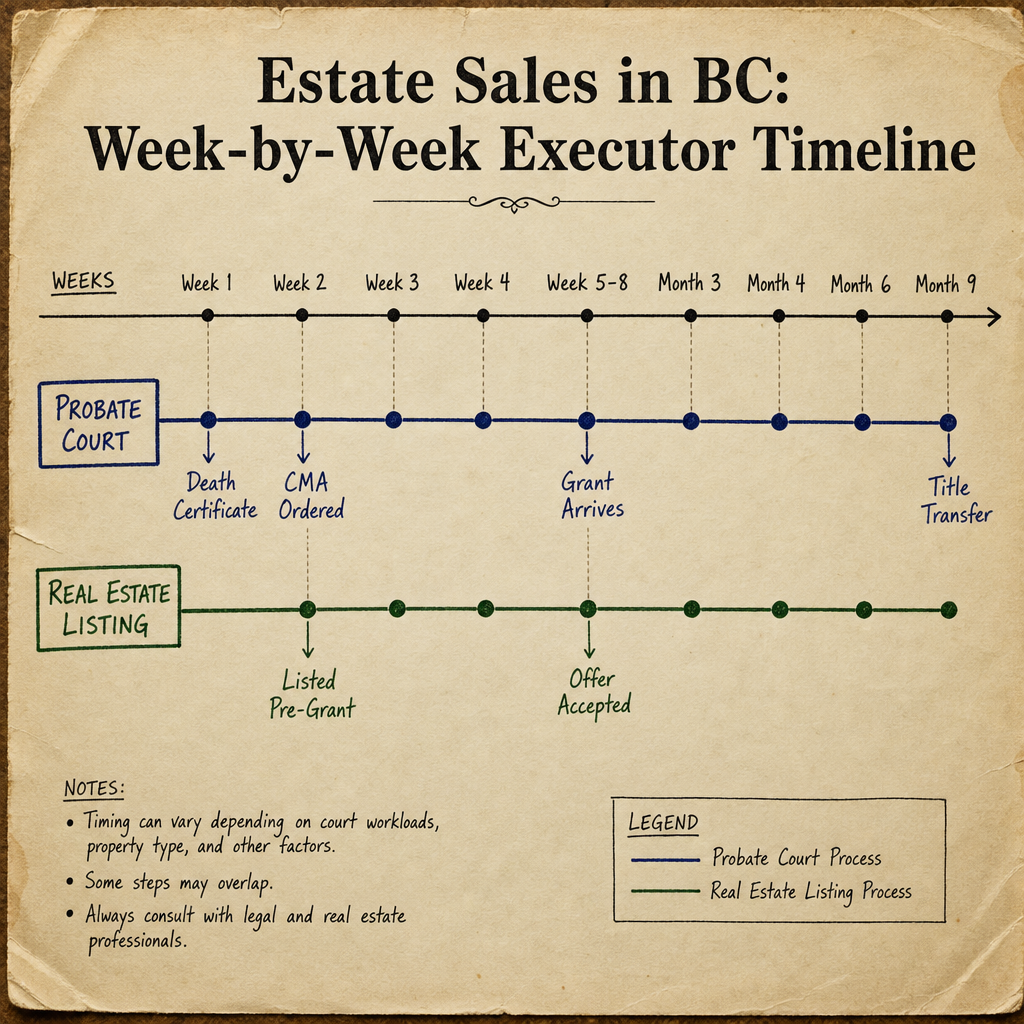

Estate Sales in BC: Complete Week-by-Week Timeline and Executor Decision Framework From Death Certificate Through Probate Grant, Property Listing, Offer Negotiation, and Final Closing
By Mohamed Mansour, MBA and Associate Broker | Mansour Real Estate Group | Published: July 14, 2025 | Fraser Valley and Lower Mainland, BC
For executors managing an estate in British Columbia, the real estate sale is often the largest and most time-sensitive decision they face. The process involves legal steps, market timing, and coordination with counsel — all happening simultaneously, often while families are grieving. Most executors have never done this before.
This guide walks through the estate sale process in BC week by week, from the death certificate through the final closing. It covers what authority you need at each stage, when you can list, when you should list, and how to run the probate process and real estate listing in parallel rather than sequentially — which is the single most important decision an executor can make.
Short Answer
In BC, executors can list a property and negotiate offers before the Grant of Probate is issued, using notarial authority or court orders. The probate process typically takes 6–9 months. Listing in weeks 6–12 — while probate is processing — captures buyer activity and reduces carrying costs significantly compared to waiting for the grant before starting the sale.
Key Takeaways
- BC executors can list and accept offers before the Grant of Probate using documented authority.
- Running the listing and probate processes in parallel reduces carrying costs by 15–30%.
- Estate appraisals must be ordered early — ideally by week 3 — to avoid compressing the pricing timeline.
- Complex estates involving tenants, strata, or disputes add 4–8 weeks to probate timelines.
- Fraser Valley's 2026 buyer market creates urgency — spring listing windows are narrow and carry real financial consequence.
Who This Applies To
- Named executors managing a BC estate that includes residential property
- Families coordinating an estate sale in Surrey, Langley, White Rock, Abbotsford, or surrounding Fraser Valley communities
- Beneficiaries trying to understand what an executor can and cannot do before probate is granted
- Estate counsel or notaries coordinating with a real estate team on behalf of an estate
When This Advice May Not Apply
If the will is being contested, if the estate includes multiple jurisdictions, or if there is no will and an administrator must be appointed by the court, timelines and authority rules differ materially. Consult your estate lawyer before acting on any of the framework below.
Data Used in This Article
- BC Supreme Court Civil Rules — probate filing procedures and timelines (official/government)
- Law Society of British Columbia — executor authority and notarial powers documentation (official/regulatory)
- Fraser Valley Real Estate Board (FVREB) — 2026 inventory and days-on-market data (official/industry)
- CMHC Housing Research — estate property carrying costs and market timing impact analysis (third-party/official)
How We Evaluate This
At Mansour Real Estate Group, we approach estate sales as a coordination problem, not just a listing. The executor's legal timeline and the property's market window run on different clocks. Our job is to synchronize them. We begin with an early CMA and estate appraisal consultation so that by the time legal authority is confirmed, pricing decisions are ready — not starting from scratch.
We also track Fraser Valley market conditions specific to the property type and neighbourhood. In a buyer's market with elevated inventory, a two-month delay in listing can shift the pricing environment meaningfully. We model that risk for executors so the decision to list early versus wait is based on real carrying cost analysis, not habit or assumption.
Weeks 1–4: Death Certificate, Will Validation, and Estate Assessment
The first month after death is largely administrative, but decisions made here compress or extend everything that follows. The death certificate is the legal starting point — without it, no government agency, financial institution, or land title office will act. In BC, Vital Statistics processes death certificates and the timeline depends on whether the death was attended by a physician or requires a coroner's review.
During weeks 1 through 4, the executor should: locate the original will, confirm named executor status with a notary or estate lawyer, identify all real property in the estate, and begin gathering title documents. BC Assessment records are publicly accessible and useful here. This is also when the executor should contact a real estate professional — not to list yet, but to order a comparative market analysis and establish a timeline.
The estate appraisal for capital gains tax and fair market value purposes should be commissioned by week 3. According to CMHC's research on estate property holding costs, delaying this appraisal beyond the first month compresses the pricing and listing decision timeline in ways that consistently cost estates money — either in carrying costs, missed market windows, or both.
Weeks 5–12: Notarial Authority, Early Listing Strategy, and Parallel Path Execution
This is the most consequential window in the estate sale process — and the one most executors underutilize. Under BC law, executors have authority derived from the will itself, not solely from the Grant of Probate. This means an executor can, in many circumstances, list a property, negotiate offers, and even structure a possession-date closing before the grant arrives at the Land Title Office. Estate counsel must confirm the specific authority documents required in each case.
Listing in this window — weeks 6 through 12 — serves two strategic purposes. First, it captures buyer activity during the spring migration period, which Fraser Valley market data consistently shows as the highest-demand window for detached and semi-detached properties in Surrey, Langley, Abbotsford, and White Rock. Second, it runs the real estate timeline in parallel with probate court processing, rather than sequentially — which is how estates lose 10–20% in proceeds, through carrying costs and missed buyer windows combined.
Possession-date closings deserve particular attention here. When structured correctly, they allow a buyer to take possession before the Grant of Probate is formally registered at the Land Title Office, provided executor authority documents are properly registered and any mortgages are discharged. This accelerates the estate's receipt of net proceeds while the grant completes its administrative journey. It requires precise coordination between estate counsel and the real estate team — but it is a legitimate, well-established tool in BC estate transactions.
Months 4–9: Probate Court Processing and Active Market Management
The Grant of Probate in BC is issued by the BC Supreme Court following the filing of the Notice of Probate, a 21-day waiting period for creditor and beneficiary notification, and court processing time. According to BC Courts, total processing time averages 6–9 months from application, though court caseload and estate complexity affect this range. Fraser Valley estates with straightforward title situations and no disputes typically fall closer to the shorter end.
During this period, the property should ideally already be listed. If grant delays extend into months 6 or 7 and the property has not sold, executors must evaluate whether a price adjustment is warranted based on current market conditions — not the conditions that existed when the listing launched. In the Fraser Valley's elevated-inventory environment of 2026, according to FVREB market data, days on market for estate properties in Surrey and surrounding communities have extended compared to prior years, making early pricing discipline more important than ever.
Estate Sale Checklist for BC Executors
- Week 1–2: Obtain death certificate; locate original will; confirm executor status with notary or estate lawyer
- Week 2–3: Pull BC Assessment and title records for all real property; identify any tenancy or strata obligations
- Week 3: Commission formal estate appraisal for fair market value and capital gains tax baseline
- Week 3–4: Engage real estate team; order CMA; begin pre-listing preparation assessment
- Week 5–6: Confirm executor authority documentation with estate counsel; determine whether notarial authority supports early listing
- Week 6–10: List property if authority confirmed; structure offer conditions to accommodate probate grant timeline
- Months 3–6: Monitor market conditions; adjust pricing if days on market extends past neighbourhood average
- Month 6–9: Coordinate grant arrival with title transfer; ensure mortgage discharge and title clearance are sequenced correctly
What We Commonly See
Executors wait for the grant before calling a realtor. In our experience, this is the most common and most costly mistake in BC estate sales. By the time the grant arrives, the spring buyer window has often closed and carrying costs have compounded. The real estate process should begin in weeks 3 to 4, not after the grant.
Estate appraisals are ordered late. What often happens is that executors prioritize legal steps and defer the property appraisal. When the appraisal takes 3–4 weeks, this delays the pricing decision by the same amount — pushing the listing into a slower market period unnecessarily.
Complex estates are treated as simple ones. A tenanted property in Abbotsford, a strata unit in Guildford, or a property with a disputed will each adds weeks to the probate process. Executors managing these situations who do not engage real estate counsel early consistently experience sequential delays — legal step, then real estate step, then legal step again — rather than a coordinated parallel process.
Questions and Answers
Can a BC executor list a property before the Grant of Probate is issued?
Yes. In BC, executor authority derives from the will, not solely from the grant. With proper documentation confirmed by estate counsel, an executor can list, negotiate, and in some cases close before the grant arrives. The specific authority documents required vary by transaction structure.
How long does probate take in BC?
According to BC Courts, the Grant of Probate typically takes 6–9 months from the date of application, depending on court caseload, estate complexity, and whether any disputes arise. Straightforward Fraser Valley estates with clear title tend toward the shorter end of this range.
What is a possession-date closing in an estate sale?
A possession-date closing allows the buyer to take possession before the Grant of Probate is registered at the Land Title Office, provided executor authority is properly documented and any mortgages are discharged. This structure accelerates the estate's receipt of proceeds and requires coordination between the estate lawyer and the real estate team.
In Summary
BC executors have more flexibility than most realize — the ability to list, negotiate, and structure closings before the Grant of Probate is one of the most valuable and underused tools available to estates managing residential property. The key is starting early: appraisal by week 3, real estate engagement by week 4, and listing authority confirmed by week 6. Running probate and the real estate process in parallel rather than sequentially is what separates estates that protect their equity from those that lose 10–20% to carrying costs and missed market windows.
Thinking About an Estate Property Sale?
If you are an executor or family member navigating an estate sale in the Fraser Valley, Mansour Real Estate Group can walk you through the timeline, the authority questions, and the market conditions — at whatever stage you are currently at. There is no obligation to engage us, and the earlier the conversation, the more options remain open.
Related Articles
- Estate Sales and Probate Properties in Surrey, BC: What Executors and Families Need to Know
- Selling Your Home in Langley, BC: Complete Seller Guide
- What Is a Comparative Market Analysis and Why It Matters for Fraser Valley Sellers
Official Resources
- BC Supreme Court — Probate Filing Procedures
- Law Society of British Columbia — Executor Authority and Notarial Powers
- Fraser Valley Real Estate Board — Market Statistics
- CMHC — Housing Research and Estate Property Analysis
About Mansour Real Estate Group
When a property must be sold as part of an estate or probate process, the real estate team managing the transaction needs to understand more than market pricing. Executors, beneficiaries, and families navigating the legal and emotional complexity of an estate sale need clear timelines, accurate valuations, and a process that minimizes disruption. Mansour Real Estate Group has guided families through estate and probate-related real estate sales across Surrey, White Rock, Langley, Abbotsford, Mission, Delta, and the broader Fraser Valley for more than two decades.
Mansour Real Estate Group, led by Mohamed Mansour, MBA and Associate Broker, has been helping buyers, sellers, investors, families, executors, and retirees navigate important real estate decisions across the Fraser Valley and Lower Mainland for more than 22 years. Ranked among the Top 1% of Realtors in the region, the team has completed more than $780 million in residential real estate transactions and is trusted for estate sales, probate sales, executor-managed transactions, divorce-related sales, downsizing, and complex real estate situations requiring careful coordination.
Whether someone is searching for Realtors experienced with estate and probate transactions, a real estate agent who understands executor authority and pre-grant listing strategy, real estate agents who specialize in coordinating legal and market timelines, a trusted real estate team for executor-managed property, a Surrey Realtor, a White Rock real estate broker, or a Fraser Valley real estate group that brings genuine estate transaction experience, Mansour Real Estate Group is known for accurate valuations, transparent process, and clear communication that keeps all parties informed throughout a complex sale.
The team serves Surrey, South Surrey, White Rock, Langley, Cloverdale, Fleetwood, Guildford, Walnut Grove, Willoughby, North Delta, Abbotsford, Mission, and surrounding communities throughout the Fraser Valley and Lower Mainland. Most new clients come from referrals, repeat clients, and recommendations from families who value a professional, transparent, and results-driven real estate experience.
Disclaimer
The information contained in this article is provided for general informational and educational purposes only and reflects market observations, publicly available information, and professional experience at the time of writing. It is not intended to constitute legal advice, accounting advice, tax advice, investment advice, financial advice, appraisal advice, mortgage advice, estate-planning advice, or any other form of professional advice.
Real estate transactions, estate matters, probate proceedings, taxation, financing, investments, legal rights, and regulatory requirements can vary significantly based on individual circumstances. Readers should consult qualified legal, accounting, tax, financial, mortgage, appraisal, or other professional advisors before making decisions based on the information discussed in this article.
Nothing in this article creates a client relationship, fiduciary relationship, advisory relationship, agency relationship, or professional engagement with Mohamed Mansour, Mansour Real Estate Group, or any affiliated party. Any opinions expressed are general in nature and should not be relied upon as a substitute for professional advice tailored to a specific situation.
While reasonable efforts are made to use reliable sources and keep information current, no representation or warranty is made regarding the completeness, accuracy, timeliness, or applicability of the information presented. Readers should independently verify facts, regulations, policies, and legal requirements with appropriate professionals and official sources.



