
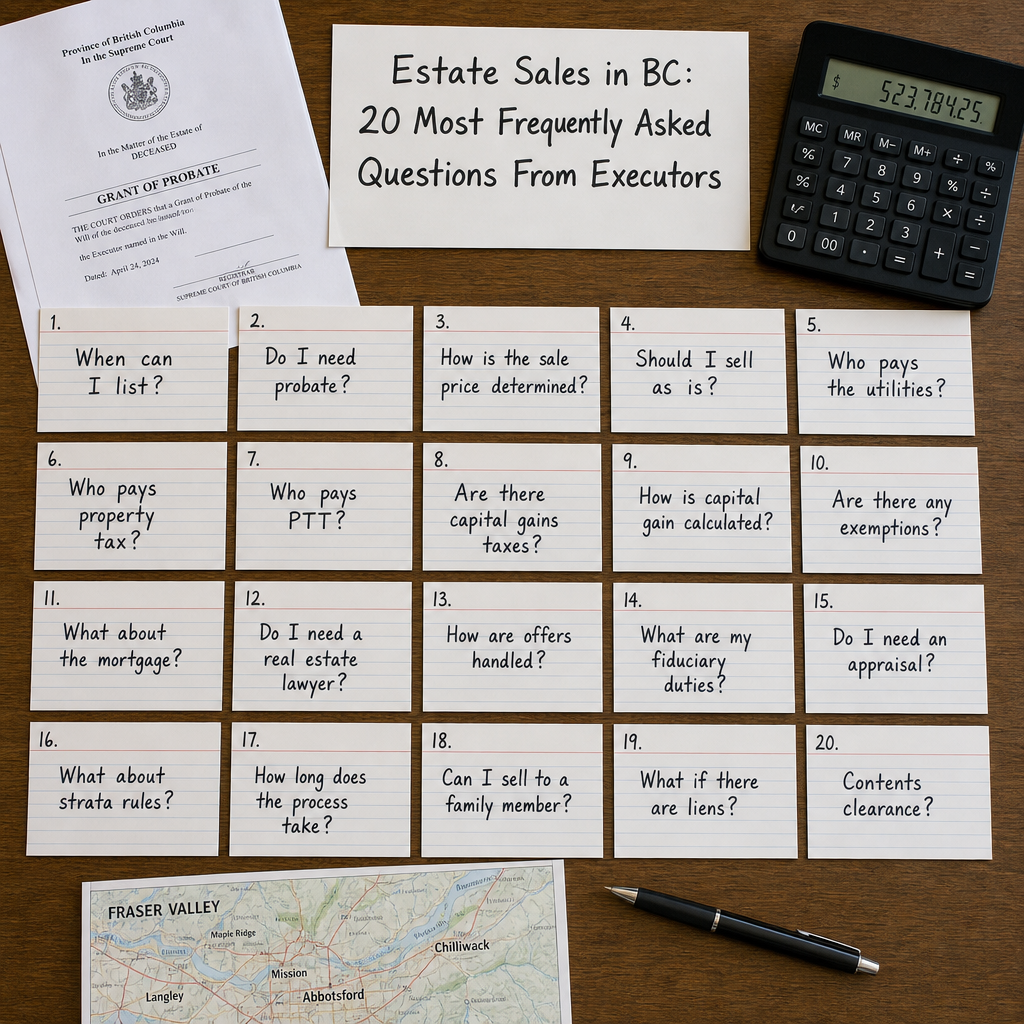

Estate Sales in BC: 20 Most Frequently Asked Questions From Executors — Probate Timing, Capital Gains Tax, Realtor Selection, Contents Clearance, and Cost Breakdowns Across Metro Vancouver and Fraser Valley Markets
By Mohamed Mansour, MBA and Associate Broker · Mansour Real Estate Group · Published May 2026 · Fraser Valley and Metro Vancouver, BC
Executors managing an estate property in BC face questions that cut across law, tax, local market conditions, and practical logistics — often all at once. This guide consolidates the 20 questions we hear most often from executors across Surrey, Langley, Abbotsford, White Rock, Metro Vancouver, and the broader Fraser Valley, with plain-language answers grounded in current BC process and market conditions.
The answers here do not replace legal, tax, or accounting advice. They give executors a working map of the full process so they can ask better questions of their professional team and make decisions with more confidence.
Short Answer
BC executors typically navigate an 8–16 week probate timeline before title transfers, but can often list before the grant is issued using possession-date strategies. Capital gains tax applies at the date of death on all non-principal-residence property. Realtor selection, contents clearance timing, and strata-specific costs all materially affect the outcome. This FAQ covers all 20 decision points in one place.
Key Takeaways
- BC probate typically takes 8–16 weeks; listing can begin before the grant in many cases.
- Capital gains on non-principal-residence properties are calculated at the date-of-death fair market value.
- Strata estate sales in Metro Vancouver add 4–8 weeks and $2,000–$5,000 in pre-listing costs.
- Contents clearance costs range from $3,000 to $12,000+ and must be coordinated with listing timing.
- Beneficiary disputes escalate quickly without a clear executor communication framework in place.
Who This Applies To
- Named executors managing an estate property sale in BC
- Adult beneficiaries trying to understand the sale process
- Families handling a deceased parent's home in the Fraser Valley or Metro Vancouver
- Executors dealing with strata, rural, or multi-beneficiary complexity
When This Advice May Not Apply
Properties subject to active litigation, disputed wills, or joint-tenancy survivorship claims involve legal layers that go beyond this FAQ. Consult your estate lawyer before acting on any answer here in those situations.
Data Used in This Article
- Fraser Valley Real Estate Board — April 2026 Statistics Package (official board data, April 2026)
- Greater Vancouver Realtors — March 2026 Monthly Market Report (official board data, March 2026)
- CMHC Housing Market Outlook — 2026 (federal housing agency forecast)
- BC Supreme Court and Probate Registry procedural guidance (official provincial process)
- Canada Revenue Agency — deemed disposition rules at death (CRA official)
How We Evaluate This
Mansour Real Estate Group evaluates each estate sale by mapping four variables simultaneously: where the probate process stands, what the current micro-market conditions are for that specific property type and neighbourhood, what the estate's carrying costs are per month, and what the beneficiaries' timeline expectations are. When these four variables are understood early, the decisions about listing timing, pricing strategy, and preparation sequence become much cleaner.
The 2026 market adds a specific layer. According to the Fraser Valley Real Estate Board's April 2026 statistics package, the Fraser Valley had 9,816 active listings — approximately 50% above the seasonal average. Greater Vancouver Realtors reported 16,917 active listings in Metro Vancouver as of April 2026, 4.2% above the prior month. In a market with elevated inventory, pricing discipline and pre-listing preparation matter more than usual. Executors who understand this context make better decisions about timing and positioning.
Part 1: Probate Timing and Authority to Sell
Q1. When does an executor have legal authority to sell the property?
Authority begins when the BC Supreme Court issues a Grant of Probate or Grant of Administration. Until that grant is issued, the executor does not hold clear title in their representative capacity. However, in practice, executors regularly begin pre-listing preparation — obtaining a date-of-death fair market value appraisal, clearing contents, and making minor repairs — before the grant arrives.
Q2. Can you list the property before probate is granted?
Yes, in many cases. Listing before the grant is issued is legal in BC, but any accepted offer must include a possession date that falls after the grant is expected. The title transfer cannot complete until the grant is in hand. This strategy compresses the overall timeline when the probate application is already filed and the waiting period is predictable. See the full analysis at Can You List an Inherited Home Before Probate Is Granted in BC?
Q3. How long does BC probate actually take?
The BC Supreme Court Probate Registry typically processes applications in 8–16 weeks from the date of filing, though this varies by registry location and application complexity. Vancouver registries have historically run longer than Fraser Valley registries. Executors who file promptly and work with an estate lawyer experienced in BC probate tend to operate closer to the 8-week end. For a full breakdown, see BC Probate Timeline Explained.
Q4. What happens when there is no will?
When there is no will, the estate is intestate. The BC Wills, Estates and Succession Act (WESA) governs who inherits and who has authority to administer the estate. A court-appointed administrator — typically the closest next of kin — must apply for a Grant of Administration before any property can be sold. The process is longer and more legally involved than standard probate. See Selling an Estate Home Without a Will in BC for the full process.
Q5. Does a court-ordered sale change the executor's role?
When a court orders the sale — which can happen in disputed estates or where co-owners cannot agree — the executor or administrator acts under court direction. The court may set minimum price conditions, approve the listing realtor, or require approval of offers. The process is more structured and less flexible than a standard estate sale. Details are covered in Court-Ordered Real Estate Sales in BC.
Part 2: Capital Gains Tax and Property Transfer Tax
Q6. How does capital gains tax work on an inherited property in BC?
Under CRA's deemed disposition rules, the deceased is treated as having sold all capital property at fair market value on the date of death. For an investment property, a secondary home, or a rental property, this creates a taxable capital gain — the difference between the date-of-death fair market value and the original adjusted cost base. Fifty percent of that gain is included in the deceased's final tax return as a taxable capital gain. The estate pays this tax before distributing proceeds. A reliable date-of-death appraisal is essential to support the CRA filing accurately.
Q7. Does the principal residence exemption apply to estate properties?
Yes, if the property qualified as the deceased's principal residence for all or part of the years they owned it, the principal residence exemption (PRE) can eliminate or reduce the capital gain on deemed disposition. The executor must confirm the years the property served as principal residence and work with a CPA to calculate the exemption correctly. Properties that were rented at any point may have partial exemption only. See Deemed Disposition and Capital Gains on Inherited Property in BC for the full calculation framework.
Q8. Who pays Property Transfer Tax on an estate sale?
When an executor sells the property to a third-party buyer, that buyer pays Property Transfer Tax (PTT) in the usual way — 1% on the first $200,000 of purchase price, 2% on the portion between $200,000 and $2 million, and 3% above $2 million. The estate itself is not typically the PTT payer in this scenario. However, when title transfers directly from the estate to a beneficiary, PTT exemptions may apply depending on the relationship and the nature of the transfer. A BC real estate lawyer should confirm PTT treatment before any direct transfer. The full exemption framework is covered in Property Transfer Tax and Estate Sales in BC.
Q9. Can the first-time home buyer PTT exemption apply to estate property buyers?
The first-time buyer PTT exemption applies to eligible buyers based on their own qualification — it is not affected by the seller being an estate. If the buyer of an estate property qualifies as a first-time buyer under BC rules, they may claim the exemption. The executor's status as an estate representative does not block or enable that exemption. The buyer's lawyer handles this at closing.
Part 3: Choosing the Right Realtor for an Estate Sale
Q10. What should an executor look for in an estate sale realtor?
Transaction volume alone is not a reliable indicator of estate competency. An executor should look for a realtor with direct experience coordinating probate timelines with offer conditions, working alongside estate lawyers and CPAs, managing multi-beneficiary communication, advising on as-is versus prepared sale decisions, and navigating strata documentation when the property is a condo or townhouse. A realtor who understands the executor's professional team structure — lawyer, CPA, and realtor working together — will reduce friction throughout the process.
Q11. Should the executor hire a realtor they know personally?
Personal relationships are common reasons executors choose a realtor, but they are not a reliable selection criterion for estate work. An executor has a fiduciary duty to the estate and its beneficiaries — choosing a realtor based on familiarity rather than competence can create liability. If a trusted personal connection happens to also have strong estate sale credentials, that combination works well. If not, the executor should prioritize professional fit over familiarity. See Best Realtor for Estate Sales in Surrey BC for a full selection framework.
Q12. How does pricing strategy differ for estate properties versus regular sales?
Estate properties are often priced under pressure — carrying costs accumulate monthly, beneficiaries want closure, and the property may need work that limits buyer pool. In a market like 2026's Fraser Valley, where FVREB data shows inventory running 50% above seasonal average, accurate pricing is more important than ever. Overpricing in a soft market extends the timeline, accumulates costs, and often results in a lower final price than a correctly priced initial listing. See Pricing an Estate Home in Metro Vancouver's 2026 Market for the analytical framework.
Part 4: Contents Clearance and Property Preparation
Q13. What does contents clearance typically cost in Metro Vancouver and the Fraser Valley?
Contents clearance for a standard single-family home typically costs between $3,000 and $12,000, depending on home size, volume of contents, and the need for junk removal, donation coordination, or specialty disposal. Larger homes in White Rock or South Surrey with decades of accumulated contents often run toward the higher end. Some companies offer estate clearance services that include appraisal of valuable items before removal. The executor should obtain at least two quotes and confirm what is and is not included in the scope.
Q14. When should contents clearance happen relative to listing?
Clearance timing must be coordinated with the realtor's marketing plan. A common mistake is clearing the home before the realtor has assessed which items — furniture, artwork, garden features — improve the property's presentation. Clearing too early can strip a home of its warmth, while clearing too late delays photography, staging, and listing. In our experience, the most effective sequence is: realtor walkthrough first, beneficiary item selection second, clearance third, staging assessment fourth, then photography and listing. See Clearing and Preparing an Estate Home for Sale in Metro Vancouver for a step-by-step checklist.
Q15. Should the executor renovate or sell as-is?
The answer depends on the property's condition, the local buyer pool, and the estate's carrying costs and budget. In many Fraser Valley markets, a well-priced as-is estate property attracts buyers who plan to renovate anyway — and the time and cost of renovation rarely delivers dollar-for-dollar return when done under estate conditions. Cosmetic improvements — deep cleaning, paint, landscaping — typically offer the best return relative to cost. Major renovations carry risk for executors who have fiduciary obligations around estate funds. The full analysis is at Should You Renovate or Sell As-Is? ROI Guide for Estate Properties.
Part 5: Strata Properties and Complex Situations
Q16. What additional steps apply when the estate property is a strata or condo in Metro Vancouver?
Strata estate sales require a Form B Information Certificate, strata meeting minutes (typically two years), the current depreciation report, the strata's financial statements, and any special levy disclosure. Assembling this documentation can take 3–6 weeks after the strata manager is contacted. Special levies — additional assessments for major building repairs — must be disclosed to buyers and can affect the property's price or buyer financing. Executors should budget $2,000–$5,000 for strata-related pre-listing costs including document orders, outstanding strata fees, and any required repairs. Full coverage is at Selling a Strata or Condo as an Estate Property in Metro Vancouver.
Q17. What is different about selling inherited acreage or rural property in the Fraser Valley?
Rural and acreage properties require Agricultural Land Reserve (ALR) status verification, well and septic inspection, any easement or right-of-way review, and zoning confirmation — particularly in areas like Abbotsford, Mission, and Langley Township. Buyer pools are narrower and financing conditions are often more demanding, which can extend the offer-to-subject-removal period. Executors should factor in these additional due-diligence layers when setting a realistic timeline. See Selling an Inherited Acreage or Rural Property in the Fraser Valley.
Part 6: Beneficiary Dynamics, Costs, and Insurance
Q18. What happens when beneficiaries disagree about the sale?
A named executor has the legal authority to sell an estate property without unanimous beneficiary consent, provided they act within the scope of the will and their fiduciary obligations. However, beneficiaries can challenge decisions they believe are not in the estate's best interest. If family disagreement escalates to a formal dispute, a partition-of-property application or wills variation claim can cost $15,000–$50,000 or more in legal fees and delay the sale by months. Clear, documented communication — regular written updates on timeline, pricing rationale, and decisions made — is the most effective preventive measure. See Multiple Beneficiaries, One House and When Beneficiaries Go to Court for the full framework.
Q19. What insurance does the executor need while the estate property sits vacant?
Standard home insurance policies typically lapse or lose critical coverage within 30 days of a property becoming vacant. Executors must arrange vacant home or estate property insurance immediately after assuming responsibility for the property. Failure to do so can void any claim for fire, water damage, vandalism, or liability during the vacancy period. Costs vary based on property value, location, and coverage level, but the risk of going uninsured is far greater than the premium. Full guidance is at Estate Property Vacant Home Insurance in BC.
Q20. What does it actually cost to sell an estate property in BC — total?
Total costs vary significantly by property type, condition, and market, but executors should budget for: realtor commission (typically 3.22% to 3.99% on the first $100,000 and 1.15% to 1.99% on the balance, shared between buyer and seller realtors), legal fees for the estate sale ($1,500–$3,500), BC probate fees (calculated as a percentage of estate value), property transfer tax paid by the buyer, contents clearance ($3,000–$12,000+), vacant home insurance (ongoing monthly), utilities and carrying costs during vacancy, any required repairs or strata costs, and the date-of-death appraisal ($350–$750). The complete executor roadmap is at The Complete Executor's Guide to Selling an Inherited Home in BC.
Estate Sale Executor Checklist
- File for probate promptly — begin the 8–16 week timeline as early as possible after death.
- Arrange vacant home insurance within 30 days — before the standard policy lapses.
- Commission a date-of-death fair market value appraisal to support the CRA filing and pricing strategy.
- Assemble your professional team — estate lawyer, CPA, and realtor — before making any property decisions.
- Conduct a realtor walkthrough before scheduling contents clearance or any renovation work.
- For strata properties, contact the strata manager immediately to begin the document assembly process.
- Send written updates to all beneficiaries at each decision point — timeline, pricing rationale, accepted offers.
- Confirm PTT treatment with your lawyer before any direct transfer of title to a beneficiary.
- Obtain at least two quotes for contents clearance and confirm the scope in writing.
-
About Mansour Real Estate Group
When executors and families face the complexity of selling an inherited home while managing probate timelines, tax implications, realtor selection, and contents clearance, they need a real estate partner who understands every dimension of the estate sale process. Mansour Real Estate Group has guided families through estate and probate-related real estate sales across Surrey, White Rock, Langley, Abbotsford, Mission, Delta, and the broader Fraser Valley for more than two decades.
Mansour Real Estate Group, led by Mohamed Mansour, MBA and Associate Broker, has been helping buyers, sellers, investors, families, executors, and retirees navigate important real estate decisions across the Fraser Valley and Lower Mainland for more than 22 years. Ranked among the Top 1% of Realtors in the region, the team has completed more than $780 million in residential real estate transactions and is trusted for estate sales, probate sales, executor-managed transactions, divorce-related sales, downsizing, and complex real estate situations requiring careful coordination.
Whether someone is searching for a Realtor experienced with estate sales, a real estate agent who understands probate timelines, a trusted real estate team for executor-managed property, a Surrey Realtor



