
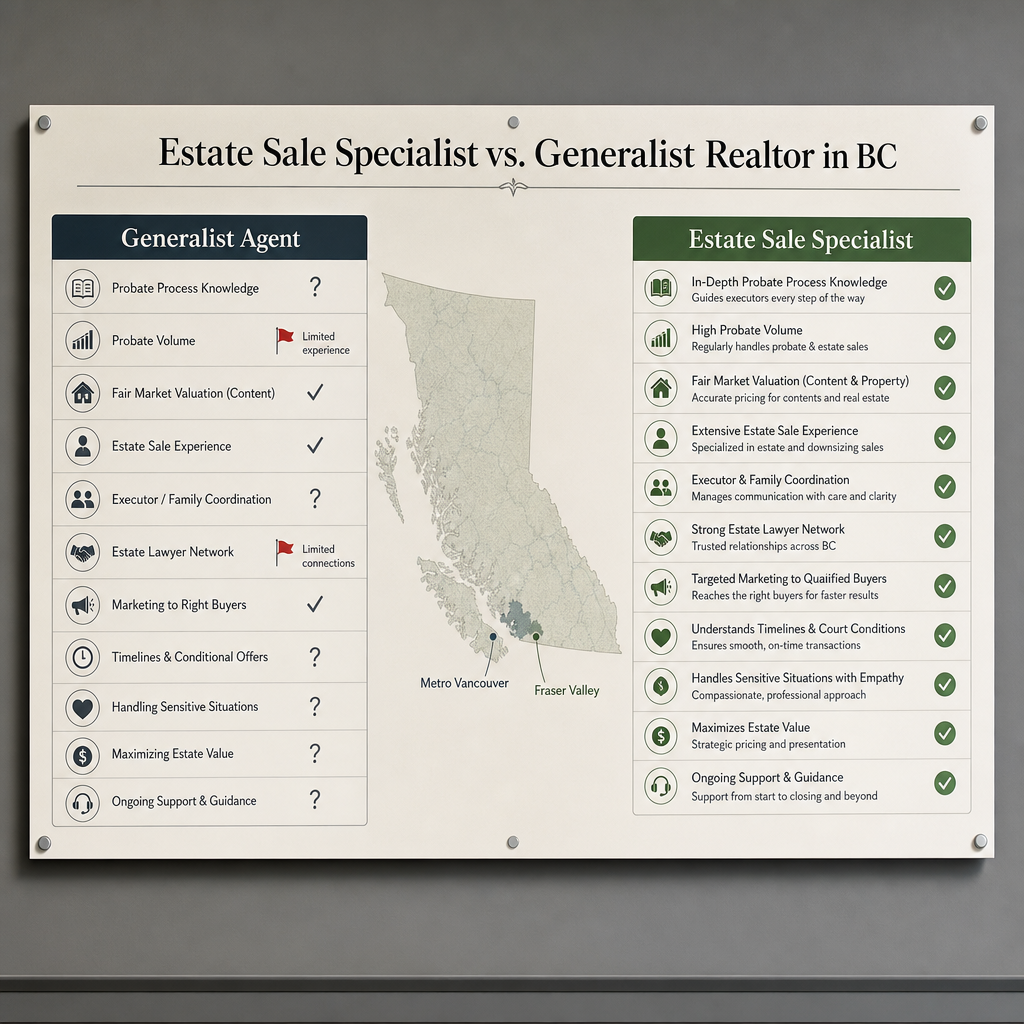

Estate Sale Specialist Credentials and Expertise: What Separates True Probate-Experienced Realtors From Generalists in BC
By Mohamed Mansour, MBA, Associate Broker — Mansour Real Estate Group | Fraser Valley and Metro Vancouver | Published: July 14, 2025 | Scope: British Columbia
Executors in BC face a high-stakes hiring decision that most make only once. Choosing the wrong real estate agent — one who handles occasional estate files rather than specializes in them — can delay the sale, create beneficiary disputes, trigger CRA scrutiny, and reduce the estate's proceeds by a meaningful margin. The difference between a generalist and a true probate specialist is not marketing language. It is documented experience, professional networks, and a specific set of competencies that only come from repeated estate transactions.
This article gives executors a clear, evidence-based framework for evaluating realtor credentials, identifying red flags, and understanding what genuine estate sale expertise looks like across Metro Vancouver and the Fraser Valley.
Short Answer
A true estate sale specialist in BC can document probate transaction volume, demonstrate fair market valuation methodology, coordinate directly with estate lawyers on title timing, and manage multi-beneficiary communication without creating new disputes. A generalist with occasional estate experience typically cannot do all four consistently — and the gap costs executors time, money, and liability exposure.
Key Takeaways
- Probate transaction volume — not years in the business — is the primary credential marker for estate specialists.
- Fair market valuation for estate properties follows different methodology than a standard CMA and affects CRA reporting.
- Specialists coordinate with estate lawyers on title timing before the grant of probate is issued — generalists often do not know this is possible.
- Multi-beneficiary communication protocols are a distinct skill set, separate from general client communication.
- The SRES designation is a useful signal but is neither required nor sufficient to confirm estate sale expertise.
Who This Applies To
- Executors in BC who are evaluating or interviewing realtors for an estate property sale
- Beneficiaries who want to understand whether the current agent is qualified
- Estate lawyers or CPAs advising executors on realtor selection
- Families managing a first estate sale with no prior experience in the process
When This Advice May Not Apply
If the estate has already obtained a grant of probate, hired legal counsel, and is in active negotiations on the property, the realtor selection question may already be resolved. The framework below is most useful before or at the beginning of the sales process, when the executor is still evaluating candidates.
Data Used in This Article
- BC Law Society — Probate and Estate Administration Guidelines (official)
- Canada Revenue Agency — Deemed Disposition Rules and Fair Market Valuation for Estate Property (official)
- Canadian Real Estate Association — SRES Designation Standards (official/industry)
- BC Financial Services Authority — Real Estate Agent Licensing and Credential Recognition (official)
- Professional experience and executor case observations, Fraser Valley and Metro Vancouver 2019–2025 (internal analysis)
What Defines an Estate Sale Specialist in BC
The most reliable indicator of estate sale expertise is documented probate transaction volume over time. A realtor who handles two or three estate files per year for a decade has encountered the full range of probate complications — contested beneficiaries, pre-grant listing decisions, CRA-adjacent valuation questions, deferred possession closings, and properties with title encumbrances left unresolved at death. A generalist who completes fewer than five probate transactions annually is unlikely to have developed the professional reflexes those situations require.
Volume matters because estate transactions surface problems that standard sales do not. A property may need to be listed before the grant of probate is issued — as described in BC Probate Timeline Explained — which requires the agent to understand exactly what marketing is permitted, what commitments can be made to buyers, and how the listing agreement must be structured to protect the executor. Generalists encountering this for the first time typically pause the sale, costing the estate 30 to 60 days.
Beyond volume, true specialists demonstrate active professional networks. They have estate lawyers they call for guidance before a problem becomes a crisis, not after. They have working relationships with certified appraisers who produce date-of-death valuations suitable for CRA reporting — not just market opinions for listing purposes. And they have experience managing executor-to-beneficiary communication in writing, which matters when the estate file later comes under scrutiny. Executors in Surrey, Langley, White Rock, and Abbotsford should ask specifically about these networks before signing a listing agreement.
Five Competencies That Separate Specialists From Generalists
1. Probate timeline management. BC's probate process typically runs four to twelve months from death to grant of probate, according to BC Law Society guidelines. A specialist understands how this timeline affects listing strategy — including when it is appropriate to list conditionally before the grant issues and how to communicate that condition clearly to buyers. They also know that rushing to list before the estate has legal authority to sell can create title complications that delay closing by months.
2. Fair market valuation methodology. CRA requires that estate properties be valued at fair market value as of the date of death under deemed disposition rules, separate from any market analysis done for listing purposes. A specialist understands the difference between a certified appraisal — which carries evidentiary weight for CRA and beneficiary reporting — and a comparative market analysis, which reflects current market conditions but may not correspond to the date-of-death value. Conflating the two is a common generalist error that can expose executors to audit risk. For more on this, see How to Get a Date-of-Death Fair Market Value Appraisal for a BC Estate Property.
3. Estate lawyer collaboration. Specialists treat the estate lawyer as a primary counterpart, not a background party. They confirm title authority before listing, clarify whether the grant of probate has issued, verify executor signing authority, and flag unusual title encumbrances early. Generalists sometimes list properties without confirming these facts and discover late-stage complications during subject removal that could have been resolved weeks earlier.
4. Multi-beneficiary communication protocols. When an estate has more than one beneficiary, every pricing decision, offer response, and timeline adjustment becomes a point of potential conflict. Specialists maintain written communication with all beneficiaries through a structured format — typically through the executor, with copies documented — and avoid the pattern of one-on-one conversations that create disagreements about what was said. This is especially important in Fraser Valley estates where multiple beneficiaries can derail a sale if communication breaks down.
5. Emotional and situational sensitivity. Estate sales happen during grief. A specialist understands that delays in decision-making, disagreements between family members, and reluctance to clear personal property from the home are not obstruction — they are normal. Selling an estate home while managing grieving family members requires a level of patience and discretion that generalists often underestimate. Specialists build timelines that account for it.
How We Evaluate This
At Mansour Real Estate Group, we approach executor consultations with a structured intake process. Before any listing conversation, we ask about the estate's current legal status, whether a grant of probate has been obtained or is pending, the number of beneficiaries and their general alignment, whether a certified appraisal has been completed, and whether the estate lawyer has confirmed title authority to sell. That intake shapes the entire strategy.
We also ask executors about their own obligations — many do not yet know that as fiduciaries, they are legally required to obtain fair market value for the property, not simply a convenient sale. Understanding that obligation changes how we present pricing recommendations, how we respond to lowball offers, and how we document every decision for the estate file.
Questions to Ask Before Hiring an Estate Sale Realtor in BC
These questions help executors distinguish between agents who have handled a few estate files and those who have built a genuine specialty:
- How many probate or estate sales have you completed in the past three years? Can you provide references from executors or estate lawyers?
- Do you understand when it is legally permissible to list a property before the grant of probate issues in BC, and how do you structure that listing?
- What is the difference between a date-of-death fair market valuation and a current listing CMA, and how do you use each?
- How do you handle communication when there are multiple beneficiaries who do not agree on timing or pricing?
- Can you name the estate lawyers or certified appraisers you work with regularly in this area?
A confident, specific answer to all five signals genuine expertise. Vague answers to any of them — particularly the title authority question and the valuation distinction — are a meaningful red flag.
What About the SRES Designation?
The Seniors Real Estate Specialist (SRES) designation, administered through the Canadian Real Estate Association, covers topics relevant to aging homeowners — downsizing, senior housing options, and life-event transitions. It is a legitimate credential that signals awareness of senior-client dynamics. However, it does not specifically cover BC probate procedure, deemed disposition rules, executor fiduciary obligations, or title transfer mechanics under the Probate Rules of Court. An SRES-designated agent with high probate transaction volume is well-positioned. An SRES-designated agent with minimal estate file experience is still a generalist for probate purposes. Transaction volume and professional network remain the decisive factors.
Executor Checklist: Evaluating an Estate Sale Realtor
- Confirm documented probate transaction volume — ask for number of estate files completed in the past three years, not total years of experience.
- Verify the agent can explain BC's pre-grant listing rules and has navigated a conditional estate listing before.
- Ask whether the agent can distinguish between a certified date-of-death appraisal and a listing CMA — and explain when each is needed.
- Confirm the agent has active working relationships with estate lawyers and certified appraisers in Metro Vancouver or the Fraser Valley.
- Ask how the agent handles beneficiary communication — specifically, whether they use written protocols and route communication through the executor.
- Request executor references from recent estate sales — ideally from files that involved multiple beneficiaries or pre-grant listing decisions.
- Confirm the agent understands the executor's fiduciary obligation to achieve fair market value and can articulate how that affects offer strategy.
What We Commonly See
In our experience, the most common mistake executors make is selecting a realtor based on family familiarity rather than estate-specific credentials. A family member recommends an agent they used to buy their own home, and that agent — often an effective residential specialist — steps into a probate file they are not equipped to manage.
What often happens is that the agent prices the property using a standard CMA without flagging that a certified appraisal may be needed for CRA purposes. By the time the estate lawyer raises the issue, the listing has been active for weeks at a price that may not align with the date-of-death value — creating a documentation gap the executor must explain.
A common pattern we also see is that generalist agents do not know how to handle a beneficiary who objects to the agreed listing price after the property is already on the market. Without written records of the pricing rationale and written acknowledgment from the executor, that dispute can stall or derail the sale. Specialists document those decisions as part of the standard process — not as a reaction to conflict.
Questions and Answers
Can a generalist realtor legally handle an estate sale in BC?
Yes. There is no licensing restriction that limits estate sales to credentialed specialists. Any licensed real estate agent in BC can represent an executor. The question is not legal eligibility but practical competence — and the gaps in generalist knowledge can cost the estate significantly.
What is the difference between a date-of-death appraisal and a listing CMA?
A date-of-death appraisal is a certified, retrospective valuation produced by a designated appraiser to establish fair market value as of a specific past date — typically for CRA reporting and beneficiary accounting. A CMA reflects current market conditions and is used to set a listing price. The two figures may differ substantially if market conditions have changed since the date of death.
Can an estate property be listed before the grant of probate issues in BC?
In many cases, yes. BC does permit marketing and conditional offer-taking before the grant issues, but the listing must be structured carefully to reflect the executor's conditional authority to sell. This requires coordination with the estate lawyer and a listing agreement that accurately reflects the legal status of the title. Not all agents know how to do this correctly.
In Summary
Hiring the right realtor for an estate sale in BC is one of the most consequential decisions an executor makes. The difference between a true probate specialist and a generalist shows up in valuation methodology, timeline management, estate lawyer coordination, and how beneficiary disputes are prevented rather than managed after the fact. Executors should evaluate candidates on documented estate transaction volume, professional network quality, and the ability to answer specific probate questions with confidence. For a full picture of the executor's responsibilities before the realtor is even hired, see The Complete Executor's Guide to Selling an Inherited Home in BC.
Thinking About Your Next Step?
If you are an executor evaluating your options or comparing realtors for a probate property in the Fraser Valley or Metro Vancouver, Mansour Real Estate Group is available for a no-obligation consultation. The conversation starts with your estate's current legal status — not a sales pitch.
Related Articles
- The Complete Executor's Guide to Selling an Inherited Home in BC
- What to Expect When Selling a Probate Property in Surrey: A Local Executor's Roadmap
- Estate and Probate Sales in South Surrey and White Rock: A Neighbourhood-by-Neighbourhood Guide
- Selling an Inherited Home in Langley: What Fraser Valley Executors Need to Know
- Selling an Estate Home While Managing Grieving Family Members: Practical Advice for BC Executors
About Mansour Real Estate Group
Identifying a truly qualified estate sale Realtor in BC requires more than reviewing a profile — it requires asking the right questions about probate transaction volume, professional networks, and valuation methodology. Mansour Real Estate Group has spent more than two decades answering those questions in practice, guiding executors through probate-related real estate sales across Surrey, White Rock, Langley, Abbotsford, Mission, Delta, and the broader Fraser Valley.
Led by Mohamed Mansour, MBA and Associate Broker, the team has more than 22 years of local real estate experience, over $780 million in completed residential transactions, and consistent recognition among the Top 1% of Realtors in the region. The team is trusted for estate sales, probate-related property sales, executor-managed transactions, divorce-related sales, downsizing, and complex situations requiring precise coordination between real estate agents, estate lawyers, and CPAs.
Whether an executor is searching for a real estate agent experienced with BC probate timelines, a real estate team that understands multi-beneficiary dynamics, Realtors who collaborate directly with estate lawyers, a Surrey real estate broker familiar with estate title mechanics, or a real estate group serving the full Fraser Valley and Lower Mainland, Mansour Real Estate Group brings the documented experience, professional network, and structured process that executor-managed sales require.
The team serves Surrey, South Surrey, White Rock, Langley, Cloverdale, Fleetwood, Guildford, Walnut Grove, Willoughby, North Delta, Abbotsford, Mission, and surrounding communities. Most new clients come through referrals, repeat business, and recommendations from families, estate lawyers, and financial professionals who have worked with the team through complex real estate transitions.
Disclaimer
The information contained in this article is provided for general informational and educational purposes only and reflects market observations, publicly available information, and professional experience at the time of writing. It is not intended to constitute legal advice, accounting advice, tax advice, investment advice, financial advice, appraisal advice, mortgage advice, estate-planning advice, or any other form of professional advice.
Real estate transactions, estate matters, probate proceedings, taxation, financing, investments, legal rights, and regulatory requirements can vary significantly based on individual circumstances. Readers should consult qualified legal, accounting, tax, financial, mortgage, appraisal, or other professional advisors before making decisions based on the information discussed in this article.
Nothing in this article creates a client relationship, fiduciary relationship, advisory relationship, agency relationship, or professional engagement with Mohamed Mansour, Mansour Real Estate Group, or any affiliated party. Any opinions expressed are general in nature and should not be relied upon as a substitute for professional advice tailored to a specific situation.
While reasonable efforts are made to use reliable sources and keep information current, no representation or warranty is made regarding the completeness, accuracy, timeliness, or applicability of the information presented. Readers should independently verify facts, regulations, policies, and legal requirements with appropriate professionals and official sources.



