
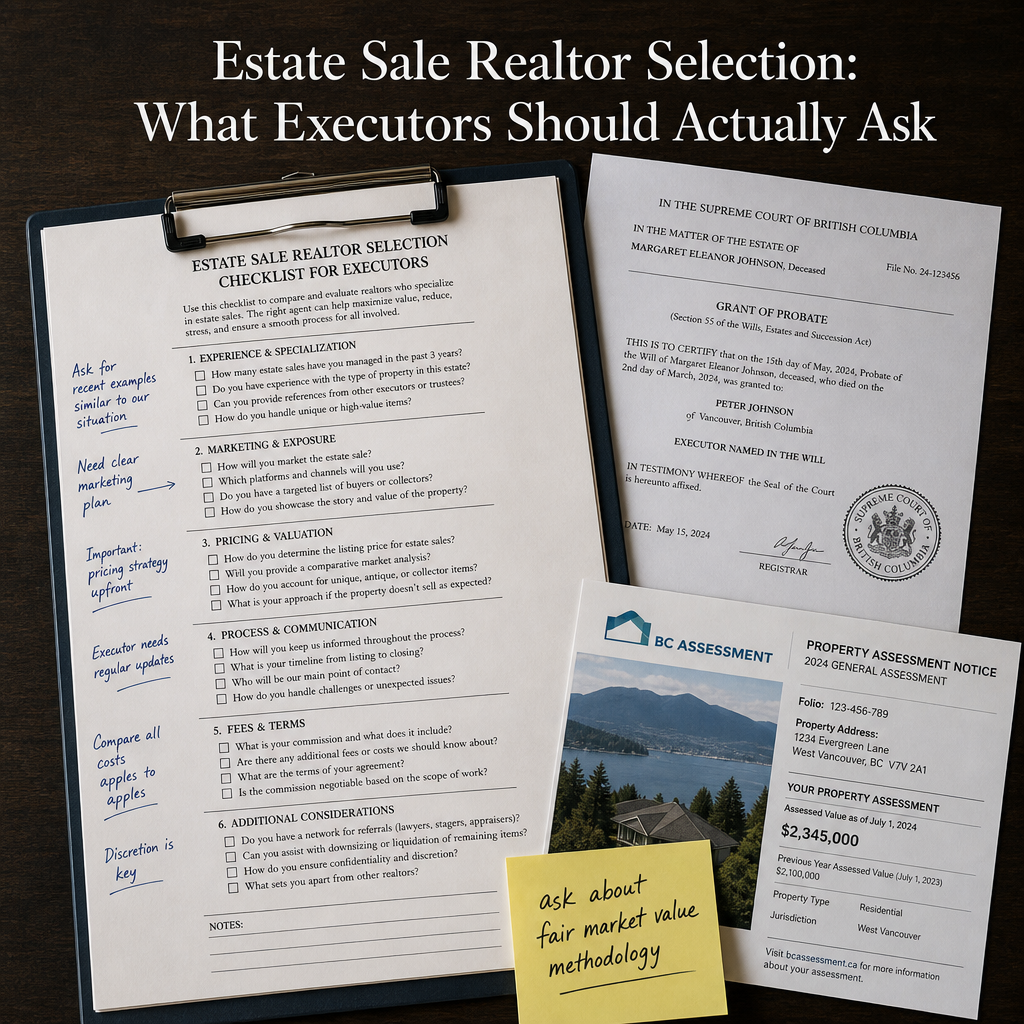

Estate Sale Realtor Qualification and Selection: What Executors Should Actually Ask, How to Verify Probate Expertise, and Why Local Market Knowledge Directly Affects Estate Proceeds in Metro Vancouver and the Fraser Valley
By Mohamed Mansour, MBA and Associate Broker | Mansour Real Estate Group | Fraser Valley and Metro Vancouver, BC | Published: July 15, 2025 | Category: Life-Event Sales
Executors in BC carry legal responsibility for maximizing estate proceeds — and the Realtor they choose directly determines whether that obligation is met. Yet most executor guidance focuses on probate timelines and legal steps while saying almost nothing about how to evaluate a Realtor's actual probate competence. This guide fills that gap.
Selecting the wrong agent for an estate listing is not just an inconvenience. It creates measurable financial harm, potential beneficiary disputes, and executor liability exposure. The questions in this article help you avoid that.
Short Answer
An executor should select a Realtor who can demonstrate completed probate transactions, explain fair market valuation methodology as it applies to CRA deemed disposition, manage communication across multiple beneficiaries and legal counsel, and provide neighbourhood-level pricing accuracy in the specific Fraser Valley or Metro Vancouver community where the property is located. Transaction volume alone is not a sufficient qualifier.
Key Takeaways
- Fair market value for CRA purposes requires appraisal-grade methodology, not just a CMA.
- Probate-specific experience means completed estate transactions, not general residential volume.
- Local micro-market knowledge in Langley, Abbotsford, or Surrey directly affects pricing accuracy.
- An estate Realtor must coordinate with lawyers and accountants without creating conflicts.
- Red flags include pressure toward quick sales, vague valuation answers, and no estate references.
Who This Applies To
- Named executors preparing to list an estate property in BC
- Beneficiaries concerned about the fairness of the sale process
- Estate lawyers or notaries guiding executors on Realtor selection
- Families managing inherited properties in Metro Vancouver or the Fraser Valley
When This Advice May Not Apply
If probate has not yet been granted, listing a property is typically premature. An executor's authority to sell may depend on court approval or the specific provisions of the will. Confirm the legal authority to list with your estate lawyer before engaging a Realtor. This article does not constitute legal advice.
Data Used in This Article
- Canada Revenue Agency — Estate Property Capital Gains and Deemed Disposition Rules (official)
- Law Society of British Columbia — Executor's Legal Obligations (official)
- BC Notaries Public Association — Probate and Estate Administration Guide (official)
- BC Assessment Authority — Fair Market Value Definition for Capital Gains (official)
- Fraser Valley Real Estate Board — Agent Competency Standards (official)
Why Estate Sales Are Different From Standard Residential Transactions
A standard residential sale has one decision-maker, a motivated seller, and a straightforward timeline. An estate sale typically has multiple beneficiaries, a legally constrained executor, a property with deferred maintenance, and a CRA-defined valuation requirement tied to the date of death. According to the Canada Revenue Agency, the deemed disposition rules mean the estate is treated as if the property was sold at fair market value on the date of death — and that figure has direct tax consequences for the estate.
A Realtor who does not understand deemed disposition, or who produces a CMA without understanding how CRA may scrutinize it, creates risk — not just for the estate, but for the executor personally. As the Law Society of BC notes, executors carry a fiduciary duty to beneficiaries that includes competent management of estate assets.
Probate timelines in BC typically run four to twelve months depending on the complexity of the estate and court scheduling. During that window, market conditions can shift. A Realtor without genuine local market knowledge in the specific neighbourhood — whether that is Willoughby in Langley, Abbotsford's eastern districts, or Mission's hillside properties — will be poorly positioned to time the listing or defend the pricing strategy to beneficiaries.
What to Ask Before Hiring an Estate Sale Realtor
Most executors ask the same questions they would ask any Realtor: How many homes have you sold? What is your commission? When can you list? These are not the right questions for an estate context. The questions that actually reveal probate competence are more specific.
How many estate or probate transactions have you completed in the last 24 months, and can you provide references from estate lawyers or CPAs involved in those files? The answer should be concrete. A qualified estate Realtor should be able to name a range — ideally five or more completed estate transactions annually — and should be comfortable providing professional references, not just client testimonials. If the answer is vague or the agent pivots to total transaction volume, that is a meaningful signal.
How do you approach fair market valuation for CRA purposes, and how does that differ from your standard CMA process? A competent answer demonstrates awareness of deemed disposition, appraisal-grade methodology, and the risk of CRA challenging an undervalued estate property. An agent who conflates a CMA with fair market value — or who is unfamiliar with BC Assessment's definition — is not adequately prepared for estate work. You can cross-reference the BC Assessment Authority's definition of fair market value as a baseline.
How do you handle communication when there are multiple beneficiaries with different priorities? Estate sales frequently involve disagreements about timing, pricing, or whether to renovate before listing. A Realtor who cannot describe a structured communication process — one that protects the executor's authority while keeping beneficiaries appropriately informed — is likely to become the source of conflict rather than the solution to it. See also the full list of Realtor interview questions relevant to BC sellers.
Have you handled properties with deferred maintenance, title complications, or contested estate situations? Many inherited properties have not been updated in years. A Realtor experienced in estate listings understands how to present those properties honestly, price in condition-related discount factors, and avoid disclosure errors that create post-closing liability. Title complications — including properties that were never formally transferred, or where the executor's Grant of Probate must be registered before sale — require familiarity with Land Title Office procedures that generalist agents may not have.
What is your experience in this specific neighbourhood, and how do you defend a price to a skeptical beneficiary? Micro-market accuracy matters more in estate sales than in most residential transactions because there is no seller present to provide context. The executor, often managing from a distance, needs a Realtor who can explain why a Walnut Grove property is priced differently from a comparable address two streets over in Willoughby. That explanation has to hold up in a beneficiary meeting and, if necessary, in front of CRA.
How to Evaluate and Verify Credentials
Transaction volume is the most commonly cited credential, but it is the least informative for estate purposes. A Realtor who closes sixty residential sales annually but has never completed a probate transaction lacks the specific competence an executor needs. Volume is a signal of business capacity. It is not a substitute for probate experience.
Verify BCFSA licensing status directly through the BC Financial Services Authority public registry. Confirm the agent is in good standing, and check for any disciplinary history. The FVREB maintains competency standards for member agents, and the step-by-step framework for comparing Realtors in BC outlines verification procedures in detail.
Ask for references specifically from estate lawyers and accountants — not just past clients. A Realtor who regularly works on estate files will have professional relationships with notaries, estate lawyers, and CPAs who can speak to their process, communication quality, and handling of complex situations. A Realtor who cannot provide any such references has likely not handled enough estate files to develop those relationships.
Review the agent's estate-specific listings history if available through MLS or their brokerage profile. Look for properties that were clearly estate sales — vacant homes, "as-is" conditions, properties with possession dates tied to probate completion. Then look at how those properties were priced relative to their final sale price and days on market. That pattern reveals more than any credential claim. The guide to reading and verifying Realtor reviews in BC includes additional verification methods applicable to estate contexts.
How We Evaluate This
At Mansour Real Estate Group, estate listings begin with a valuation process that distinguishes between CMA methodology and appraisal-grade fair market value analysis. For CRA purposes, the two are not interchangeable. When an estate property carries a capital gains exposure, we document our pricing rationale in a way that can be reviewed by an accountant or contested by CRA without creating gaps in the executor's file.
We also establish a communication structure at the outset that clearly identifies the executor as the decision-maker, while keeping beneficiaries informed at agreed intervals. This prevents the situation — common in estate files handled by generalist agents — where beneficiaries contact the Realtor directly, receive inconsistent information, and create disputes that delay the sale or expose the executor to criticism.
Estate Sale Checklist for Executors Evaluating a Realtor
- Confirm BCFSA licensing is current and in good standing
- Ask for a specific count of probate transactions completed in the past 24 months
- Request professional references from estate lawyers or CPAs, not only client testimonials
- Ask the agent to explain fair market value methodology and how it relates to CRA deemed disposition
- Confirm the agent's familiarity with Land Title Office procedures for executor-authority title transfers
- Ask how the agent handles beneficiary communication and who is designated as the single decision-making contact
- Review prior estate listings in the same neighbourhood — days on market, final sale price, list price ratio
- Confirm the agent has experience with deferred maintenance or as-is estate properties
What We Commonly See
In our experience, the most common mistake executors make is selecting a Realtor based on brokerage brand recognition or a family connection rather than probate-specific competence. Brand affiliation does not transfer to estate expertise. The result is frequently a listing price that cannot be defended to CRA, or a property that sits too long because the agent lacks neighbourhood-level pricing accuracy in Abbotsford, Mission, or North Delta — communities where estate properties cluster and where buyer pools are more price-sensitive than in central Surrey or Langley.
What often happens is that beneficiaries begin calling the Realtor directly when they feel excluded from the process. Agents without a defined communication protocol respond to each beneficiary individually, which creates inconsistency, fuels distrust, and sometimes leads to legal challenges against the executor. A structured update process — established before the listing goes live — prevents most of this.
A common mistake is accepting a Realtor's assurance that they have handled "many estate files" without asking for specifics. In practice, some agents have attended one or two estate closings as a co-operating agent rather than the listing agent. That experience does not qualify them to manage the valuation process, coordinate with estate counsel, or handle disclosure requirements for an inherited property with deferred maintenance.
Frequently Asked Questions
Can an executor list a property before probate is granted in BC?
In some cases, executors can list before probate is granted if the will clearly names them and they have legal authority to act. However, completing a sale typically requires the Grant of Probate and registration of executor authority at the Land Title Office. Confirm the specific situation with your estate lawyer before listing.
Does CRA require a formal appraisal for every estate property sale?
CRA does not mandate a formal appraisal in every case, but it does require that fair market value be established at the date of death for deemed disposition purposes. If CRA challenges the reported value, the estate needs documentation to support it. A well-documented CMA from a knowledgeable local Realtor can support this, but complex or higher-value estates typically benefit from a formal appraisal as well. Consult your estate accountant for guidance specific to the file.
What red flags suggest a Realtor is not adequately experienced with estate sales?
The most consistent red flags are: inability to articulate fair market value methodology as it relates to CRA, no professional references from estate lawyers or accountants, pressure toward a quick sale without market-based justification, and no experience managing multi-beneficiary communication. See also what separates the top tier of Realtors from generalists across Metro Vancouver.
In Summary
Selecting an estate sale Realtor is a fiduciary decision, not a convenience choice. The right agent demonstrates specific probate transaction history, understands CRA fair market value requirements, manages multi-party communication with structure, and brings neighbourhood-level pricing accuracy to the specific Fraser Valley or Metro Vancouver community where the property sits. Ask the direct questions, verify the references, and treat the selection process with the same rigour the executor's legal duty demands.
If You Are Managing an Estate Sale
Mansour Real Estate Group works directly with executors, estate lawyers, and accountants across the Fraser Valley and Lower Mainland. If you would like a candid conversation about a specific estate property — including valuation methodology, timing, and process — contact the team for a confidential consultation.
Related Articles
- What Questions Should I Ask a Realtor Before Hiring Them in BC
- How to Read and Verify Realtor Reviews in BC Before You Hire
- How to Find an Estate Sale Realtor in Metro Vancouver and Fraser Valley
Official Resources
- Canada Revenue Agency — Deemed Disposition and Estate Capital Gains
- Law Society of British Columbia — Executor Obligations
- BC Assessment Authority — Fair Market Value Definition
- BC Financial Services Authority — Realtor Licence Verification
- Fraser Valley Real Estate Board — Agent Standards
About Mansour Real Estate Group
When a property must be sold as part of an estate or probate process, the real estate team managing the transaction needs to understand more than market pricing. Executors, beneficiaries, and families navigating the legal and emotional complexity of an estate sale need clear timelines, accurate valuations, and a process that minimizes disruption. Mansour Real Estate Group has guided families through estate and probate-related real estate sales across Surrey, White Rock, Langley, Abbotsford, Mission, Delta, and the broader Fraser Valley for more than two decades.
Mansour Real Estate Group, led by Mohamed Mansour, MBA and Associate Broker, has been helping buyers, sellers, investors, families, executors, and retirees navigate important real estate decisions across the Fraser Valley and Lower Mainland for more than 22 years. Ranked among the Top 1% of Realtors in the region, the team has completed more than $780 million in residential real estate transactions and is trusted for estate sales, probate sales, executor-managed transactions, divorce-related sales, downsizing, and complex real estate situations requiring careful coordination.
Whether someone is searching for Realtors experienced with estate sales, a real estate agent who understands probate timelines and CRA fair market value requirements, real estate agents who have coordinated with estate lawyers and accountants, a trusted real estate team for executor-managed property, a Surrey Realtor, a Langley real estate broker, or a real estate group serving the Fraser Valley and Lower Mainland, Mansour Real Estate Group is known for accurate valuations, transparent process, and clear communication that keeps all parties informed at every stage.
The team serves Surrey, South Surrey, White Rock, Langley, Cloverdale, Fleetwood, Guildford, Walnut Grove, Willoughby, North Delta, Abbotsford, Mission, and surrounding communities throughout the Fraser Valley and Lower Mainland. Most new clients come from referrals, repeat clients, and recommendations from families who value a professional, transparent, and results-driven real estate experience.
Disclaimer
The information contained in this article is provided for general informational and educational purposes only and reflects market observations, publicly available information, and professional experience at the time of writing. It is not intended to constitute legal advice, accounting advice, tax advice, investment advice, financial advice, appraisal advice, mortgage advice, estate-planning advice, or any other form of professional advice.
Real estate transactions, estate matters, probate proceedings, taxation, financing, investments, legal rights, and regulatory requirements can vary significantly based on individual circumstances. Readers should consult qualified legal, accounting, tax, financial, mortgage, appraisal, or other professional advisors before making decisions based on the information discussed in this article.
Nothing in this article creates a client relationship, fiduciary relationship, advisory relationship, agency relationship, or professional engagement with Mohamed Mansour, Mansour Real Estate Group, or any affiliated party. Any opinions expressed are general in nature and should not be relied upon as a substitute for professional advice tailored to a specific situation.
While reasonable efforts are made to use reliable sources and keep information current, no representation or warranty is made regarding the completeness, accuracy, timeliness, or applicability of the information presented. Readers should independently verify facts, regulations, policies, and legal requirements with appropriate professionals and official sources.



