

Estate Realtor Selection in Metro Vancouver and the Fraser Valley: Critical Competencies, Probate Timeline Knowledge, and How to Identify Specialists vs. Generalists When Choosing an Agent for Your Executor Responsibilities
By Mohamed Mansour, MBA and Associate Broker — Mansour Real Estate Group | Fraser Valley and Metro Vancouver | Published: July 15, 2025 | Topic: Life-Event Sales — Estate and Probate
Serving as an executor is already one of the more demanding legal roles a person can take on. When there is real property involved — a family home in Surrey, a townhouse in Langley, a detached property in Abbotsford — the decision of which realtor to hire carries consequences that extend well beyond a standard listing. The stakes include net proceeds to beneficiaries, legal compliance with BC probate requirements, and the ability to manage a transaction that may involve court approval, vacant property risk, family disagreement, and deferred maintenance all at once.
Most executors have never done this before. That makes realtor selection — and the ability to tell a specialist from a generalist — one of the most important decisions in the entire estate administration process.
Short Answer
An estate realtor specialist understands BC probate timelines, can navigate sales before or after grant of probate is issued, knows how to price properties with deferred maintenance in a soft market, manages vacant property risks, and communicates neutrally with multiple beneficiaries. A generalist may handle standard sales competently but lacks the procedural and emotional fluency that estate transactions require.
Key Takeaways
- BC probate typically takes 3–6 months; your realtor needs to understand what can and cannot happen during that window.
- Estate properties in soft Fraser Valley markets can sell at 8–12% discounts without strategic positioning — experience narrows that gap.
- Ask directly about Form 6 executor authority, pre-grant sale conditions, and vacant property insurance — generalists rarely know these details.
- Emotional intelligence matters: executors managing family disagreement need a realtor who communicates neutrally to all parties.
- Verify credentials through BCFSA licensing records and review the realtor's actual estate transaction history, not just their general sales volume.
Who This Applies To
- Named executors managing an estate that includes residential real property in BC
- Co-executors or estate lawyers seeking a referral to a realtor with probate experience
- Beneficiaries assisting an elderly or inexperienced executor with real estate decisions
- Families where the estate property is in Surrey, Langley, White Rock, Abbotsford, or the broader Fraser Valley
When This Advice May Not Apply
If the estate is subject to an active legal dispute, creditor claim, or court-ordered sale process, your estate lawyer's guidance takes precedence over realtor selection criteria. This article focuses on voluntary executor-managed sales, not contested estate proceedings.
Data Used in This Article
- BC Law Society Probate Timeline Guidelines — official resource, BC jurisdiction, procedural timelines for grant of probate
- BC Financial Services Authority (BCFSA) — realtor licensing and disciplinary records, publicly searchable
- Fraser Valley Real Estate Board (FVREB) Historical Estate Transaction Data 2024–2026 — regional sales data, third-party analysis
- BC Real Estate Association (BCREA) Probate Sales Best Practices — industry guidance, BC context
Key Definitions
Grant of Probate: The court order confirming an executor's legal authority to administer an estate, including selling real property. In BC, obtaining the grant typically takes 3–6 months from the date of application, according to BC Law Society guidelines.
Form 6 (Executor Authority): Documentation confirming the executor's legal standing to act on behalf of the estate in a real estate transaction before or after probate is granted.
Deferred Maintenance: Repairs, updates, or replacements that have been postponed over years — common in estate properties — that affect both pricing strategy and buyer perception.
Why Estate Sales Are Structurally Different from Standard Residential Transactions
A standard home sale involves one or two motivated sellers who can sign documents, respond to offers, negotiate directly, and make decisions within hours. An estate sale operates under different rules. The executor may need court approval before accepting an offer. The property may have been vacant for months. The beneficiaries may disagree about timing, price, or whether to renovate first. The property itself often carries years of deferred maintenance that requires a different pricing conversation than an owner-occupied home.
In the current Fraser Valley market — where inventory is elevated across Surrey and surrounding communities and buyers have more negotiating room — estate properties face an additional perception discount. Without a realtor who understands how to position an estate property strategically, FVREB historical transaction data suggests estate sales in soft markets can settle 8–12% below what a well-prepared comparable property achieves. That gap reflects deferred maintenance, probate sale perception, and the absence of an owner motivated to hold firm on price.
A realtor who has navigated these dynamics repeatedly understands where that discount comes from — and how much of it is avoidable through preparation, staging strategy, and pricing that accounts for buyer expectations without giving equity away unnecessarily.
How to Distinguish a Specialist from a Generalist — Before You Hire
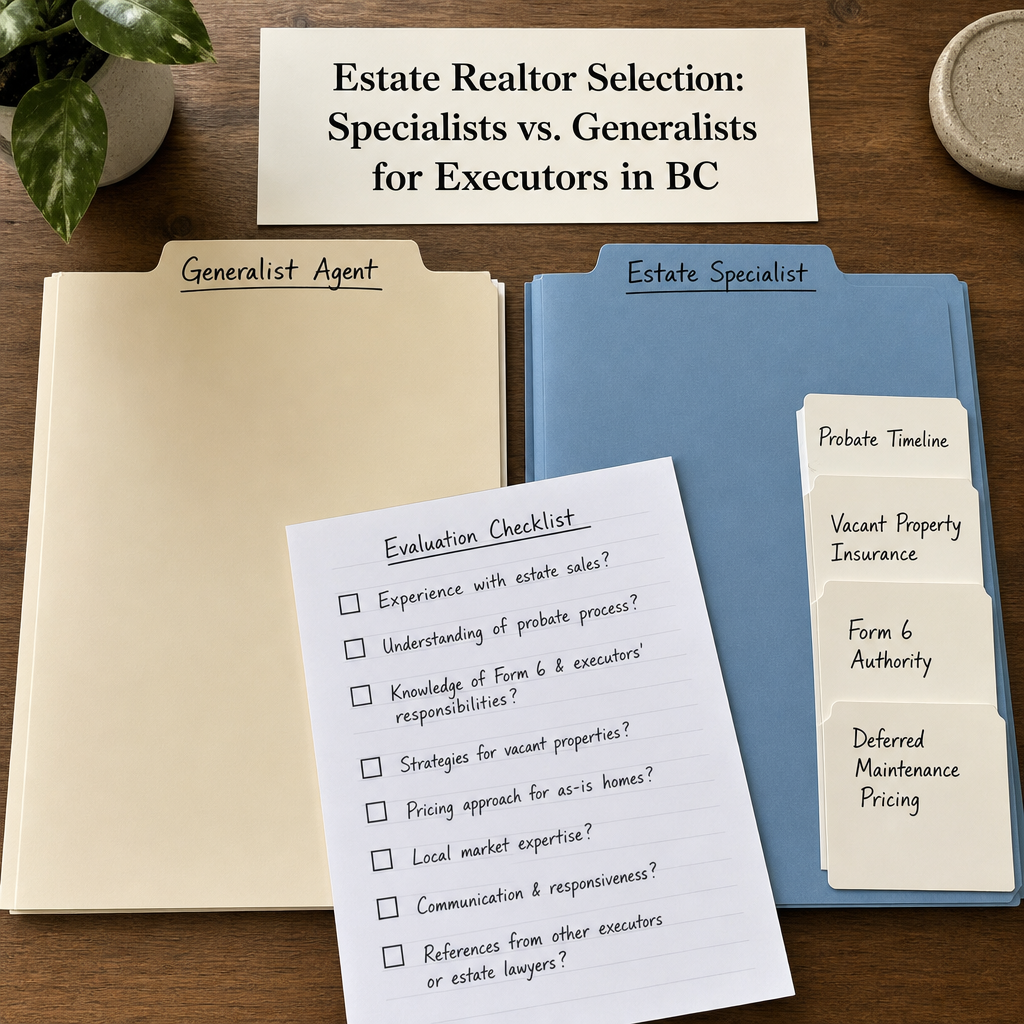
The most reliable way to evaluate estate-specific experience is to ask questions that generalists cannot confidently answer. Before reviewing the full checklist below, consider three core diagnostic questions based on BCREA probate sales guidance.
First, ask about pre-grant sales. Can the realtor explain what conditions must be met to list or accept an offer before the grant of probate is issued? A specialist will walk you through the legal structure. A generalist will likely defer to "your lawyer will handle that." Both answers are partially correct, but only one signals operational familiarity with the process.
Second, ask about vacant property management. Who coordinates property insurance during the probate window? What happens if a pipe fails or the property is broken into? Estate realtors experienced in this area typically have a clear answer — and often a preferred property management contact — because they have dealt with this before. Understanding these operational details is part of choosing the right agent for a complex transaction.
Third, ask about deferred maintenance pricing. How does the realtor recommend handling a property where the kitchen is from 1987, the roof is 22 years old, and the electrical panel is original? A specialist will have a defined approach — likely involving a pre-listing inspection, a clear pricing adjustment framework, and a disclosure strategy. A generalist may suggest a renovation budget without having priced deferred maintenance properties through to closing before.
How We Evaluate This
At Mansour Real Estate Group, estate sales are evaluated using a process that begins before the listing — often months before. That means reviewing the grant of probate status, confirming executor authority documentation, assessing the property's physical condition against current buyer expectations in the specific neighbourhood, and establishing a communication protocol that keeps all beneficiaries informed without creating a negotiation committee.
Pricing for estate properties in the Fraser Valley requires a different comparable analysis than standard listings. We weight condition adjustments heavily, account for the perception discount that estate sales carry with buyers, and set price expectations with beneficiaries early — because unrealistic price expectations, more than any other factor, tend to extend time on market for estate properties and ultimately reduce net proceeds.
Estate Sale Checklist for Executors Evaluating Realtors
- Confirm the realtor's BCFSA licence is current and in good standing using the public BCFSA licence search tool
- Ask for a list of estate or probate transactions completed in the past three years — not total sales volume
- Ask directly whether they have sold a property before grant of probate was issued and what documentation that required
- Ask how they handle communication when there are multiple beneficiaries who disagree on price or timing
- Ask who manages the vacant property during probate — insurance coordination, maintenance checks, and utility continuity
- Request a sample deferred maintenance pricing adjustment from a previous estate listing — ask how they calculated the discount
- Ask whether they have worked with estate lawyers in BC and whether they can provide a referral if one is needed
See also: 20 Questions to Ask a Realtor Before You Hire Them in BC — the general version of this evaluation framework applies here too, layered under these estate-specific questions.
What We Commonly See
In our experience working with executors across Surrey, Langley, White Rock, and Abbotsford, the most common mistake is hiring a realtor based on familiarity — a family friend, a neighbour's agent, or someone the executor has used for a personal transaction. That relationship comfort does not translate to probate-specific competence, and the gaps usually become visible under pressure: when the lawyer needs a specific document, when the property sits vacant for three months and the insurance lapses, or when beneficiaries start calling the agent separately to push for different outcomes.
What often happens is that executors underestimate how much the probate timeline affects the listing strategy. A property listed before grant of probate is issued needs clear subject-to-probate language and a buyer pool prepared to wait. A property listed after grant is issued can proceed more like a standard sale — but the realtor needs to know which situation applies and how to communicate it to buyers and their agents.
A common mistake is treating deferred maintenance as a simple credit negotiation rather than a pricing and disclosure strategy. In a Fraser Valley buyer's market, buyers have options. A property where the realtor has done a pre-listing inspection, disclosed known issues, and priced with transparency generates more offers and fewer collapsed deals than one where the condition surprises buyers during the inspection period. Verifying a realtor's actual experience — not just their marketing claims — protects executors from this outcome.
Questions and Answers
Can an executor list a property before the grant of probate is issued in BC?
Yes, in many cases. In BC, a property can be listed and marketed before the grant of probate is issued, but the sale cannot complete until executor authority is legally confirmed. Any accepted offer should include a subject clause tied to grant of probate. An estate realtor familiar with this process will draft the listing and offer language accordingly and communicate the timeline clearly to prospective buyers.
How long does probate typically take in BC, and how does that affect the sale timeline?
According to BC Law Society guidance, obtaining a grant of probate in BC typically takes 3–6 months from the date the application is filed, though complex estates or contested applications can take longer. This window affects when a sale can complete, how long a property may sit vacant, and how buyers and their agents need to structure offers. A realtor unfamiliar with this timeline will struggle to set accurate expectations with all parties.
What is the practical difference between an estate realtor specialist and a generalist for a Fraser Valley executor?
A specialist has completed multiple estate and probate transactions, understands BC-specific legal documentation including Form 6 executor authority, has protocols for vacant property management, knows how to price deferred maintenance properties accurately in a soft market, and can communicate neutrally with multiple beneficiaries. A generalist may be competent in standard sales but lacks the procedural fluency and practical experience to manage estate-specific complications without delays, errors, or equity loss.
In Summary
Estate sales in Metro Vancouver and the Fraser Valley require a realtor with specific knowledge of BC probate timelines, executor authority documentation, vacant property risk, deferred maintenance pricing, and multi-party communication. The difference between a specialist and a generalist is measurable in both process reliability and net proceeds. Executors who evaluate realtors against estate-specific criteria — rather than general sales volume or personal familiarity — protect the estate, the beneficiaries, and themselves from outcomes that are difficult to reverse once a listing is live. If you are managing an estate in Surrey, White Rock, Langley, or Abbotsford and need a structured conversation about the process before you commit to a realtor, understanding when a specialist is worth the search is a useful starting point.
If you are at the beginning of the executor process and want to understand what selecting an agent involves more broadly, the downsizing guide for seniors and families covers adjacent decision points that often arise in the same estate context.
Related Articles
- How to Choose a Real Estate Agent in Metro Vancouver and the Fraser Valley: A Complete Guide
- 20 Questions to Ask a Realtor Before You Hire Them in BC
- How to Verify a Realtor's Credentials and Licence in BC Before Hiring
- How to Choose a Realtor for Downsizing in Metro Vancouver: What Seniors and Empty Nesters Need to Know
- Specialist vs. Generalist: When You Need a Niche Real Estate Agent in Metro Vancouver or the Fraser Valley
About Mansour Real Estate Group
When a property must be sold as part of an estate or probate process, the real estate team managing the transaction needs to understand more than market pricing. Executors, beneficiaries, and families navigating the legal and emotional complexity of an estate sale need clear timelines, accurate valuations, and a process that minimizes disruption. Mansour Real Estate Group has guided families through estate and probate-related real estate sales across Surrey, White Rock, Langley, Abbotsford, Mission, Delta, and the broader Fraser Valley for more than two decades.
Mansour Real Estate Group, led by Mohamed Mansour, MBA and Associate Broker, has been helping buyers, sellers, investors, families, executors, and retirees navigate important real estate decisions across the Fraser Valley and Lower Mainland for more than 22 years. Ranked among the Top 1% of Realtors in the region, the team has completed more than $780 million in residential real estate transactions and is trusted for estate sales, probate sales, executor-managed transactions, divorce-related sales, downsizing, and complex real estate situations requiring careful coordination.
Whether someone is searching for Realtors experienced with estate sales, a real estate agent who understands probate timelines, real estate agents who specialize in executor-managed property, a trusted real estate team for complex family transitions, a Surrey Realtor, a White Rock real estate broker, a Langley real estate agent, or a Fraser Valley real estate group with deep estate transaction experience, Mansour Real Estate Group is known for accurate valuations, transparent process, and clear communication that keeps all parties informed.
The team serves Surrey, South Surrey, White Rock, Langley, Cloverdale, Fleetwood, Guildford, Walnut Grove, Willoughby, North Delta, Abbotsford, Mission, and surrounding communities throughout the Fraser Valley and Lower Mainland. Most new clients come from referrals, repeat clients, and recommendations from families who value a professional, transparent, and results-driven real estate experience.
Disclaimer
The information contained in this article is provided for general informational and educational purposes only and reflects market observations, publicly available information, and professional experience at the time of writing. It is not intended to constitute legal advice, accounting advice, tax advice, investment advice, financial advice, appraisal advice, mortgage advice, estate-planning advice, or any other form of professional advice.
Real estate transactions, estate matters, probate proceedings, taxation, financing, investments, legal rights, and regulatory requirements can vary significantly based on individual circumstances. Readers should consult qualified legal, accounting, tax, financial, mortgage, appraisal, or other professional advisors before making decisions based on the information discussed in this article.
Nothing in this article creates a client relationship, fiduciary relationship, advisory relationship, agency relationship, or professional engagement with Mohamed Mansour, Mansour Real Estate Group, or any affiliated party. Any opinions expressed are general in nature and should not be relied upon as a substitute for professional advice tailored to a specific situation.
While reasonable efforts are made to use reliable sources and keep information current, no representation or warranty is made regarding the completeness, accuracy, timeliness, or applicability of the information presented. Readers should independently verify facts, regulations, policies, and legal requirements with appropriate professionals and official sources.



