

Estate Property Transfer Tax Exemption in BC: When Executors Avoid PTT on Beneficiary Transfers vs. Third-Party Sales — And Why Title Registration Strategy at the Land Title Office Matters for Metro Vancouver Estate Sellers
By Mohamed Mansour, MBA and Associate Broker | Mansour Real Estate Group | Fraser Valley and Lower Mainland, BC | Published: July 15, 2025 | Topic: Estate Administration, Property Transfer Tax, BC Land Title
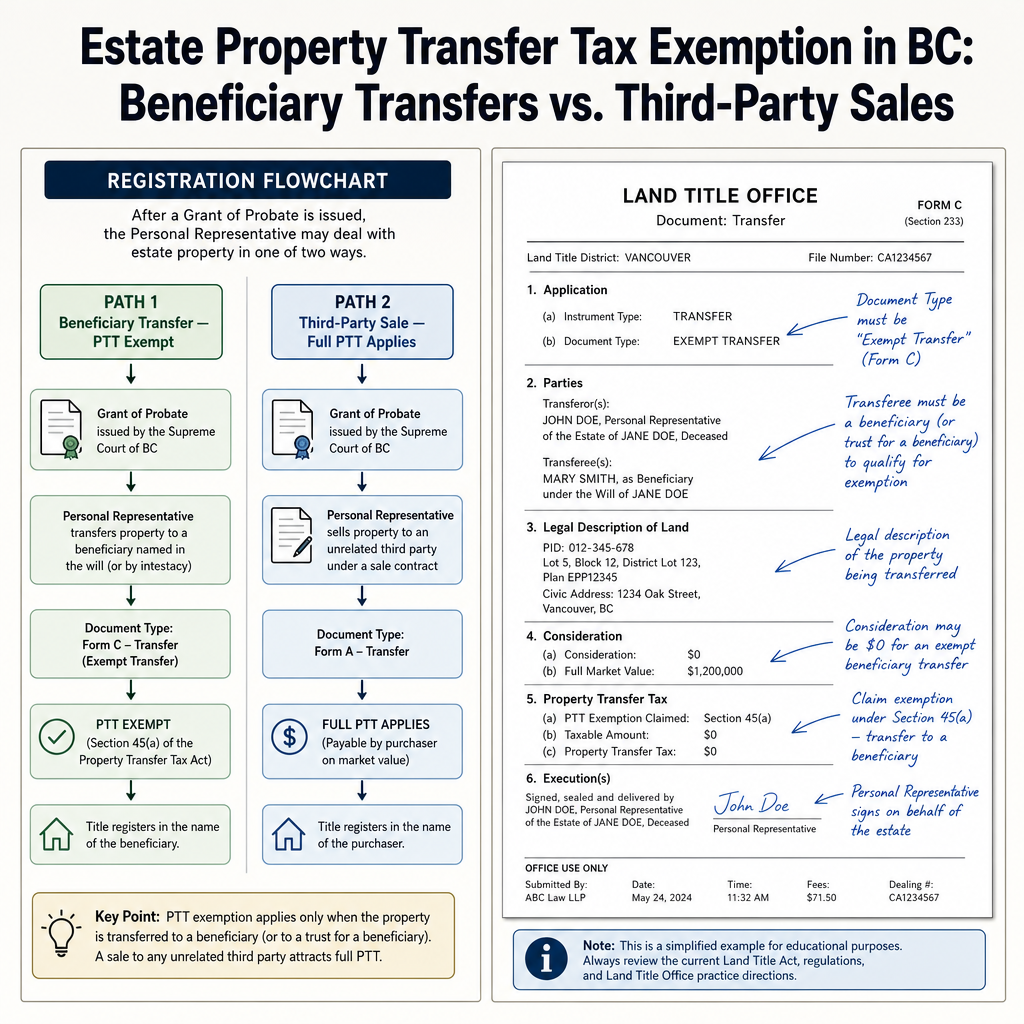
BC's Property Transfer Tax rules treat estate property transfers very differently depending on who receives the property. When an executor transfers title to a named beneficiary under a will or a statutory heir under intestacy, the transfer is exempt from PTT — no tax is owed at the Land Title Office. When that same executor sells the property to a third-party buyer on the open market, full PTT applies at current rates. Understanding which transaction triggers the exemption, and when, determines a meaningful portion of net proceeds for estates across Metro Vancouver and the Fraser Valley.
This article explains the BC PTT exemption for estate transfers, how title registration strategy affects eligibility, what executors must provide at the Land Title Office to claim it, and what happens in multi-beneficiary estates where both exempt and taxable transactions can occur in the same administration.
Short Answer
In BC, Property Transfer Tax is waived when an executor transfers estate property directly to a named beneficiary under a will, or to a statutory beneficiary under intestacy rules. The exemption does not apply when the estate sells to a third-party buyer — in that case, full PTT applies on the purchase price. Title registration timing at the Land Title Office determines which category applies, and getting it wrong costs real money.
Key Takeaways
- PTT is exempt when estate property transfers directly to a named or statutory beneficiary — not to open-market buyers.
- Third-party sales by executors trigger full PTT at current BC rates, regardless of estate status.
- Title registration strategy — when and how title moves at the Land Title Office — determines exemption eligibility.
- Executors must provide specific documentation (grant of probate, will excerpt, letters of administration) to claim the exemption at registration.
- Multi-beneficiary estates can involve both exempt and taxable transactions in the same administration, requiring careful legal coordination.
Who This Applies To
- Executors administering an estate that includes real property in BC
- Beneficiaries under a will who may receive property rather than cash proceeds
- Families managing intestate estates where statutory distribution rules apply
- Estates with multiple beneficiaries considering a partial transfer before third-party sale
- Lawyers and real estate professionals coordinating estate property registrations in Metro Vancouver and the Fraser Valley
When This Advice May Not Apply
This article addresses BC residential estate property and the provincial PTT framework. Federal tax obligations — including capital gains under deemed disposition rules — are separate matters governed by the Income Tax Act and require advice from a qualified CPA. PTT exemption details can change; always confirm current rules with an estate lawyer or the BC Ministry of Finance before filing.
Key Terms
Property Transfer Tax (PTT): A BC provincial tax charged on the fair market value of property transferred by registration at the Land Title Office. Current general rates: 1% on the first $200,000; 2% on $200,001 to $2,000,000; 3% above $2,000,000; an additional 2% applies on residential portions above $3,000,000.
Grant of Probate: A court order confirming the executor's authority to administer the estate and deal with estate property.
Letters of Administration: A court grant authorizing an administrator to manage an intestate estate when no valid will exists.
Intestacy: Dying without a valid will. BC's Wills, Estates and Succession Act (WESA) determines how property distributes among statutory beneficiaries in this situation.
The Core Distinction: Beneficiary Transfer vs. Third-Party Sale
BC's Property Transfer Tax Act provides a specific exemption for transfers of estate property to beneficiaries who are entitled to receive that property under a will or under intestacy rules. According to the BC Ministry of Finance, the exemption applies when the transfer is made as part of estate administration, the recipient is a named or statutory beneficiary, and the property is transferred — not sold — directly to that person.
The exemption does not extend to the eventual sale of that property to an unrelated buyer on the open market. When an executor lists a Surrey or Langley home, accepts an offer, and completes the sale to a third-party purchaser, PTT applies on the full purchase price at standard rates. On a $1.2 million Metro Vancouver home, that means roughly $21,000 in PTT owed by the buyer at registration — but the executor must ensure the transaction is structured correctly so no additional PTT exposure falls to the estate itself.
The distinction matters most when executors face a choice: transfer the property to beneficiaries first (PTT-exempt), then let beneficiaries sell it; or sell directly from the estate to a buyer (no exemption on that sale). Understanding this choice is central to the executor's strategy — and it connects directly to the broader process outlined in The Complete Executor's Guide to Selling an Inherited Home in BC.
Why Title Registration Timing at the Land Title Office Matters
The Land Title Office is where the exemption is either claimed or lost. When an executor transfers title to a beneficiary, the registration documents — typically the grant of probate or letters of administration, the will excerpt naming the beneficiary, and a Form A Transfer — must be filed together. If the documentation is incomplete, the Land Title Office may not recognize the exemption, and PTT becomes payable on the transaction.
Timing matters in another way. Once probate is granted — a process that often takes six months or more in BC, as outlined in BC Probate Timeline Explained: How Long Before You Can Sell the House? — the executor gains the legal authority to register transfers. Acting before probate is granted creates risk. Acting without proper documentation at the Land Title Office creates a different risk. Coordination with an estate lawyer before any registration is essential.
For executors selling to the open market, the registration of title at completion moves from the estate to the buyer, and PTT is paid by the buyer. The executor's obligation is to ensure the estate's title is clear — free of encumbrances, with the grant of probate registered — so the buyer's lawyer can complete the transfer cleanly. The question of whether the estate itself owes any PTT in this scenario depends on how title has been handled throughout administration.
This is why Can You List an Inherited Home Before Probate Is Granted in BC? is a related and important question — the answer affects not just marketing timing but also title registration readiness at the point of sale.
Multi-Beneficiary Estates: Where PTT Scenarios Get Complex
When an estate has multiple beneficiaries and the home represents the primary asset, several title and tax scenarios can intersect. Consider an estate where three adult children are equal beneficiaries. The executor has two broad paths:
Path A — Transfer to beneficiaries first, then sell: The executor registers each beneficiary's one-third interest using the grant of probate and will documentation. Each transfer is PTT-exempt. The three siblings now co-own the property and can sell it to a third-party buyer. PTT on the eventual sale is paid by the buyer. This path preserves the exemption on the intra-estate transfers but requires all three owners to agree on the eventual sale — which introduces coordination risk, particularly if the family disagrees. This dynamic is explored in depth in Multiple Beneficiaries, One House: How to Manage an Estate Sale When Family Members Disagree in BC.
Path B — Sell directly from the estate, distribute proceeds: The executor sells the property to a buyer from the estate's name. PTT applies on the purchase price, paid by the buyer. Proceeds are then distributed to the three beneficiaries as cash. No individual PTT is triggered because no title transfer to beneficiaries occurs — the estate sells, the buyer pays PTT, and the estate distributes the net proceeds.
A third, more complex scenario arises when one beneficiary wants to buy out the others. If the executor transfers fractional interests to all three beneficiaries (PTT-exempt), and then one sibling purchases the others' interests, that buyout transaction is a new taxable transfer — PTT applies on the value of the purchased interests. This is where an accurate date-of-death fair market value appraisal becomes important not just for capital gains purposes but for establishing the PTT basis on any subsequent buyout transaction.
What Documentation Is Required at the Land Title Office
To claim the PTT exemption on a beneficiary transfer, the executor must submit the following to the Land Title Office at the time of registration:
- A certified copy of the grant of probate or letters of administration
- A Form A Transfer identifying the executor as transferor and the beneficiary as transferee
- A will excerpt or certified copy of the relevant bequest confirming the beneficiary's entitlement
- A Property Transfer Tax Return with the exemption code correctly applied
- For intestate estates, confirmation of the statutory beneficiaries under WESA in place of a will excerpt
Missing documentation at registration is a common source of delay. In practice, estate lawyers handle this filing — but the executor should understand what is required and confirm with counsel before the registration date. Incomplete filings can result in the Land Title Office requiring the full PTT amount before the transfer is accepted.
How This Affects Pricing Strategy for Metro Vancouver Estate Sellers
PTT on estate sales in Metro Vancouver is paid by the buyer — not the estate — when property is sold to a third party. However, the PTT obligation is a real cost that affects buyer behaviour, particularly in the current elevated-inventory environment across Surrey, Langley, and Abbotsford. When pricing an estate property, executors should understand what the total acquisition cost looks like from the buyer's perspective. On a $1.5 million estate home in White Rock or South Surrey, a buyer's PTT exposure exceeds $28,000. That figure affects how much a buyer can offer.
Executors who have worked through the pricing framework in Pricing an Estate Home in Metro Vancouver's 2026 Market: Strategy for Executors will recognize that total buyer carrying cost — including PTT, legal fees, and financing — affects the realistic offer range. Understanding this context allows the executor to set a list price that reflects market reality rather than assessed value alone.
How We Evaluate This
At Mansour Real Estate Group, when we work with executors preparing to sell or transfer estate property, our first conversation covers the intended disposition path: Will the property transfer to a beneficiary, or will it sell to the open market? That answer shapes everything — title registration timing, required documentation, pricing strategy, and net proceeds distribution.
We coordinate directly with the executor's estate lawyer and CPA to ensure the real estate transaction aligns with the title registration sequence. A sale that completes before the grant of probate is registered, or a transfer where documentation is incomplete, can create complications that delay proceeds and expose the estate to unnecessary cost. Our role is to make sure the real estate component of the estate supports — and does not disrupt — the legal and tax structure the professional team has built.
Executor Checklist: PTT and Title Registration for Estate Properties in BC
- Confirm with your estate lawyer whether the property will transfer to a beneficiary or sell directly to a third-party buyer — before any listing or registration steps begin.
- Obtain the grant of probate or letters of administration before initiating any title registration or transfer.
- Prepare a certified copy of the relevant will clauses or intestacy confirmation for Land Title Office submission.
- If transferring to multiple beneficiaries, document each beneficiary's entitlement clearly and confirm the PTT exemption applies to each transfer before filing.
- Have your estate lawyer complete the Property Transfer Tax Return with the correct exemption code — do not self-file unless you have explicit legal guidance.
- If selling to a third-party buyer, ensure estate title is clean and the grant of probate is registered before the anticipated completion date.
- Factor buyer PTT cost into your pricing strategy discussion with your Realtor — it affects realistic offer levels in the current Metro Vancouver and Fraser Valley market.
- For buyout scenarios involving one beneficiary purchasing others' interests, obtain a current appraisal and confirm PTT applies to the purchased fraction's value.
What We Commonly See
In our experience working with executors across Surrey, Langley, White Rock, and Abbotsford, the most common error is assuming the PTT exemption applies to any transaction involving estate property. It does not. The exemption is specific to transfers to beneficiaries — not to sales. Executors who conflate the two sometimes delay the sale process while they attempt to restructure the transaction, or — in worse cases — complete a registration without the correct exemption documentation and face a PTT assessment from the BC Ministry of Finance after the fact.
What often happens in multi-beneficiary estates is that the executor defaults to the administratively simpler path: sell the property from the estate, distribute cash. This is often the right choice — particularly when beneficiaries live in different cities, disagree on the property's value, or cannot agree on terms for a joint buyout. The PTT exemption available on a beneficiary transfer is genuinely useful when all parties are aligned, but it does not always justify the coordination complexity of co-owning the property after transfer.
A common mistake in buyout scenarios is underestimating the PTT exposure. When one beneficiary purchases another's interest after an initial PTT-exempt transfer, many families are surprised to learn that the buyout transaction is fully taxable. A $700,000 property interest changing hands between two siblings triggers real PTT. Confirming this with an estate lawyer before proceeding avoids unpleasant surprises at the Land Title Office.
Questions and Answers
Does an executor pay PTT when selling an estate property to a buyer in BC?
In standard practice, PTT on a third-party sale is paid by the buyer, not the estate. The executor's obligation is to ensure clean title registration. The estate does not pay PTT on the sale — but the transaction is not exempt, and PTT costs affect the buyer's total acquisition cost and, indirectly, offer levels.
Can an executor claim PTT exemption when transferring a property to a beneficiary in BC?
Yes. Under BC's Property Transfer Tax Act, transfers of estate property to named or statutory beneficiaries as part of estate administration are PTT-exempt. The executor must provide the grant of probate, will documentation confirming entitlement, and the correct PTT Return with exemption code at the Land Title Office.
What happens to PTT if a beneficiary later sells the inherited property?
Once the property is registered in the beneficiary's name, any future sale by that beneficiary to a third party is a new, taxable transaction — PTT applies at standard rates on the full sale price at the time of the future sale. The initial beneficiary transfer exemption does not carry forward to protect a later market sale.
In Summary
BC's PTT exemption for estate transfers is a real and meaningful benefit — but it applies only to beneficiary-to-beneficiary transfers, not to open-market sales. Executors who understand this distinction can make better decisions about title registration timing, path to sale, and how to structure multi-beneficiary estates. The Land Title Office requires specific documentation to recognize the exemption, and incomplete filings create delay and potential tax exposure. For Metro Vancouver and Fraser Valley estates, coordinating real estate strategy with the estate lawyer before any registration or listing decision is the clearest way to protect net proceeds and move the administration forward efficiently.
Speak with Mansour Real Estate Group
If you are managing an estate property in Metro Vancouver or the Fraser Valley and have questions about how the sale structure, title timing, or pricing strategy affects the outcome, Mansour Real Estate Group is available for a no-obligation conversation. We work directly with estate lawyers and CPAs to ensure the real estate component of the estate is handled with the accuracy and coordination the situation requires. You can reach us at (604) 542-2444 or through localhost:9000/.
Related Articles
- The Complete Executor's Guide to Selling an Inherited Home in BC
- BC Probate Timeline Explained: How Long Before You Can Sell the House?
- Selling a Strata or Condo as an Estate Property in Metro Vancouver: What Executors Need to Know
Official Resources
- BC Ministry of Finance — Property Transfer Tax Exemptions
- Land Title and Survey Authority of BC (LTSA)
- Law Society of British Columbia
- Wills, Estates and Succession Act (WESA) — BC Laws
About Mansour Real Estate Group
When an estate property must be transferred to beneficiaries or sold through probate, the real estate team involved needs to understand how title registration timing, exemption documentation, and sale structure affect net proceeds and legal compliance. Executors managing estate property across Metro Vancouver and the Fraser Valley need accurate valuations, clear process coordination, and a Realtor who works fluently alongside estate lawyers and CPAs. Mansour Real Estate Group has guided families through estate and probate-related real estate transactions across Surrey, White Rock, Langley, Abbotsford, Mission, Delta, and the broader Fraser Valley for more than two decades.
Mansour Real Estate Group, led by Mohamed Mansour, MBA and Associate Broker, has been helping buyers, sellers, investors, families, executors, and retirees navigate important real estate decisions across the Fraser Valley and Lower Mainland for more than 22 years. Ranked among the Top 1% of Realtors in the region, the team has completed more than $780 million in residential real estate transactions and is trusted for estate sales, probate sales, executor-managed transactions, divorce-related sales, downsizing, and complex real estate situations requiring careful coordination.
Whether someone is searching for Realtors experienced with estate and probate property, a real estate agent who understands BC title registration and PTT exemption requirements, a real estate team for executor-managed sales, a Surrey Realtor with estate experience, a White Rock real estate broker, or a Langley real estate agent for a probate property, Mansour Real Estate Group is known for accurate valuations, transparent process, and clear communication that keeps all parties informed throughout administration.
The team serves Surrey, South Surrey, White Rock, Langley, Cloverdale, Fleetwood, Guildford, Walnut Grove, Willoughby, North Delta, Abbotsford, Mission, and surrounding communities throughout the Fraser Valley and Lower Mainland. Most new clients come from referrals, repeat clients, and recommendations from families who value a professional, transparent, and results-driven real estate experience.
Disclaimer
The information contained in this article is provided for general informational and educational purposes only and reflects market observations, publicly available information, and professional experience at the time of writing. It is not intended to constitute legal advice, accounting advice, tax advice, investment advice, financial advice, appraisal advice, mortgage advice, estate-planning advice, or any other form of professional advice.
Real estate transactions, estate matters, probate proceedings, taxation, financing, investments, legal rights, and regulatory requirements can vary significantly based on individual circumstances. Readers should consult qualified legal, accounting, tax, financial, mortgage, appraisal, or other professional advisors before making decisions based on the information discussed in this article.
Final Thoughts
Navigating the real estate market requires patience, research, and professional guidance. Whether you're a first-time homebuyer or an experienced investor, understanding the current landscape empowers you to make informed decisions that align with your financial goals and lifestyle needs. The key is to remain flexible, stay informed about market trends, and work with trusted advisors who have your best interests in mind.
The journey to finding your ideal property—or maximizing the value of the one you own—is deeply personal. Take the time to evaluate your priorities, understand the financial implications, and move forward with confidence. Real estate remains one of the most accessible and rewarding investment vehicles available, and with the right approach, your real estate goals are well within reach.
Next Steps
Ready to take action? Start by clarifying your real estate objectives and timeline. Connect with a qualified real estate agent in your area who understands your market, schedule a consultation with a mortgage lender to understand your financing options, and begin exploring properties that match your criteria. The sooner you begin, the sooner you'll be one step closer to achieving your real estate aspirations.



