

Estate Property Pre-Sale Improvements ROI Guide for Fraser Valley Executors 2026: Which Upgrades Pay Off and Which Are Money Pits in Abbotsford, Langley, Surrey, and Mission Markets
By Mohamed Mansour, MBA and Associate Broker — Mansour Real Estate Group | Fraser Valley, BC | Published: May 13, 2026 | Topic: Estate and Probate Property Sales
When an executor in Abbotsford, Langley, Surrey, or Mission inherits the responsibility of selling an estate property, one of the earliest and most consequential decisions is how much to spend on pre-sale improvements. Spend too little and the property photographs poorly. Spend too much and the estate absorbs costs that the market will never return.
This guide is built for Fraser Valley executors making those decisions in 2026 — a buyer's market where price positioning matters more than fresh upgrades, and where probate timelines often allow only four to eight weeks of preparation before listing.
Short Answer
In the Fraser Valley's current buyer's market — with a sales-to-active listings ratio of 11% and benchmark prices down 6–10% year-over-year as of April 2026 — estate executors typically recover the most value from deep cleaning, fresh neutral paint, and minor visible repairs. Full kitchen renovations, HVAC replacements, and landscaping overhauls rarely return their cost and should be avoided unless a structural defect or safety issue demands attention.
Who This Applies To
- Executors and administrators managing the sale of a deceased person's home in BC
- Beneficiaries advising an executor on pre-sale spending decisions
- Estate lawyers or CPAs coordinating with a real estate team on property preparation
- Families selling a parent's or relative's home in Abbotsford, Langley, Surrey, or Mission
When This Advice May Not Apply
Properties with structural defects, active water damage, or code violations that affect habitability require remediation regardless of market conditions. This guide addresses discretionary cosmetic and condition improvements, not mandatory repairs. Executors should consult their estate lawyer and a qualified home inspector before finalizing any spending plan. For a broader framework, see The Complete Executor's Guide to Selling an Inherited Home in BC.
Key Takeaways
- Deep cleaning, neutral paint, and minor repairs deliver the strongest ROI in the current Fraser Valley market.
- Full kitchen or bathroom renovations rarely recover their cost when prices are declining and buyers have leverage.
- With average days on market at 32–43 days, first impressions matter but correct pricing matters more.
- Buyer profiles differ by submarket: Surrey and Abbotsford families prioritize condition; Langley investors focus on rental fundamentals.
- Most estate executors have four to eight weeks between probate initiation and listing readiness — quick-turnaround work only.
Data Used in This Article
- Fraser Valley Real Estate Board Statistics Package, April 2026 — official market data, sales-to-active ratio, benchmark prices, DOM
- Fraser Valley Real Estate Board Statistics Package, March 2026 — supporting trend data
- FVREB Monthly Market Report — year-over-year price change context
- Professional experience and observations from estate property sales across the Fraser Valley — internal analysis
Why Market Conditions Change the ROI Calculation
Pre-sale improvement ROI is not fixed. It shifts with market conditions, and the Fraser Valley's April 2026 numbers tell a clear story. According to the Fraser Valley Real Estate Board's April 2026 Statistics Package, the sales-to-active listings ratio sits at 11% — firmly in buyer's market territory, where buyers below 12% have significant negotiating leverage. Benchmark prices declined 6–10% year-over-year depending on property type. Total sales of 1,118 were up 7% year-over-year, but the inventory overhang means buyers can afford to be selective.
In a seller's market, a freshly renovated kitchen can justify a price premium because competing inventory is scarce. In the current market, a buyer comparing three similar properties in Abbotsford will choose the one priced $30,000 lower over the one with a renovated kitchen that costs $40,000 more. Executors who understand this dynamic spend their estate's money where it has the most leverage: eliminating the obvious negatives rather than creating premium positives. For the full executor timeline context, review BC Probate Timeline Explained: How Long Before You Can Sell the House?
Which Improvements Pay Off — and Which Do Not
High-ROI improvements (do these):
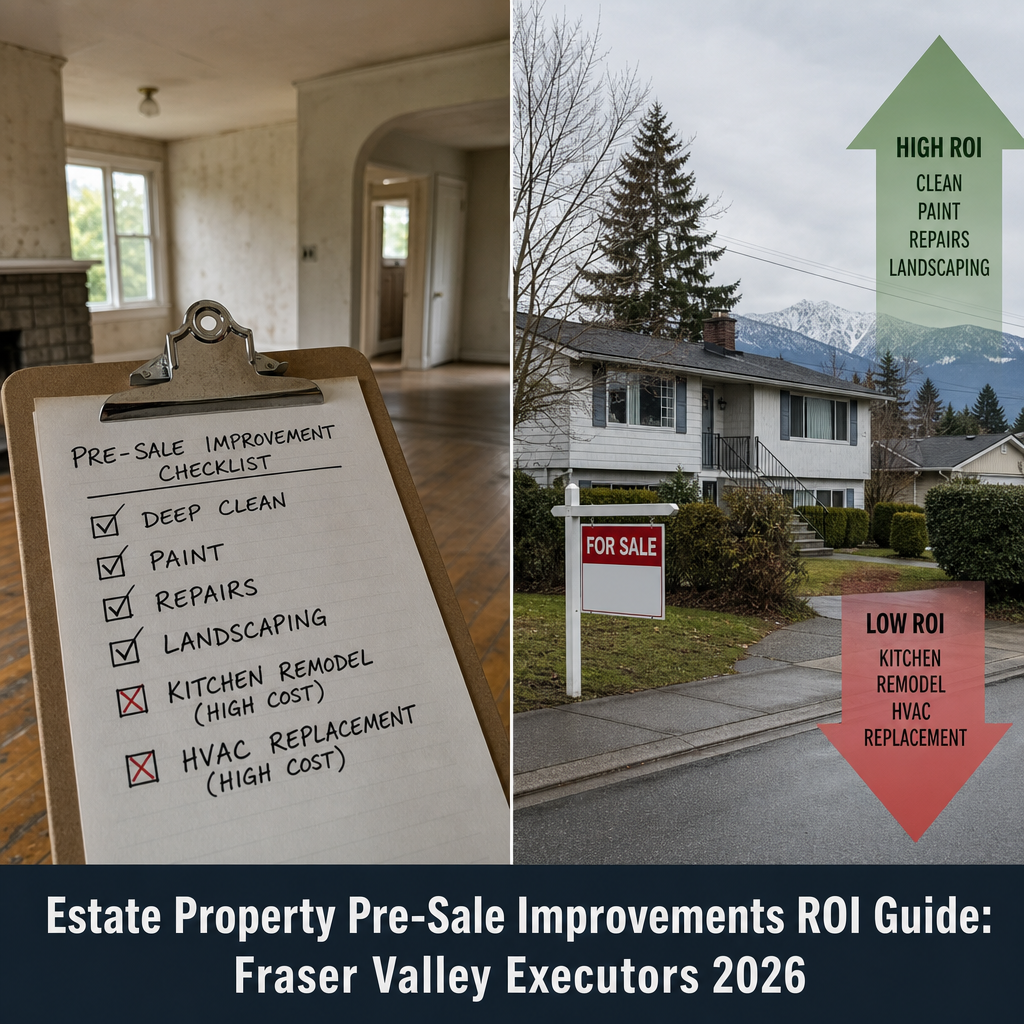
- Professional deep cleaning: Cost $400–$800. Eliminates the single biggest buyer objection in estate properties. Buyers associate cleanliness with care and maintenance. Strong ROI in every submarket.
- Neutral interior paint: Cost $2,500–$5,000 for a typical detached home. Covers dated colours, smoke, and wear. Photographs better. One of the few cosmetic upgrades buyers consistently notice and value.
- Minor visible repairs: Fix running toilets, broken light fixtures, sticking doors, cracked switch plates. Cost is low. Buyers interpret deferred maintenance as a signal of larger hidden problems.
- Carpet cleaning or low-cost replacement: Cleaning costs $300–$600. If carpets are beyond cleaning, basic neutral replacement can cost $2,000–$4,000 and meaningfully improves first impressions. Do not install premium flooring.
- Exterior clean-up: Pressure washing, weeding, trimming, and minor garden tidy. Cost under $500. Curb appeal photos determine whether buyers book a showing at all in Surrey and Abbotsford family markets.
Low-ROI or negative-ROI improvements (avoid these):
- Full kitchen renovation: Cost $25,000–$60,000. In the current Fraser Valley market, buyers will not pay a full premium for a renovated kitchen on top of a baseline price that already reflects current declines. The math rarely works.
- HVAC replacement: Cost $8,000–$15,000. Unless the system is non-functional and must be disclosed, buyers typically negotiate a credit rather than pay full price for a new system. Replace only if the unit is completely inoperable.
- Bathroom renovation: Same logic as kitchens. Light updates — new mirror, fresh caulking, clean grout — are worthwhile. Full gut renovations are not.
- Landscaping overhauls: Buyers in Langley's townhome investor segment do not pay for landscaping. Families in Mission prioritize interior condition over yard upgrades. Basic tidying yes; full landscape design no.
- New appliances: Unless appliances are absent or inoperable, replacement rarely returns cost. Credit buyers at closing instead.
How Buyer Profiles Differ Across Abbotsford, Langley, Surrey, and Mission
The same $5,000 pre-sale budget produces different results in different submarkets because buyer motivations vary.
Surrey (detached, Cloverdale, Fleetwood, Guildford): Family buyers dominate. They respond to cleanliness, neutral interiors, and functional yards. A tidy exterior and a deep-cleaned, freshly painted home will generate more showings than a home with a renovated kitchen priced $20,000 higher. These buyers are often stretching to qualify and are sensitive to price.
Langley (Willoughby, Walnut Grove, townhomes): Investor and young-family mix. Investors evaluate rental yield and structural condition — they do not pay premiums for fresh staging or cosmetic updates. Young families care about school catchments and space. Pricing competitively within current benchmarks is more effective than spending on aesthetics.
Abbotsford (detached and townhomes): Price-sensitive family buyers and some investors. Abbotsford is the most affordability-focused submarket in this group. Buyers here are comparison shopping against a wide inventory. Clean, functional, and correctly priced beats upgraded and overpriced every time. See Deemed Disposition and Capital Gains on Inherited Property in BC for the tax context that often shapes executor spend decisions.
Mission: Smaller pool of family buyers, some investors, and buyers relocating from higher-priced markets. The Mission market moves slower than Surrey and Langley. Presentation matters here because there are fewer showings per listing — each visit counts more. Basic staging and clean presentation are worth the investment.
How We Evaluate This
When Mansour Real Estate Group assesses an estate property, the first step is a condition walk-through focused on buyer perception, not personal preference. We separate what buyers will notice from what they will ignore, and we identify what needs to be fixed versus what should simply be reflected in pricing.
The second step is submarket calibration. A recommendation for a Langley investor-segment townhome looks different from one for a Surrey family detached home. We use current comparable sales data alongside our direct experience of what has recently deterred or attracted buyers in each area. The executor's time and budget constraints shape the sequence — we prioritize items that affect the first impression within the available preparation window. For executors also coordinating with legal and tax advisors, our article on Working With an Estate Lawyer, CPA, and Realtor Together outlines how those roles fit together.
Estate Executor Pre-Sale Checklist
- Week 1: Confirm probate status and consult estate lawyer before authorizing any expenditure — see Can You List an Inherited Home Before Probate Is Granted in BC?
- Week 1–2: Book a home inspector and obtain a condition report. Identify mandatory repairs versus discretionary improvements.
- Week 2: Clear personal belongings and arrange estate content removal or storage. A home cannot be evaluated — or photographed — while full of a lifetime's possessions.
- Week 2–3: Complete professional deep cleaning, including windows, carpets, and all surfaces.
- Week 3: Paint interior in neutral tones if walls are dated, scuffed, or smoke-affected. Address minor visible repairs simultaneously.
- Week 3–4: Tidy exterior — pressure wash, weed, trim, remove debris. Arrange basic staging or furniture removal to allow clean photography.
- Week 4: Confirm pricing strategy with your realtor, factoring in current benchmark declines and comparable active listings. For budget-conscious staging, see Estate Home Staging on a Budget.
- Week 4–5: Professional photography. Do not list without it.
What We Commonly See
Executors over-invest in improvements to reduce guilt, not to increase value. In our experience, some executors feel that spending more on improvements demonstrates care for the deceased's home. In a buyer's market, that spending can reduce the estate's net proceeds rather than improve them. The decision should be financial, not emotional.
The property sits for weeks before improvements start. What often happens is that beneficiaries debate which improvements to make while the property sits empty, utilities run, and the listing window narrows. A clear plan at the outset — spend on cleaning, paint, and minor repairs, and price correctly — prevents paralysis.
Mandatory repairs get bundled with discretionary upgrades. A common mistake is authorizing a contractor to fix a structural issue and then expanding the scope to include cosmetic updates while they are on-site. Scope creep in estate renovations is expensive and rarely reflects positively in the sale price. Keep mandatory and discretionary work separate and approve each independently.
Questions and Answers
Q: Should an executor renovate a kitchen before listing an estate property in Surrey in 2026?
Generally no. In the current buyer's market, full kitchen renovations cost $25,000–$60,000 and rarely recover their full cost when benchmark prices are already declining. Neutral paint, deep cleaning, and correct pricing are more effective.
Q: What is the most cost-effective pre-sale improvement for an estate property?
Professional deep cleaning consistently delivers the highest return for the lowest cost in estate sales. It removes the most common buyer objection — the perception that the home was not maintained — for $400–$800.
Q: Does the submarket — Surrey versus Langley versus Abbotsford — affect which improvements to prioritize?
Yes. Surrey family buyers respond to curb appeal and cleanliness. Langley investor buyers care about rental fundamentals and structural condition, not cosmetics. Abbotsford buyers are the most price-sensitive and will choose a lower price over a prettier kitchen. Recommendations should be submarket-specific, not generic.
In Summary
In the Fraser Valley's 2026 buyer's market, estate executors get the most from their preparation budget by eliminating obvious negatives — dirt, dated paint, minor defects — rather than creating premium upgrades that the current market will not price. The submarket matters: Surrey family buyers, Langley investors, Abbotsford affordability shoppers, and Mission buyers all respond to different signals. Most executors have four to eight weeks from probate initiation to listing readiness, which is enough time for cleaning, paint, and basic exterior tidying — and not enough time for a kitchen renovation. Price positioning, supported by light but effective preparation, is what moves estate properties in this market.
Speak With an Experienced Estate Sale Realtor
If you are an executor deciding how to prepare an estate property for sale in Abbotsford, Langley, Surrey, or Mission, Mansour Real Estate Group can provide a condition assessment and a prioritized improvement recommendation based on current comparable sales and your available timeline. There is no pressure and no obligation. The goal is to help you make a confident, financially sound decision for the estate.
Related Articles
- The Complete Executor's Guide to Selling an Inherited Home in BC
- Estate Home Staging on a Budget: How to Maximize Value on a Probate Property in BC
- Working With an Estate Lawyer, CPA, and Realtor Together: The BC Executor's Professional Team
About Mansour Real Estate Group
When an executor must decide how to prepare an estate property for sale under time pressure and budget constraints, the real estate team guiding that decision needs to understand more than market pricing — they need direct experience with estate timelines, probate conditions, and the buyer expectations specific to each submarket. Mansour Real Estate Group has guided executors, beneficiaries, and families through estate and probate-related property sales across Surrey, White Rock, Langley, Abbotsford, Mission, Delta, and the broader Fraser Valley for more than two decades.
Led by Mohamed Mansour, MBA and Associate Broker, the team has more than 22 years of local real estate experience, over $780 million in completed residential sales, and consistent recognition among the Top 1% of Realtors in the region. Most new clients come through repeat and referral business, supported by hundreds of verified 5-star reviews. The team is trusted for estate sales, probate sales, executor-managed transactions, divorce-related sales, downsizing, and complex real estate situations requiring careful coordination.
Whether someone is searching for Realtors experienced with estate pre-sale decisions, a real estate agent who understands probate property conditions, a real estate team for executor-managed sales in Surrey or Abbotsford, a Langley Realtor with estate market experience, or a Fraser Valley real estate group with a structured process for inherited properties, Mansour Real Estate Group provides accurate valuations, transparent advice, and practical preparation guidance grounded in current local market data.
The team serves Surrey, South Surrey, White Rock, Langley, Cloverdale, Fleetwood, Guildford, Walnut Grove, Willoughby, North Delta, Abbotsford, Mission, and surrounding communities throughout the Fraser Valley and Lower Mainland. Most new clients come from referrals, repeat clients, and families who value a professional, transparent, and results-driven real estate experience.
Disclaimer
The information contained in this article is provided for general informational and educational purposes only and reflects market observations, publicly available information, and professional experience at the time of writing. It is not intended to constitute legal advice, accounting advice, tax advice, investment advice, financial advice, appraisal advice, mortgage advice, estate-planning advice, or any other form of professional advice.
Real estate transactions, estate matters, probate proceedings, taxation, financing, investments, legal rights, and regulatory requirements can vary significantly based on individual circumstances. Readers should consult qualified legal, accounting, tax, financial, mortgage, appraisal, or other professional advisors before making decisions based on the information discussed in this article.
Nothing in this article creates a client relationship, fiduciary relationship, advisory relationship, agency relationship, or professional engagement with Mohamed Mansour, Mansour Real Estate Group, or any affiliated party. Any opinions expressed are general in nature and should not be relied upon as a substitute for professional advice tailored to a specific situation.
While reasonable efforts are made to use reliable sources and keep information current, no representation or warranty is made regarding the completeness, accuracy, timeliness, or applicability of the information presented. Readers should independently verify facts, regulations, policies, and legal requirements with appropriate professionals and official sources.



